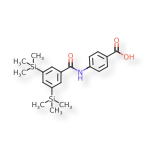
Details
| Stereochemistry | ACHIRAL |
| Molecular Formula | C20H27NO3Si2 |
| Molecular Weight | 385.6043 |
| Optical Activity | NONE |
| Defined Stereocenters | 0 / 0 |
| E/Z Centers | 0 |
| Charge | 0 |
SHOW SMILES / InChI
SMILES
C[Si](C)(C)C1=CC(=CC(=C1)C(=O)NC2=CC=C(C=C2)C(O)=O)[Si](C)(C)C
InChI
InChIKey=VVTNSTLJOVCBDL-UHFFFAOYSA-N
InChI=1S/C20H27NO3Si2/c1-25(2,3)17-11-15(12-18(13-17)26(4,5)6)19(22)21-16-9-7-14(8-10-16)20(23)24/h7-13H,1-6H3,(H,21,22)(H,23,24)
Amsilarotene (TAC-101) is a retinobenzoic acid (RAR) derivative with high affinity to the RAR-alpha receptor. It is a Retinoic acid receptor alpha antagonist. Amsilarotene is an orally absorbed synthetic retinoid. This analogue of
vitamin A (retinol) binds to nuclear retinoic acid receptor-a
(RAR-a), activates RAR-a transcriptional activity, and has
shown antitumor activity in primary and metastatic preclinical
models of liver cancer. Amsilarotene inhibits retinoblastoma-gene product (RB) phosphorylation and increases the presence of 2 cyclin-dependent kinase (CDK) inhibitors, resulting in cell cycle arrest. This agent also causes a cytotoxic decline in cyclin A and thymidylate synthase expression.Amsilarotene inhibits tumor growth in
the liver with low toxicity and markedly improves survival in
both primary HCC and metastatic colon cancer models. It was in phase II clinical development with Taiho Pharmaceutical for liver cancer, however it was discontinued.
Originator
Approval Year
PubMed
| Title | Date | PubMed |
|---|---|---|
| Using a water-immiscible ionic liquid to improve asymmetric reduction of 4-(trimethylsilyl)-3-butyn-2-one catalyzed by immobilized Candida parapsilosis CCTCC M203011 cells. | 2009-10-22 |
|
| Retinoic acid receptor stimulation protects midbrain dopaminergic neurons from inflammatory degeneration via BDNF-mediated signaling. | 2009-07 |
|
| Chemopreventive effect of 4-[3,5-Bis(trimethylsilyl) benzamido] benzoic acid (TAC-101) on MNU-induced colon carcinogenesis in a rat model. | 2009-06 |
|
| Gateways to clinical trials. | 2009-04 |
|
| Contribution of AP-1 interference induced by TAC-101 to tumor growth suppression in a hepatocellular carcinoma model. | 2009 |
|
| 4- [3,5-bis(trimethylsilyl)benzamido] benzoic acid (TAC-101) induced fas expression and activated caspase-3 and -8 in a DLD-1 colon cancer cell line. | 2007-04-18 |
|
| 4-[3,5-Bis(trimethylsilyl)benzamido] benzoic acid (TAC-101) induces apoptosis in colon cancer partially through the induction of Fas expression. | 2005-03-31 |
|
| A novel retinoid, 4-[3,5-bis (trimethylsilyl) benzamido] benzoic acid (TAC-101), induces apoptosis of human ovarian carcinoma cells and shows potential as a new antitumor agent for clear cell adenocarcinoma. | 2004-09 |
|
| 4-[3,5-Bis(trimethylsilyl)benzamido] benzoic acid inhibits angiogenesis in colon cancer through reduced expression of vascular endothelial growth factor. | 2004 |
|
| Anti-tumor effect of vitamin A and D on head and neck squamous cell carcinoma. | 2003-12 |
|
| TAC-101 inhibits intrahepatic metastasis of orthotopically implanted murine hepatocellular carcinoma. | 2003-08-20 |
|
| Effect of synthetic retinoid, TAC-101, on experimental autoimmune disease. | 2003-01 |
|
| A potential use of a synthetic retinoid TAC-101 as an orally active agent that blocks angiogenesis in liver metastases of human stomach cancer cells. | 2001-11 |
Patents
Sample Use Guides
In a phase I/II study,
TAC-101 was administered orally in 21-day cycles (14 days
on/7 days off) to patients with advanced HCC. In the phase I
portion of the study, the initial dose was 40 mg/day. Two
patients had DLT, and the dose was reduced to 20 mg/day.
Since only 1 of 6 assessable patients had DLT during the first
two cycles of therapy, 20 mg/day was designated as the maximum tolerated dose (MTD) for the 21-day treatment cycle. At
this dose level, TAC-101 was generally well tolerated
Route of Administration:
Oral
| Name | Type | Language | ||
|---|---|---|---|---|
|
Preferred Name | English | ||
|
Official Name | English | ||
|
Code | English | ||
|
Common Name | English | ||
|
Code | English | ||
|
Common Name | English | ||
|
Code | English |
| Classification Tree | Code System | Code | ||
|---|---|---|---|---|
|
NCI_THESAURUS |
C804
Created by
admin on Wed Apr 02 07:43:27 GMT 2025 , Edited by admin on Wed Apr 02 07:43:27 GMT 2025
|
||
|
EU-Orphan Drug |
EU/3/07/497
Created by
admin on Wed Apr 02 07:43:27 GMT 2025 , Edited by admin on Wed Apr 02 07:43:27 GMT 2025
|
| Code System | Code | Type | Description | ||
|---|---|---|---|---|---|
|
300000024718
Created by
admin on Wed Apr 02 07:43:27 GMT 2025 , Edited by admin on Wed Apr 02 07:43:27 GMT 2025
|
PRIMARY | |||
|
9800306
Created by
admin on Wed Apr 02 07:43:27 GMT 2025 , Edited by admin on Wed Apr 02 07:43:27 GMT 2025
|
PRIMARY | |||
|
Q1418F39MH
Created by
admin on Wed Apr 02 07:43:27 GMT 2025 , Edited by admin on Wed Apr 02 07:43:27 GMT 2025
|
PRIMARY | |||
|
DTXSID90155013
Created by
admin on Wed Apr 02 07:43:27 GMT 2025 , Edited by admin on Wed Apr 02 07:43:27 GMT 2025
|
PRIMARY | |||
|
C38684
Created by
admin on Wed Apr 02 07:43:27 GMT 2025 , Edited by admin on Wed Apr 02 07:43:27 GMT 2025
|
PRIMARY | |||
|
8915
Created by
admin on Wed Apr 02 07:43:27 GMT 2025 , Edited by admin on Wed Apr 02 07:43:27 GMT 2025
|
PRIMARY | |||
|
125973-56-0
Created by
admin on Wed Apr 02 07:43:27 GMT 2025 , Edited by admin on Wed Apr 02 07:43:27 GMT 2025
|
PRIMARY |
ACTIVE MOIETY