


Details
| Stereochemistry | ACHIRAL |
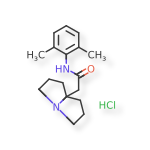
| Molecular Formula | 2C17H24N2O.2ClH.H2O |
| Molecular Weight | 635.708 |
| Optical Activity | NONE |
| Defined Stereocenters | 0 / 0 |
| E/Z Centers | 0 |
| Charge | 0 |
SHOW SMILES / InChI
SMILES
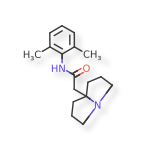
O.Cl.Cl.CC1=CC=CC(C)=C1NC(=O)CC23CCCN2CCC3.CC4=CC=CC(C)=C4NC(=O)CC56CCCN5CCC6
InChI
InChIKey=BZVJYJOFEKSVLE-UHFFFAOYSA-N
InChI=1S/2C17H24N2O.2ClH.H2O/c2*1-13-6-3-7-14(2)16(13)18-15(20)12-17-8-4-10-19(17)11-5-9-17;;;/h2*3,6-7H,4-5,8-12H2,1-2H3,(H,18,20);2*1H;1H2
| Molecular Formula | C17H24N2O |
| Molecular Weight | 272.3853 |
| Charge | 0 |
| Count |
|
| Stereochemistry | ACHIRAL |
| Additional Stereochemistry | No |
| Defined Stereocenters | 0 / 0 |
| E/Z Centers | 0 |
| Optical Activity | NONE |
| Molecular Formula | ClH |
| Molecular Weight | 36.461 |
| Charge | 0 |
| Count |
|
| Stereochemistry | ACHIRAL |
| Additional Stereochemistry | No |
| Defined Stereocenters | 0 / 0 |
| E/Z Centers | 0 |
| Optical Activity | NONE |
| Molecular Formula | H2O |
| Molecular Weight | 18.0153 |
| Charge | 0 |
| Count |
|
| Stereochemistry | ACHIRAL |
| Additional Stereochemistry | No |
| Defined Stereocenters | 0 / 0 |
| E/Z Centers | 0 |
| Optical Activity | NONE |
DescriptionCurator's Comment: description was created based on several sources, including
http://www.rad-ar.or.jp/siori/english/kekka.cgi?n=1112
http://www.ncbi.nlm.nih.gov/pubmed/1328732
Curator's Comment: description was created based on several sources, including
http://www.rad-ar.or.jp/siori/english/kekka.cgi?n=1112
http://www.ncbi.nlm.nih.gov/pubmed/1328732
Pilsicainide is marketed in Japan as (Sunrythm). Pilsicainide controls the cardiac conduction abnormalities and improves the symptoms of arrhythmia with the blocking action on Na channel. It is usually used to treat tachycardiac arrhythmia. Pilsicainide did not affect the resting membrane potential. Under the voltage-clamp condition, pilsicainide inhibited the transient outward current (Ito) that is more prominent in the atrium than in the ventricle in a concentration-dependent manner. However, in contrast to other class Ic agents, the inhibition to Ito by pilsicainide was observed only at much higher concentrations (IC50-300 uM) and did not affect the inactivation time-course of Ito. Moreover, the drug (10 uM) did not significantly affect the Ca2+, delayed rectifier K+, inward rectifying K+, acetylcholine-induced K+ or ATP-sensitive K+ currents. From these results pilsicainide could be differentiated as a pure Na+ channel blocker from other class Ic agents with diverse effects on membrane currents and should be recognized accordingly in clinical situations. A single oral dose of pilsicainide effectively restores normal sinus rhythm in patients with recent-onset atrial fibrillation and a healthy left ventricle. Long-term therapy with pilsicainide is successful in treating chronic atrial fibrillation
Originator
Approval Year
Cmax
| Value | Dose | Co-administered | Analyte | Population |
|---|---|---|---|---|
0.34 μg/mL EXPERIMENT https://pubmed.ncbi.nlm.nih.gov/24480637/ |
0.25 mg/kg single, intravenous dose: 0.25 mg/kg route of administration: Intravenous experiment type: SINGLE co-administered: |
PILSICAINIDE plasma | Homo sapiens population: HEALTHY age: ADULT sex: FEMALE / MALE food status: FED |
|
0.54 μg/mL EXPERIMENT https://pubmed.ncbi.nlm.nih.gov/24480637/ |
0.5 mg/kg single, intravenous dose: 0.5 mg/kg route of administration: Intravenous experiment type: SINGLE co-administered: |
PILSICAINIDE plasma | Homo sapiens population: HEALTHY age: ADULT sex: FEMALE / MALE food status: FED |
|
1.05 μg/mL EXPERIMENT https://pubmed.ncbi.nlm.nih.gov/24480637/ |
0.75 mg/kg single, intravenous dose: 0.75 mg/kg route of administration: Intravenous experiment type: SINGLE co-administered: |
PILSICAINIDE plasma | Homo sapiens population: HEALTHY age: ADULT sex: FEMALE / MALE food status: FED |
|
409 ng/mL EXPERIMENT https://pubmed.ncbi.nlm.nih.gov/2050177/ |
50 mg single, oral dose: 50 mg route of administration: Oral experiment type: SINGLE co-administered: |
PILSICAINIDE plasma | Homo sapiens population: UNHEALTHY age: ADULT sex: FEMALE / MALE food status: FED |
|
459 ng/mL EXPERIMENT https://pubmed.ncbi.nlm.nih.gov/2050177/ |
50 mg single, oral dose: 50 mg route of administration: Oral experiment type: SINGLE co-administered: |
PILSICAINIDE plasma | Homo sapiens population: UNHEALTHY age: ADULT sex: FEMALE / MALE food status: FED |
|
505 ng/mL EXPERIMENT https://pubmed.ncbi.nlm.nih.gov/2050177/ |
50 mg single, oral dose: 50 mg route of administration: Oral experiment type: SINGLE co-administered: |
PILSICAINIDE plasma | Homo sapiens population: UNHEALTHY age: ADULT sex: FEMALE / MALE food status: FED |
|
630 ng/mL EXPERIMENT https://pubmed.ncbi.nlm.nih.gov/2050177/ |
50 mg single, oral dose: 50 mg route of administration: Oral experiment type: SINGLE co-administered: |
PILSICAINIDE plasma | Homo sapiens population: UNHEALTHY age: ADULT sex: FEMALE / MALE food status: FED |
AUC
| Value | Dose | Co-administered | Analyte | Population |
|---|---|---|---|---|
0.79 μg × h/mL EXPERIMENT https://pubmed.ncbi.nlm.nih.gov/24480637/ |
0.25 mg/kg single, intravenous dose: 0.25 mg/kg route of administration: Intravenous experiment type: SINGLE co-administered: |
PILSICAINIDE plasma | Homo sapiens population: HEALTHY age: ADULT sex: FEMALE / MALE food status: FED |
|
1.71 μg × h/mL EXPERIMENT https://pubmed.ncbi.nlm.nih.gov/24480637/ |
0.5 mg/kg single, intravenous dose: 0.5 mg/kg route of administration: Intravenous experiment type: SINGLE co-administered: |
PILSICAINIDE plasma | Homo sapiens population: HEALTHY age: ADULT sex: FEMALE / MALE food status: FED |
|
2.72 μg × h/mL EXPERIMENT https://pubmed.ncbi.nlm.nih.gov/24480637/ |
0.75 mg/kg single, intravenous dose: 0.75 mg/kg route of administration: Intravenous experiment type: SINGLE co-administered: |
PILSICAINIDE plasma | Homo sapiens population: HEALTHY age: ADULT sex: FEMALE / MALE food status: FED |
|
3470 ng × h/mL EXPERIMENT https://pubmed.ncbi.nlm.nih.gov/2050177/ |
50 mg single, oral dose: 50 mg route of administration: Oral experiment type: SINGLE co-administered: |
PILSICAINIDE plasma | Homo sapiens population: UNHEALTHY age: ADULT sex: FEMALE / MALE food status: FED |
|
4760 ng × h/mL EXPERIMENT https://pubmed.ncbi.nlm.nih.gov/2050177/ |
50 mg single, oral dose: 50 mg route of administration: Oral experiment type: SINGLE co-administered: |
PILSICAINIDE plasma | Homo sapiens population: UNHEALTHY age: ADULT sex: FEMALE / MALE food status: FED |
|
7870 ng × h/mL EXPERIMENT https://pubmed.ncbi.nlm.nih.gov/2050177/ |
50 mg single, oral dose: 50 mg route of administration: Oral experiment type: SINGLE co-administered: |
PILSICAINIDE plasma | Homo sapiens population: UNHEALTHY age: ADULT sex: FEMALE / MALE food status: FED |
|
23800 ng × h/mL EXPERIMENT https://pubmed.ncbi.nlm.nih.gov/2050177/ |
50 mg single, oral dose: 50 mg route of administration: Oral experiment type: SINGLE co-administered: |
PILSICAINIDE plasma | Homo sapiens population: UNHEALTHY age: ADULT sex: FEMALE / MALE food status: FED |
T1/2
| Value | Dose | Co-administered | Analyte | Population |
|---|---|---|---|---|
5.19 h EXPERIMENT https://pubmed.ncbi.nlm.nih.gov/24480637/ |
0.25 mg/kg single, intravenous dose: 0.25 mg/kg route of administration: Intravenous experiment type: SINGLE co-administered: |
PILSICAINIDE plasma | Homo sapiens population: HEALTHY age: ADULT sex: FEMALE / MALE food status: FED |
|
5.98 h EXPERIMENT https://pubmed.ncbi.nlm.nih.gov/24480637/ |
0.5 mg/kg single, intravenous dose: 0.5 mg/kg route of administration: Intravenous experiment type: SINGLE co-administered: |
PILSICAINIDE plasma | Homo sapiens population: HEALTHY age: ADULT sex: FEMALE / MALE food status: FED |
|
5.46 h EXPERIMENT https://pubmed.ncbi.nlm.nih.gov/24480637/ |
0.75 mg/kg single, intravenous dose: 0.75 mg/kg route of administration: Intravenous experiment type: SINGLE co-administered: |
PILSICAINIDE plasma | Homo sapiens population: HEALTHY age: ADULT sex: FEMALE / MALE food status: FED |
|
3.4 h EXPERIMENT https://pubmed.ncbi.nlm.nih.gov/2050177/ |
50 mg single, oral dose: 50 mg route of administration: Oral experiment type: SINGLE co-administered: |
PILSICAINIDE plasma | Homo sapiens population: UNHEALTHY age: ADULT sex: FEMALE / MALE food status: FED |
|
5.7 h EXPERIMENT https://pubmed.ncbi.nlm.nih.gov/2050177/ |
50 mg single, oral dose: 50 mg route of administration: Oral experiment type: SINGLE co-administered: |
PILSICAINIDE plasma | Homo sapiens population: UNHEALTHY age: ADULT sex: FEMALE / MALE food status: FED |
|
9.3 h EXPERIMENT https://pubmed.ncbi.nlm.nih.gov/2050177/ |
50 mg single, oral dose: 50 mg route of administration: Oral experiment type: SINGLE co-administered: |
PILSICAINIDE plasma | Homo sapiens population: UNHEALTHY age: ADULT sex: FEMALE / MALE food status: FED |
|
23.7 h EXPERIMENT https://pubmed.ncbi.nlm.nih.gov/2050177/ |
50 mg single, oral dose: 50 mg route of administration: Oral experiment type: SINGLE co-administered: |
PILSICAINIDE plasma | Homo sapiens population: UNHEALTHY age: ADULT sex: FEMALE / MALE food status: FED |
Funbound
| Value | Dose | Co-administered | Analyte | Population |
|---|---|---|---|---|
73.2% EXPERIMENT https://pubmed.ncbi.nlm.nih.gov/2050177/ |
50 mg single, oral dose: 50 mg route of administration: Oral experiment type: SINGLE co-administered: |
PILSICAINIDE plasma | Homo sapiens population: UNHEALTHY age: ADULT sex: FEMALE / MALE food status: FED |
|
65.5% EXPERIMENT https://pubmed.ncbi.nlm.nih.gov/2050177/ |
50 mg single, oral dose: 50 mg route of administration: Oral experiment type: SINGLE co-administered: |
PILSICAINIDE plasma | Homo sapiens population: UNHEALTHY age: ADULT sex: FEMALE / MALE food status: FED |
|
63.3% EXPERIMENT https://pubmed.ncbi.nlm.nih.gov/2050177/ |
50 mg single, oral dose: 50 mg route of administration: Oral experiment type: SINGLE co-administered: |
PILSICAINIDE plasma | Homo sapiens population: UNHEALTHY age: ADULT sex: FEMALE / MALE food status: FED |
|
63% EXPERIMENT https://pubmed.ncbi.nlm.nih.gov/2050177/ |
50 mg single, oral dose: 50 mg route of administration: Oral experiment type: SINGLE co-administered: |
PILSICAINIDE plasma | Homo sapiens population: UNHEALTHY age: ADULT sex: FEMALE / MALE food status: FED |
Doses
| Dose | Population | Adverse events |
|---|---|---|
150 mg single, oral Recommended Dose: 150 mg Route: oral Route: single Dose: 150 mg Sources: |
unhealthy, ADULT Health Status: unhealthy Age Group: ADULT Sex: M+F Food Status: UNKNOWN Sources: |
Disc. AE: Myocardial infarct... AEs leading to discontinuation/dose reduction: Myocardial infarct Sources: |
50 mg 3 times / day multiple, oral Recommended Dose: 50 mg, 3 times / day Route: oral Route: multiple Dose: 50 mg, 3 times / day Sources: |
unhealthy, ADULT Health Status: unhealthy Age Group: ADULT Sex: M+F Food Status: UNKNOWN Sources: |
Disc. AE: Rash... AEs leading to discontinuation/dose reduction: Rash (2%) Sources: |
50 mg 3 times / day multiple, oral Recommended Dose: 50 mg, 3 times / day Route: oral Route: multiple Dose: 50 mg, 3 times / day Sources: |
unhealthy, ADULT Health Status: unhealthy Age Group: ADULT Sex: M+F Food Status: UNKNOWN Sources: |
AEs
| AE | Significance | Dose | Population |
|---|---|---|---|
| Myocardial infarct | Disc. AE | 150 mg single, oral Recommended Dose: 150 mg Route: oral Route: single Dose: 150 mg Sources: |
unhealthy, ADULT Health Status: unhealthy Age Group: ADULT Sex: M+F Food Status: UNKNOWN Sources: |
| Rash | 2% Disc. AE |
50 mg 3 times / day multiple, oral Recommended Dose: 50 mg, 3 times / day Route: oral Route: multiple Dose: 50 mg, 3 times / day Sources: |
unhealthy, ADULT Health Status: unhealthy Age Group: ADULT Sex: M+F Food Status: UNKNOWN Sources: |
PubMed
| Title | Date | PubMed |
|---|---|---|
| A Case of Sudden Cardiac Death due to Pilsicainide-Induced Torsades de Pointes. | 2014-03 |
|
| Early identification of clinically relevant drug interactions with the human bile salt export pump (BSEP/ABCB11). | 2013-12 |
|
| Pilsicainide-induced ST segment elevation and ST segment depression in two patients with variant forms of Brugada-type electrocardiographic abnormalities. | 2009-06 |
|
| Menstruation-dependent idiopathic ventricular arrhythmia. | 2008-06 |
|
| The effects of losartan on signal-averaged P wave in patients with atrial fibrillation. | 2008-05-07 |
|
| Repolarization heterogeneity in the right ventricular outflow tract: correlation with ventricular arrhythmias in Brugada patients and in an in vitro canine Brugada model. | 2008-05 |
|
| Use of bepridil in combination with Ic antiarrhythmic agent in converting persistent atrial fibrillation to sinus rhythm. | 2008-05 |
|
| Neutral endopeptidase inhibitor suppresses the early phase of atrial electrical remodeling in a canine rapid atrial pacing model. | 2008-04-01 |
|
| Re: Clinical significance of macroscopic T-wave alternans after sodium channel blocker administration in patients with Brugada syndrome. | 2008-04 |
|
| Longer repolarization in the epicardium at the right ventricular outflow tract causes type 1 electrocardiogram in patients with Brugada syndrome. | 2008-03-25 |
|
| Clinical and electrophysiological characteristics of patients having atrial flutter with 1:1 atrioventricular conduction. | 2008-03 |
|
| Clinical significance of macroscopic T-wave alternans after sodium channel blocker administration in patients with Brugada syndrome. | 2008-01 |
|
| Sodium channel blockers enhance the temporal QT interval variability in the right precordial leads in Brugada syndrome. | 2008-01 |
|
| Pilsicainide-induced Brugada-type ECG and ventricular arrhythmias originating from the left posterior fascicle in a case with Brugada syndrome associated with idiopathic left ventricular tachycardia. | 2008-01 |
|
| [Brugada syndrome]. | 2007-12 |
|
| Effects of cooling on histamine-induced contractions of human umbilical artery: the role of ion channels. | 2007-11 |
|
| Mechanisms of the preventive effect of pilsicainide on atrial fibrillation originating from the pulmonary vein. | 2007-11 |
|
| [Elderly Brugada syndrome with recurrent syncope, diagnosed by pilsicainide challenge test]. | 2007-06-10 |
|
| Incidence and initial characteristics of pilsicainide-induced ventricular arrhythmias in patients with Brugada syndrome. | 2007-05 |
|
| Pilsicainide-induced ventricular tachycardia originating from right ventricular outflow tract. | 2007-05 |
|
| Mechanism of the conversion of a pulmonary vein tachycardia to atrial fibrillation in normal canine hearts: role of autonomic nerve stimulation. | 2007-05 |
|
| Novel SCN5A mutation (Q55X) associated with age-dependent expression of Brugada syndrome presenting as neurally mediated syncope. | 2007-04 |
|
| Discrimination of Brugada syndrome patients from individuals with the saddle-back type ST-segment elevation using a marker of the standard 12-lead electrocardiography. | 2007-04 |
|
| Two-dimensional tracking and TDI are consistent methods for evaluating myocardial longitudinal peak strain in left and right ventricle basal segments in athletes. | 2007-02-07 |
|
| How can a single mutation cause such arrhythmic havoc? | 2007-02 |
|
| Temperature modulation of ventricular arrhythmogenicity in a canine tissue model of Brugada syndrome. | 2007-02 |
|
| Different effect of the pure Na+ channel-blocker pilsicainide on the ST-segment response in the right precordial leads in patients with normal left ventricular function. | 2007-01 |
|
| A case of a concealed type of Brugada syndrome with a J wave and mild ST-segment elevation in the inferolateral leads. | 2007-01 |
|
| Transition from purkinje fiber-related rapid polymorphic ventricular tachycardia to sustained monomorphic ventricular tachycardia in a patient with a structurally normal heart: a case report. | 2007-01 |
|
| Multiple premature beats triggered ventricular arrhythmias during pilsicainide infusion in a patient with inferior ST-segment elevation. | 2006-12 |
|
| Comment on severe arrhythmia as a result of the interaction of cetirizine and pilsicainide in a patient with renal insufficiency. | 2006-12 |
|
| High-frequency potentials developed in wavelet-transformed electrocardiogram as a novel indicator for detecting Brugada syndrome. | 2006-12 |
|
| Spatial distribution of repolarization and depolarization abnormalities evaluated by body surface potential mapping in patients with Brugada syndrome. | 2006-10 |
|
| Spontaneous polymorphic ventricular tachycardia after administration of pilsicainide in a patient resuscitated from ventricular fibrillation. | 2006-09 |
|
| Effects of antiarrhythmic drugs on apoptotic pathways in H9c2 cardiac cells. | 2006-08 |
|
| The full stomach test as a novel diagnostic technique for identifying patients at risk of Brugada syndrome. | 2006-06 |
|
| Randomized crossover study of the long-term effects of pilsicainide and cibenzoline in preventing recurrence of symptomatic paroxysmal atrial fibrillation: influence of the duration of arrhythmia before therapy. | 2006-06 |
|
| Cellular basis for trigger and maintenance of ventricular fibrillation in the Brugada syndrome model: high-resolution optical mapping study. | 2006-05-16 |
|
| Pilsicainide-induced verapamil sensitive idiopathic left ventricular tachycardia. | 2006-05 |
|
| Pilsicainide for atrial fibrillation. | 2006 |
|
| Long-term efficacy of hybrid pharmacologic and ablation therapy in patients with pilsicainide-induced atrial flutter. | 2005-07 |
|
| Pilsicainide-induced coronary vasospasm in a patient with Brugada-type electrocardiogram. | 2005-07 |
|
| A case of the toxicity of pilsicainide hydrochloride with comparison of the serial serum pilsicainide levels and electrocardiographic findings. | 2004-11 |
|
| [Brugada syndrome associated with ventricular fibrillation induced by administration of pilsicainide: a case report]. | 2003-11 |
|
| Brugada disease: chronology of discovery and paternity. Preliminary observations and historical aspects. | 2003-10-01 |
|
| Role of atrial fibrillation threshold evaluation on guiding treatment. | 2003-10-01 |
|
| Tachycardiomyopathy. | 2002-10-01 |
|
| Class I antiarrhythmic drug and coronary vasospasm-induced T wave alternans and ventricular tachyarrhythmia in a patient with Brugada syndrome and vasospastic angina. | 2002-02 |
|
| A case of sinus pause due to the proarrhythmia of pilsicainide. | 2000-05 |
|
| General pharmacological studies on N-(2,6-dimethylphenyl)-8-pyrrolizidineacetamide hydrochloride hemihydrate. 1st communication: effect on the central nervous system. | 1988-10 |
Patents
Sample Use Guides
Using a whole cell clamp technique, the blockade of sodium currents (INa) by pilsicainide applied either intracellularly or extracellularly, was studied in single myocytes isolated from guinea pig right ventricle. Pilsicainide applied extracellularly inhibited the peak amplitude of INa in concentration- (from 10(-5) M to 10(-4) M) and rate- (from 0.5 Hz to 3.0 Hz) dependent manners. Pilsicainide applied intracellularly inhibited INa in a rate-dependent manner. The blocking potency of internally applied pilsicainide almost corresponded to that of external 10(-5) M pilsicainide.
| Substance Class |
Chemical
Created
by
admin
on
Edited
Mon Mar 31 21:29:25 GMT 2025
by
admin
on
Mon Mar 31 21:29:25 GMT 2025
|
| Record UNII |
1O3YJ4R7ZA
|
| Record Status |
Validated (UNII)
|
| Record Version |
|
-
Download
| Name | Type | Language | ||
|---|---|---|---|---|
|
Preferred Name | English | ||
|
Common Name | English | ||
|
Brand Name | English | ||
|
Common Name | English | ||
|
Code | English | ||
|
Common Name | English | ||
|
Common Name | English | ||
|
Common Name | English |
| Code System | Code | Type | Description | ||
|---|---|---|---|---|---|
|
1O3YJ4R7ZA
Created by
admin on Mon Mar 31 21:29:25 GMT 2025 , Edited by admin on Mon Mar 31 21:29:25 GMT 2025
|
PRIMARY | |||
|
m8809
Created by
admin on Mon Mar 31 21:29:25 GMT 2025 , Edited by admin on Mon Mar 31 21:29:25 GMT 2025
|
PRIMARY | Merck Index | ||
|
23724804
Created by
admin on Mon Mar 31 21:29:25 GMT 2025 , Edited by admin on Mon Mar 31 21:29:25 GMT 2025
|
PRIMARY |
| Related Record | Type | Details | ||
|---|---|---|---|---|
|
ANHYDROUS->SOLVATE | |||
|
|
PARENT -> SALT/SOLVATE |
| Related Record | Type | Details | ||
|---|---|---|---|---|
|
|
ACTIVE MOIETY |