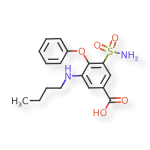
Details
| Stereochemistry | ACHIRAL |
| Molecular Formula | C17H19N2O5S.Na |
| Molecular Weight | 386.398 |
| Optical Activity | NONE |
| Defined Stereocenters | 0 / 0 |
| E/Z Centers | 0 |
| Charge | 0 |
SHOW SMILES / InChI
SMILES
[Na+].CCCCNC1=C(OC2=CC=CC=C2)C(=CC(=C1)C([O-])=O)S(N)(=O)=O
InChI
InChIKey=QDFGOJHAQZEYQL-UHFFFAOYSA-M
InChI=1S/C17H20N2O5S.Na/c1-2-3-9-19-14-10-12(17(20)21)11-15(25(18,22)23)16(14)24-13-7-5-4-6-8-13;/h4-8,10-11,19H,2-3,9H2,1H3,(H,20,21)(H2,18,22,23);/q;+1/p-1
| Molecular Formula | C17H19N2O5S |
| Molecular Weight | 363.408 |
| Charge | -1 |
| Count |
|
| Stereochemistry | ACHIRAL |
| Additional Stereochemistry | No |
| Defined Stereocenters | 0 / 0 |
| E/Z Centers | 0 |
| Optical Activity | NONE |
| Molecular Formula | Na |
| Molecular Weight | 22.98976928 |
| Charge | 1 |
| Count |
|
| Stereochemistry | ACHIRAL |
| Additional Stereochemistry | No |
| Defined Stereocenters | 0 / 0 |
| E/Z Centers | 0 |
| Optical Activity | NONE |
DescriptionCurator's Comment: description was created based on several sources, including:
http://www.rxlist.com/bumex-drug/side-effects-interactions.htm
https://www.drugs.com/cdi/bumetanide.html
http://www.wikidoc.org/index.php/Bumetanide_(oral)
Curator's Comment: description was created based on several sources, including:
http://www.rxlist.com/bumex-drug/side-effects-interactions.htm
https://www.drugs.com/cdi/bumetanide.html
http://www.wikidoc.org/index.php/Bumetanide_(oral)
Bumetanide is indicated for the treatment of edema associated with congestive heart failure, hepatic and renal disease, including the nephrotic syndrome. It blocks the reabsorption of sodium and fluid from the kidney's tubules. The most frequent clinical adverse reactions considered probably or possibly related to bumetanide are muscle cramps (seen in 1.1% of treated patients), dizziness (1.1%), hypotension (0.8%), headache (0.6%), nausea (0.6%) and encephalopathy (in patients with preexisting liver disease) (0.6%). One or more of these adverse reactions have been reported in approximately 4.1% of patients treated with Bumex (bumetanide). Lithium should generally not be given with diuretics (such as Bumex (bumetanide)) because they reduce its renal clearance and add a high risk of lithium toxicity. Bumex (bumetanide) may potentiate the effect of various antihypertensive drugs, necessitating a reduction in the dosage of these drugs.
CNS Activity
Originator
Approval Year
Targets
| Primary Target | Pharmacology | Condition | Potency |
|---|---|---|---|
Target ID: P55011 Gene ID: 6558.0 Gene Symbol: SLC12A2 Target Organism: Homo sapiens (Human) |
3.0 µM [IC50] | ||
Target ID: Q9UP95|||O60632 Gene ID: 6560.0 Gene Symbol: SLC12A4 Target Organism: Homo sapiens (Human) |
60.0 µM [IC50] | ||
Target ID: Q9H2X9 Gene ID: 57468.0 Gene Symbol: SLC12A5 Target Organism: Homo sapiens (Human) |
55.0 µM [IC50] | ||
Target ID: Q13621 Gene ID: 6557.0 Gene Symbol: SLC12A1 Target Organism: Homo sapiens (Human) |
4.0 µM [IC50] |
Conditions
| Condition | Modality | Targets | Highest Phase | Product |
|---|---|---|---|---|
| Primary | BUMEX Approved UseBumetanide Injection is indicated for the treatment of edema associated with congestive heart failure, hepatic and renal disease, including the nephrotic syndrome. Almost equal diuretic response occurs after oral and parenteral administration of bumetanide. Therefore, if impaired gastrointestinal absorption is suspected or oral administration is not practical, bumetanide should be given by the intramuscular or intravenous route. Successful treatment with bumetanide following instances of allergic reactions to furosemide suggests a lack of cross-sensitivity. Launch Date1983 |
Cmax
| Value | Dose | Co-administered | Analyte | Population |
|---|---|---|---|---|
111.38 ng/mL EXPERIMENT https://www.ncbi.nlm.nih.gov/pubmed/22475517 |
2 mg single, oral dose: 2 mg route of administration: Oral experiment type: SINGLE co-administered: |
BUMETANIDE plasma | Homo sapiens population: HEALTHY age: ADULT sex: MALE food status: FASTED |
|
42 ng/mL EXPERIMENT https://www.ncbi.nlm.nih.gov/pubmed/8312869 |
2 mg single, oral dose: 2 mg route of administration: Oral experiment type: SINGLE co-administered: |
BUMETANIDE plasma | Homo sapiens population: UNKNOWN age: ADULT sex: FEMALE / MALE food status: FASTED |
AUC
| Value | Dose | Co-administered | Analyte | Population |
|---|---|---|---|---|
258 ng × h/mL EXPERIMENT https://www.ncbi.nlm.nih.gov/pubmed/22475517 |
2 mg single, oral dose: 2 mg route of administration: Oral experiment type: SINGLE co-administered: |
BUMETANIDE plasma | Homo sapiens population: HEALTHY age: ADULT sex: MALE food status: FASTED |
|
167.34 ng × h/mL EXPERIMENT https://www.ncbi.nlm.nih.gov/pubmed/8312869 |
2 mg single, oral dose: 2 mg route of administration: Oral experiment type: SINGLE co-administered: |
BUMETANIDE plasma | Homo sapiens population: UNKNOWN age: ADULT sex: FEMALE / MALE food status: FASTED |
T1/2
| Value | Dose | Co-administered | Analyte | Population |
|---|---|---|---|---|
1.88 h EXPERIMENT https://www.ncbi.nlm.nih.gov/pubmed/22475517 |
2 mg single, oral dose: 2 mg route of administration: Oral experiment type: SINGLE co-administered: |
BUMETANIDE plasma | Homo sapiens population: HEALTHY age: ADULT sex: MALE food status: FASTED |
Funbound
| Value | Dose | Co-administered | Analyte | Population |
|---|---|---|---|---|
3% |
BUMETANIDE serum | Homo sapiens population: HEALTHY age: NEWBORN sex: UNKNOWN food status: UNKNOWN |
||
5% EXPERIMENT https://www.ncbi.nlm.nih.gov/pubmed/22475517 |
2 mg single, oral dose: 2 mg route of administration: Oral experiment type: SINGLE co-administered: |
BUMETANIDE plasma | Homo sapiens population: HEALTHY age: ADULT sex: MALE food status: FASTED |
Doses
| Dose | Population | Adverse events |
|---|---|---|
2 mg 2 times / day multiple, oral Recommended Dose: 2 mg, 2 times / day Route: oral Route: multiple Dose: 2 mg, 2 times / day Sources: |
unhealthy, 14–18 |
Disc. AE: Hypokalemia, Anorexia... AEs leading to discontinuation/dose reduction: Hypokalemia (moderate, 14.3%) Sources: Anorexia (moderate) Fatigue (moderate) Polyuria (moderate, 4.8%) |
10 mg 1 times / day multiple, oral Recommended Dose: 10 mg, 1 times / day Route: oral Route: multiple Dose: 10 mg, 1 times / day Sources: |
unhealthy, 22-72 |
AEs
| AE | Significance | Dose | Population |
|---|---|---|---|
| Hypokalemia | moderate, 14.3% Disc. AE |
2 mg 2 times / day multiple, oral Recommended Dose: 2 mg, 2 times / day Route: oral Route: multiple Dose: 2 mg, 2 times / day Sources: |
unhealthy, 14–18 |
| Polyuria | moderate, 4.8% Disc. AE |
2 mg 2 times / day multiple, oral Recommended Dose: 2 mg, 2 times / day Route: oral Route: multiple Dose: 2 mg, 2 times / day Sources: |
unhealthy, 14–18 |
| Anorexia | moderate Disc. AE |
2 mg 2 times / day multiple, oral Recommended Dose: 2 mg, 2 times / day Route: oral Route: multiple Dose: 2 mg, 2 times / day Sources: |
unhealthy, 14–18 |
| Fatigue | moderate Disc. AE |
2 mg 2 times / day multiple, oral Recommended Dose: 2 mg, 2 times / day Route: oral Route: multiple Dose: 2 mg, 2 times / day Sources: |
unhealthy, 14–18 |
Overview
| CYP3A4 | CYP2C9 | CYP2D6 | hERG |
|---|---|---|---|
Drug as perpetrator
| Target | Modality | Activity | Metabolite | Clinical evidence |
|---|---|---|---|---|
| modest [IC50 348 uM] | ||||
| yes [IC50 0.75 uM] | ||||
| yes [IC50 7.6 uM] | ||||
| yes [IC50 77.5 uM] |
Drug as victim
| Target | Modality | Activity | Metabolite | Clinical evidence |
|---|---|---|---|---|
| no | ||||
| yes | ||||
| yes | ||||
| yes | ||||
| yes | ||||
| yes |
PubMed
| Title | Date | PubMed |
|---|---|---|
| Contribution of the Na(+)-K(+)-2Cl(-) cotransporter (NKCC1) to transepithelial transport of H(+), NH(4)(+), K(+), and Na(+) in rat outer medullary collecting duct. | 2002-04 |
|
| Renal Na-K-Cl cotransporter NKCC2 in Dahl salt-sensitive rats. | 2002-04 |
|
| NKCC2: a drug target in hypertension. | 2002-04 |
|
| Steroids modulate transepithelial resistance and Na(+) absorption across cultured porcine vas deferens epithelia. | 2002-04 |
|
| Chloride transport in rabbit esophageal epithelial cells. | 2002-04 |
|
| Manipulation of chloride flux affects histamine-induced contraction in rabbit basilar artery. | 2002-04 |
|
| cAMP regulation of Cl(-) and HCO(-)(3) secretion across rat fetal distal lung epithelial cells. | 2002-04 |
|
| Functional properties of the apical Na+-K+-2Cl- cotransporter isoforms. | 2002-03-29 |
|
| Rat NKCC2/NKCC1 cotransporter selectivity for loop diuretic drugs. | 2002-03 |
|
| The flavonol quercetin activates basolateral K(+) channels in rat distal colon epithelium. | 2002-03 |
|
| Basolateral PAR-2 receptors mediate KCl secretion and inhibition of Na+ absorption in the mouse distal colon. | 2002-02-15 |
|
| Effects of butyrate on active sodium and chloride transport in rat and rabbit distal colon. | 2002-02-15 |
|
| Tonic and spillover inhibition of granule cells control information flow through cerebellar cortex. | 2002-02-14 |
|
| Activation of NKCC1 by hyperosmotic stress in human tracheal epithelial cells involves PKC-delta and ERK. | 2002-02-13 |
|
| Na(+)/K(+)/Cl(-) cotransporter activates mitogen-activated protein kinase in fibroblasts and lymphocytes. | 2002-02 |
|
| Activation of ion secretion via proteinase-activated receptor-2 in human colon. | 2002-02 |
|
| Interleukin-13 induces a hypersecretory ion transport phenotype in human bronchial epithelial cells. | 2002-02 |
|
| Intrinsic optical signals in the rat optic nerve: role for K(+) uptake via NKCC1 and swelling of astrocytes. | 2002-02 |
|
| Cyclic AMP-dependent Cl secretion is regulated by multiple phosphodiesterase subtypes in human colonic epithelial cells. | 2002-01-15 |
|
| An integrative, in situ approach to examining K+ flux in resting skeletal muscle. | 2001-12 |
|
| Neurotransmitter-stimulated ion transport across cultured bovine mammary epithelial cell monolayers. | 2001-12 |
|
| Bumetanide annihilation of amphotericin B-induced apoptosis and cytotoxicity is due to its effect on cellular K+ flux. | 2001-12 |
|
| Growth factors stimulate the Na-K-2Cl cotransporter NKCC1 through a novel Cl(-)-dependent mechanism. | 2001-12 |
|
| Vacuolation induced by VacA toxin of Helicobacter pylori requires the intracellular accumulation of membrane permeant bases, Cl(-) and water. | 2001-11-23 |
|
| Localization of a Na(+)-K(+)-2Cl(-) cotransporter in the rabbit lens. | 2001-11 |
|
| Role of Cl- current in endothelin-1-induced contraction in rabbit basilar artery. | 2001-11 |
|
| Ion transport and ligand binding by the Na-K-Cl cotransporter, structure-function studies. | 2001-10 |
|
| Ionic mechanisms of GABA-induced long-term potentiation in the rat superior colliculus. | 2001-10 |
|
| Mechanism(s) of chloride transport in human distal colonic apical membrane vesicles. | 2001-10 |
|
| Quantitative determination of the loop diuretic bumetanide in urine and pharmaceuticals by high-performance liquid chromatography with amperometric detection. | 2001-10 |
|
| Indirectly gated Cl(-)-dependent Cl(-) channels sense physiological changes of extracellular chloride in the leech. | 2001-10 |
|
| Ion transport by sheep distal airways in a miniature chamber. | 2001-10 |
|
| Prostanoids stimulate K secretion and Cl secretion in guinea pig distal colon via distinct pathways. | 2001-10 |
|
| Selective inhibition of Cl(-) conductance in toad skin by blockers of Cl(-) channels and transporters. | 2001-10 |
|
| Thermogenesis induced by intravenous infusion of hypertonic solutions in the rat. | 2001-09-01 |
|
| Loop diuretics alter the diurnal rhythm of endogenous parathyroid hormone secretion. A randomized-controlled study on the effects of loop- and thiazide-diuretics on the diurnal rhythms of calcitropic hormones and biochemical bone markers in postmenopausal women. | 2001-09 |
|
| Apoptosis in post-streptococcal glomerulonephritis. | 2001-09 |
|
| Spontaneous water secretion in T84 cells: effects of STa enterotoxin, bumetanide, VIP, forskolin, and A-23187. | 2001-09 |
|
| Mechanism of substance P-induced liquid secretion across bronchial epithelium. | 2001-09 |
|
| Contribution of the Na-K-Cl cotransporter on GABA(A) receptor-mediated presynaptic depolarization in excitatory nerve terminals. | 2001-08-15 |
|
| Cisplatin-induced apoptosis of mesothelioma cells is affected by potassium ion flux modulator amphotericin B and bumetanide. | 2001-08-15 |
|
| Regional differences in ciliary epithelial cell transport properties. | 2001-08-01 |
|
| Differential roles of the sodium-calcium exchanger in renin secretion and renal vascular resistance. | 2001-08 |
|
| Effects of thiazide- and loop-diuretics, alone or in combination, on calcitropic hormones and biochemical bone markers: a randomized controlled study. | 2001-08 |
|
| HCO3- transport in relation to mucus secretion from submucosal glands. | 2001-07 |
|
| Application of multiple response optimization technique to extended release formulations design. | 2001-06-15 |
|
| Na+-K+-Cl- cotransporter in rat focal cerebral ischemia. | 2001-06 |
|
| Pharmacokinetics and pharmacodynamics of intravenous bumetanide in mutant Nagase analbuminemic rats: importance of globulin binding for the pharmacodynamic effects. | 2001-05 |
|
| External Cl(-)-dependent formation of watery vacuoles by long-term hypotonic shock in 3T3-L1 cells. | 2001 |
|
| Diuretic therapy and resistance in congestive heart failure. | 2001 |
Patents
Sample Use Guides
In Vivo Use Guide
Curator's Comment: Parenteral Administration: The usual initial dose is 0.5 to 1 mg intravenously or intramuscularly. Intravenous administration should be given over a period of 1 to 2 minutes. If the response to an initial dose is deemed insufficient, a second or third dose may be given at intervals of 2 to 3 hours, but should not exceed a daily dosage of 10 mg.
The usual total daily dosage of Bumetanide is 0.5 mg to 2 mg and in most patients is given as a single
dose.
Route of Administration:
Other
| Substance Class |
Chemical
Created
by
admin
on
Edited
Tue Apr 01 20:06:20 GMT 2025
by
admin
on
Tue Apr 01 20:06:20 GMT 2025
|
| Record UNII |
1QC8KM52D1
|
| Record Status |
Validated (UNII)
|
| Record Version |
|
-
Download
| Name | Type | Language | ||
|---|---|---|---|---|
|
Common Name | English | ||
|
Preferred Name | English | ||
|
Common Name | English | ||
|
Systematic Name | English |
| Code System | Code | Type | Description | ||
|---|---|---|---|---|---|
|
DTXSID60182634
Created by
admin on Tue Apr 01 20:06:20 GMT 2025 , Edited by admin on Tue Apr 01 20:06:20 GMT 2025
|
PRIMARY | |||
|
28434-74-4
Created by
admin on Tue Apr 01 20:06:20 GMT 2025 , Edited by admin on Tue Apr 01 20:06:20 GMT 2025
|
PRIMARY | |||
|
249-015-6
Created by
admin on Tue Apr 01 20:06:20 GMT 2025 , Edited by admin on Tue Apr 01 20:06:20 GMT 2025
|
PRIMARY | |||
|
1QC8KM52D1
Created by
admin on Tue Apr 01 20:06:20 GMT 2025 , Edited by admin on Tue Apr 01 20:06:20 GMT 2025
|
PRIMARY | |||
|
23696786
Created by
admin on Tue Apr 01 20:06:20 GMT 2025 , Edited by admin on Tue Apr 01 20:06:20 GMT 2025
|
PRIMARY |
| Related Record | Type | Details | ||
|---|---|---|---|---|
|
PARENT -> SALT/SOLVATE |
|