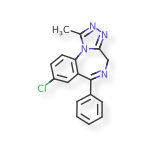
Details
| Stereochemistry | ACHIRAL |
| Molecular Formula | C17H13ClN4.2H2O |
| Molecular Weight | 344.795 |
| Optical Activity | NONE |
| Defined Stereocenters | 0 / 0 |
| E/Z Centers | 0 |
| Charge | 0 |
SHOW SMILES / InChI
SMILES
O.O.CC1=NN=C2CN=C(C3=CC=CC=C3)C4=C(C=CC(Cl)=C4)N12
InChI
InChIKey=BTXVPVVNJNBVPC-UHFFFAOYSA-N
InChI=1S/C17H13ClN4.2H2O/c1-11-20-21-16-10-19-17(12-5-3-2-4-6-12)14-9-13(18)7-8-15(14)22(11)16;;/h2-9H,10H2,1H3;2*1H2
| Molecular Formula | H2O |
| Molecular Weight | 18.0153 |
| Charge | 0 |
| Count |
|
| Stereochemistry | ACHIRAL |
| Additional Stereochemistry | No |
| Defined Stereocenters | 0 / 0 |
| E/Z Centers | 0 |
| Optical Activity | NONE |
| Molecular Formula | C17H13ClN4 |
| Molecular Weight | 308.765 |
| Charge | 0 |
| Count |
|
| Stereochemistry | ACHIRAL |
| Additional Stereochemistry | No |
| Defined Stereocenters | 0 / 0 |
| E/Z Centers | 0 |
| Optical Activity | NONE |
DescriptionCurator's Comment: description was created based on several sources, including
https://www.ncbi.nlm.nih.gov/pubmed/14978513
Curator's Comment: description was created based on several sources, including
https://www.ncbi.nlm.nih.gov/pubmed/14978513
Alprazolam, a benzodiazepine, is used to treat panic disorder and anxiety disorder. Unlike chlordiazepoxide, clorazepate, and prazepam, alprazolam has a shorter half-life and metabolites with minimal activity. Alprazolam may have significant drug interactions involving the hepatic cytochrome P-450 3A4 isoenzyme. Clinically, all benzodiazepines cause a dose-related central nervous system depressant activity varying from mild impairment of task performance to hypnosis. Unlike other benzodiazepines, alprazolam may also have some antidepressant activity, although clinical evidence of this is lacking. CNS agents of the 1,4 benzodiazepine class presumably exert their effects by binding at stereo specific receptors at several sites within the central nervous system. Their exact mechanism of action is unknown. Benzodiazepines bind nonspecifically to benzodiazepine receptors BNZ1, which mediates sleep, and BNZ2, which affects muscle relaxation, anticonvulsant activity, motor coordination, and memory. As benzodiazepine receptors are thought to be coupled to gamma-aminobutyric acid-A (GABAA) receptors, this enhances the effects of GABA by increasing GABA affinity for the GABA receptor. Binding of the inhibitory neurotransmitter GABA to the site opens the chloride channel, resulting in a hyperpolarized cell membrane that prevents further excitation of the cell.
CNS Activity
Originator
Approval Year
Targets
| Primary Target | Pharmacology | Condition | Potency |
|---|---|---|---|
Target ID: CHEMBL2093872 |
Conditions
| Condition | Modality | Targets | Highest Phase | Product |
|---|---|---|---|---|
| Palliative | XANAX Approved UseXANAX Tablets (alprazolam) are indicated for the management of anxiety disorder (a condition corresponding most closely to the APA Diagnostic and Statistical Manual [DSMIII-R] diagnosis of generalized anxiety disorder) or the short-term relief of symptoms of anxiety. Anxiety or tension associated with the stress of everyday life usually does not require treatment with an anxiolytic. XANAX is also indicated for the treatment of panic disorder, with or without agoraphobia. Studies supporting this claim were conducted in patients whose diagnoses corresponded closely to the DSM-III-R/IV criteria for panic disorder Launch Date1981 |
|||
| Primary | XANAX Approved UseXANAX Tablets (alprazolam) are indicated for the management of anxiety disorder (a condition corresponding most closely to the APA Diagnostic and Statistical Manual [DSMIII-R] diagnosis of generalized anxiety disorder) or the short-term relief of symptoms of anxiety. Anxiety or tension associated with the stress of everyday life usually does not require treatment with an anxiolytic. XANAX is also indicated for the treatment of panic disorder, with or without agoraphobia. Studies supporting this claim were conducted in patients whose diagnoses corresponded closely to the DSM-III-R/IV criteria for panic disorder Launch Date1981 |
Cmax
| Value | Dose | Co-administered | Analyte | Population |
|---|---|---|---|---|
17.4 ng/mL EXPERIMENT https://pubmed.ncbi.nlm.nih.gov/6152055/ |
1 g single, oral dose: 1 g route of administration: Oral experiment type: SINGLE co-administered: |
ALPRAZOLAM plasma | Homo sapiens population: HEALTHY age: ADULT sex: MALE food status: FASTED |
AUC
| Value | Dose | Co-administered | Analyte | Population |
|---|---|---|---|---|
261 ng × h/mL EXPERIMENT https://pubmed.ncbi.nlm.nih.gov/6152055/ |
1 g single, oral dose: 1 g route of administration: Oral experiment type: SINGLE co-administered: |
ALPRAZOLAM plasma | Homo sapiens population: HEALTHY age: ADULT sex: MALE food status: FASTED |
T1/2
| Value | Dose | Co-administered | Analyte | Population |
|---|---|---|---|---|
11.8 h EXPERIMENT https://pubmed.ncbi.nlm.nih.gov/6152055/ |
1 g single, oral dose: 1 g route of administration: Oral experiment type: SINGLE co-administered: |
ALPRAZOLAM plasma | Homo sapiens population: HEALTHY age: ADULT sex: MALE food status: FASTED |
|
2.2 h |
unknown |
ALPRAZOLAM plasma | Homo sapiens population: UNKNOWN age: UNKNOWN sex: UNKNOWN food status: UNKNOWN |
Funbound
| Value | Dose | Co-administered | Analyte | Population |
|---|---|---|---|---|
20% |
unknown |
ALPRAZOLAM plasma | Homo sapiens population: UNKNOWN age: UNKNOWN sex: UNKNOWN food status: UNKNOWN |
Doses
| Dose | Population | Adverse events |
|---|---|---|
1 mg 1 times / week multiple, oral Dose: 1 mg, 1 times / week Route: oral Route: multiple Dose: 1 mg, 1 times / week Sources: |
unhealthy |
Other AEs: Nausea, Fatigue... Other AEs: Nausea (below serious, 3 patients) Sources: Fatigue (below serious, 14 patients) Dizziness (below serious, 26 patients) Headache (below serious, 6 patients) Lethargy (below serious, 3 patients) Somnolence (below serious, 45 patients) Hiccups (below serious, 5 patients) |
AEs
| AE | Significance | Dose | Population |
|---|---|---|---|
| Fatigue | below serious, 14 patients | 1 mg 1 times / week multiple, oral Dose: 1 mg, 1 times / week Route: oral Route: multiple Dose: 1 mg, 1 times / week Sources: |
unhealthy |
| Dizziness | below serious, 26 patients | 1 mg 1 times / week multiple, oral Dose: 1 mg, 1 times / week Route: oral Route: multiple Dose: 1 mg, 1 times / week Sources: |
unhealthy |
| Lethargy | below serious, 3 patients | 1 mg 1 times / week multiple, oral Dose: 1 mg, 1 times / week Route: oral Route: multiple Dose: 1 mg, 1 times / week Sources: |
unhealthy |
| Nausea | below serious, 3 patients | 1 mg 1 times / week multiple, oral Dose: 1 mg, 1 times / week Route: oral Route: multiple Dose: 1 mg, 1 times / week Sources: |
unhealthy |
| Somnolence | below serious, 45 patients | 1 mg 1 times / week multiple, oral Dose: 1 mg, 1 times / week Route: oral Route: multiple Dose: 1 mg, 1 times / week Sources: |
unhealthy |
| Hiccups | below serious, 5 patients | 1 mg 1 times / week multiple, oral Dose: 1 mg, 1 times / week Route: oral Route: multiple Dose: 1 mg, 1 times / week Sources: |
unhealthy |
| Headache | below serious, 6 patients | 1 mg 1 times / week multiple, oral Dose: 1 mg, 1 times / week Route: oral Route: multiple Dose: 1 mg, 1 times / week Sources: |
unhealthy |
Overview
| CYP3A4 | CYP2C9 | CYP2D6 | hERG |
|---|---|---|---|
OverviewOther
| Other Inhibitor | Other Substrate | Other Inducer |
|---|---|---|
Drug as victim
| Target | Modality | Activity | Metabolite | Clinical evidence |
|---|---|---|---|---|
| major | ||||
| minor | ||||
| minor | ||||
| minor | yes (pharmacogenomic study) Comment: [PMID:16765147]:CYP3A5*3 genotype affects the disposition of alprazolam and thus influences the plasma levels of alprazolam |
|||
| no | ||||
| no | ||||
| no | ||||
| no | ||||
| no | ||||
| no | ||||
| no | ||||
| no | ||||
| no | ||||
| no | ||||
| no | ||||
| no | ||||
| no | ||||
| no | ||||
| no | ||||
| no | ||||
| yes |
PubMed
| Title | Date | PubMed |
|---|---|---|
| Determination of hypnotic benzodiazepines (alprazolam, estazolam, and midazolam) and their metabolites in rat hair and plasma by reversed-phase liquid-chromatography with electrospray ionization mass spectrometry. | 2003-01-15 |
|
| Discriminative stimulus effects of zolpidem in squirrel monkeys: role of GABA(A)/alpha1 receptors. | 2003-01 |
|
| Development of Cushing's syndrome after use of a herbal remedy. | 2002-12-07 |
|
| Preoperative alprazolam reduces anxiety in ambulatory surgery patients: a comparison with oral midazolam. | 2002-12 |
|
| Synthesis and biological evaluation of 7,8,9,10-tetrahydroimidazo[1,2-c]pyrido[3,4-e]pyrimdin-5(6H)-ones as functionally selective ligands of the benzodiazepine receptor site on the GABA(A) receptor. | 2002-11-07 |
|
| Nightmares and panic disorder associated with carvedilol overdose. | 2002-11 |
|
| 5-ethoxymethyl-7-fluoro-3-oxo-1,2,3,5-tetrahydrobenzo[4,5]imidazo[1,2a]pyridine-4-N-(2-fluorophenyl)carboxamide (RWJ-51204), a new nonbenzodiazepine anxiolytic. | 2002-11 |
|
| Self-association and cyclodextrin solubilization of drugs. | 2002-11 |
|
| Prenatal exposure to diazepam and alprazolam, but not to zolpidem, affects behavioural stress reactivity in handling-naïve and handling-habituated adult male rat progeny. | 2002-10-25 |
|
| Effects of GABA(A) compounds on mCPP drug discrimination in rats. | 2002-10-18 |
|
| Spectrofluorimetric assay for the photodegradation products of alprazolam. | 2002-10-15 |
|
| Segmental ion spray LC-MS-MS analysis of benzodiazepines in hair of psychiatric patients. | 2002-10 |
|
| Clinical inquiries. What medications are effective for treating symptoms of premenstrual syndrome (PMS)? | 2002-10 |
|
| Neurobehavior effects in four strains of mice offspring exposed prenatally to alprazolam. | 2002-10 |
|
| The stimulatory effect of canrenoate, a mineralocorticoid antagonist, on the activity of the hypothalamus-pituitary-adrenal axis is abolished by alprazolam, a benzodiazepine, in humans. | 2002-10 |
|
| Suppression of monocyte chemoattractant protein 1, but not IL-8, by alprazolam: effect of alprazolam on c-Rel/p65 and c-Rel/p50 binding to the monocyte chemoattractant protein 1 promoter region. | 2002-09-15 |
|
| Assay sensitivity, failed clinical trials, and the conduct of science. | 2002-09-11 |
|
| The effects of alprazolam and buspirone in light and moderate female social drinkers. | 2002-09 |
|
| Don't ask, don't tell, but benzodiazepines are still the leading treatments for anxiety disorder. | 2002-09 |
|
| Benzodiazepines and anterior pituitary function. | 2002-09 |
|
| Selective serotonin reuptake inhibitors decrease impulsive behavior as measured by an adjusting delay procedure in the pigeon. | 2002-09 |
|
| Target-controlled infusion of propofol induction with or without plasma concentration constraint in high-risk adult patients undergoing cardiac surgery. | 2002-09 |
|
| Utilization of psychotropic drugs in Taiwan: an overview of outpatient sector in 2000. | 2002-08 |
|
| Molecular actions of (S)-desmethylzopiclone (SEP-174559), an anxiolytic metabolite of zopiclone. | 2002-08 |
|
| Comparative metabolic capabilities of CYP3A4, CYP3A5, and CYP3A7. | 2002-08 |
|
| Effects of alprazolam on driving ability, memory functioning and psychomotor performance: a randomized, placebo-controlled study. | 2002-08 |
|
| Street drug toxicity resulting from opiates combined with anticholinergics. | 2002-07-12 |
|
| Tonic immobility in guinea pigs: a behavioural response for detecting an anxiolytic-like effect? | 2002-07 |
|
| Effects of psychological stress and alprazolam on development of oral candidiasis in rats. | 2002-07 |
|
| GABA(A)-benzodiazepine receptor complex sensitivity in 5-HT(1A) receptor knockout mice on a 129/Sv background. | 2002-06-28 |
|
| [The application of a broard spectrum automatic rapid drug identification system in acute drug poisoning]. | 2002-06 |
|
| Acute dystonic reactions to "street Xanax". | 2002-05-30 |
|
| Investigation of excipient type and level on drug release from controlled release tablets containing HPMC. | 2002-05 |
|
| Determination of estazolam in plasma by high-performance liquid chromatography with solid-phase extraction. | 2002-05 |
|
| Alprazolam, a benzodiazepine, does not modify the ACTH and cortisol response to hCRH and AVP, but blunts the cortisol response to ACTH in humans. | 2002-05 |
|
| Isolation and structural elucidation of degradation products of alprazolam: photostability studies of alprazolam tablets. | 2002-05 |
|
| Sensitive method for the detection of 22 benzodiazepines by gas chromatography-ion trap tandem mass spectrometry. | 2002-04-19 |
|
| Orally delivered alprazolam, diazepam, and triazolam as reinforcers in rhesus monkeys. | 2002-04 |
|
| Influence of the 5-HT2C receptor antagonist, SB-242084, in tests of anxiety. | 2002-04 |
|
| The orphanin receptor agonist RO 64-6198 does not induce place conditioning in rats. | 2002-03-25 |
|
| A comparative evaluation of the effects of oral lorazepam, alprazolam and diazepam on venous admixture. | 2002-03 |
|
| [Psychiatric and psychological aspects of premenstrual syndrome]. | 2002-02-28 |
|
| What did she want with Xanax? | 2002-02-11 |
|
| The comorbidity of bipolar and anxiety disorders: prevalence, psychobiology, and treatment issues. | 2002-02 |
|
| Behavioral, psycho-physiological and salivary cortisol modifications after short-term alprazolam treatment in patients with recent myocardial infarction. | 2002-01 |
|
| Effects of alprazolam and fluoxetine on morphine sensitization in mice. | 2002 |
|
| Differential metabolism of alprazolam by liver and brain cytochrome (P4503A) to pharmacologically active metabolite. | 2002 |
|
| Augmentation of analgesic effect of ibuprofen by alprazolam in experimental model of pain. | 2002 |
|
| Repeated measurements of aldicarb in blood and urine in a case of nonfatal poisoning. | 2001-12 |
|
| Pharmacokinetically induced benzodiazepine withdrawal. | 2001 |
Patents
Sample Use Guides
Tablets may be administered once daily, preferably in the morning. The tablets should be taken intact; they should not be chewed, crushed, or broken. The suggested total daily dose ranges between 3 to 6 mg/day. Dosage should be individualized for maximum beneficial effect
Route of Administration:
Oral
| Substance Class |
Chemical
Created
by
admin
on
Edited
Mon Mar 31 19:52:22 GMT 2025
by
admin
on
Mon Mar 31 19:52:22 GMT 2025
|
| Record UNII |
2I8KVA57TM
|
| Record Status |
Validated (UNII)
|
| Record Version |
|
-
Download
| Name | Type | Language | ||
|---|---|---|---|---|
|
Preferred Name | English |
| Code System | Code | Type | Description | ||
|---|---|---|---|---|---|
|
135748-32-2
Created by
admin on Mon Mar 31 19:52:22 GMT 2025 , Edited by admin on Mon Mar 31 19:52:22 GMT 2025
|
PRIMARY | |||
|
2I8KVA57TM
Created by
admin on Mon Mar 31 19:52:22 GMT 2025 , Edited by admin on Mon Mar 31 19:52:22 GMT 2025
|
PRIMARY | |||
|
178274
Created by
admin on Mon Mar 31 19:52:22 GMT 2025 , Edited by admin on Mon Mar 31 19:52:22 GMT 2025
|
PRIMARY | |||
|
DTXSID00159507
Created by
admin on Mon Mar 31 19:52:22 GMT 2025 , Edited by admin on Mon Mar 31 19:52:22 GMT 2025
|
PRIMARY |
| Related Record | Type | Details | ||
|---|---|---|---|---|
|
|
PARENT -> SALT/SOLVATE | |||
|
ANHYDROUS->SOLVATE |