


Details
| Stereochemistry | ACHIRAL |
| Molecular Formula | C6H6N2O.ClH |
| Molecular Weight | 158.586 |
| Optical Activity | NONE |
| Defined Stereocenters | 0 / 0 |
| E/Z Centers | 0 |
| Charge | 0 |
SHOW SMILES / InChI
SMILES
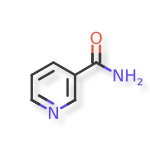
Cl.NC(=O)C1=CC=CN=C1
InChI
InChIKey=OBLVPWTUALCMGD-UHFFFAOYSA-N
InChI=1S/C6H6N2O.ClH/c7-6(9)5-2-1-3-8-4-5;/h1-4H,(H2,7,9);1H
| Molecular Formula | ClH |
| Molecular Weight | 36.461 |
| Charge | 0 |
| Count |
|
| Stereochemistry | ACHIRAL |
| Additional Stereochemistry | No |
| Defined Stereocenters | 0 / 0 |
| E/Z Centers | 0 |
| Optical Activity | NONE |
| Molecular Formula | C6H6N2O |
| Molecular Weight | 122.1246 |
| Charge | 0 |
| Count |
|
| Stereochemistry | ACHIRAL |
| Additional Stereochemistry | No |
| Defined Stereocenters | 0 / 0 |
| E/Z Centers | 0 |
| Optical Activity | NONE |
DescriptionCurator's Comment: Description was created based on several sources, including
https://www.ncbi.nlm.nih.gov/pubmed/4244068
Curator's Comment: Description was created based on several sources, including
https://www.ncbi.nlm.nih.gov/pubmed/4244068
Niacinamide, known as nicotinamide, is an important compound functioning as a component of the coenzyme NAD. Its primary significance is in the prevention and/or cure of blacktongue and pellagra. Pellagra is a nutritional disease that occurs due to insufficient dietary amounts of vitamin B3 or the chemical it is made from (tryptophan). Symptoms of pellagra include skin disease, diarrhea, dementia, and depression. In addition, was experiments, revealed, that niacinamide hydroiodide might have role in ophthalmology and parenteral use of niacinamide hydroiodide can treat arteriosclerotic syndromes.
CNS Activity
Approval Year
Targets
| Primary Target | Pharmacology | Condition | Potency |
|---|---|---|---|
Target ID: CHEMBL4462 |
11.0 µM [IC50] | ||
Target ID: CHEMBL4506 |
100.0 µM [IC50] | ||
Target ID: CHEMBL4461 |
14.0 µM [IC50] |
Conditions
| Condition | Modality | Targets | Highest Phase | Product |
|---|---|---|---|---|
| Primary | Unknown Approved UseUnknown |
|||
| Primary | Unknown Approved UseUnknown |
|||
| Preventing | Niacinamide Approved UseTreatment and prevention of niacin deficiency, and certain conditions related to niacin deficiency such as pellagra. |
Cmax
| Value | Dose | Co-administered | Analyte | Population |
|---|---|---|---|---|
213.2 ng/mL |
500 mg single, oral dose: 500 mg route of administration: Oral experiment type: SINGLE co-administered: LOVASTATIN |
NIACINAMIDE plasma | Homo sapiens population: HEALTHY age: ADULT sex: FEMALE / MALE food status: FASTED |
AUC
| Value | Dose | Co-administered | Analyte | Population |
|---|---|---|---|---|
2669 ng × h/mL |
500 mg single, oral dose: 500 mg route of administration: Oral experiment type: SINGLE co-administered: LOVASTATIN |
NIACINAMIDE plasma | Homo sapiens population: HEALTHY age: ADULT sex: FEMALE / MALE food status: FASTED |
T1/2
| Value | Dose | Co-administered | Analyte | Population |
|---|---|---|---|---|
15.9 h |
500 mg single, oral dose: 500 mg route of administration: Oral experiment type: SINGLE co-administered: LOVASTATIN |
NIACINAMIDE plasma | Homo sapiens population: HEALTHY age: ADULT sex: FEMALE / MALE food status: FASTED |
Doses
| Dose | Population | Adverse events |
|---|---|---|
6 g single, oral Highest studied dose |
healthy, 27-45 |
Other AEs: Vomiting... |
80 mg/kg 1 times / day multiple, oral MTD Dose: 80 mg/kg, 1 times / day Route: oral Route: multiple Dose: 80 mg/kg, 1 times / day Sources: |
unhealthy, 41-82 |
DLT: Nausea... Disc. AE: Nausea, Toxicity renal... Dose limiting toxicities: Nausea (severe, 17.5%) AEs leading todiscontinuation/dose reduction: Nausea (20%) Sources: Toxicity renal (2.5%) |
80 mg/kg 1 times / day multiple, oral MTD Dose: 80 mg/kg, 1 times / day Route: oral Route: multiple Dose: 80 mg/kg, 1 times / day Sources: |
unhealthy, 54-81 |
|
100 mg/kg 1 times / day multiple, oral Highest studied dose Dose: 100 mg/kg, 1 times / day Route: oral Route: multiple Dose: 100 mg/kg, 1 times / day Sources: |
unhealthy, 75-82 |
DLT: Hypotension, Oliguria... Disc. AE: Nausea, Vomiting... Dose limiting toxicities: Hypotension (severe, 50%) AEs leading toOliguria (50%) discontinuation/dose reduction: Nausea (severe, 50%) Sources: Vomiting (severe, 50%) |
AEs
| AE | Significance | Dose | Population |
|---|---|---|---|
| Vomiting | 6 g single, oral Highest studied dose |
healthy, 27-45 |
|
| Toxicity renal | 2.5% Disc. AE |
80 mg/kg 1 times / day multiple, oral MTD Dose: 80 mg/kg, 1 times / day Route: oral Route: multiple Dose: 80 mg/kg, 1 times / day Sources: |
unhealthy, 41-82 |
| Nausea | 20% Disc. AE |
80 mg/kg 1 times / day multiple, oral MTD Dose: 80 mg/kg, 1 times / day Route: oral Route: multiple Dose: 80 mg/kg, 1 times / day Sources: |
unhealthy, 41-82 |
| Nausea | severe, 17.5% DLT |
80 mg/kg 1 times / day multiple, oral MTD Dose: 80 mg/kg, 1 times / day Route: oral Route: multiple Dose: 80 mg/kg, 1 times / day Sources: |
unhealthy, 41-82 |
| Oliguria | 50% DLT |
100 mg/kg 1 times / day multiple, oral Highest studied dose Dose: 100 mg/kg, 1 times / day Route: oral Route: multiple Dose: 100 mg/kg, 1 times / day Sources: |
unhealthy, 75-82 |
| Hypotension | severe, 50% DLT |
100 mg/kg 1 times / day multiple, oral Highest studied dose Dose: 100 mg/kg, 1 times / day Route: oral Route: multiple Dose: 100 mg/kg, 1 times / day Sources: |
unhealthy, 75-82 |
| Nausea | severe, 50% Disc. AE |
100 mg/kg 1 times / day multiple, oral Highest studied dose Dose: 100 mg/kg, 1 times / day Route: oral Route: multiple Dose: 100 mg/kg, 1 times / day Sources: |
unhealthy, 75-82 |
| Vomiting | severe, 50% Disc. AE |
100 mg/kg 1 times / day multiple, oral Highest studied dose Dose: 100 mg/kg, 1 times / day Route: oral Route: multiple Dose: 100 mg/kg, 1 times / day Sources: |
unhealthy, 75-82 |
Overview
| CYP3A4 | CYP2C9 | CYP2D6 | hERG |
|---|---|---|---|
OverviewOther
| Other Inhibitor | Other Substrate | Other Inducer |
|---|---|---|
Drug as perpetrator
| Target | Modality | Activity | Metabolite | Clinical evidence |
|---|---|---|---|---|
Page: 3.0 |
yes [Ki 13000 uM] | |||
Page: 3.0 |
yes [Ki 13000 uM] | |||
Page: 3.0 |
yes [Ki 3800 uM] | |||
Page: 3.0 |
yes [Ki 44000 uM] | |||
Page: 3.0 |
yes [Ki 51000 uM] | |||
| yes | ||||
| yes |
Drug as victim
| Target | Modality | Activity | Metabolite | Clinical evidence |
|---|---|---|---|---|
| no | ||||
| no | ||||
| yes |
PubMed
| Title | Date | PubMed |
|---|---|---|
| Fast hydride transfer in proton-translocating transhydrogenase revealed in a rapid mixing continuous flow device. | 2001-11-30 |
|
| Identification of a new class of molecules, the arachidonyl amino acids, and characterization of one member that inhibits pain. | 2001-11-16 |
|
| Contributions of valine-292 in the nicotinamide binding site of liver alcohol dehydrogenase and dynamics to catalysis. | 2001-10-23 |
|
| Molecular targets for cannabidiol and its synthetic analogues: effect on vanilloid VR1 receptors and on the cellular uptake and enzymatic hydrolysis of anandamide. | 2001-10 |
|
| Behavioral evidence for the interaction of oleamide with multiple neurotransmitter systems. | 2001-10 |
|
| NAD+-dependent DNA ligase encoded by a eukaryotic virus. | 2001-09-28 |
|
| Mycobacterium tuberculosis lipoamide dehydrogenase is encoded by Rv0462 and not by the lpdA or lpdB genes. | 2001-09-25 |
|
| In vitro and in vivo inhibition of telomerase activity from Chinese hamster V79 cells. | 2001-09-21 |
|
| 13C NMR analysis of electrostatic interactions between NAD+ and active site residues of UDP-galactose 4-epimerase: implications for the activation induced by uridine nucleotides. | 2001-09-18 |
|
| Lipopolysaccharide downregulates fatty acid amide hydrolase expression and increases anandamide levels in human peripheral lymphocytes. | 2001-09-15 |
|
| Oxidation of NADH by chloramines and chloramides and its activation by iodide and by tertiary amines. | 2001-09-15 |
|
| Significance of interferon-gamma in coronary artery bypass surgery. | 2001-09-11 |
|
| Effect of nicotinamide on the properties of aqueous HPMC solutions. | 2001-09-11 |
|
| Fatty acid amide hydrolase: biochemistry, pharmacology, and therapeutic possibilities for an enzyme hydrolyzing anandamide, 2-arachidonoylglycerol, palmitoylethanolamide, and oleamide. | 2001-09-01 |
|
| A dinucleotide repeat polymorphism at the poly(ADP-ribose) polymerase gene is not associated with predisposition to type 1 diabetes in French Caucasians. | 2001-09 |
|
| Prospects for predicting and stopping the development of type 1 of diabetes. | 2001-09 |
|
| A possible role of lipoxygenase in the activation of vanilloid receptors by anandamide in the guinea-pig bronchus. | 2001-09 |
|
| Backbone dynamics in dihydrofolate reductase complexes: role of loop flexibility in the catalytic mechanism. | 2001-08-21 |
|
| Nicotinamide adenine dinucleotide (NAD) and its metabolites inhibit T lymphocyte proliferation: role of cell surface NAD glycohydrolase and pyrophosphatase activities. | 2001-08-15 |
|
| Palmitoylethanolamide inhibits the expression of fatty acid amide hydrolase and enhances the anti-proliferative effect of anandamide in human breast cancer cells. | 2001-08-15 |
|
| Cannabinoid receptors are absent in insects. | 2001-08-06 |
|
| Ca(2+)-calmodulin antagonist chlorpromazine and poly(ADP-ribose) polymerase modulators 4-aminobenzamide and nicotinamide influence hepatic expression of BCL-XL and P53 and protect against acetaminophen-induced programmed and unprogrammed cell death in mice. | 2001-08-01 |
|
| Psychrophilic valine dehydrogenase of the antarctic psychrophile, Cytophaga sp. KUC-1: purification, molecular characterization and expression. | 2001-08 |
|
| Increased plasma tryptophan in HIV-infected patients treated with pharmacologic doses of nicotinamide. | 2001-07-13 |
|
| Anandamide degradation and N-acylethanolamines level in wild-type and CB1 cannabinoid receptor knockout mice of different ages. | 2001-07 |
|
| Allosteric activation of pyruvate kinase via NAD+ in rat liver cells. | 2001-07 |
|
| Characterization of poly(ADP-ribose)polymerase from Crithidia fasciculata: enzyme inhibition by beta-lapachone. | 2001-07 |
|
| An NMR-based metabonomic approach to the investigation of coelomic fluid biochemistry in earthworms under toxic stress. | 2001-06-29 |
|
| alpha-Keto heterocycle inhibitors of fatty acid amide hydrolase: carbonyl group modification and alpha-substitution. | 2001-06-18 |
|
| Erythromycin biosynthesis. The 4-pro-S hydride of NADPH is utilized for ketoreduction by both module 5 and module 6 of the 6-deoxyerythronolide B synthase. | 2001-06-18 |
|
| Characterization of multicomponent monosaccharide solutions using an enzyme-based sensor array. | 2001-06-15 |
|
| Progesterone up-regulates anandamide hydrolase in human lymphocytes: role of cytokines and implications for fertility. | 2001-06-15 |
|
| Molecularly imprinted polymers from nicotinamide and its positional isomers. | 2001-06-08 |
|
| Probing catalysis by Escherichia coli dTDP-glucose-4,6-dehydratase: identification and preliminary characterization of functional amino acid residues at the active site. | 2001-06-05 |
|
| [Effect of feeding with a poisonous mushroom Clitocybe acromelalga on the metabolism of tryptophan-niacin in rats]. | 2001-06 |
|
| Effects of dietary pyrazinamide, an antituberculosis agent, on the metabolism of tryptophan to niacin and of tryptophan to serotonin in rats. | 2001-06 |
|
| Delayed multidose treatment with nicotinamide extends the degree and duration of neuroprotection by reducing infarction and improving behavioral scores up to two weeks following transient focal cerebral ischemia in Wistar rats. | 2001-06 |
|
| [Ring cleavage of N-arylpyridinium salts by nucleophiles--regioselectivity and stereochemistry of the products. 2]. | 2001-06 |
|
| The structure of Escherichia coli nitroreductase complexed with nicotinic acid: three crystal forms at 1.7 A, 1.8 A and 2.4 A resolution. | 2001-05-25 |
|
| Antinociceptive activity of the endogenous fatty acid amide, palmitylethanolamide. | 2001-05-11 |
|
| Dietary vitamin K1 requirement and comparison of biopotency of different vitamin K sources for young turkeys. | 2001-05 |
|
| Enhanced maturation of porcine neonatal pancreatic cell clusters with growth factors fails to improve transplantation outcome. | 2001-04-27 |
|
| Elevation of blood NAD level after moderate exercise in young women and mice. | 2001-04 |
|
| Dose-dependent prophylactic effect of nicorandil, an ATP-sensitive potassium channel opener, on intra-operative myocardial ischaemia in patients undergoing major abdominal surgery. | 2001-03 |
|
| Evolution of the aldose reductase-related gecko eye lens protein rhoB-crystallin: a sheep in wolf's clothing. | 2001-03 |
|
| Lessons to be learned from studying Vibrio cholerae in model systems. | 2001 |
|
| Induction of oxidative stress by homocyst(e)ine impairs endothelial function. | 2001 |
|
| Prevention of cyclophosphamide-induced accelerated diabetes in the NOD mouse by nicotinamide or a soy protein-based infant formula. | 2001 |
|
| Update on major trials for the prevention of type 1 diabetes mellitus: the American Diabetes Prevention Trial (DPT-1) and the European Nicotinamide Diabetes Intervention Trial (ENDIT). | 2001 |
|
| The nitrilase superfamily: classification, structure and function. | 2001 |
Patents
Sample Use Guides
For mild vitamin B3 deficiency, niacin or niacinamide 50-100 mg per day is used. For pellagra in adults, niacin or niacinamide 300-500 mg daily is given in divided doses. For pellagra in children, niacin or niacinamide 100-300 mg daily is given in divided doses. For Hartnup disease, niacin or niacinamide 50-200 mg daily.
Route of Administration:
Oral
| Substance Class |
Chemical
Created
by
admin
on
Edited
Mon Mar 31 18:03:49 GMT 2025
by
admin
on
Mon Mar 31 18:03:49 GMT 2025
|
| Record UNII |
4D16EOF1QW
|
| Record Status |
Validated (UNII)
|
| Record Version |
|
-
Download
| Name | Type | Language | ||
|---|---|---|---|---|
|
Common Name | English | ||
|
Preferred Name | English | ||
|
Systematic Name | English | ||
|
Systematic Name | English |
| Code System | Code | Type | Description | ||
|---|---|---|---|---|---|
|
DBSALT002262
Created by
admin on Mon Mar 31 18:03:49 GMT 2025 , Edited by admin on Mon Mar 31 18:03:49 GMT 2025
|
PRIMARY | |||
|
4D16EOF1QW
Created by
admin on Mon Mar 31 18:03:49 GMT 2025 , Edited by admin on Mon Mar 31 18:03:49 GMT 2025
|
PRIMARY | |||
|
91408
Created by
admin on Mon Mar 31 18:03:49 GMT 2025 , Edited by admin on Mon Mar 31 18:03:49 GMT 2025
|
PRIMARY | |||
|
DTXSID00179982
Created by
admin on Mon Mar 31 18:03:49 GMT 2025 , Edited by admin on Mon Mar 31 18:03:49 GMT 2025
|
PRIMARY | |||
|
25334-23-0
Created by
admin on Mon Mar 31 18:03:49 GMT 2025 , Edited by admin on Mon Mar 31 18:03:49 GMT 2025
|
PRIMARY | |||
|
246-862-3
Created by
admin on Mon Mar 31 18:03:49 GMT 2025 , Edited by admin on Mon Mar 31 18:03:49 GMT 2025
|
PRIMARY |
| Related Record | Type | Details | ||
|---|---|---|---|---|
|
|
PARENT -> SALT/SOLVATE |
| Related Record | Type | Details | ||
|---|---|---|---|---|
|
|
ACTIVE MOIETY |