


Details
| Stereochemistry | ABSOLUTE |
| Molecular Formula | 2C7H15NO3.C4H4O6.2H |
| Molecular Weight | 472.4846 |
| Optical Activity | UNSPECIFIED |
| Defined Stereocenters | 4 / 6 |
| E/Z Centers | 0 |
| Charge | 0 |
SHOW SMILES / InChI
SMILES
[H+].[H+].O[C@H]([C@@H](O)C([O-])=O)C([O-])=O.C[N+](C)(C)C[C@H](O)CC([O-])=O.C[N+](C)(C)C[C@H](O)CC([O-])=O
InChI
InChIKey=GADIJPCDIWZEMB-BTNVMJJCSA-N
InChI=1S/2C7H15NO3.C4H6O6/c2*1-8(2,3)5-6(9)4-7(10)11;5-1(3(7)8)2(6)4(9)10/h2*6,9H,4-5H2,1-3H3;1-2,5-6H,(H,7,8)(H,9,10)/t2*6-;1-,2-/m111/s1
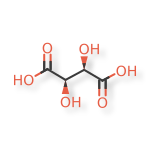
| Molecular Formula | C4H6O6 |
| Molecular Weight | 150.0868 |
| Charge | 0 |
| Count |
|
| Stereochemistry | ABSOLUTE |
| Additional Stereochemistry | |
| Defined Stereocenters | 2 / 2 |
| E/Z Centers | 0 |
| Optical Activity | UNSPECIFIED |
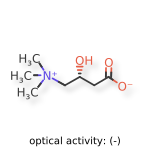
| Molecular Formula | C7H15NO3 |
| Molecular Weight | 161.1989 |
| Charge | 0 |
| Count |
|
| Stereochemistry | EPIMERIC |
| Additional Stereochemistry | |
| Defined Stereocenters | 1 / 2 |
| E/Z Centers | 0 |
| Optical Activity | UNSPECIFIED |
Levocarnitine propionate or Propionyl L-carnitine (PLC) is the propionyl ester of L-carnitine. Propionyl-L-carnitine stimulates energy production in ischaemic muscles by increasing citric acid cycle flux and stimulating pyruvate dehydrogenase activity. The free radical scavenging activity of the drug may also be beneficial. Propionyl-L-carnitine improves coagulative fibrinolytic homeostasis in vasal endothelium and positively affects blood viscosity. It exhibits a high affinity for the muscle enzyme, carnitine acyl transferase, and as such readily converts into propionyl-CoA and free carnitine. Most studies of the therapeutic use of PLC are focused on the prevention and treatment of ischemic heart disease, congestive heart failure, hypertrophic heart disease, and peripheral arterial disease. PLC is marketed under the trade name Dromos®. It is indicated for patients with peripheral arterial occlusive disorders and for exercise intolerance enhancement in patients with chronic congestive heart failure. Dromos is marketed in Italy.
Originator
Sources: www.ncbi.nlm.nih.gov/pubmed/16857830http://adisinsight.springer.com/drugs/800003253
Approval Year
Targets
| Primary Target | Pharmacology | Condition | Potency |
|---|---|---|---|
Target ID: P50416 Gene ID: 1374.0 Gene Symbol: CPT1A Target Organism: Homo sapiens (Human) |
|||
Target ID: P23786 Gene ID: 1376.0 Gene Symbol: CPT2 Target Organism: Homo sapiens (Human) |
|||
Target ID: P43155 Gene ID: 1384.0 Gene Symbol: CRAT Target Organism: Homo sapiens (Human) |
|||
Target ID: O43772 Gene ID: 788.0 Gene Symbol: SLC25A20 Target Organism: Homo sapiens (Human) |
|||
Target ID: WP408 Sources: DOI: 10.1201/b17092-12 |
|||
Target ID: CHEMBL2216739 |
|||
Target ID: WP623 Sources: DOI: 10.1201/b17092-12 |
Conditions
| Condition | Modality | Targets | Highest Phase | Product |
|---|---|---|---|---|
| Primary | CARNITOR Approved UseCARNITOR (levocarnitine) is indicated in the treatment of primary systemic carnitine
deficiency. Launch Date1985 |
|||
| Primary | Dromos Approved UseIt is indicated for patients with peripheral arterial occlusive disorders and for exercise intolerance enchancement in patients with chronic congestive heart failure. |
|||
| Primary | Unknown Approved UseUnknown |
|||
| Primary | Unknown Approved UseUnknown |
Cmax
| Value | Dose | Co-administered | Analyte | Population |
|---|---|---|---|---|
79.2 nmol/mL EXPERIMENT https://pubmed.ncbi.nlm.nih.gov/7658356 |
1980 mg 2 times / day multiple, oral dose: 1980 mg route of administration: Oral experiment type: MULTIPLE co-administered: |
LEVOCARNITINE plasma | Homo sapiens population: HEALTHY age: ADULT sex: MALE food status: UNKNOWN |
|
80.3 nmol/mL EXPERIMENT https://pubmed.ncbi.nlm.nih.gov/7658356 |
2 g 2 times / day multiple, oral dose: 2 g route of administration: Oral experiment type: MULTIPLE co-administered: |
LEVOCARNITINE plasma | Homo sapiens population: HEALTHY age: ADULT sex: MALE food status: UNKNOWN |
AUC
| Value | Dose | Co-administered | Analyte | Population |
|---|---|---|---|---|
771.4 nmol × h/mL EXPERIMENT https://pubmed.ncbi.nlm.nih.gov/7658356 |
1980 mg 2 times / day multiple, oral dose: 1980 mg route of administration: Oral experiment type: MULTIPLE co-administered: |
LEVOCARNITINE plasma | Homo sapiens population: HEALTHY age: ADULT sex: MALE food status: UNKNOWN |
|
779.9 nmol × h/mL EXPERIMENT https://pubmed.ncbi.nlm.nih.gov/7658356 |
2 g 2 times / day multiple, oral dose: 2 g route of administration: Oral experiment type: MULTIPLE co-administered: |
LEVOCARNITINE plasma | Homo sapiens population: HEALTHY age: ADULT sex: MALE food status: UNKNOWN |
PubMed
| Title | Date | PubMed |
|---|---|---|
| Inflammatory and fibrotic processes are involved in the cardiotoxic effect of sunitinib: Protective role of L-carnitine. | 2016-01-22 |
|
| Inhibition of mitochondrial carnitine/acylcarnitine transporter by H(2)O(2): molecular mechanism and possible implication in pathophysiology. | 2013-04-25 |
|
| L-Carnitine rescues ketamine-induced attenuated heart rate and MAPK (ERK) activity in zebrafish embryos. | 2012-04 |
|
| Downregulation of oxidative and nitrosative apoptotic signaling by L-carnitine in Ifosfamide-induced Fanconi syndrome rat model. | 2012 |
|
| Inhibition of gene expression of organic cation/carnitine transporter and antioxidant enzymes in oxazaphosphorines-induced acute cardiomyopathic rat models. | 2012 |
|
| The protection role of heat shock protein 70 (HSP-70) in the testes of cadmium-exposed rats. | 2012 |
|
| Bezafibrate upregulates carnitine palmitoyltransferase II expression and promotes mitochondrial energy crisis dissipation in fibroblasts of patients with influenza-associated encephalopathy. | 2011-11 |
|
| The disruption of L-carnitine metabolism by aluminum toxicity and oxidative stress promotes dyslipidemia in human astrocytic and hepatic cells. | 2011-06-24 |
|
| Selective regulation of cardiac organic cation transporter novel type 2 (OCTN2) in dilated cardiomyopathy. | 2011-06 |
|
| L-carnitine protects against nickel-induced neurotoxicity by maintaining mitochondrial function in Neuro-2a cells. | 2011-05-15 |
|
| Transcellular movement of hydroxyurea is mediated by specific solute carrier transporters. | 2011-04 |
|
| Inhibition of gene expression of heart fatty acid binding protein and organic cation/carnitine transporter in doxorubicin cardiomyopathic rat model. | 2010-08-25 |
|
| The plasma carnitine concentration regulates renal OCTN2 expression and carnitine transport in rats. | 2010-06-10 |
|
| Valproate-induced hyperammonemic encephalopathy, rapidly improved by i.v. carnitine and glucose/thiamine. | 2010-06 |
|
| Integration of metabolomics and transcriptomics data to aid biomarker discovery in type 2 diabetes. | 2010-05 |
|
| Comparative effects of captopril and l-carnitine on blood pressure and antioxidant enzyme gene expression in the heart of spontaneously hypertensive rats. | 2010-04-25 |
|
| Vincristine-induced peripheral neuropathy in a neonate with congenital acute lymphoblastic leukemia. | 2010-04 |
|
| Inhibition of hepatic carnitine palmitoyl-transferase I (CPT IA) by valproyl-CoA as a possible mechanism of valproate-induced steatosis. | 2010-03-01 |
|
| Increased urinary losses of carnitine and decreased intramitochondrial coenzyme A in gentamicin-induced acute renal failure in rats. | 2010-01 |
|
| Identification of a novel organic anion transporter mediating carnitine transport in mouse liver and kidney. | 2010 |
|
| Organic cation/carnitine transporter OCTN3 is present in astrocytes and is up-regulated by peroxisome proliferators-activator receptor agonist. | 2009-12 |
|
| Peroxisome proliferator-activated receptor alpha plays a crucial role in L-carnitine anti-apoptosis effect in renal tubular cells. | 2009-10 |
|
| Interaction between pivaloylcarnitine and L-carnitine transport into L6 cells overexpressing hOCTN2. | 2009-08-14 |
|
| Inactivation by omeprazole of the carnitine transporter (OCTN2) reconstituted in liposomes. | 2009-05-15 |
|
| Pharmacological analysis demonstrates dramatic alteration of D1 dopamine receptor neuronal distribution in the rat analog of L-DOPA-induced dyskinesia. | 2009-04-15 |
|
| L-carnitine mediates protection against DNA damage in lymphocytes of aged rats. | 2009-04 |
|
| Progression of diethylnitrosamine-induced hepatic carcinogenesis in carnitine-depleted rats. | 2009-03-21 |
|
| The carnitine transporter SLC22A5 is not a general drug transporter, but it efficiently translocates mildronate. | 2009-02 |
|
| Carnitine deficiency: a possible risk factor in paracetamol hepatotoxicity. | 2009-02 |
|
| Carnitine deficiency aggravates carboplatin nephropathy through deterioration of energy status, oxidant/anti-oxidant balance, and inflammatory endocoids. | 2008-12-05 |
|
| High concentrations of stavudine impair fatty acid oxidation without depleting mitochondrial DNA in cultured rat hepatocytes. | 2008-06 |
|
| Role of Na+/L-carnitine transporter (OCTN2) in renal handling of pivaloylcarnitine and valproylcarnitine formed during pivalic acid-containing prodrugs and valproic acid treatment. | 2008 |
|
| Mechanism of the inhibitory effect of zwitterionic drugs (levofloxacin and grepafloxacin) on carnitine transporter (OCTN2) in Caco-2 cells. | 2006-11 |
|
| Acute renal failure due to phenazopyridine (Pyridium) overdose: case report and review of the literature. | 2006-11 |
|
| L-carnitine ameliorates doxorubicin-induced nephrotic syndrome in rats. | 2006-08 |
|
| Involvement of recognition and interaction of carnitine transporter in the decrease of L-carnitine concentration induced by pivalic acid and valproic acid. | 2006-08 |
|
| Positive regulation of hepatic carnitine palmitoyl transferase 1A (CPT1A) activities by soy isoflavones and L-carnitine. | 2006-03 |
|
| Effects of doxorubicin-containing chemotherapy and a combination with L-carnitine on oxidative metabolism in patients with non-Hodgkin lymphoma. | 2006-02 |
|
| Cardio-protective effects of carnitine in streptozotocin-induced diabetic rats. | 2006-01-19 |
|
| Pivotal role of Harakiri in the induction and prevention of gentamicin-induced hearing loss. | 2005-11-01 |
|
| Lethal cardiomyopathy in epidermolysis bullosa associated with amitriptyline. | 2005-08 |
|
| Effect of L-carnitine supplementation on acute valproate intoxication. | 1996-07 |
|
| Muscle carnitine deficiency associated with zidovudine-induced mitochondrial myopathy. | 1994-10 |
|
| Effect of L-carnitine on the zidovudine-induced destruction of human myotubes. Part I: L-carnitine prevents the myotoxicity of AZT in vitro. | 1994-07 |
|
| Zidovudine-induced mitochondrial myopathy is associated with muscle carnitine deficiency and lipid storage. | 1994-04 |
|
| Modulation of ethanol-mediated CYP2E1 induction by clofibrate and L-carnitine in rat liver. | 1993-12 |
|
| Echocardiographic assessment of anthracycline cardiotoxicity during different therapeutic regimens. | 1987 |
|
| Carnitine protection against adriamycin-induced cardiomyopathy in rats. | 1986-02-10 |
|
| Effect of administration of carnitine on the severity of myocardial infarction induced by isoproterenol in rats. | 1986-02 |
|
| Antagonism of doxorubicin cardiotoxicity by carnitine is specific of the L-diasteroisomer. | 1981-05 |
Patents
Sample Use Guides
Adults: The recommended oral dosage for adults is 990 mg two or three times a day using the 330 mg tablets, depending on clinical response. Infants and children: The recommended oral dosage for infants and children is between 50 and 100 mg/kg/day in divided doses, with a maximum of 3 g/day. Dosage should begin at 50 mg/kg/day.
Route of Administration:
Oral
| Substance Class |
Chemical
Created
by
admin
on
Edited
Mon Mar 31 18:26:46 GMT 2025
by
admin
on
Mon Mar 31 18:26:46 GMT 2025
|
| Record UNII |
4D8F2Q45LQ
|
| Record Status |
Validated (UNII)
|
| Record Version |
|
-
Download
| Name | Type | Language | ||
|---|---|---|---|---|
|
Preferred Name | English | ||
|
Common Name | English | ||
|
Common Name | English | ||
|
Common Name | English | ||
|
Common Name | English | ||
|
Common Name | English | ||
|
Systematic Name | English | ||
|
Systematic Name | English | ||
|
Common Name | English | ||
|
Systematic Name | English | ||
|
Systematic Name | English | ||
|
Systematic Name | English | ||
|
Code | English |
| Code System | Code | Type | Description | ||
|---|---|---|---|---|---|
|
4D8F2Q45LQ
Created by
admin on Mon Mar 31 18:26:46 GMT 2025 , Edited by admin on Mon Mar 31 18:26:46 GMT 2025
|
PRIMARY | |||
|
1364375
Created by
admin on Mon Mar 31 18:26:46 GMT 2025 , Edited by admin on Mon Mar 31 18:26:46 GMT 2025
|
PRIMARY | RxNorm | ||
|
SUB129663
Created by
admin on Mon Mar 31 18:26:46 GMT 2025 , Edited by admin on Mon Mar 31 18:26:46 GMT 2025
|
PRIMARY | |||
|
C1505
Created by
admin on Mon Mar 31 18:26:46 GMT 2025 , Edited by admin on Mon Mar 31 18:26:46 GMT 2025
|
CONCEPT | Dietary Supplement | ||
|
935
Created by
admin on Mon Mar 31 18:26:46 GMT 2025 , Edited by admin on Mon Mar 31 18:26:46 GMT 2025
|
PRIMARY | |||
|
56973705
Created by
admin on Mon Mar 31 18:26:46 GMT 2025 , Edited by admin on Mon Mar 31 18:26:46 GMT 2025
|
PRIMARY | |||
|
100000155608
Created by
admin on Mon Mar 31 18:26:46 GMT 2025 , Edited by admin on Mon Mar 31 18:26:46 GMT 2025
|
PRIMARY | |||
|
DTXSID501018114
Created by
admin on Mon Mar 31 18:26:46 GMT 2025 , Edited by admin on Mon Mar 31 18:26:46 GMT 2025
|
PRIMARY | |||
|
C80057
Created by
admin on Mon Mar 31 18:26:46 GMT 2025 , Edited by admin on Mon Mar 31 18:26:46 GMT 2025
|
PRIMARY | NCIT | ||
|
4D8F2Q45LQ
Created by
admin on Mon Mar 31 18:26:46 GMT 2025 , Edited by admin on Mon Mar 31 18:26:46 GMT 2025
|
PRIMARY | |||
|
36687-82-8
Created by
admin on Mon Mar 31 18:26:46 GMT 2025 , Edited by admin on Mon Mar 31 18:26:46 GMT 2025
|
PRIMARY |
| Related Record | Type | Details | ||
|---|---|---|---|---|
|
|
PARENT -> SALT/SOLVATE |
|
||
|
|
PARENT -> SALT/SOLVATE |
|
| Related Record | Type | Details | ||
|---|---|---|---|---|
|
|
ACTIVE MOIETY |
|