


Details
| Stereochemistry | ABSOLUTE |
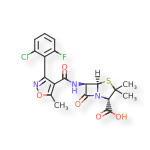
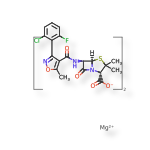
| Molecular Formula | 2C19H16ClFN3O5S.Mg.8H2O |
| Molecular Weight | 1074.155 |
| Optical Activity | UNSPECIFIED |
| Defined Stereocenters | 6 / 6 |
| E/Z Centers | 0 |
| Charge | 0 |
SHOW SMILES / InChI
SMILES
O.O.O.O.O.O.O.O.[Mg++].CC1=C(C(=O)N[C@H]2[C@H]3SC(C)(C)[C@@H](N3C2=O)C([O-])=O)C(=NO1)C4=C(F)C=CC=C4Cl.CC5=C(C(=O)N[C@H]6[C@H]7SC(C)(C)[C@@H](N7C6=O)C([O-])=O)C(=NO5)C8=C(F)C=CC=C8Cl
InChI
InChIKey=KEPODGZDCGXBMJ-PQYXWZOCSA-L
InChI=1S/2C19H17ClFN3O5S.Mg.8H2O/c2*1-7-10(12(23-29-7)11-8(20)5-4-6-9(11)21)15(25)22-13-16(26)24-14(18(27)28)19(2,3)30-17(13)24;;;;;;;;;/h2*4-6,13-14,17H,1-3H3,(H,22,25)(H,27,28);;8*1H2/q;;+2;;;;;;;;/p-2/t2*13-,14+,17-;;;;;;;;;/m11........./s1
| Molecular Formula | Mg |
| Molecular Weight | 24.305 |
| Charge | 2 |
| Count |
|
| Stereochemistry | ACHIRAL |
| Additional Stereochemistry | No |
| Defined Stereocenters | 0 / 0 |
| E/Z Centers | 0 |
| Optical Activity | NONE |
| Molecular Formula | H2O |
| Molecular Weight | 18.0153 |
| Charge | 0 |
| Count |
|
| Stereochemistry | ACHIRAL |
| Additional Stereochemistry | No |
| Defined Stereocenters | 0 / 0 |
| E/Z Centers | 0 |
| Optical Activity | NONE |
| Molecular Formula | C19H17ClFN3O5S |
| Molecular Weight | 453.872 |
| Charge | 0 |
| Count |
|
| Stereochemistry | ABSOLUTE |
| Additional Stereochemistry | No |
| Defined Stereocenters | 3 / 3 |
| E/Z Centers | 0 |
| Optical Activity | UNSPECIFIED |
DescriptionCurator's Comment: description was created based on several sources, including
https://www.ncbi.nlm.nih.gov/pubmed/23542420
Curator's Comment: description was created based on several sources, including
https://www.ncbi.nlm.nih.gov/pubmed/23542420
Flucloxacillin is an isoxazolyl penicillin of the β-lactam group of antibiotics, which exerts a bactericidal effect upon many Gram-positive organisms including β-lactamase-producing staphylococci and streptococci. While no longer used in the United States, Flucloxacillin is supplied under a variety of trade names in other countries, including Floxapen, Flopen, Staphylex. Floxapen is indicated for the treatment of infections due to sensitive Gram-positive organisms, including β-lactamase-producing staphylococci and streptococci. Typical indications including, skin and soft tissue infections; respiratory tract infections; other infections caused by floxapen-sensitive organisms, like example, osteomyelitis, urinary tract infection, septicaemia, endocarditis. Floxapen is also indicated for use as a prophylactic agent during major surgical procedures when appropriate; for example cardiothoracic and orthopaedic surgery. Flucloxacillin, by its action on the synthesis of the bacterial wall, exerts a bactericidal effect on streptococci except those of group D (Enterococcus faecalis) staphylococci. It is not active against methicillin-resistant staphylococci. There is evidence that the risk of flucloxacillin induced liver injury is increased in subjects carrying the HLA-B*5701 allele. Despite this strong association, only 1 in 500-1000 carriers will develop liver injury. Consequently, the positive predictive value of testing the HLA-B*5701 allele for liver injury is very low (0.12%) and routine screening for this allele is not recommended. Flucloxacillin diffuses well into most tissue. Specifically, active concentrations of flucloxacillin have been recovered in bones: 11.6 mg/L (compact bone) and 15.6 mg/L (spongy bone), with a mean serum level of 8.9 mg/L. Flucloxacillin diffuses in only small proportion into the cerebrospinal fluid of subjects whose meninges are not inflamed. It is also excreted in small quantities in mother's milk. In normal subjects approximately 10% of the flucloxacillin administered is metabolised to penicilloic acid. The elimination half-life of flucloxacillin is in the order of 53 minutes.
Approval Year
Targets
| Primary Target | Pharmacology | Condition | Potency |
|---|---|---|---|
Target ID: CHEMBL2363021 |
|||
Target ID: CHEMBL2362973 |
Conditions
| Condition | Modality | Targets | Highest Phase | Product |
|---|---|---|---|---|
| Curative | Floxapen Approved UseFloxapen is indicated for the treatment of infections due to sensitive Gram-positive organisms, including β-lactamase-producing staphylococci and streptococci. Typical indications include: Skin and soft tissue infections; Respiratory tract infections; Other infections caused by Floxapen-sensitive organisms, like example, Osteomyelitis, Urinary tract infection, Septicaemia, Endocarditis. Floxapen is also indicated for use as a prophylactic agent during major surgical procedures when appropriate; for example cardiothoracic and orthopaedic surgery. |
|||
| Curative | Floxapen Approved UseFloxapen is indicated for the treatment of infections due to sensitive Gram-positive organisms, including β-lactamase-producing staphylococci and streptococci. Typical indications include: Skin and soft tissue infections; Respiratory tract infections; Other infections caused by Floxapen-sensitive organisms, like example, Osteomyelitis, Urinary tract infection, Septicaemia, Endocarditis. Floxapen is also indicated for use as a prophylactic agent during major surgical procedures when appropriate; for example cardiothoracic and orthopaedic surgery. |
|||
| Curative | Floxapen Approved UseFloxapen is indicated for the treatment of infections due to sensitive Gram-positive organisms, including β-lactamase-producing staphylococci and streptococci. Typical indications include: Skin and soft tissue infections; Respiratory tract infections; Other infections caused by Floxapen-sensitive organisms, like example, Osteomyelitis, Urinary tract infection, Septicaemia, Endocarditis. Floxapen is also indicated for use as a prophylactic agent during major surgical procedures when appropriate; for example cardiothoracic and orthopaedic surgery. |
|||
| Curative | Floxapen Approved UseFloxapen is indicated for the treatment of infections due to sensitive Gram-positive organisms, including β-lactamase-producing staphylococci and streptococci. Typical indications include: Skin and soft tissue infections; Respiratory tract infections; Other infections caused by Floxapen-sensitive organisms, like example, Osteomyelitis, Urinary tract infection, Septicaemia, Endocarditis. Floxapen is also indicated for use as a prophylactic agent during major surgical procedures when appropriate; for example cardiothoracic and orthopaedic surgery. |
PubMed
| Title | Date | PubMed |
|---|---|---|
| Flucloxacillin alone or combined with benzylpenicillin to treat lower limb cellulitis: a randomised controlled trial. | 2005-05 |
|
| The role of antibiotic prophylaxis in clean incised hand injuries: a prospective randomized placebo controlled double blind trial. | 2005-05 |
|
| Staphylococcus aureus bacteremia, Australia. | 2005-04 |
|
| Flucloxacillin-induced aplastic anaemia and liver failure. | 2005-04 |
|
| Bactericidal activity of flucloxacillin against Staphylococcus aureus in primary keratinocyte cultures of lesional and unaffected skin of patients suffering from atopic dermatitis. | 2005-03 |
|
| An isocratic ion exchange HPLC method for the simultaneous determination of flucloxacillin and amoxicillin in a pharmaceutical formulation for injection. | 2005-02-23 |
|
| Quantitative determination method for trace amount of penicillin contaminants in commercially available drug product by HPLC coupled with tandem mass spectrometry. | 2005-02 |
|
| Non-paracetamol drug-induced fulminant hepatic failure among adults in Scotland. | 2005-02 |
|
| Acute osteomyelitis and septic arthritis in children. | 2005-01-27 |
|
| Flucloxacillin associated neutropenia in children treated for bone and joint infections. | 2005-01-27 |
|
| Cutaneous adverse drug reaction to oral chlorphenamine detected with patch testing. | 2005-01 |
|
| Streptococcal necrotising fasciitis from diverse strains of Streptococcus pyogenes in tropical northern Australia: case series and comparison with the literature. | 2004-12-16 |
|
| A randomized clinical trial to compare fleroxacin-rifampicin with flucloxacillin or vancomycin for the treatment of staphylococcal infection. | 2004-11-01 |
|
| Allogenic blood transfusion does not predispose to infection after cardiac surgery. | 2004-11 |
|
| Therapeutic impact of percutaneous spinal biopsy in spinal infection. | 2004-10 |
|
| Activity of nadifloxacin (OPC-7251) and seven other antimicrobial agents against aerobic and anaerobic Gram-positive bacteria isolated from bacterial skin infections. | 2004-10 |
|
| Thoracic spondylitis from a mycotic (Streptococcus pneumoniae) aortic aneurysm: a case report. | 2004-09-01 |
|
| Methicillin-resistant Staphylococcus aureus in Europe, 1999-2002. | 2004-09 |
|
| Osteomyelitis complicating pyomyositis in HIV disease. | 2004-09 |
|
| Determination of certain drugs in binary mixtures formulations by second derivative ratio spectrophotometry and LC. | 2004-09 |
|
| Investigation of microenvironmental factors influencing the longitudinal relaxation times of drugs and other compounds. | 2004-09 |
|
| [Diagnostic image (202). A newborn with subfebrile temperature and skin lesions. Staphylococcal scalded skin syndrome]. | 2004-08-14 |
|
| Acute and clinically relevant drug-induced liver injury: a population based case-control study. | 2004-07 |
|
| Effects of duplicate and screening isolates on surveillance of community and hospital antibiotic resistance. | 2004-07 |
|
| Treatment of bullous impetigo and the staphylococcal scalded skin syndrome in infants. | 2004-06 |
|
| Osteomyelitis of the accessory navicular bone in the foot. A case report. | 2004-06 |
|
| Dermoscopy of tungiasis. | 2004-06 |
|
| Percutaneous closure of interatrial communications in adults - prospective embolism prevention study with two- and three-dimensional echocardiography. | 2004-05-19 |
|
| Modulation of beta-lactam resistance in Staphylococcus aureus by catechins and gallates. | 2004-05 |
|
| [Diagnostic image (185). A man with a pimple on the upper lip. Carbuncle of the upper lip]. | 2004-04-17 |
|
| Is the MIC useful in deciding to treat endocarditis surgically? | 2004-04 |
|
| [Cutaneous nocardiosis as an opportunistic infection]. | 2004-03-13 |
|
| Imported cutaneous diphtheria, United Kingdom. | 2004-03 |
|
| Purpura fulminans due to E. coli septicemia. | 2004-02-16 |
|
| Pharmacokinetics of intravenous flucloxacillin and amoxicillin in neonatal and infant cardiopulmonary bypass surgery. | 2004-02 |
|
| Congenital cyanotic heart disease and headache. | 2004-01-14 |
|
| Panton-valentine leukocidin and staphyloccoccal skin infections in schoolchildren. | 2004-01 |
|
| Early interventions in CF. | 2004 |
|
| [Optimalization of antibiotic policy in the Netherlands. VII. SWAB-guidelines for antimicrobial therapy in adults patients with infectious endocarditis]. | 2003-12-06 |
|
| Unilateral submandibular suppurative sialadenitis in a premature infant. | 2003-12 |
|
| Small colony variants of Staphylococcus aureus and pacemaker-related infection. | 2003-10 |
|
| The use of prophylactic flucloxacillin in treatment of open fractures of the distal phalanx within an accident and emergency department: a double-blind randomized placebo-controlled trial. | 2003-10 |
|
| Methicillin-resistant Staphylococcus aureus in children with cystic fibrosis: An eradication protocol. | 2003-09 |
|
| Necrotising fasciitis in neonates: a multidisciplinary approach. | 2003-08-22 |
|
| The pharmacokinetics of the interstitial space in humans. | 2003-07-30 |
|
| Clinicopathological case 3: pemphigus foliaceus; bullous impetigo; subcorneal pustular dermatoses. | 2003-07 |
|
| A systematic review and meta-analysis of treatments for impetigo. | 2003-06 |
|
| Ringworm causing childhood preseptal cellulitis. | 2003-05 |
|
| [Diagnostic image (128). A boy who refused to walk. Spondylodiscitis LIV-LV]. | 2003-03-01 |
|
| How to calculate clearance of highly protein-bound drugs during continuous venovenous hemofiltration demonstrated with flucloxacillin. | 2003 |
Patents
Sample Use Guides
Usual adult dosage (including elderly patients): Oral - 250 mg four times a day. Osteomyelitis, endocarditis - Up to 8 g daily, in divided doses six to eight hourly.
Usual children's dosage: 2-10 years: half adult dose. Under 2 years: quarter adult dose.
Route of Administration:
Oral
| Substance Class |
Chemical
Created
by
admin
on
Edited
Mon Mar 31 19:14:02 GMT 2025
by
admin
on
Mon Mar 31 19:14:02 GMT 2025
|
| Record UNII |
4Z8782KMVT
|
| Record Status |
Validated (UNII)
|
| Record Version |
|
-
Download
| Name | Type | Language | ||
|---|---|---|---|---|
|
Preferred Name | English | ||
|
Common Name | English | ||
|
Common Name | English | ||
|
Common Name | English | ||
|
Common Name | English | ||
|
Common Name | English | ||
|
Common Name | English |
| Code System | Code | Type | Description | ||
|---|---|---|---|---|---|
|
100000164775
Created by
admin on Mon Mar 31 19:14:02 GMT 2025 , Edited by admin on Mon Mar 31 19:14:02 GMT 2025
|
PRIMARY | |||
|
4Z8782KMVT
Created by
admin on Mon Mar 31 19:14:02 GMT 2025 , Edited by admin on Mon Mar 31 19:14:02 GMT 2025
|
PRIMARY | |||
|
76969488
Created by
admin on Mon Mar 31 19:14:02 GMT 2025 , Edited by admin on Mon Mar 31 19:14:02 GMT 2025
|
PRIMARY | |||
|
SUB179354
Created by
admin on Mon Mar 31 19:14:02 GMT 2025 , Edited by admin on Mon Mar 31 19:14:02 GMT 2025
|
PRIMARY | |||
|
SUB02206MIG
Created by
admin on Mon Mar 31 19:14:02 GMT 2025 , Edited by admin on Mon Mar 31 19:14:02 GMT 2025
|
PRIMARY | |||
|
235825
Created by
admin on Mon Mar 31 19:14:02 GMT 2025 , Edited by admin on Mon Mar 31 19:14:02 GMT 2025
|
PRIMARY | RxNorm |
| Related Record | Type | Details | ||
|---|---|---|---|---|
|
|
PARENT -> SALT/SOLVATE |
|
||
|
ANHYDROUS->SOLVATE |
|
| Related Record | Type | Details | ||
|---|---|---|---|---|
|
IMPURITY -> PARENT |
|
||
|
IMPURITY -> PARENT |
|
||
|
IMPURITY -> PARENT |
|
||
|
IMPURITY -> PARENT |
|

| Related Record | Type | Details | ||
|---|---|---|---|---|
|
|
ACTIVE MOIETY |
|