Details
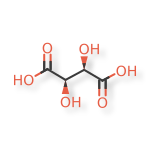
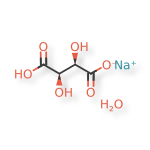
| Stereochemistry | ABSOLUTE |
| Molecular Formula | C4H5O6.Na |
| Molecular Weight | 172.0687 |
| Optical Activity | UNSPECIFIED |
| Defined Stereocenters | 2 / 2 |
| E/Z Centers | 0 |
| Charge | 0 |
SHOW SMILES / InChI
SMILES
[Na+].O[C@H]([C@@H](O)C([O-])=O)C(O)=O
InChI
InChIKey=NKAAEMMYHLFEFN-ZVGUSBNCSA-M
InChI=1S/C4H6O6.Na/c5-1(3(7)8)2(6)4(9)10;/h1-2,5-6H,(H,7,8)(H,9,10);/q;+1/p-1/t1-,2-;/m1./s1
| Molecular Formula | C4H5O6 |
| Molecular Weight | 149.0789 |
| Charge | -1 |
| Count |
|
| Stereochemistry | ABSOLUTE |
| Additional Stereochemistry | No |
| Defined Stereocenters | 2 / 2 |
| E/Z Centers | 0 |
| Optical Activity | UNSPECIFIED |
| Molecular Formula | Na |
| Molecular Weight | 22.98976928 |
| Charge | 1 |
| Count |
|
| Stereochemistry | ACHIRAL |
| Additional Stereochemistry | No |
| Defined Stereocenters | 0 / 0 |
| E/Z Centers | 0 |
| Optical Activity | NONE |
Tartaric acid is found in many plants such as grapes, tamarinds, pineapples, mulberries and so on. Wine lees (called mud in the US), the sediment collected during the fermentation of grapes, contains potassium bitartrate (potassium hydrogen tartrate) as its major component. L-(+)-tartaric acid is an enantiomer of tartaric acid. Twenty five years before the tetrahedral structure for carbon was proposed in 1874 to explain the optical activity and other properties of organic compounds, Louis Pasteur discovered the existence of enantiomerism in tartaric acid. L-(+)-tartaric acid is widely used in food and beverage as acidity regulator with E number E334.
Approval Year
Overview
| CYP3A4 | CYP2C9 | CYP2D6 | hERG |
|---|---|---|---|
OverviewOther
| Other Inhibitor | Other Substrate | Other Inducer |
|---|---|---|
Drug as perpetrator
| Target | Modality | Activity | Metabolite | Clinical evidence |
|---|---|---|---|---|
| no [IC50 >10 uM] | ||||
| no [IC50 >10 uM] | ||||
| no [IC50 >10 uM] | ||||
| no [IC50 >10 uM] | ||||
| no [IC50 >10 uM] | ||||
| no | ||||
| yes [Ki 91 uM] |
Drug as victim
| Target | Modality | Activity | Metabolite | Clinical evidence |
|---|---|---|---|---|
| yes | ||||
| yes |
Tox targets
| Target | Modality | Activity | Metabolite | Clinical evidence |
|---|---|---|---|---|
PubMed
| Title | Date | PubMed |
|---|---|---|
| Large scale gene expression analysis of osteoclastogenesis in vitro and elucidation of NFAT2 as a key regulator. | 2002-10-25 |
|
| Development of high-affinity ligands and photoaffinity labels for the D-fructose transporter GLUT5. | 2002-10-15 |
|
| Synovial macrophage-osteoclast differentiation in inflammatory arthritis. | 2002-10 |
|
| Ectonucleotide diphosphohydrolase activity in Crithidia deanei. | 2002-10 |
|
| Formation of methylantimony species by an aerobic prokaryote: Flavobacterium sp. | 2002-10 |
|
| Effects of sigma(1) receptor ligand MS-377 on D(2) antagonists-induced behaviors. | 2002-10 |
|
| Symmetric and helical growth of polyacetylene fibers over a single copper crystal derived from copper tartrate decomposition. | 2002-09-05 |
|
| Towards atomic resolution with crystals grown in gel: the case of thaumatin seen at room temperature. | 2002-08-01 |
|
| Boronic acid receptors for alpha-hydroxycarboxylates: high affinity of Shinkai's glucose receptor for tartrate. | 2002-07-26 |
|
| Engineering the substrate specificity of D-amino-acid oxidase. | 2002-07-26 |
|
| High frequency of phenotypic deviations in Physcomitrella patens plants transformed with a gene-disruption library. | 2002-07-18 |
|
| Improving the labeling of S-acetyl NHS-MAG(3)-conjugated morpholino oligomers. | 2002-07-18 |
|
| A simple spectrophotometric method for the determination of copper in industrial, environmental, biological and soil samples using 2,5-dimercapto-1,3,4-thiadiazole. | 2002-07 |
|
| Stereoselective radical reactions of some tartaric and glyceric acid derivatives. | 2002-06-13 |
|
| Recruitment, augmentation and apoptosis of rat osteoclasts in 1,25-(OH)2D3 response to short-term treatment with 1,25-dihydroxyvitamin D3 in vivo. | 2002-06-07 |
|
| Determination of the side-products formed during the nitroxide-mediated bleach oxidation of glucose to glucaric acid. | 2002-06-05 |
|
| The separation of racemic crystals into enantiomers by chiral block copolymers. | 2002-06-03 |
|
| Effects of cyclic pressure on bone marrow cell cultures. | 2002-06 |
|
| Dissociation of angiogenesis and osteoclastogenesis during endochondral bone formation in neonatal mice. | 2002-06 |
|
| Release of an acid phosphatase activity during lily pollen tube growth involves components of the secretory pathway. | 2002-05 |
|
| Use of disposable GRC electrodes for the detection of phenol and chlorophenols in liquid chromatography. | 2002-05 |
|
| Crystallization and preliminary X-ray crystallographic analysis of UDP-N-acetylglucosamine acyltransferase from Helicobacter pylori. | 2002-05 |
|
| Potassium antimonyl tartrate induces reactive oxygen species-related apoptosis in human myeloid leukemic HL60 cells. | 2002-05 |
|
| Stereoselective synthesis of myo-inositol via ring-closing metathesis: a building block for glycosylphosphatidylinositol (GPI) anchor synthesis. | 2002-04-18 |
|
| Effect of antibiotics on in vitro and in vivo avian cartilage degradation. | 2002-04-02 |
|
| In vitro antibiotic susceptibility of field isolates of Mycoplasma synoviae in Argentina. | 2002-04-02 |
|
| The MRP1-mediated effluxes of arsenic and antimony do not require arsenic-glutathione and antimony-glutathione complex formation. | 2002-04 |
|
| New materials for ESR dosimetry. | 2002-04 |
|
| Acid phosphatases. | 2002-04 |
|
| The structure and mechanism of the type II dehydroquinase from Streptomyces coelicolor. | 2002-04 |
|
| Initial stages of cell-matrix adhesion can be mediated and modulated by cell-surface hyaluronan. | 2002-04 |
|
| Chiral versus racemic building blocks in supramolecular chemistry: tartrate salts of organic diamines. | 2002-04 |
|
| Consumption of an omega-3 fatty acids product, INCELL AAFA, reduced side-effects of CPT-11 (irinotecan) in mice. | 2002-03-18 |
|
| Role of the Multidrug Resistance Protein 1 in protection from heavy metal oxyanions: investigations in vitro and in MRP1-deficient mice. | 2002-03-01 |
|
| Gender- and age-related differences in osteoclast formation from circulating precursors. | 2002-03 |
|
| Screening method for inherited disorders of purine and pyrimidine metabolism by capillary electrophoresis with reversed electroosmotic flow. | 2002-02-15 |
|
| Thermophysical properties of pharmaceutically compatible buffers at sub-zero temperatures: implications for freeze-drying. | 2002-02 |
|
| Retention of anions on silica-based metalloporphyrin stationary phases. | 2002-02 |
|
| Ergotamine-induced anorectal strictures: report of five cases. | 2002-02 |
|
| Diaquabis[mu-(R,R)-tartrato-kappa4O1,O2:O3,O4]dinickel(II) trihydrate. | 2002-02 |
|
| The microphthalmia transcription factor and the related helix-loop-helix zipper factors TFE-3 and TFE-C collaborate to activate the tartrate-resistant acid phosphatase promoter. | 2002-02 |
|
| Fibroblasts from the inner granulation tissue of the pseudocapsule in hips at revision arthroplasty induce osteoclast differentiation, as do stromal cells. | 2002-02 |
|
| From local adsorption stresses to chiral surfaces: (R,R)-tartaric acid on Ni(110). | 2002-01-23 |
|
| Selective estrogen receptor modulators as a new therapeutic drug group: concept to reality in a decade. | 2002-01 |
|
| Therapy and disease concepts: the history (and future?) of antimony in cancer. | 2002-01 |
|
| Some comparative aspects of the pharmacokinetics of tylosin in buffaloes and cattle. | 2002-01 |
|
| Anaerobaculum mobile sp. nov., a novel anaerobic, moderately thermophilic, peptide-fermenting bacterium that uses crotonate as an electron acceptor, and emended description of the genus Anaerobaculum. | 2002-01 |
|
| Preformulation studies for an ultrashort-acting neuromuscular blocking agent GW280430A. I. Buffer and cosolvent effects on the solution stability. | 2002 |
|
| [Acid phosphatase, ACP (EC 3.1.3.2)]. | 2001-11 |
|
| Cell-surface recognition of biotinylated membrane proteins requires very long spacer arms: an example from glucose-transporter probes. | 2001-01-08 |
| Substance Class |
Chemical
Created
by
admin
on
Edited
Mon Mar 31 17:36:05 GMT 2025
by
admin
on
Mon Mar 31 17:36:05 GMT 2025
|
| Record UNII |
75E63I9H07
|
| Record Status |
Validated (UNII)
|
| Record Version |
|
-
Download
| Name | Type | Language | ||
|---|---|---|---|---|
|
Preferred Name | English | ||
|
Systematic Name | English | ||
|
Common Name | English | ||
|
Code | English | ||
|
Common Name | English | ||
|
Systematic Name | English | ||
|
Common Name | English | ||
|
Systematic Name | English | ||
|
Common Name | English | ||
|
Common Name | English | ||
|
Code | English | ||
|
Systematic Name | English | ||
|
Common Name | English | ||
|
Common Name | English | ||
|
Common Name | English | ||
|
Common Name | English | ||
|
Common Name | English | ||
|
Systematic Name | English |
| Classification Tree | Code System | Code | ||
|---|---|---|---|---|
|
JECFA EVALUATION |
INS-335(I)
Created by
admin on Mon Mar 31 17:36:05 GMT 2025 , Edited by admin on Mon Mar 31 17:36:05 GMT 2025
|
||
|
CFR |
21 CFR 331.11
Created by
admin on Mon Mar 31 17:36:05 GMT 2025 , Edited by admin on Mon Mar 31 17:36:05 GMT 2025
|
||
|
CODEX ALIMENTARIUS (GSFA) |
INS-335(I)
Created by
admin on Mon Mar 31 17:36:05 GMT 2025 , Edited by admin on Mon Mar 31 17:36:05 GMT 2025
|
||
|
CFR |
21 CFR 331.15
Created by
admin on Mon Mar 31 17:36:05 GMT 2025 , Edited by admin on Mon Mar 31 17:36:05 GMT 2025
|
| Code System | Code | Type | Description | ||
|---|---|---|---|---|---|
|
526-94-3
Created by
admin on Mon Mar 31 17:36:05 GMT 2025 , Edited by admin on Mon Mar 31 17:36:05 GMT 2025
|
PRIMARY | |||
|
75E63I9H07
Created by
admin on Mon Mar 31 17:36:05 GMT 2025 , Edited by admin on Mon Mar 31 17:36:05 GMT 2025
|
PRIMARY | |||
|
100000078102
Created by
admin on Mon Mar 31 17:36:05 GMT 2025 , Edited by admin on Mon Mar 31 17:36:05 GMT 2025
|
PRIMARY | |||
|
DTXSID70883423
Created by
admin on Mon Mar 31 17:36:05 GMT 2025 , Edited by admin on Mon Mar 31 17:36:05 GMT 2025
|
PRIMARY | |||
|
MONOSODIUM TARTRATE
Created by
admin on Mon Mar 31 17:36:05 GMT 2025 , Edited by admin on Mon Mar 31 17:36:05 GMT 2025
|
PRIMARY | |||
|
208-400-9
Created by
admin on Mon Mar 31 17:36:05 GMT 2025 , Edited by admin on Mon Mar 31 17:36:05 GMT 2025
|
PRIMARY | |||
|
m9995
Created by
admin on Mon Mar 31 17:36:05 GMT 2025 , Edited by admin on Mon Mar 31 17:36:05 GMT 2025
|
PRIMARY | Merck Index | ||
|
23684900
Created by
admin on Mon Mar 31 17:36:05 GMT 2025 , Edited by admin on Mon Mar 31 17:36:05 GMT 2025
|
PRIMARY | |||
|
SUB15273MIG
Created by
admin on Mon Mar 31 17:36:05 GMT 2025 , Edited by admin on Mon Mar 31 17:36:05 GMT 2025
|
PRIMARY | |||
|
89900
Created by
admin on Mon Mar 31 17:36:05 GMT 2025 , Edited by admin on Mon Mar 31 17:36:05 GMT 2025
|
PRIMARY | RxNorm |
| Related Record | Type | Details | ||
|---|---|---|---|---|
|
|
PARENT -> SALT/SOLVATE | |||
|
SOLVATE->ANHYDROUS |