


Details
| Stereochemistry | ABSOLUTE |
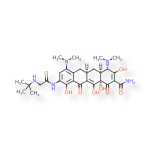
| Molecular Formula | C29H39N5O8.ClH |
| Molecular Weight | 622.11 |
| Optical Activity | UNSPECIFIED |
| Defined Stereocenters | 4 / 4 |
| E/Z Centers | 0 |
| Charge | 0 |
SHOW SMILES / InChI
SMILES
Cl.CN(C)[C@H]1[C@@H]2C[C@@H]3CC4=C(C(=O)C3=C(O)[C@]2(O)C(=O)C(C(N)=O)=C1O)C(O)=C(NC(=O)CNC(C)(C)C)C=C4N(C)C
InChI
InChIKey=ATIINCUPZOADER-KXLOKULZSA-N
InChI=1S/C29H39N5O8.ClH/c1-28(2,3)31-11-17(35)32-15-10-16(33(4)5)13-8-12-9-14-21(34(6)7)24(38)20(27(30)41)26(40)29(14,42)25(39)18(12)23(37)19(13)22(15)36;/h10,12,14,21,31,36,38-39,42H,8-9,11H2,1-7H3,(H2,30,41)(H,32,35);1H/t12-,14-,21-,29-;/m0./s1
| Molecular Formula | ClH |
| Molecular Weight | 36.461 |
| Charge | 0 |
| Count |
|
| Stereochemistry | ACHIRAL |
| Additional Stereochemistry | No |
| Defined Stereocenters | 0 / 0 |
| E/Z Centers | 0 |
| Optical Activity | NONE |
| Molecular Formula | C29H39N5O8 |
| Molecular Weight | 585.6487 |
| Charge | 0 |
| Count |
|
| Stereochemistry | ABSOLUTE |
| Additional Stereochemistry | No |
| Defined Stereocenters | 4 / 4 |
| E/Z Centers | 0 |
| Optical Activity | UNSPECIFIED |
DescriptionCurator's Comment: description was created based on several sources, including:
http://www.drugbank.ca/drugs/DB00560
https://en.wikipedia.org/wiki/Tigecycline
Curator's Comment: description was created based on several sources, including:
http://www.drugbank.ca/drugs/DB00560
https://en.wikipedia.org/wiki/Tigecycline
Tigecycline (INN) is an antibiotic used to treat a number of bacterial infections. It is a first in class glycylcycline that is administered intravenously. For the treatment of infections caused by susceptible strains of the designated microorganisms in the following conditions: Complicated skin and skin structure infections caused by Escherichia coli, Enterococcus faecalis (vancomycin-susceptible isolates only), Staphylococcus aureus (methicillin-susceptible and -resistant isolates), Streptococcus agalactiae, Streptococcus anginosus grp. (includes S. anginosus, S. intermedius, and S. constellatus), Streptococcus pyogenes and Bacteroides fragilis. Complicated intra-abdominal infections caused by Citrobacter freundii, Enterobacter cloacae, Escherichia coli, Klebsiella oxytoca, Klebsiella pneumoniae, Enterococcus faecalis (vancomycin-susceptible isolates only), Staphylococcus aureus (methicillin-susceptible isolates only), Streptococcus anginosus grp. (includes S. anginosus, S. intermedius, and S. constellatus), Bacteroides fragilis, Bacteroides thetaiotaomicron, Bacteroides uniformis, Bacteroides vulgatus, Clostridium perfringens, and Peptostreptococcus micros. Tigecycline, a glycylcycline, inhibits protein translation in bacteria by binding to the 30S ribosomal subunit and blocking entry of amino-acyl tRNA molecules into the A site of the ribosome. This prevents incorporation of amino acid residues into elongating peptide chains. Tigecycline carries a glycylamido moiety attached to the 9-position of minocycline. The substitution pattern is not present in any naturally occurring or semisynthetic tetracycline and imparts certain microbiologic properties to tigecycline. In general, tigecycline is considered bacteriostatic; however, TYGACIL has demonstrated bactericidal activity against isolates of S. pneumoniae and L. pneumophila. In vitro studies have not demonstrated antagonism between tigecycline and other commonly used antibacterials.
Approval Year
Targets
| Primary Target | Pharmacology | Condition | Potency |
|---|---|---|---|
Target ID: CHEMBL2363135 |
Conditions
| Condition | Modality | Targets | Highest Phase | Product |
|---|---|---|---|---|
| Curative | TYGACIL Approved Useis a tetracycline-class antibacterial drug indicated in patients 18 years of age and older for: Complicated skin and skin structure infections; Complicated intra-abdominal infections; Community-acquired bacterial pneumonia; Limitations of Use: TYGACIL is not indicated for treatment of diabetic foot infection or hospital-acquired pneumonia, including ventilator-associated pneumonia Launch Date2006 |
|||
| Curative | TYGACIL Approved Useis a tetracycline-class antibacterial drug indicated in patients 18 years of age and older for: Complicated skin and skin structure infections; Complicated intra-abdominal infections; Community-acquired bacterial pneumonia; Limitations of Use: TYGACIL is not indicated for treatment of diabetic foot infection or hospital-acquired pneumonia, including ventilator-associated pneumonia Launch Date2006 |
|||
| Curative | TYGACIL Approved Useis a tetracycline-class antibacterial drug indicated in patients 18 years of age and older for: Complicated skin and skin structure infections; Complicated intra-abdominal infections; Community-acquired bacterial pneumonia; Limitations of Use: TYGACIL is not indicated for treatment of diabetic foot infection or hospital-acquired pneumonia, including ventilator-associated pneumonia Launch Date2006 |
Cmax
| Value | Dose | Co-administered | Analyte | Population |
|---|---|---|---|---|
0.63 μg/mL |
50 mg 2 times / day multiple, intravenous dose: 50 mg route of administration: Intravenous experiment type: MULTIPLE co-administered: |
TIGECYCLINE plasma | Homo sapiens population: UNHEALTHY age: ADULT sex: UNKNOWN food status: UNKNOWN |
AUC
| Value | Dose | Co-administered | Analyte | Population |
|---|---|---|---|---|
7.64 mg*h/L Clinical Trial https://clinicaltrials.gov/ct2/show/NCT01560143 |
100 mg single, intravenous dose: 100 mg route of administration: intravenous experiment type: single co-administered: |
TIGECYCLINE serum | Homo sapiens |
|
4.7 μg × h/mL |
50 mg 2 times / day multiple, intravenous dose: 50 mg route of administration: Intravenous experiment type: MULTIPLE co-administered: |
TIGECYCLINE plasma | Homo sapiens population: UNHEALTHY age: ADULT sex: UNKNOWN food status: UNKNOWN |
T1/2
| Value | Dose | Co-administered | Analyte | Population |
|---|---|---|---|---|
42.4 h |
50 mg 2 times / day multiple, intravenous dose: 50 mg route of administration: Intravenous experiment type: MULTIPLE co-administered: |
TIGECYCLINE plasma | Homo sapiens population: UNHEALTHY age: ADULT sex: UNKNOWN food status: UNKNOWN |
Funbound
| Value | Dose | Co-administered | Analyte | Population |
|---|---|---|---|---|
11% |
50 mg 2 times / day multiple, intravenous dose: 50 mg route of administration: Intravenous experiment type: MULTIPLE co-administered: |
TIGECYCLINE plasma | Homo sapiens population: UNHEALTHY age: ADULT sex: UNKNOWN food status: UNKNOWN |
Doses
| Dose | Population | Adverse events |
|---|---|---|
100 mg 2 times / day multiple, intravenous Highest studied dose Dose: 100 mg, 2 times / day Route: intravenous Route: multiple Dose: 100 mg, 2 times / day Sources: |
healthy |
Disc. AE: Gastrointestinal disorder (NOS)... AEs leading to discontinuation/dose reduction: Gastrointestinal disorder (NOS) (50%) Sources: |
300 mg single, intravenous Highest studied dose Dose: 300 mg Route: intravenous Route: single Dose: 300 mg Sources: |
healthy |
DLT: Gastrointestinal disorder NOS... Dose limiting toxicities: Gastrointestinal disorder NOS Sources: |
100 mg single, intravenous MTD Dose: 100 mg Route: intravenous Route: single Dose: 100 mg Sources: |
healthy |
Other AEs: Nausea, Vomiting... |
200 mg single, intravenous MTD Dose: 200 mg Route: intravenous Route: single Dose: 200 mg Sources: |
healthy |
Other AEs: Nausea, Vomiting... |
50 mg 2 times / day multiple, intravenous Recommended Dose: 50 mg, 2 times / day Route: intravenous Route: multiple Dose: 50 mg, 2 times / day Sources: |
unhealthy Health Status: unhealthy Sources: |
Disc. AE: Anaphylaxis, Anaphylactoid reaction... AEs leading to discontinuation/dose reduction: Anaphylaxis Sources: Anaphylactoid reaction Hepatic dysfunction NOS Liver failure Pancreatitis (grade 5) Fetal damage Tooth discoloration Diarrhea, Clostridium difficile |
50 mg 2 times / day multiple, intravenous Recommended Dose: 50 mg, 2 times / day Route: intravenous Route: multiple Dose: 50 mg, 2 times / day Sources: |
unhealthy Health Status: unhealthy Sources: |
Disc. AE: Nausea, Vomiting... AEs leading to discontinuation/dose reduction: Nausea (1%) Sources: Vomiting (1%) |
AEs
| AE | Significance | Dose | Population |
|---|---|---|---|
| Gastrointestinal disorder (NOS) | 50% Disc. AE |
100 mg 2 times / day multiple, intravenous Highest studied dose Dose: 100 mg, 2 times / day Route: intravenous Route: multiple Dose: 100 mg, 2 times / day Sources: |
healthy |
| Gastrointestinal disorder NOS | DLT | 300 mg single, intravenous Highest studied dose Dose: 300 mg Route: intravenous Route: single Dose: 300 mg Sources: |
healthy |
| Nausea | 50% | 100 mg single, intravenous MTD Dose: 100 mg Route: intravenous Route: single Dose: 100 mg Sources: |
healthy |
| Vomiting | 50% | 100 mg single, intravenous MTD Dose: 100 mg Route: intravenous Route: single Dose: 100 mg Sources: |
healthy |
| Nausea | 200 mg single, intravenous MTD Dose: 200 mg Route: intravenous Route: single Dose: 200 mg Sources: |
healthy |
|
| Vomiting | 200 mg single, intravenous MTD Dose: 200 mg Route: intravenous Route: single Dose: 200 mg Sources: |
healthy |
|
| Anaphylactoid reaction | Disc. AE | 50 mg 2 times / day multiple, intravenous Recommended Dose: 50 mg, 2 times / day Route: intravenous Route: multiple Dose: 50 mg, 2 times / day Sources: |
unhealthy Health Status: unhealthy Sources: |
| Anaphylaxis | Disc. AE | 50 mg 2 times / day multiple, intravenous Recommended Dose: 50 mg, 2 times / day Route: intravenous Route: multiple Dose: 50 mg, 2 times / day Sources: |
unhealthy Health Status: unhealthy Sources: |
| Diarrhea, Clostridium difficile | Disc. AE | 50 mg 2 times / day multiple, intravenous Recommended Dose: 50 mg, 2 times / day Route: intravenous Route: multiple Dose: 50 mg, 2 times / day Sources: |
unhealthy Health Status: unhealthy Sources: |
| Fetal damage | Disc. AE | 50 mg 2 times / day multiple, intravenous Recommended Dose: 50 mg, 2 times / day Route: intravenous Route: multiple Dose: 50 mg, 2 times / day Sources: |
unhealthy Health Status: unhealthy Sources: |
| Hepatic dysfunction NOS | Disc. AE | 50 mg 2 times / day multiple, intravenous Recommended Dose: 50 mg, 2 times / day Route: intravenous Route: multiple Dose: 50 mg, 2 times / day Sources: |
unhealthy Health Status: unhealthy Sources: |
| Liver failure | Disc. AE | 50 mg 2 times / day multiple, intravenous Recommended Dose: 50 mg, 2 times / day Route: intravenous Route: multiple Dose: 50 mg, 2 times / day Sources: |
unhealthy Health Status: unhealthy Sources: |
| Tooth discoloration | Disc. AE | 50 mg 2 times / day multiple, intravenous Recommended Dose: 50 mg, 2 times / day Route: intravenous Route: multiple Dose: 50 mg, 2 times / day Sources: |
unhealthy Health Status: unhealthy Sources: |
| Pancreatitis | grade 5 Disc. AE |
50 mg 2 times / day multiple, intravenous Recommended Dose: 50 mg, 2 times / day Route: intravenous Route: multiple Dose: 50 mg, 2 times / day Sources: |
unhealthy Health Status: unhealthy Sources: |
| Nausea | 1% Disc. AE |
50 mg 2 times / day multiple, intravenous Recommended Dose: 50 mg, 2 times / day Route: intravenous Route: multiple Dose: 50 mg, 2 times / day Sources: |
unhealthy Health Status: unhealthy Sources: |
| Vomiting | 1% Disc. AE |
50 mg 2 times / day multiple, intravenous Recommended Dose: 50 mg, 2 times / day Route: intravenous Route: multiple Dose: 50 mg, 2 times / day Sources: |
unhealthy Health Status: unhealthy Sources: |
Overview
| CYP3A4 | CYP2C9 | CYP2D6 | hERG |
|---|---|---|---|
OverviewOther
| Other Inhibitor | Other Substrate | Other Inducer |
|---|---|---|
Drug as perpetrator
| Target | Modality | Activity | Metabolite | Clinical evidence |
|---|---|---|---|---|
| no [IC50 >100 uM] | ||||
| no [IC50 >100 uM] | ||||
| no [IC50 >100 uM] | ||||
| no [IC50 >100 uM] | ||||
| no [IC50 >100 uM] | ||||
| no [IC50 >100 uM] | ||||
| no |
Drug as victim
| Target | Modality | Activity | Metabolite | Clinical evidence |
|---|---|---|---|---|
| inconclusive |
Tox targets
| Target | Modality | Activity | Metabolite | Clinical evidence |
|---|---|---|---|---|
PubMed
| Title | Date | PubMed |
|---|---|---|
| Systems pharmacological analysis of drugs inducing stevens-johnson syndrome and toxic epidermal necrolysis. | 2015-05-18 |
|
| Tigecycline prevents LPS-induced release of pro-inflammatory and apoptotic mediators in neuronal cells. | 2013-03 |
|
| Fluorocyclines. 1. 7-fluoro-9-pyrrolidinoacetamido-6-demethyl-6-deoxytetracycline: a potent, broad spectrum antibacterial agent. | 2012-01-26 |
|
| Prevalence of antimicrobial-resistant pathogens in Canadian hospitals: results of the Canadian Ward Surveillance Study (CANWARD 2008). | 2010-11 |
|
| Tigecycline attenuates staphylococcal superantigen-induced T-cell proliferation and production of cytokines and chemokines. | 2009 |
|
| Non-susceptibility trends among staphylococci from bacteraemias in the UK and Ireland, 2001-06. | 2008-11 |
|
| Meticillin-resistant Staphylococcus aureus hepatic abscess treated with tigecycline. | 2008-08 |
|
| Tigecycline: first of a new class of antimicrobial agents. | 2006-08 |
|
| Tigecycline: a new glycylcycline antimicrobial agent. | 2006-07-01 |
|
| Comparison of the in vitro activity of the glycylcycline tigecycline (formerly GAR-936) with those of tetracycline, minocycline, and doxycycline against isolates of nontuberculous mycobacteria. | 2002-10 |
|
| Antimicrobial activity and spectrum of the new glycylcycline, GAR-936 tested against 1,203 recent clinical bacterial isolates. | 2000-01 |
|
| Disk diffusion susceptibility test development for the new glycylcycline, GAR-936. | 1999-11 |
Sample Use Guides
Initial dose of 100 mg, followed by 50 mg every 12 hours administered intravenously over approximately 30 to 60 minutes.
Severe hepatic impairment (Child Pugh C): Initial dose of 100 mg followed by 25 mg every 12 hours.
Route of Administration:
Intravenous
| Substance Class |
Chemical
Created
by
admin
on
Edited
Wed Apr 02 05:20:13 GMT 2025
by
admin
on
Wed Apr 02 05:20:13 GMT 2025
|
| Record UNII |
7F4TZ17Y3R
|
| Record Status |
Validated (UNII)
|
| Record Version |
|
-
Download
| Name | Type | Language | ||
|---|---|---|---|---|
|
Preferred Name | English | ||
|
Common Name | English | ||
|
Systematic Name | English |
| Code System | Code | Type | Description | ||
|---|---|---|---|---|---|
|
7F4TZ17Y3R
Created by
admin on Wed Apr 02 05:20:13 GMT 2025 , Edited by admin on Wed Apr 02 05:20:13 GMT 2025
|
PRIMARY | |||
|
197654-04-9
Created by
admin on Wed Apr 02 05:20:13 GMT 2025 , Edited by admin on Wed Apr 02 05:20:13 GMT 2025
|
PRIMARY |
| Related Record | Type | Details | ||
|---|---|---|---|---|
|
PARENT -> SALT/SOLVATE |
|
| Related Record | Type | Details | ||
|---|---|---|---|---|
|
ACTIVE MOIETY |