


Details
| Stereochemistry | ACHIRAL |
| Molecular Formula | C11H20O2.C2H7NO |
| Molecular Weight | 245.3584 |
| Optical Activity | NONE |
| Defined Stereocenters | 0 / 0 |
| E/Z Centers | 0 |
| Charge | 0 |
SHOW SMILES / InChI
SMILES
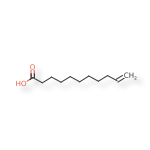
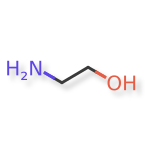
NCCO.OC(=O)CCCCCCCCC=C
InChI
InChIKey=GPOFRJKTYRFQLJ-UHFFFAOYSA-N
InChI=1S/C11H20O2.C2H7NO/c1-2-3-4-5-6-7-8-9-10-11(12)13;3-1-2-4/h2H,1,3-10H2,(H,12,13);4H,1-3H2
| Molecular Formula | C11H20O2 |
| Molecular Weight | 184.2753 |
| Charge | 0 |
| Count |
|
| Stereochemistry | ACHIRAL |
| Additional Stereochemistry | No |
| Defined Stereocenters | 0 / 0 |
| E/Z Centers | 0 |
| Optical Activity | NONE |
| Molecular Formula | C2H7NO |
| Molecular Weight | 61.0831 |
| Charge | 0 |
| Count |
|
| Stereochemistry | ACHIRAL |
| Additional Stereochemistry | No |
| Defined Stereocenters | 0 / 0 |
| E/Z Centers | 0 |
| Optical Activity | NONE |
DescriptionCurator's Comment: description was created based on several sources, including
http://www.altmedrev.com/publications/7/1/68.pdf |
https://www.ncbi.nlm.nih.gov/pubmed/10991877
Curator's Comment: description was created based on several sources, including
http://www.altmedrev.com/publications/7/1/68.pdf |
https://www.ncbi.nlm.nih.gov/pubmed/10991877
Undecylenic acid is unsaturated fatty acid, which naturally occurs in sweat, and is commercially produced by the vacuum distillation of castor bean oil. It is recognized as GRASE by FDA, and is marketed over the counter to treat skin infections and to relieve itching. Undecylenic acid acts by inhibition of morphogenesis from yeast to hyphae forms.
Approval Year
Targets
| Primary Target | Pharmacology | Condition | Potency |
|---|---|---|---|
Target ID: map00061 |
Conditions
| Condition | Modality | Targets | Highest Phase | Product |
|---|---|---|---|---|
| Curative | CRUEX Approved UseFor the cure of most tinea pedis (athlete's foot) and tinea corporis (ringworm). |
|||
| Curative | CRUEX Approved UseFor the cure of most tinea pedis (athlete's foot) and tinea corporis (ringworm). |
|||
| Primary | Unknown Approved UseUnknown |
|||
| Primary | CRUEX Approved UseItching, burning, redness, irritation, scaling, soreness and discomfort which may accompany these conditions |
Doses
| Dose | Population | Adverse events |
|---|---|---|
2.2 g 3 times / day multiple, oral Dose: 2.2 g, 3 times / day Route: oral Route: multiple Dose: 2.2 g, 3 times / day Sources: |
unhealthy, 56 years |
Disc. AE: Toxic labyrinthitis... AEs leading to discontinuation/dose reduction: Toxic labyrinthitis (1 patient) Sources: |
1 g 3 times / day multiple, oral Dose: 1 g, 3 times / day Route: oral Route: multiple Dose: 1 g, 3 times / day Sources: |
unhealthy, 8-14 years |
|
10 g 3 times / day multiple, oral Highest studied dose Dose: 10 g, 3 times / day Route: oral Route: multiple Dose: 10 g, 3 times / day Sources: |
unhealthy, adult |
|
2 % 1 times / day multiple, topical Dose: 2 %, 1 times / day Route: topical Route: multiple Dose: 2 %, 1 times / day Sources: |
unhealthy |
AEs
| AE | Significance | Dose | Population |
|---|---|---|---|
| Toxic labyrinthitis | 1 patient Disc. AE |
2.2 g 3 times / day multiple, oral Dose: 2.2 g, 3 times / day Route: oral Route: multiple Dose: 2.2 g, 3 times / day Sources: |
unhealthy, 56 years |
PubMed
| Title | Date | PubMed |
|---|---|---|
| Bioconjugate functionalization of thermally carbonized porous silicon using a radical coupling reaction. | 2010-12-07 |
|
| Simple surface modification of poly(dimethylsiloxane) for DNA hybridization. | 2010-12-06 |
|
| Production of functionalized polyhydroxyalkanoates by genetically modified Methylobacterium extorquens strains. | 2010-09-16 |
|
| Capric acid secreted by S. boulardii inhibits C. albicans filamentous growth, adhesion and biofilm formation. | 2010-08-10 |
|
| Rapid approach to biobased telechelics through two one-pot thiol-ene click reactions. | 2010-06-14 |
|
| Simultaneous biosynthesis of two copolymers in Pseudomonas putida GPo1 using a two-stage continuous culture system. | 2010-06-14 |
|
| Stimulatory effect of undecylenic acid on mouse osteoblast differentiation. | 2010-04 |
|
| Electrochemical behavior of gold colloidal alkyl modified silicon surfaces. | 2009-11 |
|
| Porous silicon for photosensitized formation of singlet oxygen in water and in simulated body fluid: two methods of modification by undecylenic acid. | 2009-06 |
|
| Fed-batch production of unsaturated medium-chain-length polyhydroxyalkanoates with controlled composition by Pseudomonas putida KT2440. | 2009-03 |
|
| Polymerizable vesicles based on a single-tailed fatty acid surfactant: a simple route to robust nanocontainers. | 2009-02-03 |
|
| The compatibility of hepatocytes with chemically modified porous silicon with reference to in vitro biosensors. | 2009-01 |
|
| Undecylenic acid: a valuable and physiologically active renewable building block from castor oil. | 2009 |
|
| A rapid and sensitive screening system for human type I collagen with the aim of discovering potent anti-aging or anti-fibrotic compounds. | 2008-12-31 |
|
| Oxidation-triggered release of fluorescent molecules or drugs from mesoporous Si microparticles. | 2008-11-25 |
|
| Spectra and kinetic studies of the compound I derivative of cytochrome P450 119. | 2008-10-08 |
|
| Topographical and functional characterization of the ssDNA probe layer generated through EDC-mediated covalent attachment to nanocrystalline diamond using fluorescence microscopy. | 2008-08-19 |
|
| Comparison of the skin sensitizing potential of unsaturated compounds as assessed by the murine local lymph node assay (LLNA) and the guinea pig maximization test (GPMT). | 2008-06 |
|
| Genomic analysis of post-mating changes in the honey bee queen (Apis mellifera). | 2008-05-19 |
|
| A new concept in the topical treatment of onychomycosis with cyanoacrylate, undecylenic acid, and hydroquinone. | 2008-04 |
|
| Effect of double bonds in the formation of sodium dodecanoate and sodium 10-undecenoate mixed micelles in water. | 2007-10-11 |
|
| Effects of insemination quantity on honey bee queen physiology. | 2007-10-03 |
|
| Determination of nateglinide in human plasma by high-performance liquid chromatography with pre-column derivatization using a coumarin-type fluorescent reagent. | 2007-09-05 |
|
| Enzymatic synthesis of arbutin undecylenic acid ester and its inhibitory effect on melanin synthesis. | 2007-06-01 |
|
| Covalent biofunctionalization of silicon nitride surfaces. | 2007-05-22 |
|
| Optimizing biosensing properties on undecylenic Acid-functionalized diamond. | 2007-05-08 |
|
| Cell adhesion properties on photochemically functionalized diamond. | 2007-05-08 |
|
| Enzymatic synthesis of arbutin undecylenic acid ester and its inhibitory effect on mushroom tyrosinase. | 2007-03 |
|
| Mechanisms of thermal decomposition of organic monolayers grafted on (111) silicon. | 2007-01-30 |
|
| Structure and polymer form of poly-3-hydroxyalkanoates produced by Pseudomonas oleovorans grown with mixture of sodium octanoate/undecylenic acid and sodium octanoate/5-phenylvaleric acid. | 2007-01-30 |
|
| Self-assembled monolayers with latent aldehydes for protein immobilization. | 2007-01-18 |
|
| Nanovectors for anticancer agents based on superparamagnetic iron oxide nanoparticles. | 2007 |
|
| Self-assembled thermo- and pH responsive micelles of poly(10-undecenoic acid-b-N-isopropylacrylamide) for drug delivery. | 2006-12-01 |
|
| 3,3,5-Trimethylcyclohexanols and derived esters: green synthetic procedures, odour evaluation and in vitro skin cytotoxicity assays. | 2006-12 |
|
| Grazing angle mirror-backed reflection (GMBR) for infrared analysis of monolayers on silicon. | 2006-09-14 |
|
| Natural treatment of chronic rhinosinusitis. | 2006-09 |
|
| EDC-mediated DNA attachment to nanocrystalline CVD diamond films. | 2006-08-15 |
|
| Controlling electroosmotic flow in poly(dimethylsiloxane) separation channels by means of prepolymer additives. | 2006-07-01 |
|
| Simple fluorimetric liquid chromatographic method for the analysis of undecylenic acid and zinc undecylenate in pharmaceutical preparations. | 2006-06-30 |
|
| Synthesis and HPLC evaluation of carboxylic acid phases on a hydride surface. | 2006-04 |
|
| UV photodissociation spectroscopy of oxidized undecylenic acid films. | 2006-03-16 |
|
| Tailor-made olefinic medium-chain-length poly[(R)-3-hydroxyalkanoates] by Pseudomonas putida GPo1: batch versus chemostat production. | 2006-03-05 |
|
| Well-defined carboxyl-terminated alkyl monolayers grafted onto H-Si(111): packing density from a combined AFM and quantitative IR study. | 2006-01-03 |
|
| Silicon nanoparticles: applications in cell biology and medicine. | 2006 |
|
| Simple methods for the direct assembly, functionalization, and patterning of acid-terminated monolayers on Si111. | 2005-11-08 |
|
| Kinetic control of the photochemical reactivity of hydrogen-terminated silicon with bifunctional molecules. | 2005-05-24 |
|
| Synthesis, stereochemistry and biological activity of some novel long alkyl chain substituted thiazolidin-4-ones and thiazan-4-one from 10-undecenoic acid hydrazide. | 2005-02 |
|
| Formation, characterization, and chemistry of undecanoic acid-terminated silicon surfaces: patterning and immobilization of DNA. | 2004-12-21 |
|
| Surface functionalization of silicon nanoparticles produced by laser-driven pyrolysis of silane followed by HF-HNO3 etching. | 2004-05-25 |
|
| Screening for new compounds with antiherpes activity. | 1984-10 |
Patents
Sample Use Guides
Undecylenic acid antifungal liquid should be applied to affected area topically.
Route of Administration:
Topical
To investigate effect of undecylenic acid on Candida albicans morphogenesis, cells were grown overnight at 30°C on YPD agar and harvested by scraping the cells from the plate and suspending in YPD broth. Two milliliters of cells at 106 cells/ml was distributed into tubes containing liner, approximately 0.5 g of liner per tube. The cultures were incubated at 39°C with agitation for 2 h; planktonic cells were analyzed microscopically to determine the percentage of cells with germ tubes. The presence of Undecylenic acid inhibited the appearance of germ tubes, with 10 μM UDA causing a sevenfold reduction.
| Substance Class |
Chemical
Created
by
admin
on
Edited
Mon Mar 31 17:54:40 GMT 2025
by
admin
on
Mon Mar 31 17:54:40 GMT 2025
|
| Record UNII |
89FB3I7256
|
| Record Status |
Validated (UNII)
|
| Record Version |
|
-
Download
| Name | Type | Language | ||
|---|---|---|---|---|
|
Preferred Name | English | ||
|
Common Name | English | ||
|
Common Name | English | ||
|
Systematic Name | English | ||
|
Systematic Name | English |
| Code System | Code | Type | Description | ||
|---|---|---|---|---|---|
|
DTXSID20971980
Created by
admin on Mon Mar 31 17:54:40 GMT 2025 , Edited by admin on Mon Mar 31 17:54:40 GMT 2025
|
PRIMARY | |||
|
12041-82-6
Created by
admin on Mon Mar 31 17:54:40 GMT 2025 , Edited by admin on Mon Mar 31 17:54:40 GMT 2025
|
SUPERSEDED | |||
|
56532-40-2
Created by
admin on Mon Mar 31 17:54:40 GMT 2025 , Edited by admin on Mon Mar 31 17:54:40 GMT 2025
|
PRIMARY | |||
|
260-247-7
Created by
admin on Mon Mar 31 17:54:40 GMT 2025 , Edited by admin on Mon Mar 31 17:54:40 GMT 2025
|
PRIMARY | |||
|
25494
Created by
admin on Mon Mar 31 17:54:40 GMT 2025 , Edited by admin on Mon Mar 31 17:54:40 GMT 2025
|
PRIMARY | |||
|
89FB3I7256
Created by
admin on Mon Mar 31 17:54:40 GMT 2025 , Edited by admin on Mon Mar 31 17:54:40 GMT 2025
|
PRIMARY |
| Related Record | Type | Details | ||
|---|---|---|---|---|
|
|
PARENT -> SALT/SOLVATE | |||
|
|
PARENT -> SALT/SOLVATE |
| Related Record | Type | Details | ||
|---|---|---|---|---|
|
ACTIVE MOIETY |