


Details
| Stereochemistry | ABSOLUTE |
| Molecular Formula | C14H23NO.H3O4P |
| Molecular Weight | 319.3337 |
| Optical Activity | UNSPECIFIED |
| Defined Stereocenters | 2 / 2 |
| E/Z Centers | 0 |
| Charge | 0 |
SHOW SMILES / InChI
SMILES
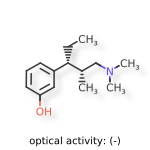
OP(O)(O)=O.CC[C@H]([C@@H](C)CN(C)C)C1=CC=CC(O)=C1
InChI
InChIKey=RXZPQFCLVLHDKN-YECZQDJWSA-N
InChI=1S/C14H23NO.H3O4P/c1-5-14(11(2)10-15(3)4)12-7-6-8-13(16)9-12;1-5(2,3)4/h6-9,11,14,16H,5,10H2,1-4H3;(H3,1,2,3,4)/t11-,14+;/m0./s1
| Molecular Formula | C14H23NO |
| Molecular Weight | 221.3385 |
| Charge | 0 |
| Count |
|
| Stereochemistry | ABSOLUTE |
| Additional Stereochemistry | No |
| Defined Stereocenters | 2 / 2 |
| E/Z Centers | 0 |
| Optical Activity | UNSPECIFIED |
| Molecular Formula | H3O4P |
| Molecular Weight | 97.9952 |
| Charge | 0 |
| Count |
|
| Stereochemistry | ACHIRAL |
| Additional Stereochemistry | No |
| Defined Stereocenters | 0 / 0 |
| E/Z Centers | 0 |
| Optical Activity | NONE |
DescriptionCurator's Comment: Description was created based on several sources, including
https://www.ncbi.nlm.nih.gov/pubmed/21476608 | https://www.nucynta.com/hcp/er/mechanism-of-action#isi-0
Curator's Comment: Description was created based on several sources, including
https://www.ncbi.nlm.nih.gov/pubmed/21476608 | https://www.nucynta.com/hcp/er/mechanism-of-action#isi-0
Tapentadol is the first US FDA-approved centrally acting analgesic having both μ-opioid receptor agonist and noradrenaline (norepinephrine) reuptake inhibition activity with minimal serotonin reuptake inhibition. Tapentadol is indicated for the management of pain severe enough to require daily, around-the-clock, long-term opioid treatment and for which alternative treatment options are inadequate, neuropathic pain associated with diabetic peripheral neuropathy (DPN) severe enough to require daily, around-the-clock, long-term opioid treatment and for which alternative treatment options are inadequate.
Approval Year
Targets
| Primary Target | Pharmacology | Condition | Potency |
|---|---|---|---|
Target ID: CHEMBL233 |
0.16 µM [Ki] | ||
Target ID: CHEMBL222 |
8.8 µM [Ki] | ||
Target ID: CHEMBL228 |
5.28 µM [Ki] |
Conditions
| Condition | Modality | Targets | Highest Phase | Product |
|---|---|---|---|---|
| Primary | NUCYNTA Approved UseNUCYNTA ER (tapentadol) is indicated for the management of:
pain severe enough to require daily, around-the-clock, long-term opioid treatment and for which alternative treatment options are inadequate
neuropathic pain associated with diabetic peripheral neuropathy (DPN) severe enough to require daily, around-the-clock, long-term opioid treatment and for which alternative treatment options are inadequate. Launch Date2008 |
Cmax
| Value | Dose | Co-administered | Analyte | Population |
|---|---|---|---|---|
221.34 ng/mL |
86 mg single, oral dose: 86 mg route of administration: Oral experiment type: SINGLE co-administered: |
TAPENTADOL plasma | Homo sapiens population: HEALTHY age: ADULT sex: MALE food status: FASTED |
AUC
| Value | Dose | Co-administered | Analyte | Population |
|---|---|---|---|---|
221.34 ng × h/mL |
86 mg single, oral dose: 86 mg route of administration: Oral experiment type: SINGLE co-administered: |
TAPENTADOL plasma | Homo sapiens population: HEALTHY age: ADULT sex: MALE food status: FASTED |
T1/2
| Value | Dose | Co-administered | Analyte | Population |
|---|---|---|---|---|
1.16 h |
86 mg single, oral dose: 86 mg route of administration: Oral experiment type: SINGLE co-administered: |
TAPENTADOL plasma | Homo sapiens population: HEALTHY age: ADULT sex: MALE food status: FASTED |
|
4 h |
100 mg single, oral dose: 100 mg route of administration: Oral experiment type: SINGLE co-administered: |
TAPENTADOL plasma | Homo sapiens population: UNKNOWN age: UNKNOWN sex: UNKNOWN food status: UNKNOWN |
Funbound
| Value | Dose | Co-administered | Analyte | Population |
|---|---|---|---|---|
80% |
100 mg single, oral dose: 100 mg route of administration: Oral experiment type: SINGLE co-administered: |
TAPENTADOL plasma | Homo sapiens population: UNKNOWN age: UNKNOWN sex: UNKNOWN food status: UNKNOWN |
Overview
| CYP3A4 | CYP2C9 | CYP2D6 | hERG |
|---|---|---|---|
OverviewOther
| Other Inhibitor | Other Substrate | Other Inducer |
|---|---|---|
Drug as perpetrator
| Target | Modality | Activity | Metabolite | Clinical evidence |
|---|---|---|---|---|
| no | ||||
| no | ||||
| no | ||||
| no | ||||
| no | ||||
| no | ||||
| no | ||||
| no | ||||
| no | ||||
| no |
Drug as victim
| Target | Modality | Activity | Metabolite | Clinical evidence |
|---|---|---|---|---|
| yes | ||||
| yes | ||||
| yes |
Tox targets
| Target | Modality | Activity | Metabolite | Clinical evidence |
|---|---|---|---|---|
PubMed
| Title | Date | PubMed |
|---|---|---|
| Tapentadol hydrochloride: A novel analgesic. | 2013-07 |
|
| Comparative pharmacokinetics and bioavailability of tapentadol following oral administration of immediate- and prolonged-release formulations. | 2013-04 |
|
| [Tapentadol. Opioid analgesic and norepinephrine reuptake inhibitors]. | 2010-12 |
|
| Oral hydromorphone extended-release. | 2010-12 |
|
| Advances in perioperative pain management: use of medications with dual analgesic mechanisms, tramadol & tapentadol. | 2010-12 |
|
| Determination of tapentadol and its metabolite N-desmethyltapentadol in urine and oral fluid using liquid chromatography with tandem mass spectral detection. | 2010-10 |
|
| Determination of tapentadol (Nucynta®) and N-desmethyltapentadol in authentic urine specimens by ultra-performance liquid chromatography-tandem mass spectrometry. | 2010-10 |
|
| Analgesic update: tapentadol hydrochloride. | 2010-10 |
|
| A thorough QT/QTc study of multiple doses of tapentadol immediate release in healthy subjects. | 2010-10 |
|
| Population pharmacokinetics of tapentadol immediate release (IR) in healthy subjects and patients with moderate or severe pain. | 2010-10 |
|
| Tapentadol immediate release: a review of its use in the treatment of moderate to severe acute pain. | 2010-09-10 |
|
| Cost-effectiveness analysis of tapentadol immediate release for the treatment of acute pain. | 2010-09 |
|
| Tapentadol and its two mechanisms of action: is there a new pharmacological class of centrally-acting analgesics on the horizon? | 2010-09 |
|
| Differential contribution of opioid and noradrenergic mechanisms of tapentadol in rat models of nociceptive and neuropathic pain. | 2010-09 |
|
| Tapentadol for acute and chronic pain. | 2010-08 |
|
| Efficacy and safety of tapentadol extended release for the management of chronic low back pain: results of a prospective, randomized, double-blind, placebo- and active-controlled Phase III study. | 2010-08 |
|
| Tapentadol: an initial analysis. | 2010-07-21 |
|
| Evaluation of study discontinuations with tapentadol inmmediate release and oxycodone immediate release in patients with low back or osteoarthritis pain. | 2010-07-21 |
|
| Long-term safety and tolerability of tapentadol extended release for the management of chronic low back pain or osteoarthritis pain. | 2010-07-07 |
|
| Review of the effect of opioid-related side effects on the undertreatment of moderate to severe chronic non-cancer pain: tapentadol, a step toward a solution? | 2010-07 |
|
| Efficacy and safety of tapentadol prolonged release for chronic osteoarthritis pain and low back pain. | 2010-06 |
|
| Tapentadol immediate-release for acute pain. | 2010-06 |
|
| Neuropathy, retinopathy, and glucose-lowering treatments. | 2010-06 |
|
| In vitro and in vivo characterization of tapentadol metabolites. | 2010-04-13 |
|
| Recent advances in postoperative pain management. | 2010-03 |
|
| Stereochemical basis for a unified structure activity theory of aromatic and heterocyclic rings in selected opioids and opioid peptides. | 2010-02-18 |
|
| Tapentadol, but not morphine, selectively inhibits disease-related thermal hyperalgesia in a mouse model of diabetic neuropathic pain. | 2010-02-12 |
|
| Tapentadol immediate release: a new treatment option for acute pain management. | 2010-02-08 |
|
| Dose conversion between tapentadol immediate and extended release for low back pain. | 2010-02-02 |
|
| Effects of acetaminophen, naproxen, and acetylsalicylic acid on tapentadol pharmacokinetics: results of two randomized, open-label, crossover, drug-drug interaction studies. | 2010-01 |
|
| Efficacy and safety of Tapentadol extended release compared with oxycodone controlled release for the management of moderate to severe chronic pain related to osteoarthritis of the knee: a randomized, double-blind, placebo- and active-controlled phase III study. | 2010 |
|
| Tapentadol hydrochloride: a centrally acting oral analgesic. | 2009-12 |
|
| Is tapentadol an advance on tramadol? | 2009-11 |
|
| Tapentadol immediate release for the relief of moderate-to-severe acute pain. | 2009-11 |
|
| The importance of the descending monoamine system for the pain experience and its treatment. | 2009-10-29 |
|
| Tapentadol (Nucynta)--a new analgesic. | 2009-08-10 |
|
| Tapentadol hydrochloride: a next-generation, centrally acting analgesic with two mechanisms of action in a single molecule. | 2009-07 |
|
| A randomized, double-blind, placebo-controlled phase 3 study of the relative efficacy and tolerability of tapentadol IR and oxycodone IR for acute pain. | 2009-06 |
|
| Schedules of controlled substances: placement of tapentadol into schedule II. Final rule. | 2009-05-21 |
|
| Tolerability of tapentadol immediate release in patients with lower back pain or osteoarthritis of the hip or knee over 90 days: a randomized, double-blind study. | 2009-05 |
|
| A randomized, double-blind, phase III study comparing multiple doses of tapentadol IR, oxycodone IR, and placebo for postoperative (bunionectomy) pain. | 2009-03 |
|
| Efficacy and tolerability of tapentadol immediate release and oxycodone HCl immediate release in patients awaiting primary joint replacement surgery for end-stage joint disease: a 10-day, phase III, randomized, double-blind, active- and placebo-controlled study. | 2009-02 |
|
| Tapentadol approved as pain reliever. | 2009-01-01 |
|
| Single dose analgesic efficacy of tapentadol in postsurgical dental pain: the results of a randomized, double-blind, placebo-controlled study. | 2008-12 |
|
| The efficacy and tolerability of multiple-dose tapentadol immediate release for the relief of acute pain following orthopedic (bunionectomy) surgery . | 2008-11 |
|
| Tapentadol a 'realistic alternative' to strong opioids for severe pain. | 2008-09 |
|
| Investigations into the drug-drug interaction potential of tapentadol in human liver microsomes and fresh human hepatocytes. | 2008-01 |
|
| Absorption, metabolism, and excretion of 14C-labeled tapentadol HCl in healthy male subjects. | 2007-12-08 |
|
| (-)-(1R,2R)-3-(3-dimethylamino-1-ethyl-2-methyl-propyl)-phenol hydrochloride (tapentadol HCl): a novel mu-opioid receptor agonist/norepinephrine reuptake inhibitor with broad-spectrum analgesic properties. | 2007-10 |
Sample Use Guides
As with many centrally-acting analgesic medications, the dosing regimen of NUCYNTA® should be individualized according to the severity of pain being treated, the previous experience with similar drugs and the ability to monitor the patient.
Initiate NUCYNTA® with or without food at a dose of 50 mg, 75 mg, or 100 mg every 4 to 6 hours depending upon pain intensity. On the first day of dosing, the second dose may be administered as soon as one hour after the first dose, if adequate pain relief is not attained with the first dose. Subsequent dosing is 50 mg, 75 mg, or 100 mg every 4 to 6 hours and should be adjusted to maintain adequate analgesia with acceptable tolerability. Daily doses greater than 700 mg on the first day of therapy and 600 mg on subsequent days have not been studied and are, therefore, not recommended.
Route of Administration:
Oral
Upon exposure to tramadol and tapentadol concentrations up to 600μM, cell toxicity was assessed through evaluation of oxidative stress, mitochondrial and metabolic alterations, as well as cell viability and death mechanisms through necrosis or apoptosis, and related signalling. Tapentadol was observed to trigger much more prominent toxic effects than tramadol, ultimately leading to energy deficit and cell death.
| Substance Class |
Chemical
Created
by
admin
on
Edited
Wed Apr 02 10:33:09 GMT 2025
by
admin
on
Wed Apr 02 10:33:09 GMT 2025
|
| Record UNII |
9ZGH2D23QF
|
| Record Status |
Validated (UNII)
|
| Record Version |
|
-
Download
| Name | Type | Language | ||
|---|---|---|---|---|
|
Preferred Name | English | ||
|
Common Name | English | ||
|
Systematic Name | English | ||
|
Common Name | English |
| Code System | Code | Type | Description | ||
|---|---|---|---|---|---|
|
132017410
Created by
admin on Wed Apr 02 10:33:09 GMT 2025 , Edited by admin on Wed Apr 02 10:33:09 GMT 2025
|
PRIMARY | |||
|
9ZGH2D23QF
Created by
admin on Wed Apr 02 10:33:09 GMT 2025 , Edited by admin on Wed Apr 02 10:33:09 GMT 2025
|
PRIMARY | |||
|
1356394-30-3
Created by
admin on Wed Apr 02 10:33:09 GMT 2025 , Edited by admin on Wed Apr 02 10:33:09 GMT 2025
|
NON-SPECIFIC STOICHIOMETRY | |||
|
300000017060
Created by
admin on Wed Apr 02 10:33:09 GMT 2025 , Edited by admin on Wed Apr 02 10:33:09 GMT 2025
|
PRIMARY |
| Related Record | Type | Details | ||
|---|---|---|---|---|
|
PARENT -> SALT/SOLVATE |
|
| Related Record | Type | Details | ||
|---|---|---|---|---|
|
ACTIVE MOIETY |
|