


Details
| Stereochemistry | ACHIRAL |
| Molecular Formula | C16H15N2O6P |
| Molecular Weight | 362.2739 |
| Optical Activity | NONE |
| Defined Stereocenters | 0 / 0 |
| E/Z Centers | 0 |
| Charge | 0 |
SHOW SMILES / InChI
SMILES
OP(O)(=O)OCN1C(=O)NC(C1=O)(C2=CC=CC=C2)C3=CC=CC=C3
InChI
InChIKey=XWLUWCNOOVRFPX-UHFFFAOYSA-N
InChI=1S/C16H15N2O6P/c19-14-16(12-7-3-1-4-8-12,13-9-5-2-6-10-13)17-15(20)18(14)11-24-25(21,22)23/h1-10H,11H2,(H,17,20)(H2,21,22,23)
| Molecular Formula | C16H15N2O6P |
| Molecular Weight | 362.2739 |
| Charge | 0 |
| Count |
|
| Stereochemistry | ACHIRAL |
| Additional Stereochemistry | No |
| Defined Stereocenters | 0 / 0 |
| E/Z Centers | 0 |
| Optical Activity | NONE |
DescriptionCurator's Comment: Description was created based on several sources, including
http://www.accessdata.fda.gov/drugsatfda_docs/label/2013/020450s020lbl.pdf
Curator's Comment: Description was created based on several sources, including
http://www.accessdata.fda.gov/drugsatfda_docs/label/2013/020450s020lbl.pdf
Phenytoin is an anti-epileptic drug. Phenytoin has been used with much clinical success against all types of epileptiform seizures, except petit mal epilepsy. Phenytoin is a available for oral administration (tablets, capsules, suspension). CEREBYX® (fosphenytoin sodium injection) is a prodrug intended for parenteral administration; its active metabolite is phenytoin. CEREBYX should be used only when oral phenytoin administration is not possible. Although several potential targets for phenytoin action have been identified within the CNS (Na-K-ATPase, the GABAA receptor complex, ionotropic glutamate receptors, calcium channels and sigma binding sites) to date, though, the best evidence hinges on the inhibition of voltage-sensitive Na channels in the plasma membrane of neurons undergoing seizure activity.
CNS Activity
Originator
Approval Year
Targets
| Primary Target | Pharmacology | Condition | Potency |
|---|---|---|---|
Target ID: CHEMBL4187 |
10.4 µM [EC50] | ||
Target ID: CHEMBL5163 |
52.5 µM [EC50] | ||
Target ID: CHEMBL5202 |
20.0 µM [EC50] | ||
Target ID: CHEMBL1845 |
19.9 µM [EC50] |
Conditions
| Condition | Modality | Targets | Highest Phase | Product |
|---|---|---|---|---|
| Primary | DILANTIN-125 Approved UseDilantin (phenytoin) is indicated for the control of tonic-clonic (grand mal) and psychomotor (temporal lobe) seizures Launch Date1953 |
|||
| Primary | CEREBYX Approved UseCEREBYX is indicated for the control of generalized tonic-clonic status epilepticus and prevention and treatment of seizures occurring during neurosurgery. CEREBYX can also be substituted, short-term, for oral phenytoin. CEREBYX should be used only when oral phenytoin administration is not possible. CEREBYX must not be given orally. Launch Date1996 |
Cmax
| Value | Dose | Co-administered | Analyte | Population |
|---|---|---|---|---|
1.176 μg/mL |
100 mg single, oral dose: 100 mg route of administration: Oral experiment type: SINGLE co-administered: |
PHENYTOIN plasma | Homo sapiens population: HEALTHY age: ADULT sex: MALE food status: FASTED |
AUC
| Value | Dose | Co-administered | Analyte | Population |
|---|---|---|---|---|
32.172 μg × h/mL |
100 mg single, oral dose: 100 mg route of administration: Oral experiment type: SINGLE co-administered: |
PHENYTOIN plasma | Homo sapiens population: HEALTHY age: ADULT sex: MALE food status: FASTED |
T1/2
| Value | Dose | Co-administered | Analyte | Population |
|---|---|---|---|---|
15.49 h |
100 mg single, oral dose: 100 mg route of administration: Oral experiment type: SINGLE co-administered: |
PHENYTOIN plasma | Homo sapiens population: HEALTHY age: ADULT sex: MALE food status: FASTED |
Doses
| Dose | Population | Adverse events |
|---|---|---|
600 mg single, oral Highest studied dose Dose: 600 mg Route: oral Route: single Dose: 600 mg Sources: |
unhealthy, 31 years Health Status: unhealthy Age Group: 31 years Sex: M+F Sources: |
|
20 g single, oral Overdose |
unhealthy, 41 years |
Other AEs: Sinus bradycardia, Hypotension... Other AEs: Sinus bradycardia (1 patient) Sources: Hypotension (severe, 1 patient) |
5 g single, oral Overdose |
unhealthy, 49 years |
Other AEs: Acute respiratory failure... |
60 mg/kg multiple, intravenous Overdose Dose: 60 mg/kg Route: intravenous Route: multiple Dose: 60 mg/kg Sources: |
unhealthy, 7 years |
Other AEs: Encephalopathy... |
2 g single, oral Overdose Dose: 2 g Route: oral Route: single Dose: 2 g Sources: |
unhealthy, adult Health Status: unhealthy Age Group: adult Sources: |
Other AEs: Nystagmus, Ataxia... Other AEs: Nystagmus (grade 5) Sources: Ataxia (grade 5) Dysarthria (grade 5) Tremor (grade 5) Hyperreflexia (grade 5) Lethargy (grade 5) Slurred speech (grade 5) Blurred vision (grade 5) Nausea (grade 5) Vomiting (grade 5) |
10 mg/kg single, intramuscular Dose: 10 mg/kg Route: intramuscular Route: single Dose: 10 mg/kg Sources: |
unhealthy, adult Health Status: unhealthy Age Group: adult Sources: |
Other AEs: Hypotension, Cardiac arrhythmias... Other AEs: Hypotension (severe) Sources: Cardiac arrhythmias |
10 mg/kg single, intravenous Dose: 10 mg/kg Route: intravenous Route: single Dose: 10 mg/kg Sources: |
unhealthy, adult Health Status: unhealthy Age Group: adult Sources: |
Other AEs: Hypotension, Cardiac arrhythmias... Other AEs: Hypotension (severe) Sources: Cardiac arrhythmias |
AEs
| AE | Significance | Dose | Population |
|---|---|---|---|
| Sinus bradycardia | 1 patient | 20 g single, oral Overdose |
unhealthy, 41 years |
| Hypotension | severe, 1 patient | 20 g single, oral Overdose |
unhealthy, 41 years |
| Acute respiratory failure | 1 patient | 5 g single, oral Overdose |
unhealthy, 49 years |
| Encephalopathy | 1 patient | 60 mg/kg multiple, intravenous Overdose Dose: 60 mg/kg Route: intravenous Route: multiple Dose: 60 mg/kg Sources: |
unhealthy, 7 years |
| Ataxia | grade 5 | 2 g single, oral Overdose Dose: 2 g Route: oral Route: single Dose: 2 g Sources: |
unhealthy, adult Health Status: unhealthy Age Group: adult Sources: |
| Blurred vision | grade 5 | 2 g single, oral Overdose Dose: 2 g Route: oral Route: single Dose: 2 g Sources: |
unhealthy, adult Health Status: unhealthy Age Group: adult Sources: |
| Dysarthria | grade 5 | 2 g single, oral Overdose Dose: 2 g Route: oral Route: single Dose: 2 g Sources: |
unhealthy, adult Health Status: unhealthy Age Group: adult Sources: |
| Hyperreflexia | grade 5 | 2 g single, oral Overdose Dose: 2 g Route: oral Route: single Dose: 2 g Sources: |
unhealthy, adult Health Status: unhealthy Age Group: adult Sources: |
| Lethargy | grade 5 | 2 g single, oral Overdose Dose: 2 g Route: oral Route: single Dose: 2 g Sources: |
unhealthy, adult Health Status: unhealthy Age Group: adult Sources: |
| Nausea | grade 5 | 2 g single, oral Overdose Dose: 2 g Route: oral Route: single Dose: 2 g Sources: |
unhealthy, adult Health Status: unhealthy Age Group: adult Sources: |
| Nystagmus | grade 5 | 2 g single, oral Overdose Dose: 2 g Route: oral Route: single Dose: 2 g Sources: |
unhealthy, adult Health Status: unhealthy Age Group: adult Sources: |
| Slurred speech | grade 5 | 2 g single, oral Overdose Dose: 2 g Route: oral Route: single Dose: 2 g Sources: |
unhealthy, adult Health Status: unhealthy Age Group: adult Sources: |
| Tremor | grade 5 | 2 g single, oral Overdose Dose: 2 g Route: oral Route: single Dose: 2 g Sources: |
unhealthy, adult Health Status: unhealthy Age Group: adult Sources: |
| Vomiting | grade 5 | 2 g single, oral Overdose Dose: 2 g Route: oral Route: single Dose: 2 g Sources: |
unhealthy, adult Health Status: unhealthy Age Group: adult Sources: |
| Cardiac arrhythmias | 10 mg/kg single, intramuscular Dose: 10 mg/kg Route: intramuscular Route: single Dose: 10 mg/kg Sources: |
unhealthy, adult Health Status: unhealthy Age Group: adult Sources: |
|
| Hypotension | severe | 10 mg/kg single, intramuscular Dose: 10 mg/kg Route: intramuscular Route: single Dose: 10 mg/kg Sources: |
unhealthy, adult Health Status: unhealthy Age Group: adult Sources: |
| Cardiac arrhythmias | 10 mg/kg single, intravenous Dose: 10 mg/kg Route: intravenous Route: single Dose: 10 mg/kg Sources: |
unhealthy, adult Health Status: unhealthy Age Group: adult Sources: |
|
| Hypotension | severe | 10 mg/kg single, intravenous Dose: 10 mg/kg Route: intravenous Route: single Dose: 10 mg/kg Sources: |
unhealthy, adult Health Status: unhealthy Age Group: adult Sources: |
Overview
| CYP3A4 | CYP2C9 | CYP2D6 | hERG |
|---|---|---|---|
OverviewOther
| Other Inhibitor | Other Substrate | Other Inducer |
|---|---|---|
Drug as perpetrator
| Target | Modality | Activity | Metabolite | Clinical evidence |
|---|---|---|---|---|
| no | ||||
| no | ||||
Page: 6.0 |
weak | |||
Page: 7.0 |
yes [IC50 145 uM] | |||
Page: 7.0 |
yes [IC50 280 uM] | |||
Page: 7.0 |
yes [IC50 607 uM] | |||
| yes | ||||
| yes | likely (co-administration study) Comment: See https://www.accessdata.fda.gov/drugsatfda_docs/label/2019/084427s042lbl.pdf#page=10 |
|||
| yes | likely (co-administration study) Comment: See https://www.accessdata.fda.gov/drugsatfda_docs/label/2019/084427s042lbl.pdf#page=10 |
|||
Page: 46.0 |
yes | likely (co-administration study) Comment: See https://www.accessdata.fda.gov/drugsatfda_docs/label/2019/084427s042lbl.pdf#page=11 Page: 46.0 |
||
| yes | likely (co-administration study) Comment: See https://www.accessdata.fda.gov/drugsatfda_docs/label/2019/084427s042lbl.pdf#page=9 |
|||
| yes | likely (co-administration study) Comment: See https://www.accessdata.fda.gov/drugsatfda_docs/label/2019/084427s042lbl.pdf#page=11 |
|||
| yes | yes (co-administration study) Comment: mean AUC(0-24) of losartan was insignificantly increased by 17% when losartan was coadministered with phenytoin. See more on https://www.accessdata.fda.gov/drugsatfda_docs/label/2019/084427s042lbl.pdf#page=9 |
Drug as victim
| Target | Modality | Activity | Metabolite | Clinical evidence |
|---|---|---|---|---|
Page: 6.0 |
no | |||
| yes | ||||
Page: 7.0 |
yes | |||
| yes | likely (co-administration study) Comment: See https://www.accessdata.fda.gov/drugsatfda_docs/label/2019/084427s042lbl.pdf#page=9 |
|||
| yes | yes (co-administration study) Comment: Coadministration of losartan had no effect on the pharmacokinetics of phenytoin. See more on https://www.accessdata.fda.gov/drugsatfda_docs/label/2019/084427s042lbl.pdf#page8 Page: 8.0 |
Tox targets
| Target | Modality | Activity | Metabolite | Clinical evidence |
|---|---|---|---|---|
PubMed
| Title | Date | PubMed |
|---|---|---|
| Efficacy of levetiracetam versus fosphenytoin for the recurrence of seizures after status epilepticus. | 2017-06 |
|
| N6-cyclohexyladenosine and 3-(2-carboxypiperazine-4-yl)-1-propenyl-1-phosphonic acid enhance the effect of antiepileptic drugs against induced seizures in mice. | 2001-04-17 |
|
| The teratogenicity of anticonvulsant drugs. | 2001-04-12 |
|
| [Lamotrigine in refractory partial and general epilepsies]. | 2001-04-11 |
|
| Evaluation of the neuroprotective effects of sodium channel blockers after spinal cord injury: improved behavioral and neuroanatomical recovery with riluzole. | 2001-04 |
|
| Performance characteristics of four free phenytoin immunoassays. | 2001-04 |
|
| Rocuronium-induced neuromuscular blockade is affected by chronic phenytoin therapy. | 2001-04 |
|
| Stereoselective determination of p-hydroxyphenyl-phenylhydantoin enantiomers in rat liver microsomal incubates by reversed-phase high-performance liquid chromatography using beta-cyclodextrin as chiral mobile phase additives. | 2001-04 |
|
| Decreases in phenytoin hydroxylation activities catalyzed by liver microsomal cytochrome P450 enzymes in phenytoin-treated rats. | 2001-04 |
|
| Inhibition of phenytoin hydroxylation in human liver microsomes by several selective serotonin re-uptake inhibitors. | 2001-04 |
|
| Interaction of plasma proteins with cytochromes P450 mediated metabolic reactions: inhibition by human serum albumin and alpha-globulins of the debrisoquine 4-hydroxylation (CYP2D) in liver microsomes of human, hamster and rat. | 2001-03-08 |
|
| Volume-selective proton MR spectroscopy for in-vitro quantification of anticonvulsants. | 2001-03 |
|
| Fosphenytoin in infants of extremely low birth weight. | 2001-03 |
|
| Influence of retigabine on the anticonvulsant activity of some antiepileptic drugs against audiogenic seizures in DBA/2 mice. | 2001-03 |
|
| Phenytoin-induced cleft palate: evidence for embryonic cardiac bradyarrhythmia due to inhibition of delayed rectifier K+ channels resulting in hypoxia-reoxygenation damage. | 2001-03 |
|
| [Febrile convulsions, Treatment and prognosis]. | 2001-02-19 |
|
| [Maintenance dose requirement for phenytoin is lowered in genetically impaired drug metabolism independent of concommitant use of other antiepileptics]. | 2001-02-17 |
|
| Nitroso-urea-cisplatin-based chemotherapy associated with valproate: increase of haematologic toxicity. | 2001-02 |
|
| Determination of the antiepileptics vigabatrin and gabapentin in dosage forms and biological fluids using Hantzsch reaction. | 2001-02 |
|
| Refractory idiopathic status epilepticus. | 2001-02 |
|
| Cardiac arrest after fast intravenous infusion of phenytoin mistaken for fosphenytoin. | 2001-02 |
|
| Antiepileptic drug withdrawal in patients with temporal lobe epilepsy undergoing presurgical video-EEG monitoring. | 2001-02 |
|
| Fosphenytoin: pharmacokinetics and tolerance of intramuscular loading doses. | 2001-02 |
|
| Glutamate receptor antagonists differentially affect the protective activity of conventional antiepileptics against amygdala-kindled seizures in rats. | 2001-02 |
|
| Phenytoin intoxication induced by fluvoxamine. | 2001-02 |
|
| The effects of concomitant phenytoin administration on the steady-state pharmacokinetics of quetiapine. | 2001-02 |
|
| Rufinamide: a double-blind, placebo-controlled proof of principle trial in patients with epilepsy. | 2001-02 |
|
| Possible function of astrocyte cytochrome P450 in control of xenobiotic phenytoin in the brain: in vitro studies on murine astrocyte primary cultures. | 2001-02 |
|
| Myotoxicity studies of injectable biodegradable in-situ forming drug delivery systems. | 2001-01-05 |
|
| Interferon-alpha2a and 13-cis-retinoic acid with radiation treatment for high-grade glioma. | 2001-01 |
|
| Inhibition of human cytochrome P450 isoforms by nonnucleoside reverse transcriptase inhibitors. | 2001-01 |
|
| Electrophysiological and pharmacological properties of the human brain type IIA Na+ channel expressed in a stable mammalian cell line. | 2001-01 |
|
| Hair analysis for pharmaceutical drugs. I. Effective extraction and determination of phenobarbital, phenytoin and their major metabolites in rat and human hair. | 2001-01 |
|
| Ritonavir-induced carbamazepine toxicity. | 2001-01 |
|
| Treatment of nonfebrile status epilepticus in Rochester, Minn, from 1965 through 1984. | 2001-01 |
|
| Effects of antiepileptic drugs on rat platelet aggregation: ex vivo and in vitro study. | 2001-01 |
|
| Effects of phenytoin on glutathione status and oxidative stress biomarker gene mRNA levels in cultured precision human liver slices. | 2001-01 |
|
| Successful treatment of antiepileptic drug hypersensitivity syndrome with intravenous immune globulin. | 2001-01 |
|
| Drugs for discoid lupus erythematosus. | 2001 |
|
| II. An altered proliferation response due to the anticonvulsant phenytoin (PHT) in epileptic patients. | 2001 |
|
| I. The modulatory effect in genotoxic responses due to age and duration of PHT-therapy in epileptic patients. | 2001 |
|
| Acute fulminant hepatic failure in a woman treated with phenytoin and trimethoprim-sulfamethoxazole. | 2000-12 |
|
| Phenytoin, midazolam, and naloxone protect against fentanyl-induced brain damage in rats. | 2000-12 |
|
| Purple glove syndrome caused by oral administration of phenytoin. | 2000-11 |
|
| Effects of combined administration of zonisamide and valproic acid or phenytoin to nitric oxide production, monoamines and zonisamide concentrations in the brain of seizure-susceptible EL mice. | 2000-09-15 |
|
| Phenytoin poisoning after using Chinese proprietary medicines. | 2000-07 |
|
| Anticonvulsant-induced suppression of IFN-gamma production by lymphocytes obtained from cervical lymph nodes in glioma-bearing mice. | 2000-04 |
|
| Procainamide and phenytoin. Comparative study of their antiarrhythmic effects at apparent therapeutic plasma levels. | 1975-07 |
|
| Harmful effect of megadoses of vitamins: electroencephalogram abnormalities and seizures induced by intravenous folate in drug-treated epileptics. | 1975-01 |
|
| The influence of aldosterone and anticonvulsant drugs on electroencephalographic and clinical disturbances induced by the spirolactone derivative, potassium canrenoate. | 1975-01 |
Sample Use Guides
Dilantin-125® (Phenytoin Oral Suspension, USP), each 5 ml of suspension contains 125 mg of phenytoin: Patients who have received no previous treatment may be started on one teaspoonful (5 mL) of Dilantin-125 Suspension three times daily, and the dose is then adjusted to suit individual requirements. An increase to five teaspoonfuls daily may be made, if necessary.
CEREBYX® (fosphenytoin sodium injection) is a prodrug intended for parenteral administration; its active metabolite is phenytoin. 1.5 mg of fosphenytoin sodium is equivalent to
1 mg phenytoin sodium, and is referred to as 1 mg phenytoin sodium equivalents (PE). CEREBYX should be used only when oral phenytoin administration is not possible.
Dosage (Status Epilepticus): The loading dose of CEREBYX is 15 to 20 mg PE/kg administered at 100 to 150 mg PE/min.
Route of Administration:
Other
Exposure of human adult keratinocytes (HaCaT cells) for 48 h to alkyd nanoemulsions producing phenytoin concentrations of 3.125-200 μg/mL resulted in relative cell viability readings using tetrazolium dye 3-(4,5-dimethylthiazol-2-yl)-2,5-diphenyltetrazolium bromide of 100% confirming nontoxicity and suggesting cell proliferation activity.
| Substance Class |
Chemical
Created
by
admin
on
Edited
Mon Mar 31 18:08:09 GMT 2025
by
admin
on
Mon Mar 31 18:08:09 GMT 2025
|
| Record UNII |
B4SF212641
|
| Record Status |
Validated (UNII)
|
| Record Version |
|
-
Download
| Name | Type | Language | ||
|---|---|---|---|---|
|
Official Name | English | ||
|
Preferred Name | English | ||
|
Common Name | English | ||
|
Common Name | English | ||
|
Common Name | English | ||
|
Common Name | English | ||
|
Common Name | English | ||
|
Common Name | English | ||
|
Systematic Name | English |
| Classification Tree | Code System | Code | ||
|---|---|---|---|---|
|
NDF-RT |
N0000008486
Created by
admin on Mon Mar 31 18:08:09 GMT 2025 , Edited by admin on Mon Mar 31 18:08:09 GMT 2025
|
||
|
WHO-ATC |
N03AB05
Created by
admin on Mon Mar 31 18:08:09 GMT 2025 , Edited by admin on Mon Mar 31 18:08:09 GMT 2025
|
||
|
WHO-VATC |
QN03AB05
Created by
admin on Mon Mar 31 18:08:09 GMT 2025 , Edited by admin on Mon Mar 31 18:08:09 GMT 2025
|
||
|
NCI_THESAURUS |
C264
Created by
admin on Mon Mar 31 18:08:09 GMT 2025 , Edited by admin on Mon Mar 31 18:08:09 GMT 2025
|
||
|
LIVERTOX |
NBK547879
Created by
admin on Mon Mar 31 18:08:09 GMT 2025 , Edited by admin on Mon Mar 31 18:08:09 GMT 2025
|
||
|
NDF-RT |
N0000175753
Created by
admin on Mon Mar 31 18:08:09 GMT 2025 , Edited by admin on Mon Mar 31 18:08:09 GMT 2025
|
||
|
FDA ORPHAN DRUG |
55790
Created by
admin on Mon Mar 31 18:08:09 GMT 2025 , Edited by admin on Mon Mar 31 18:08:09 GMT 2025
|
| Code System | Code | Type | Description | ||
|---|---|---|---|---|---|
|
DTXSID9044299
Created by
admin on Mon Mar 31 18:08:09 GMT 2025 , Edited by admin on Mon Mar 31 18:08:09 GMT 2025
|
PRIMARY | |||
|
C65766
Created by
admin on Mon Mar 31 18:08:09 GMT 2025 , Edited by admin on Mon Mar 31 18:08:09 GMT 2025
|
PRIMARY | |||
|
FOSPHENYTOIN
Created by
admin on Mon Mar 31 18:08:09 GMT 2025 , Edited by admin on Mon Mar 31 18:08:09 GMT 2025
|
PRIMARY | |||
|
SUB07804MIG
Created by
admin on Mon Mar 31 18:08:09 GMT 2025 , Edited by admin on Mon Mar 31 18:08:09 GMT 2025
|
PRIMARY | |||
|
7523
Created by
admin on Mon Mar 31 18:08:09 GMT 2025 , Edited by admin on Mon Mar 31 18:08:09 GMT 2025
|
PRIMARY | |||
|
B4SF212641
Created by
admin on Mon Mar 31 18:08:09 GMT 2025 , Edited by admin on Mon Mar 31 18:08:09 GMT 2025
|
PRIMARY | |||
|
100000080442
Created by
admin on Mon Mar 31 18:08:09 GMT 2025 , Edited by admin on Mon Mar 31 18:08:09 GMT 2025
|
PRIMARY | |||
|
Fosphenytoin
Created by
admin on Mon Mar 31 18:08:09 GMT 2025 , Edited by admin on Mon Mar 31 18:08:09 GMT 2025
|
PRIMARY | |||
|
7190
Created by
admin on Mon Mar 31 18:08:09 GMT 2025 , Edited by admin on Mon Mar 31 18:08:09 GMT 2025
|
PRIMARY | |||
|
56339
Created by
admin on Mon Mar 31 18:08:09 GMT 2025 , Edited by admin on Mon Mar 31 18:08:09 GMT 2025
|
PRIMARY | |||
|
CHEMBL1201336
Created by
admin on Mon Mar 31 18:08:09 GMT 2025 , Edited by admin on Mon Mar 31 18:08:09 GMT 2025
|
PRIMARY | |||
|
DB01320
Created by
admin on Mon Mar 31 18:08:09 GMT 2025 , Edited by admin on Mon Mar 31 18:08:09 GMT 2025
|
PRIMARY | |||
|
C043114
Created by
admin on Mon Mar 31 18:08:09 GMT 2025 , Edited by admin on Mon Mar 31 18:08:09 GMT 2025
|
PRIMARY | |||
|
72236
Created by
admin on Mon Mar 31 18:08:09 GMT 2025 , Edited by admin on Mon Mar 31 18:08:09 GMT 2025
|
PRIMARY | RxNorm | ||
|
6484
Created by
admin on Mon Mar 31 18:08:09 GMT 2025 , Edited by admin on Mon Mar 31 18:08:09 GMT 2025
|
PRIMARY | |||
|
1247
Created by
admin on Mon Mar 31 18:08:09 GMT 2025 , Edited by admin on Mon Mar 31 18:08:09 GMT 2025
|
PRIMARY | |||
|
93390-81-9
Created by
admin on Mon Mar 31 18:08:09 GMT 2025 , Edited by admin on Mon Mar 31 18:08:09 GMT 2025
|
PRIMARY | |||
|
m5555
Created by
admin on Mon Mar 31 18:08:09 GMT 2025 , Edited by admin on Mon Mar 31 18:08:09 GMT 2025
|
PRIMARY | Merck Index |
| Related Record | Type | Details | ||
|---|---|---|---|---|
|
|
SALT/SOLVATE -> PARENT |
|
||
|
METABOLIC ENZYME -> INDUCER | |||
|
|
SALT/SOLVATE -> PARENT |
|
||
|
BINDER->LIGAND |
BINDING
|
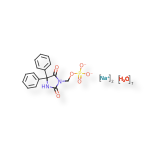

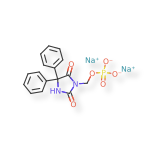

| Related Record | Type | Details | ||
|---|---|---|---|---|
|
|
ACTIVE MOIETY |
|
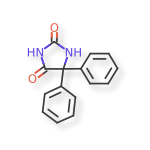
| Name | Property Type | Amount | Referenced Substance | Defining | Parameters | References |
|---|---|---|---|---|---|---|
| Volume of Distribution | PHARMACOKINETIC |
|
|
|||