


Details
| Stereochemistry | ABSOLUTE |
| Molecular Formula | 2C12H13N.C4H6O6 |
| Molecular Weight | 492.5635 |
| Optical Activity | UNSPECIFIED |
| Defined Stereocenters | 4 / 4 |
| E/Z Centers | 0 |
| Charge | 0 |
SHOW SMILES / InChI
SMILES
O[C@H]([C@@H](O)C(O)=O)C(O)=O.C#CCN[C@@H]1CCC2=CC=CC=C12.C#CCN[C@@H]3CCC4=CC=CC=C34
InChI
InChIKey=YGKHOZXCTLKSLJ-KHAGDFGNSA-N
InChI=1S/2C12H13N.C4H6O6/c2*1-2-9-13-12-8-7-10-5-3-4-6-11(10)12;5-1(3(7)8)2(6)4(9)10/h2*1,3-6,12-13H,7-9H2;1-2,5-6H,(H,7,8)(H,9,10)/t2*12-;1-,2-/m111/s1
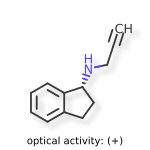
| Molecular Formula | C12H13N |
| Molecular Weight | 171.2383 |
| Charge | 0 |
| Count |
|
| Stereochemistry | ABSOLUTE |
| Additional Stereochemistry | No |
| Defined Stereocenters | 1 / 1 |
| E/Z Centers | 0 |
| Optical Activity | ( + ) |
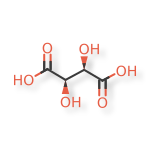
| Molecular Formula | C4H6O6 |
| Molecular Weight | 150.0868 |
| Charge | 0 |
| Count |
|
| Stereochemistry | ABSOLUTE |
| Additional Stereochemistry | No |
| Defined Stereocenters | 2 / 2 |
| E/Z Centers | 0 |
| Optical Activity | UNSPECIFIED |
Rasagiline (N-propargyl-1-(R)-aminoindan) is a selective, irreversible monoamine oxidase B (MAO B) inhibitor, which has been developed as an anti-Parkinson drug and was sold as a mesylate salt under brand name AZILECT. AZILECT is indicated for the treatment of the signs and symptoms of idiopathic Parkinson’s disease (PD) as initial monotherapy and as adjunct therapy to levodopa. The effectiveness of AZILECT was demonstrated in patients with early Parkinson’s disease who were receiving AZILECT as monotherapy and who were not receiving any concomitant dopaminergic therapy. The effectiveness of AZILECT as adjunct therapy was demonstrated in patients with Parkinson’s disease who were treated with levodopa. PD is a progressive neurodegenerative, dopamine deficiency disorder. The main therapeutic strategies for PD treatment relies on dopamine precursors (levodopa), inhibition of dopamine metabolism (monoamine oxidase [MAO] B and catechol-O-methyl transferase inhibitors), and dopamine receptor agonists. In contrast to selegiline, rasagiline is not metabolized to potentially toxic amphetamine metabolites. The precise mechanisms of action of rasagiline is unknown. One mechanism is believed to be related to its MAO-B inhibitory activity, which causes an increase in extracellular levels of dopamine in the striatum.
CNS Activity
Originator
Approval Year
Targets
| Primary Target | Pharmacology | Condition | Potency |
|---|---|---|---|
Target ID: CHEMBL2039 |
Conditions
| Condition | Modality | Targets | Highest Phase | Product |
|---|---|---|---|---|
| Primary | AZILECT Approved UseAZILECT (rasagiline tablets) is indicated for the treatment of Parkinson’s disease (PD). AZILECT, a monoamine oxidase (MAO)-B inhibitor (MAOI), is indicated for the treatment of Parkinson’s disease (1) Launch Date2006 |
Cmax
| Value | Dose | Co-administered | Analyte | Population |
|---|---|---|---|---|
56.13 ng/mL EXPERIMENT https://pubmed.ncbi.nlm.nih.gov/15628826 |
10 mg 1 times / day multiple, oral dose: 10 mg route of administration: Oral experiment type: MULTIPLE co-administered: |
RASAGILINE plasma | Homo sapiens population: HEALTHY age: ADULT sex: MALE food status: FASTED |
AUC
| Value | Dose | Co-administered | Analyte | Population |
|---|---|---|---|---|
53.53 ng × h/mL EXPERIMENT https://pubmed.ncbi.nlm.nih.gov/15628826 |
10 mg 1 times / day multiple, oral dose: 10 mg route of administration: Oral experiment type: MULTIPLE co-administered: |
RASAGILINE plasma | Homo sapiens population: HEALTHY age: ADULT sex: MALE food status: FASTED |
T1/2
| Value | Dose | Co-administered | Analyte | Population |
|---|---|---|---|---|
3.17 h EXPERIMENT https://pubmed.ncbi.nlm.nih.gov/15628826 |
10 mg 1 times / day multiple, oral dose: 10 mg route of administration: Oral experiment type: MULTIPLE co-administered: |
RASAGILINE plasma | Homo sapiens population: HEALTHY age: ADULT sex: MALE food status: FASTED |
Overview
| CYP3A4 | CYP2C9 | CYP2D6 | hERG |
|---|---|---|---|
OverviewOther
| Other Inhibitor | Other Substrate | Other Inducer |
|---|---|---|
Drug as perpetrator
| Target | Modality | Activity | Metabolite | Clinical evidence |
|---|---|---|---|---|
| no | ||||
| no | ||||
| no | ||||
| no | ||||
| no | ||||
| no | ||||
| no | ||||
| no |
Drug as victim
| Target | Modality | Activity | Metabolite | Clinical evidence |
|---|---|---|---|---|
| major | yes (co-administration study) Comment: ciprofloxacin increased rasagiline AUC by 83% Page: 56, 57, 69 |
|||
| no | ||||
| no | no (co-administration study) Comment: hesperetin and narigenin enhanced the systemic exposure of rasagiline not through P-gp |
Tox targets
| Target | Modality | Activity | Metabolite | Clinical evidence |
|---|---|---|---|---|
PubMed
| Title | Date | PubMed |
|---|---|---|
| Rationale for considering that propargylamines might be neuroprotective in Parkinson's disease. | 2006-05-23 |
|
| Rasagiline: A second-generation monoamine oxidase type-B inhibitor for the treatment of Parkinson's disease. | 2006-05-15 |
|
| Safety of rasagiline in elderly patients with Parkinson disease. | 2006-05-09 |
|
| Rasagiline improves quality of life in patients with early Parkinson's disease. | 2006-05 |
|
| Practice Parameter: treatment of Parkinson disease with motor fluctuations and dyskinesia (an evidence-based review): report of the Quality Standards Subcommittee of the American Academy of Neurology. | 2006-04-11 |
|
| Cost-utility model of rasagiline in the treatment of advanced Parkinson's disease in Finland. | 2006-04 |
|
| Rasagiline: defining the role of a novel therapy in the treatment of Parkinson's disease. | 2006-02 |
|
| Rasagiline -- is there a place for this drug in managing Parkinson's disease? | 2006-02 |
|
| Drugs in development for Parkinson's disease: an update. | 2006-01 |
|
| Monoamine oxidase: isoforms and inhibitors in Parkinson's disease and depressive illness. | 2006-01 |
|
| N-Propargylamine protects SH-SY5Y cells from apoptosis induced by an endogenous neurotoxin, N-methyl(R)salsolinol, through stabilization of mitochondrial membrane and induction of anti-apoptotic Bcl-2. | 2006-01 |
|
| Binding of rasagiline-related inhibitors to human monoamine oxidases: a kinetic and crystallographic analysis. | 2005-12-29 |
|
| Novel potential neuroprotective agents with both iron chelating and amino acid-based derivatives targeting central nervous system neurons. | 2005-11-25 |
|
| Recent advances in Parkinson's disease therapy: use of monoamine oxidase inhibitors. | 2005-11 |
|
| Present and future drug treatment for Parkinson's disease. | 2005-11 |
|
| Regulation of Bcl-2 family proteins, neurotrophic factors, and APP processing in the neurorescue activity of propargylamine. | 2005-11 |
|
| In vivo measurement of brain monoamine oxidase B occupancy by rasagiline, using (11)C-l-deprenyl and PET. | 2005-10 |
|
| Rasagiline in the pharmacotherapy of Parkinson's disease--a review. | 2005-10 |
|
| Novel multifunctional neuroprotective iron chelator-monoamine oxidase inhibitor drugs for neurodegenerative diseases: in vitro studies on antioxidant activity, prevention of lipid peroxide formation and monoamine oxidase inhibition. | 2005-10 |
|
| The neurochemical and behavioral effects of the novel cholinesterase-monoamine oxidase inhibitor, ladostigil, in response to L-dopa and L-tryptophan, in rats. | 2005-10 |
|
| [Rasagiline in motor fluctuations]. | 2005-09 |
|
| Novel neuroprotective mechanism of action of rasagiline is associated with its propargyl moiety: interaction of Bcl-2 family members with PKC pathway. | 2005-08 |
|
| Rasagiline. | 2005-08 |
|
| Reexamination of the TEMPO Study. | 2005-08 |
|
| Clinical pharmacology of rasagiline: a novel, second-generation propargylamine for the treatment of Parkinson disease. | 2005-08 |
|
| Neuroprotective effect of rasagiline, a monoamine oxidase-B inhibitor, on spontaneous cell degeneration in a rat model. | 2005-08 |
|
| [Rasagiline. A new monoamine oxidase b inhibitor for Parkinson treatment]. | 2005-07 |
|
| Parkinson's disease. Diagnosis and the initiation of therapy. | 2005-06 |
|
| Neuropharmacological, neuroprotective and amyloid precursor processing properties of selective MAO-B inhibitor antiparkinsonian drug, rasagiline. | 2005-06 |
|
| Evidence-based medical review update: pharmacological and surgical treatments of Parkinson's disease: 2001 to 2004. | 2005-05 |
|
| Novel pharmacological strategies for motor complications in Parkinson's disease. | 2005-04 |
|
| Mechanism of neuroprotective action of the anti-Parkinson drug rasagiline and its derivatives. | 2005-04 |
|
| Rasagiline as an adjunct to levodopa in patients with Parkinson's disease and motor fluctuations (LARGO, Lasting effect in Adjunct therapy with Rasagiline Given Once daily, study): a randomised, double-blind, parallel-group trial. | 2005-03-16 |
|
| Rasagiline for motor complications in Parkinson's disease. | 2005-03-16 |
|
| Characterization of the neuroprotective activity of rasagiline in cerebellar granule cells. | 2005-03 |
|
| A randomized placebo-controlled trial of rasagiline in levodopa-treated patients with Parkinson disease and motor fluctuations: the PRESTO study. | 2005-02 |
|
| Bifunctional drug derivatives of MAO-B inhibitor rasagiline and iron chelator VK-28 as a more effective approach to treatment of brain ageing and ageing neurodegenerative diseases. | 2005-02 |
|
| Movement disorders: understanding clinical trials. | 2005-01 |
|
| [The early therapy challenge]. | 2005 |
|
| Alternatives to levodopa in the initial treatment of early Parkinson's disease. | 2005 |
|
| Neuroprotection by rasagiline: a new therapeutic approach to Parkinson's disease? | 2005 |
|
| Neuroprotective therapy in Parkinson's disease and motor complications: a search for a pathogenesis-targeted, disease-modifying strategy. | 2005 |
|
| Rasagiline. | 2005 |
|
| Rasagiline: neurodegeneration, neuroprotection, and mitochondrial permeability transition. | 2004-12-02 |
|
| [Are there innovations in the treatment of Parkinson's disease?]. | 2004-11-03 |
|
| Clinical trials of neuroprotection for Parkinson's disease. | 2004-10-12 |
|
| Preclinical evidence for neuroprotection with monoamine oxidase-B inhibitors in Parkinson's disease. | 2004-10-12 |
|
| Tolerability, safety, pharmacodynamics, and pharmacokinetics of rasagiline: a potent, selective, and irreversible monoamine oxidase type B inhibitor. | 2004-10 |
|
| Novel bifunctional drugs targeting monoamine oxidase inhibition and iron chelation as an approach to neuroprotection in Parkinson's disease and other neurodegenerative diseases. | 2004-10 |
|
| Recent approaches to novel anti-Alzheimer therapy. | 2004 |
Patents
Sample Use Guides
Monotherapy: the recommended AZILECT (RASAGILINE MESYLATE) dose for the treatment of Parkinson’s disease patients is 1 mg administered once daily.
Adjunctive Therapy: the recommended initial dose is 0.5 mg administered once daily. If a sufficient clinical response is not achieved, the dose may be increased to 1 mg administered once daily. Change of levodopa dose in adjunct therapy: When AZILECT is used in combination with levodopa, a reduction of the levodopa dosage may be considered based upon individual response. During the controlled trials of AZILECT as adjunct therapy to levodopa, levodopa dosage was reduced in some patients. In clinical studies, dosage reduction of levodopa was allowed within the first 6 weeks if dopaminergic side effects, including dyskinesia and hallucinations, emerged.
Route of Administration:
Oral
The present series of in vitro experiments using the rat hippocampal slice preparation deals with effects of rasagiline and its metabolite R-(-)-aminoindan on the pyramidal cell response after electric stimulation of the Schaffer Collaterals in comparison to selegiline, another MAO B inhibitor. During the first series, this response was attenuated in the presence of rasagiline and aminoindan-to a lesser degree of selegiline-in a concentration dependent manner (5-50 μM) after single stimuli as well as under theta burst stimulation (TBS). The presence of rasagiline and aminoindan, but rarely the presence of selegiline, prevented this break down. Following glutamate receptor mediated enhancements of neuronal transmission in a second series of experiments very clear differences could be observed in comparison to the action of selegiline: NMDA receptor, AMPA receptor as well as metabotropic glutamate receptor mediated increases of transmission were concentration dependently (0,3 - 2 μM) antagonized by rasagiline and aminoindan, but not by selegiline. On the opposite, only selegiline attenuated kainate receptor mediated increases of excitability. Thus, both monoamino oxidase (MAO) B inhibitors show attenuation of glutamatergic transmission in the hippocampus but interfere with different receptor mediated excitatory modulations at low concentrations.
| Substance Class |
Chemical
Created
by
admin
on
Edited
Mon Mar 31 19:09:54 GMT 2025
by
admin
on
Mon Mar 31 19:09:54 GMT 2025
|
| Record UNII |
B9A329CN07
|
| Record Status |
Validated (UNII)
|
| Record Version |
|
-
Download
| Name | Type | Language | ||
|---|---|---|---|---|
|
Preferred Name | English | ||
|
Common Name | English | ||
|
Common Name | English | ||
|
Common Name | English |
| Classification Tree | Code System | Code | ||
|---|---|---|---|---|
|
NCI_THESAURUS |
C667
Created by
admin on Mon Mar 31 19:09:54 GMT 2025 , Edited by admin on Mon Mar 31 19:09:54 GMT 2025
|
| Code System | Code | Type | Description | ||
|---|---|---|---|---|---|
|
136236-52-7
Created by
admin on Mon Mar 31 19:09:54 GMT 2025 , Edited by admin on Mon Mar 31 19:09:54 GMT 2025
|
PRIMARY | |||
|
950981-99-4
Created by
admin on Mon Mar 31 19:09:54 GMT 2025 , Edited by admin on Mon Mar 31 19:09:54 GMT 2025
|
NON-SPECIFIC STOICHIOMETRY | |||
|
B9A329CN07
Created by
admin on Mon Mar 31 19:09:54 GMT 2025 , Edited by admin on Mon Mar 31 19:09:54 GMT 2025
|
PRIMARY | |||
|
C97711
Created by
admin on Mon Mar 31 19:09:54 GMT 2025 , Edited by admin on Mon Mar 31 19:09:54 GMT 2025
|
PRIMARY | |||
|
71550735
Created by
admin on Mon Mar 31 19:09:54 GMT 2025 , Edited by admin on Mon Mar 31 19:09:54 GMT 2025
|
PRIMARY | |||
|
SUB182629
Created by
admin on Mon Mar 31 19:09:54 GMT 2025 , Edited by admin on Mon Mar 31 19:09:54 GMT 2025
|
PRIMARY | |||
|
100000160618
Created by
admin on Mon Mar 31 19:09:54 GMT 2025 , Edited by admin on Mon Mar 31 19:09:54 GMT 2025
|
PRIMARY | |||
|
SUB172785
Created by
admin on Mon Mar 31 19:09:54 GMT 2025 , Edited by admin on Mon Mar 31 19:09:54 GMT 2025
|
PRIMARY |
| Related Record | Type | Details | ||
|---|---|---|---|---|
|
|
PARENT -> SALT/SOLVATE |
|
||
|
|
PARENT -> SALT/SOLVATE |
|
| Related Record | Type | Details | ||
|---|---|---|---|---|
|
|
ACTIVE MOIETY |
|