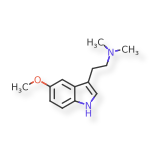
Details
| Stereochemistry | ACHIRAL |
| Molecular Formula | C13H18N2O.C4H6O4 |
| Molecular Weight | 336.3829 |
| Optical Activity | NONE |
| Defined Stereocenters | 0 / 0 |
| E/Z Centers | 0 |
| Charge | 0 |
SHOW SMILES / InChI
SMILES
OC(=O)CCC(O)=O.COC1=CC2=C(NC=C2CCN(C)C)C=C1
InChI
InChIKey=QGPJMYNZUUBWLQ-UHFFFAOYSA-N
InChI=1S/C13H18N2O.C4H6O4/c1-15(2)7-6-10-9-14-13-5-4-11(16-3)8-12(10)13;5-3(6)1-2-4(7)8/h4-5,8-9,14H,6-7H2,1-3H3;1-2H2,(H,5,6)(H,7,8)
| Molecular Formula | C4H6O4 |
| Molecular Weight | 118.088 |
| Charge | 0 |
| Count |
|
| Stereochemistry | ACHIRAL |
| Additional Stereochemistry | No |
| Defined Stereocenters | 0 / 0 |
| E/Z Centers | 0 |
| Optical Activity | NONE |
| Molecular Formula | C13H18N2O |
| Molecular Weight | 218.2948 |
| Charge | 0 |
| Count |
|
| Stereochemistry | ACHIRAL |
| Additional Stereochemistry | No |
| Defined Stereocenters | 0 / 0 |
| E/Z Centers | 0 |
| Optical Activity | NONE |
N,N-Dimethyl-5-Methoxytryptamine (aka 5-MeO-DMT) is a psychedelic of the tryptamine class. It is found in a wide variety of plant species, and a single psychoactive toad species, the Colorado River toad. Like its close relatives DMT and bufotenin (5-HO-DMT), it has been used as an entheogen in South America. It can also be found in the dart poison traditionally used by the Yanoama Indians of Upper Orinoco. It acts as a non-selective serotonin (5-HT) agonist. -MeO-DMT is O-demethylated by polymorphic cytochrome P450 2D6 (CYP2D6) to an active metabolite, bufotenine. 5-MeO-DMT is classified as a controlled substance in China, Australia, Sweden, Turkey, and the USA.
CNS Activity
Approval Year
PubMed
| Title | Date | PubMed |
|---|---|---|
| The hallucinogenic world of tryptamines: an updated review. | 2015-08 |
|
| Schedules of controlled substances: placement of 5-methoxy-N,N-dimethyltryptamine into Schedule I of the Controlled Substances Act. Final rule. | 2010-12-20 |
|
| Hearing loss alters serotonergic modulation of intrinsic excitability in auditory cortex. | 2010-11 |
|
| Psychedelic 5-methoxy-N,N-dimethyltryptamine: metabolism, pharmacokinetics, drug interactions, and pharmacological actions. | 2010-10 |
|
| Intrahippocampal LSD accelerates learning and desensitizes the 5-HT(2A) receptor in the rabbit, Romano et al. | 2010-10 |
|
| Effects of monoamine oxidase inhibitor and cytochrome P450 2D6 status on 5-methoxy-N,N-dimethyltryptamine metabolism and pharmacokinetics. | 2010-07-01 |
|
| Early-life treatment of antiserotonin antibodies alters sensitivity to serotonin receptors, nociceptive stimulus and serotonin metabolism in adult rats. | 2010-06 |
|
| LSD but not lisuride disrupts prepulse inhibition in rats by activating the 5-HT(2A) receptor. | 2010-02 |
|
| Human and mouse trace amine-associated receptor 1 have distinct pharmacology towards endogenous monoamines and imidazoline receptor ligands. | 2009-10-23 |
|
| Endogenous hallucinogens as ligands of the trace amine receptors: a possible role in sensory perception. | 2009-01 |
|
| Modification of the effects of 5-methoxy-N,N-dimethyltryptamine on exploratory behavior in rats by monoamine oxidase inhibitors. | 2008-11 |
|
| Indolealkylamines: biotransformations and potential drug-drug interactions. | 2008-06 |
|
| Solubilization of 5-methoxy tryptamine molecular probes in CTAB and SDS micelles: a cmc and binding constant study. | 2008-03 |
|
| Comparison of the separation of nine tryptamine standards based on gas chromatography, high performance liquid chromatography and capillary electrophoresis methods. | 2008-02-15 |
|
| Delta 9-tetrahydrocannabinol-induced catalepsy-like immobilization is mediated by decreased 5-HT neurotransmission in the nucleus accumbens due to the action of glutamate-containing neurons. | 2008-01-24 |
|
| A general approach to the screening and confirmation of tryptamines and phenethylamines by mass spectral fragmentation. | 2008-01-15 |
|
| Neurobiology of spirituality. | 2008-01 |
|
| In vitro screening of psychoactive drugs by [(35)S]GTPgammaS binding in rat brain membranes. | 2007-12 |
|
| The effects of non-medically used psychoactive drugs on monoamine neurotransmission in rat brain. | 2007-03-22 |
|
| Analysis of hallucinogenic constituents in Amanita mushrooms circulated in Japan. | 2006-12-20 |
|
| Efficient and sensitive method for quantitative analysis of alkaloids in hardinggrass (Phalaris aquatica L.). | 2006-12-13 |
|
| The roles of 5-HT1A and 5-HT2 receptors in the effects of 5-MeO-DMT on locomotor activity and prepulse inhibition in rats. | 2006-12 |
|
| Human trabecular meshwork cells express functional serotonin-2A (5HT2A) receptors: role in IOP reduction. | 2006-09 |
|
| A demand for clarity regarding a case report on the ingestion of 5-methoxy-N, N-dimethyltryptamine (5-MeO-DMT) in an Ayahuasca preparation. | 2006-07-29 |
|
| A fatal intoxication following the ingestion of 5-methoxy-N,N-dimethyltryptamine in an ayahuasca preparation. | 2005-12-17 |
|
| Pharmacologic analysis of non-synonymous coding h5-HT2A SNPs reveals alterations in atypical antipsychotic and agonist efficacies. | 2005-11-30 |
|
| Suppressive effects of isorhynchophylline on 5-HT2A receptor function in the brain: behavioural and electrophysiological studies. | 2005-07-11 |
|
| The rapid analysis of heroin drug seizures using micellar electrokinetic chromatography with short-end injection. | 2005-01 |
|
| Mechanism of action of aripiprazole predicts clinical efficacy and a favourable side-effect profile. | 2004-09 |
|
| The Meixner test in the detection of alpha-amanitin and false-positive reactions caused by psilocin and 5-substituted tryptamines. | 2004-08 |
|
| Binding of tryptamine analogs at h5-HT1E receptors: a structure-affinity investigation. | 2004-05-15 |
|
| Pharmacological characterization of a serotonin receptor (5-HT7) stimulating cAMP production in human corneal epithelial cells. | 2003-11 |
|
| Identification of cytokinins produced by the plant parasitic nematodes Heterodera schachtii and Meloidogyne incognita. | 2003-07-01 |
|
| Evaluation of the ocular hypotensive response of serotonin 5-HT1A and 5-HT2 receptor ligands in conscious ocular hypertensive cynomolgus monkeys. | 2003-07 |
|
| Screening for endogenous substrates reveals that CYP2D6 is a 5-methoxyindolethylamine O-demethylase. | 2003-06 |
|
| The role of 5-HT(1A) receptors in control of lower urinary tract function in cats. | 2002-08-16 |
|
| Involvement of 5-hydroxytryptamine neuronal system in Delta(9)-tetrahydrocannabinol-induced impairment of spatial memory. | 2002-06-12 |
|
| 5-HT2A receptor-stimulated phosphoinositide hydrolysis in the stimulus effects of hallucinogens. | 2002-05 |
|
| Pharmepéna-Psychonautics: Human intranasal, sublingual and oral pharmacology of 5-methoxy-N,N-dimethyl-tryptamine. | 2002-02-05 |
|
| [(3)H]-serotonin release from bovine iris-ciliary body: pharmacology of prejunctional serotonin (5-HT(7)) autoreceptors. | 2001-07 |
|
| Distribution of the hallucinogens N,N-dimethyltryptamine and 5-methoxy-N,N-dimethyltryptamine in rat brain following intraperitoneal injection: application of a new solid-phase extraction LC-APcI-MS-MS-isotope dilution method. | 2001-02-10 |
|
| Determination of potentially hallucinogenic N-dimethylated indoleamines in human urine by HPLC/ESI-MS-MS. | 2001 |
|
| Effects of serotoninergic drugs on tremor induced by physostigmine in rats. | 2000-05 |
|
| High-affinity agonist binding correlates with efficacy (intrinsic activity) at the human serotonin 5-HT2A and 5-HT2C receptors: evidence favoring the ternary complex and two-state models of agonist action. | 1999-05 |
|
| Identification of residues in transmembrane regions III and VI that contribute to the ligand binding site of the serotonin 5-HT6 receptor. | 1998-11 |
|
| Molecular cloning and expression of a 5-hydroxytryptamine7 serotonin receptor subtype. | 1993-08-25 |
|
| Cloning of another human serotonin receptor (5-HT1F): a fifth 5-HT1 receptor subtype coupled to the inhibition of adenylate cyclase. | 1993-01-15 |
|
| [Methylated and unmethylated indolamine in the cisternal fluid in acute endogenous psychoses]. | 1983 |
|
| Repeated chlorpromazine administration increases a behavioural response of rats to 5-hydroxytryptamine receptor stimulation. | 1977-02 |
Sample Use Guides
10 mg of 5-MeO-DMT administrated intranasally or sublingually causes a significant visionary response.
Route of Administration:
Other
Membranes were prepared from the cerebral cortex and striatum of Male SD rats and maintained in HEPES buffer pH 7.6, 20 mM HEPES, 7 mM MgCl2, 100 mM NaCl, 1 mM EDTA, 0.2 mM dithiothreitol (DTT). Cells were plated in 96 wells containing an assay buffer of 25 mM HEPES, pH 7.6, 7 mM MgCl2, 100 mM NaCl, 1 mM EDTA, 0.2 mM DTT and 10 mM DPCPX. Each well also received various concentrations screening compounds, DA, 5-HT, NE, and the mixture of brain membranes (2 mg protein/well for the striatum and 4 mg protein/well for the cortex) and 150 micro-M GDP. This mixture was pre-incubated at 30 °C for 20 minutes with shaking. Incubation was started by adding 0.1 nM [35S]GTPgS to a total volume of 100 mL and continued at 30 °C for 90 minutes with shaking. The reaction was stopped by rapid filtration and retained membrane-bound radioactivity on the filter was measured by liquid scintillation counting. 5-MeODMT was found to have an EC50 of 3.8 x 10^07 M.
| Substance Class |
Chemical
Created
by
admin
on
Edited
Wed Apr 02 14:33:36 GMT 2025
by
admin
on
Wed Apr 02 14:33:36 GMT 2025
|
| Record UNII |
BN4EF8WH5L
|
| Record Status |
Validated (UNII)
|
| Record Version |
|
-
Download
| Name | Type | Language | ||
|---|---|---|---|---|
|
Common Name | English | ||
|
Preferred Name | English | ||
|
Systematic Name | English | ||
|
Systematic Name | English |
| Code System | Code | Type | Description | ||
|---|---|---|---|---|---|
|
BN4EF8WH5L
Created by
admin on Wed Apr 02 14:33:36 GMT 2025 , Edited by admin on Wed Apr 02 14:33:36 GMT 2025
|
PRIMARY | |||
|
2568048-63-3
Created by
admin on Wed Apr 02 14:33:36 GMT 2025 , Edited by admin on Wed Apr 02 14:33:36 GMT 2025
|
PRIMARY | |||
|
164886348
Created by
admin on Wed Apr 02 14:33:36 GMT 2025 , Edited by admin on Wed Apr 02 14:33:36 GMT 2025
|
PRIMARY |
| Related Record | Type | Details | ||
|---|---|---|---|---|
|
|
PARENT -> SALT/SOLVATE |
|