


Details
| Stereochemistry | ACHIRAL |
| Molecular Formula | C22H23N3O4.ClH |
| Molecular Weight | 429.897 |
| Optical Activity | NONE |
| Defined Stereocenters | 0 / 0 |
| E/Z Centers | 0 |
| Charge | 0 |
SHOW SMILES / InChI
SMILES
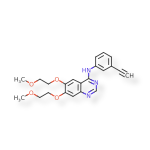
Cl.COCCOC1=CC2=NC=NC(NC3=CC=CC(=C3)C#C)=C2C=C1OCCOC
InChI
InChIKey=GTTBEUCJPZQMDZ-UHFFFAOYSA-N
InChI=1S/C22H23N3O4.ClH/c1-4-16-6-5-7-17(12-16)25-22-18-13-20(28-10-8-26-2)21(29-11-9-27-3)14-19(18)23-15-24-22;/h1,5-7,12-15H,8-11H2,2-3H3,(H,23,24,25);1H
| Molecular Formula | ClH |
| Molecular Weight | 36.461 |
| Charge | 0 |
| Count |
|
| Stereochemistry | ACHIRAL |
| Additional Stereochemistry | No |
| Defined Stereocenters | 0 / 0 |
| E/Z Centers | 0 |
| Optical Activity | NONE |
| Molecular Formula | C22H23N3O4 |
| Molecular Weight | 393.4357 |
| Charge | 0 |
| Count |
|
| Stereochemistry | ACHIRAL |
| Additional Stereochemistry | No |
| Defined Stereocenters | 0 / 0 |
| E/Z Centers | 0 |
| Optical Activity | NONE |
DescriptionSources: http://www.drugbank.ca/drugs/DB00530Curator's Comment: Description was created based on several sources, including
http://www.accessdata.fda.gov/drugsatfda_docs/label/2010/021743s14s16lbl.pdf
Sources: http://www.drugbank.ca/drugs/DB00530
Curator's Comment: Description was created based on several sources, including
http://www.accessdata.fda.gov/drugsatfda_docs/label/2010/021743s14s16lbl.pdf
Erlotinib hydrochloride (trade name Tarceva, Genentech/OSIP, originally coded as OSI-774) is a drug used to treat non-small cell lung cancer, pancreatic cancer and several other types of cancer. Similar to gefitinib, erlotinib specifically targets the epidermal growth factor receptor (EGFR) tyrosine kinase. It binds in a reversible fashion to the adenosine triphosphate (ATP) binding site of the receptor. Erlotinib has recently been shown to be a potent inhibitor of JAK2V617F activity. JAK2V617F is a mutant of tyrosine kinase JAK2, is found in most patients with polycythemia vera (PV) and a substantial proportion of patients with idiopathic myelofibrosis or essential thrombocythemia. The study suggests that erlotinib may be used for treatment of JAK2V617F-positive PV and other myeloproliferative disorders. The mechanism of clinical antitumor action of erlotinib is not fully characterized. Erlotinib inhibits the intracellular phosphorylation of tyrosine kinase associated with the epidermal growth factor receptor (EGFR). Specificity of inhibition with regard to other tyrosine kinase receptors has not been fully characterized. EGFR is expressed on the cell surface of normal cells and cancer cells.
CNS Activity
Originator
Approval Year
Targets
| Primary Target | Pharmacology | Condition | Potency |
|---|---|---|---|
Target ID: CHEMBL203 |
1.2 nM [IC50] | ||
Target ID: CHEMBL3401 Sources: http://www.drugbank.ca/drugs/DB00530 |
|||
Target ID: CHEMBL5393 |
2.23 µM [IC50] | ||
Target ID: CHEMBL614139 |
0.02 µM [IC50] | ||
Target ID: CHEMBL5145 |
0.08 µM [IC50] | ||
Target ID: CHEMBL2363049 |
0.05 µM [IC50] |
Conditions
| Condition | Modality | Targets | Highest Phase | Product |
|---|---|---|---|---|
| Primary | TARCEVA Approved UseTARCEVA is a kinase inhibitor indicated for:
Maintenance treatment of patients with locally advanced or metastatic non-small cell lung cancer (NSCLC) whose disease has not progressed after four cycles of platinum-based first-line chemotherapy.
Treatment of locally advanced or metastatic non-small cell lung cancer after failure of at least one prior chemotherapy regimen.
First-line treatment of patients with locally advanced, unresectable or metastatic pancreatic cancer, in combination with gemcitabine. Launch Date2004 |
|||
| Primary | TARCEVA Approved UseTARCEVA is a kinase inhibitor indicated for:
Maintenance treatment of patients with locally advanced or metastatic non-small cell lung cancer (NSCLC) whose disease has not progressed after four cycles of platinum-based first-line chemotherapy.
Treatment of locally advanced or metastatic non-small cell lung cancer after failure of at least one prior chemotherapy regimen.
First-line treatment of patients with locally advanced, unresectable or metastatic pancreatic cancer, in combination with gemcitabine. Launch Date2004 |
Cmax
| Value | Dose | Co-administered | Analyte | Population |
|---|---|---|---|---|
1969.5 ng/mL Clinical Trial https://clinicaltrials.gov/ct2/show/NCT01032070 |
85 mg/m^2 1 times / day steady, oral dose: 85 mg/m^2 route of administration: oral experiment type: steady co-administered: |
ERLOTINIB plasma | Homo sapiens population: unhealthy age: Children sex: UNKNOWN food status: UNKNOWN |
|
4.07 μg/mL EXPERIMENT https://www.ncbi.nlm.nih.gov/pubmed/19956953 |
100 mg single, intravenous dose: 100 mg route of administration: Intravenous experiment type: SINGLE co-administered: |
ERLOTINIB plasma | Homo sapiens population: UNHEALTHY age: ADULT sex: FEMALE / MALE food status: UNKNOWN |
|
1.25 μg/mL EXPERIMENT https://www.ncbi.nlm.nih.gov/pubmed/19956953 |
100 mg single, oral dose: 100 mg route of administration: Oral experiment type: SINGLE co-administered: |
ERLOTINIB plasma | Homo sapiens population: UNHEALTHY age: ADULT sex: UNKNOWN food status: UNKNOWN |
|
1108.89 ng/mL EXPERIMENT http://doi.org/10.4172/jbb.1000190 |
150 mg single, oral dose: 150 mg route of administration: Oral experiment type: SINGLE co-administered: |
ERLOTINIB HYDROCHLORIDE plasma | Homo sapiens population: HEALTHY age: ADULT sex: FEMALE / MALE food status: UNKNOWN |
|
1.09 μg/mL |
150 mg 1 times / day multiple, oral dose: 150 mg route of administration: Oral experiment type: MULTIPLE co-administered: |
ERLOTINIB HYDROCHLORIDE plasma | Homo sapiens population: UNHEALTHY age: ADULT sex: UNKNOWN food status: FASTED |
AUC
| Value | Dose | Co-administered | Analyte | Population |
|---|---|---|---|---|
26716.7 ng*h/mL Clinical Trial https://clinicaltrials.gov/ct2/show/NCT01032070 |
85 mg/m^2 1 times / day steady, oral dose: 85 mg/m^2 route of administration: oral experiment type: steady co-administered: |
ERLOTINIB plasma | Homo sapiens population: unhealthy age: Children sex: UNKNOWN food status: UNKNOWN |
|
32 μg × h/mL EXPERIMENT https://www.ncbi.nlm.nih.gov/pubmed/19956953 |
100 mg single, intravenous dose: 100 mg route of administration: Intravenous experiment type: SINGLE co-administered: |
ERLOTINIB plasma | Homo sapiens population: UNHEALTHY age: ADULT sex: FEMALE / MALE food status: UNKNOWN |
|
29.9 μg × h/mL EXPERIMENT https://www.ncbi.nlm.nih.gov/pubmed/19956953 |
100 mg single, oral dose: 100 mg route of administration: Oral experiment type: SINGLE co-administered: |
ERLOTINIB plasma | Homo sapiens population: UNHEALTHY age: ADULT sex: UNKNOWN food status: UNKNOWN |
|
25489.41 ng × h/mL EXPERIMENT http://doi.org/10.4172/jbb.1000190 |
150 mg single, oral dose: 150 mg route of administration: Oral experiment type: SINGLE co-administered: |
ERLOTINIB HYDROCHLORIDE plasma | Homo sapiens population: HEALTHY age: ADULT sex: FEMALE / MALE food status: UNKNOWN |
|
15.2 μg × h/mL |
150 mg 1 times / day multiple, oral dose: 150 mg route of administration: Oral experiment type: MULTIPLE co-administered: |
ERLOTINIB HYDROCHLORIDE plasma | Homo sapiens population: UNHEALTHY age: ADULT sex: UNKNOWN food status: FASTED |
T1/2
| Value | Dose | Co-administered | Analyte | Population |
|---|---|---|---|---|
12.4 h EXPERIMENT https://www.ncbi.nlm.nih.gov/pubmed/19956953 |
100 mg single, intravenous dose: 100 mg route of administration: Intravenous experiment type: SINGLE co-administered: |
ERLOTINIB plasma | Homo sapiens population: UNHEALTHY age: ADULT sex: FEMALE / MALE food status: UNKNOWN |
|
14.4 h EXPERIMENT https://www.ncbi.nlm.nih.gov/pubmed/19956953 |
100 mg single, oral dose: 100 mg route of administration: Oral experiment type: SINGLE co-administered: |
ERLOTINIB plasma | Homo sapiens population: UNHEALTHY age: ADULT sex: UNKNOWN food status: UNKNOWN |
|
36.2 h |
150 mg single, oral dose: 150 mg route of administration: Oral experiment type: SINGLE co-administered: |
ERLOTINIB HYDROCHLORIDE plasma | Homo sapiens population: UNKNOWN age: UNKNOWN sex: UNKNOWN food status: UNKNOWN |
|
14.33 h EXPERIMENT http://doi.org/10.4172/jbb.1000190 |
150 mg single, oral dose: 150 mg route of administration: Oral experiment type: SINGLE co-administered: |
ERLOTINIB HYDROCHLORIDE plasma | Homo sapiens population: HEALTHY age: ADULT sex: FEMALE / MALE food status: UNKNOWN |
|
14.75 h |
150 mg 1 times / day multiple, oral dose: 150 mg route of administration: Oral experiment type: MULTIPLE co-administered: |
ERLOTINIB HYDROCHLORIDE plasma | Homo sapiens population: UNHEALTHY age: ADULT sex: UNKNOWN food status: FASTED |
Funbound
| Value | Dose | Co-administered | Analyte | Population |
|---|---|---|---|---|
7% |
ERLOTINIB plasma | Homo sapiens population: UNKNOWN age: UNKNOWN sex: UNKNOWN food status: UNKNOWN |
||
7% |
150 mg single, oral dose: 150 mg route of administration: Oral experiment type: SINGLE co-administered: |
ERLOTINIB HYDROCHLORIDE plasma | Homo sapiens population: UNKNOWN age: UNKNOWN sex: UNKNOWN food status: UNKNOWN |
Overview
| CYP3A4 | CYP2C9 | CYP2D6 | hERG |
|---|---|---|---|
OverviewOther
| Other Inhibitor | Other Substrate | Other Inducer |
|---|---|---|
Drug as perpetrator
| Target | Modality | Activity | Metabolite | Clinical evidence |
|---|---|---|---|---|
| yes [IC50 0.93 uM] | ||||
| yes [IC50 31 uM] | ||||
| yes [IC50 <0.1 uM] | ||||
| yes [Ki 10 uM] | ||||
| yes [Ki 14.7 uM] | ||||
| yes [Ki 20 uM] | ||||
| yes [Ki 35.7 uM] | ||||
| yes [Ki 44 uM] |
Drug as victim
| Target | Modality | Activity | Metabolite | Clinical evidence |
|---|---|---|---|---|
| major [Km 5.9 uM] | yes (co-administration study) Comment: Coadministration of erlotinib with ketoconazole, a potent inhibitor of CYP3A4, resulted in a significant (67%) increase in erlotinib exposure (Study NP16612). The CYP3A4 inducer rifampicin has been demonstrated to impact the exposure to erlotinib; in Study NP16638 co-administration led to a 64% reduction in erlotinib AUC. Sources: https://www.accessdata.fda.gov/drugsatfda_docs/nda/2004/21-743_Tarceva_biopharmr.PDF#page=10 Page: - |
|||
| minor | ||||
| no | ||||
| no | ||||
| no | ||||
| yes [Km 24 uM] | ||||
| yes | ||||
| yes | ||||
| yes |
Tox targets
| Target | Modality | Activity | Metabolite | Clinical evidence |
|---|---|---|---|---|
PubMed
| Title | Date | PubMed |
|---|---|---|
| Benzamides and benzamidines as specific inhibitors of epidermal growth factor receptor and v-Src protein tyrosine kinases. | 2004-07-01 |
|
| The role of erlotinib (Tarceva, OSI 774) in the treatment of non-small cell lung cancer. | 2004-06-15 |
|
| Epidermal growth factor receptor tyrosine kinase inhibitors. | 2004-06-14 |
|
| Targeting non-small cell lung cancer with epidermal growth factor tyrosine kinase inhibitors: where do we stand, where do we go. | 2004-06 |
|
| EGFR inhibitors square off at ASCO. | 2004-06 |
|
| Antitumor activity of erlotinib (OSI-774, Tarceva) alone or in combination in human non-small cell lung cancer tumor xenograft models. | 2004-06 |
|
| Combination treatment of glioblastoma multiforme cell lines with the anti-malarial artesunate and the epidermal growth factor receptor tyrosine kinase inhibitor OSI-774. | 2004-05-01 |
|
| Current data and ongoing trials in patients with recurrent non-small-cell lung cancer. | 2004-05 |
|
| [Lung cancer: molecular targeting therapy]. | 2004-05 |
|
| New cytotoxic and molecular-targeted therapies of head and neck tumors. | 2004-05 |
|
| Identification of epidermal growth factor receptor-derived peptides immunogenic for HLA-A2(+) cancer patients. | 2004-04-19 |
|
| Gateways to clinical trials. | 2004-04 |
|
| Epidermal growth factor receptor inhibitors for the treatment of colorectal cancer: a promise fulfilled? | 2004-04 |
|
| Epidermal growth factor receptor tyrosine kinase inhibitors: evolving role in the treatment of solid tumors. | 2004-04 |
|
| Rationale and clinical validation of epidermal growth factor receptor as a target in the treatment of head and neck cancer. | 2004-04 |
|
| Emerging role of epidermal growth factor receptor inhibition in therapy for advanced malignancy: focus on NSCLC. | 2004-03-01 |
|
| The HER receptor family: a rich target for therapeutic development. | 2004-03-01 |
|
| The role of EGFR inhibitors in nonsmall cell lung cancer. | 2004-03 |
|
| [Bronchioloalveolar carcinoma (BAC)]. | 2004-03 |
|
| Inverse correlation of epidermal growth factor receptor messenger RNA induction and suppression of anchorage-independent growth by OSI-774, an epidermal growth factor receptor tyrosine kinase inhibitor, in glioblastoma multiforme cell lines. | 2004-03 |
|
| Gateways to clinical trials. | 2004-02-28 |
|
| Emerging treatments in oncology: focus on tyrosine kinase (erbB) receptor inhibitors. | 2004-02-18 |
|
| Gefitinib ('Iressa', ZD1839) and new epidermal growth factor receptor inhibitors. | 2004-02-09 |
|
| Novel treatments in non-small cell lung cancer. | 2004-02 |
|
| Pharmacology of oral chemotherapy agents. | 2004-01-07 |
|
| Synthesis and SAR of potent EGFR/erbB2 dual inhibitors. | 2004-01-05 |
|
| Multicenter phase II study of erlotinib, an oral epidermal growth factor receptor tyrosine kinase inhibitor, in patients with recurrent or metastatic squamous cell cancer of the head and neck. | 2004-01-01 |
|
| Lung cancer: looking ahead in 2004. | 2004-01 |
|
| Review of epidermal growth factor receptor biology. | 2004 |
|
| Potential role for epidermal growth factor receptor inhibitors in combined-modality therapy for non-small-cell lung cancer. | 2004 |
|
| Emerging roles of targeted small molecule protein-tyrosine kinase inhibitors in cancer therapy. | 2004 |
|
| HER1/EGFR targeting: refining the strategy. | 2004 |
|
| Distribution and function of EGFR in human tissue and the effect of EGFR tyrosine kinase inhibition. | 2003-12-12 |
|
| For investigational targeted drugs, combination trials pose challenges. | 2003-12-03 |
|
| Targeting the epidermal growth factor receptor in non-small cell lung cancer. | 2003-12-01 |
|
| Epidermal growth factor receptor tyrosine kinase inhibitors: application in non-small cell lung cancer. | 2003-12 |
|
| Tolerability of gefitinib in patients receiving treatment in everyday clinical practice. | 2003-12 |
|
| [Therapeutic implications of epidermal growth factor receptor in lung cancer]. | 2003-11 |
|
| [Inhibitors of epidermal growth factor receptor and colorectal cancer]. | 2003-11 |
|
| [Targeting of epidermal growth factor receptor and applications in ORL cancer]. | 2003-11 |
|
| Identifying predictive and surrogate markers of erlotinib antitumor activity other than rash. | 2003-11 |
|
| Can rash associated with HER1/EGFR inhibition be used as a marker of treatment outcome? | 2003-11 |
|
| Clinical experience with the HER1/EGFR tyrosine kinase inhibitor erlotinib. | 2003-11 |
|
| Erlotinib: preclinical investigations. | 2003-11 |
|
| Targeting the HER1/EGFR receptor to improve outcomes in non-small-cell lung cancer. | 2003-11 |
|
| Epidermal growth factor receptor tyrosine kinase inhibitors in late stage clinical trials. | 2003-11 |
|
| Defining the role of the epidermal growth factor receptor in pancreatic cancer grown in vitro. | 2003-11 |
|
| Gateways to clinical trials. | 2003-10 |
|
| 3D-QSAR and docking studies on 4-anilinoquinazoline and 4-anilinoquinoline epidermal growth factor receptor (EGFR) tyrosine kinase inhibitors. | 2003-08 |
|
| Small-molecule epidermal growth factor receptor tyrosine kinase inhibitors. | 2003 |
Sample Use Guides
The dose for NSCLC is 150 mg/day.
The dose for pancreatic cancer is 100 mg/day.
All doses of TARCEVA should be taken on an empty stomach at least
one hour before or two hours after food
Route of Administration:
Oral
| Substance Class |
Chemical
Created
by
admin
on
Edited
Mon Mar 31 18:00:05 GMT 2025
by
admin
on
Mon Mar 31 18:00:05 GMT 2025
|
| Record UNII |
DA87705X9K
|
| Record Status |
Validated (UNII)
|
| Record Version |
|
-
Download
| Name | Type | Language | ||
|---|---|---|---|---|
|
Preferred Name | English | ||
|
Official Name | English | ||
|
Systematic Name | English | ||
|
Common Name | English | ||
|
Common Name | English | ||
|
Common Name | English | ||
|
Code | English | ||
|
Systematic Name | English | ||
|
Common Name | English | ||
|
Common Name | English | ||
|
Common Name | English | ||
|
Common Name | English | ||
|
Common Name | English | ||
|
Code | English | ||
|
Code | English | ||
|
Common Name | English | ||
|
Code | English |
| Classification Tree | Code System | Code | ||
|---|---|---|---|---|
|
NCI_THESAURUS |
C2167
Created by
admin on Mon Mar 31 18:00:05 GMT 2025 , Edited by admin on Mon Mar 31 18:00:05 GMT 2025
|
||
|
EMA ASSESSMENT REPORTS |
TARCEVA (AUTHORIZED: PANCREATIC NEOPLASMS)
Created by
admin on Mon Mar 31 18:00:05 GMT 2025 , Edited by admin on Mon Mar 31 18:00:05 GMT 2025
|
||
|
NCI_THESAURUS |
C129825
Created by
admin on Mon Mar 31 18:00:05 GMT 2025 , Edited by admin on Mon Mar 31 18:00:05 GMT 2025
|
||
|
FDA ORPHAN DRUG |
172003
Created by
admin on Mon Mar 31 18:00:05 GMT 2025 , Edited by admin on Mon Mar 31 18:00:05 GMT 2025
|
| Code System | Code | Type | Description | ||
|---|---|---|---|---|---|
|
53509
Created by
admin on Mon Mar 31 18:00:05 GMT 2025 , Edited by admin on Mon Mar 31 18:00:05 GMT 2025
|
PRIMARY | |||
|
CHEMBL553
Created by
admin on Mon Mar 31 18:00:05 GMT 2025 , Edited by admin on Mon Mar 31 18:00:05 GMT 2025
|
PRIMARY | |||
|
477320
Created by
admin on Mon Mar 31 18:00:05 GMT 2025 , Edited by admin on Mon Mar 31 18:00:05 GMT 2025
|
PRIMARY | RxNorm | ||
|
m5000
Created by
admin on Mon Mar 31 18:00:05 GMT 2025 , Edited by admin on Mon Mar 31 18:00:05 GMT 2025
|
PRIMARY | Merck Index | ||
|
DBSALT000064
Created by
admin on Mon Mar 31 18:00:05 GMT 2025 , Edited by admin on Mon Mar 31 18:00:05 GMT 2025
|
PRIMARY | |||
|
SUB21050
Created by
admin on Mon Mar 31 18:00:05 GMT 2025 , Edited by admin on Mon Mar 31 18:00:05 GMT 2025
|
PRIMARY | |||
|
DTXSID10171412
Created by
admin on Mon Mar 31 18:00:05 GMT 2025 , Edited by admin on Mon Mar 31 18:00:05 GMT 2025
|
PRIMARY | |||
|
DA87705X9K
Created by
admin on Mon Mar 31 18:00:05 GMT 2025 , Edited by admin on Mon Mar 31 18:00:05 GMT 2025
|
PRIMARY | |||
|
100000092747
Created by
admin on Mon Mar 31 18:00:05 GMT 2025 , Edited by admin on Mon Mar 31 18:00:05 GMT 2025
|
PRIMARY | |||
|
MM-14
Created by
admin on Mon Mar 31 18:00:05 GMT 2025 , Edited by admin on Mon Mar 31 18:00:05 GMT 2025
|
PRIMARY | |||
|
183319-69-9
Created by
admin on Mon Mar 31 18:00:05 GMT 2025 , Edited by admin on Mon Mar 31 18:00:05 GMT 2025
|
PRIMARY | |||
|
C2693
Created by
admin on Mon Mar 31 18:00:05 GMT 2025 , Edited by admin on Mon Mar 31 18:00:05 GMT 2025
|
PRIMARY | |||
|
176871
Created by
admin on Mon Mar 31 18:00:05 GMT 2025 , Edited by admin on Mon Mar 31 18:00:05 GMT 2025
|
PRIMARY | |||
|
DA87705X9K
Created by
admin on Mon Mar 31 18:00:05 GMT 2025 , Edited by admin on Mon Mar 31 18:00:05 GMT 2025
|
PRIMARY | |||
|
1241608
Created by
admin on Mon Mar 31 18:00:05 GMT 2025 , Edited by admin on Mon Mar 31 18:00:05 GMT 2025
|
PRIMARY |
| Related Record | Type | Details | ||
|---|---|---|---|---|
|
|
PARENT -> SALT/SOLVATE |
| Related Record | Type | Details | ||
|---|---|---|---|---|
|
|
ACTIVE MOIETY |