


Details
| Stereochemistry | ABSOLUTE |
| Molecular Formula | C21H22Cl2FN5O.C2H4O2 |
| Molecular Weight | 510.389 |
| Optical Activity | UNSPECIFIED |
| Defined Stereocenters | 1 / 1 |
| E/Z Centers | 0 |
| Charge | 0 |
SHOW SMILES / InChI
SMILES
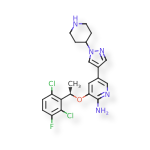
CC(O)=O.C[C@@H](OC1=CC(=CN=C1N)C2=CN(N=C2)C3CCNCC3)C4=C(Cl)C=CC(F)=C4Cl
InChI
InChIKey=LFCVDLCLKZRGFW-UTONKHPSSA-N
InChI=1S/C21H22Cl2FN5O.C2H4O2/c1-12(19-16(22)2-3-17(24)20(19)23)30-18-8-13(9-27-21(18)25)14-10-28-29(11-14)15-4-6-26-7-5-15;1-2(3)4/h2-3,8-12,15,26H,4-7H2,1H3,(H2,25,27);1H3,(H,3,4)/t12-;/m1./s1
| Molecular Formula | C2H4O2 |
| Molecular Weight | 60.052 |
| Charge | 0 |
| Count |
|
| Stereochemistry | ACHIRAL |
| Additional Stereochemistry | No |
| Defined Stereocenters | 0 / 0 |
| E/Z Centers | 0 |
| Optical Activity | NONE |
| Molecular Formula | C21H22Cl2FN5O |
| Molecular Weight | 450.337 |
| Charge | 0 |
| Count |
|
| Stereochemistry | ABSOLUTE |
| Additional Stereochemistry | No |
| Defined Stereocenters | 1 / 1 |
| E/Z Centers | 0 |
| Optical Activity | UNSPECIFIED |
DescriptionCurator's Comment: Description was created based on several sources, including http://www.accessdata.fda.gov/drugsatfda_docs/label/2013/202570s006lbl.pdf; https://www.mskcc.org/cancer-care/clinical-trials/14-063
Curator's Comment: Description was created based on several sources, including http://www.accessdata.fda.gov/drugsatfda_docs/label/2013/202570s006lbl.pdf; https://www.mskcc.org/cancer-care/clinical-trials/14-063
Crizotinib (trade name Xalkori, Pfizer, Inc.) is an anti cancer drug approved for the treatment of patients with metastatic non-small cell lung cancer (NSCLC) whose tumors are anaplastic lymphoma kinase (ALK)-positive as detected by an FDA-approved test. Crizotinib is an inhibitor of receptor tyrosine kinases including ALK, Hepatocyte Growth Factor Receptor (HGFR, c-Met), ROS1 (c-ros), and Recepteur d’Origine Nantais (RON). Common adverse reactions in clinical trials with crizotinib, occurring at an incidence of 25% or higher, included visual disorders, nausea, diarrhea, vomiting, constipation, edema, elevated transaminases, and fatigue. Crizotinib is currently under investigational study for use in treatment of Uveal Melanoma.
Originator
Approval Year
Targets
| Primary Target | Pharmacology | Condition | Potency |
|---|---|---|---|
Target ID: CHEMBL4247 |
24.0 nM [IC50] | ||
Target ID: CHEMBL3717 |
11.0 nM [IC50] |
Conditions
| Condition | Modality | Targets | Highest Phase | Product |
|---|---|---|---|---|
| Primary | XALKORI Approved UseIndicated for the treatment of patients with metastatic non-small cell lung cancer (NSCLC) whose tumors are anaplastic lymphoma kinase (ALK)-positive as detected by an FDA-approved test. Launch Date2011 |
Cmax
| Value | Dose | Co-administered | Analyte | Population |
|---|---|---|---|---|
475 ng/mL EXPERIMENT https://pubmed.ncbi.nlm.nih.gov/31778074 |
300 mg 2 times / day steady-state, oral dose: 300 mg route of administration: Oral experiment type: STEADY-STATE co-administered: |
CRIZOTINIB plasma | Homo sapiens population: UNHEALTHY age: ADULT sex: FEMALE / MALE food status: UNKNOWN |
|
87 ng/mL |
250 mg single, oral dose: 250 mg route of administration: Oral experiment type: SINGLE co-administered: |
CRIZOTINIB plasma | Homo sapiens population: UNHEALTHY age: ADULT sex: FEMALE / MALE food status: UNKNOWN |
|
327 ng/mL |
250 mg 2 times / day multiple, oral dose: 250 mg route of administration: Oral experiment type: MULTIPLE co-administered: |
CRIZOTINIB plasma | Homo sapiens population: UNHEALTHY age: ADULT sex: FEMALE / MALE food status: UNKNOWN |
|
328 ng/mL |
250 mg 2 times / day steady-state, oral dose: 250 mg route of administration: Oral experiment type: STEADY-STATE co-administered: |
CRIZOTINIB plasma | Homo sapiens population: UNHEALTHY age: ADULT sex: FEMALE / MALE food status: UNKNOWN |
|
99.6 ng/mL EXPERIMENT https://www.ncbi.nlm.nih.gov/pubmed/24990113 |
250 mg single, oral dose: 250 mg route of administration: Oral experiment type: SINGLE co-administered: |
CRIZOTINIB plasma | Homo sapiens population: HEALTHY age: ADULT sex: MALE food status: FASTED |
AUC
| Value | Dose | Co-administered | Analyte | Population |
|---|---|---|---|---|
3240 ng × h/mL EXPERIMENT https://pubmed.ncbi.nlm.nih.gov/31778074 |
300 mg 2 times / day steady-state, oral dose: 300 mg route of administration: Oral experiment type: STEADY-STATE co-administered: |
CRIZOTINIB plasma | Homo sapiens population: UNHEALTHY age: ADULT sex: FEMALE / MALE food status: UNKNOWN |
|
1817 ng × h/mL |
250 mg single, oral dose: 250 mg route of administration: Oral experiment type: SINGLE co-administered: |
CRIZOTINIB plasma | Homo sapiens population: UNHEALTHY age: ADULT sex: FEMALE / MALE food status: UNKNOWN |
|
3084 ng × h/mL |
250 mg 2 times / day multiple, oral dose: 250 mg route of administration: Oral experiment type: MULTIPLE co-administered: |
CRIZOTINIB plasma | Homo sapiens population: UNHEALTHY age: ADULT sex: FEMALE / MALE food status: UNKNOWN |
|
3054 ng × h/mL |
250 mg 2 times / day steady-state, oral dose: 250 mg route of administration: Oral experiment type: STEADY-STATE co-administered: |
CRIZOTINIB plasma | Homo sapiens population: UNHEALTHY age: ADULT sex: FEMALE / MALE food status: UNKNOWN |
|
2321 ng × h/mL EXPERIMENT https://www.ncbi.nlm.nih.gov/pubmed/24990113 |
250 mg single, oral dose: 250 mg route of administration: Oral experiment type: SINGLE co-administered: |
CRIZOTINIB plasma | Homo sapiens population: HEALTHY age: ADULT sex: MALE food status: FASTED |
T1/2
| Value | Dose | Co-administered | Analyte | Population |
|---|---|---|---|---|
42 h |
250 mg single, oral dose: 250 mg route of administration: Oral experiment type: SINGLE co-administered: |
CRIZOTINIB plasma | Homo sapiens population: UNHEALTHY age: ADULT sex: FEMALE / MALE food status: UNKNOWN |
|
29 h EXPERIMENT https://www.ncbi.nlm.nih.gov/pubmed/24990113 |
250 mg single, oral dose: 250 mg route of administration: Oral experiment type: SINGLE co-administered: |
CRIZOTINIB plasma | Homo sapiens population: HEALTHY age: ADULT sex: MALE food status: FASTED |
Funbound
| Value | Dose | Co-administered | Analyte | Population |
|---|---|---|---|---|
9.3% |
CRIZOTINIB plasma | Homo sapiens population: UNKNOWN age: UNKNOWN sex: UNKNOWN food status: UNKNOWN |
Doses
| Dose | Population | Adverse events |
|---|---|---|
300 mg 2 times / day steady, oral Dose: 300 mg, 2 times / day Route: oral Route: steady Dose: 300 mg, 2 times / day Sources: |
unhealthy, 49 years Health Status: unhealthy Age Group: 49 years Sex: M+F Sources: |
Disc. AE: Fatigue... AEs leading to discontinuation/dose reduction: Fatigue (grade 3, 1 patient) Sources: |
250 mg 2 times / day steady, oral Recommended|MTD Dose: 250 mg, 2 times / day Route: oral Route: steady Dose: 250 mg, 2 times / day Sources: |
unhealthy, 51 years (range: 21-79 years) Health Status: unhealthy Age Group: 51 years (range: 21-79 years) Sex: M+F Sources: |
Disc. AE: Autoimmune thyroiditis... AEs leading to discontinuation/dose reduction: Autoimmune thyroiditis (1 patient) Sources: |
250 mg 2 times / day steady, oral Recommended|MTD Dose: 250 mg, 2 times / day Route: oral Route: steady Dose: 250 mg, 2 times / day Sources: |
unhealthy, 52 years (range: 29-82 years) Health Status: unhealthy Age Group: 52 years (range: 29-82 years) Sex: M+F Sources: |
Disc. AE: ALT increased, Pneumonitis... AEs leading to discontinuation/dose reduction: ALT increased (2.2%) Sources: Pneumonitis (1.5%) |
AEs
| AE | Significance | Dose | Population |
|---|---|---|---|
| Fatigue | grade 3, 1 patient Disc. AE |
300 mg 2 times / day steady, oral Dose: 300 mg, 2 times / day Route: oral Route: steady Dose: 300 mg, 2 times / day Sources: |
unhealthy, 49 years Health Status: unhealthy Age Group: 49 years Sex: M+F Sources: |
| Autoimmune thyroiditis | 1 patient Disc. AE |
250 mg 2 times / day steady, oral Recommended|MTD Dose: 250 mg, 2 times / day Route: oral Route: steady Dose: 250 mg, 2 times / day Sources: |
unhealthy, 51 years (range: 21-79 years) Health Status: unhealthy Age Group: 51 years (range: 21-79 years) Sex: M+F Sources: |
| Pneumonitis | 1.5% Disc. AE |
250 mg 2 times / day steady, oral Recommended|MTD Dose: 250 mg, 2 times / day Route: oral Route: steady Dose: 250 mg, 2 times / day Sources: |
unhealthy, 52 years (range: 29-82 years) Health Status: unhealthy Age Group: 52 years (range: 29-82 years) Sex: M+F Sources: |
| ALT increased | 2.2% Disc. AE |
250 mg 2 times / day steady, oral Recommended|MTD Dose: 250 mg, 2 times / day Route: oral Route: steady Dose: 250 mg, 2 times / day Sources: |
unhealthy, 52 years (range: 29-82 years) Health Status: unhealthy Age Group: 52 years (range: 29-82 years) Sex: M+F Sources: |
Overview
| CYP3A4 | CYP2C9 | CYP2D6 | hERG |
|---|---|---|---|
OverviewOther
Drug as perpetrator
| Target | Modality | Activity | Metabolite | Clinical evidence |
|---|---|---|---|---|
| no | ||||
| no | ||||
| weak [IC50 44 uM] | ||||
| weak [IC50 48 uM] | ||||
| weak [Inhibition 30 uM] | ||||
| yes [IC50 0.83 uM] | ||||
| yes [IC50 14.6 uM] | ||||
| yes [IC50 22 uM] | ||||
| yes [IC50 23 uM] | ||||
| yes [IC50 5.79 uM] | ||||
| yes [IC50 7.3 uM] | yes (co-administration study) Comment: crizotinib increased AUC of midazolam by 3.7x |
|||
| yes [IC50 >30 uM] | ||||
| yes [IC50 >30 uM] | ||||
| yes [IC50 >30 uM] | ||||
| yes [IC50 >30 uM] | ||||
| yes | no (co-administration study) Comment: effect is masked by inhibition |
Drug as victim
| Target | Modality | Activity | Metabolite | Clinical evidence |
|---|---|---|---|---|
| major | yes (co-administration study) Comment: ketoconazole increased cmax of crizotinib by 44%, auc by 216% |
|||
| major | yes (co-administration study) Comment: ketoconazole increased cmax of crizotinib by 44%, auc by 216% |
|||
| minor | ||||
| minor | ||||
| no | ||||
| no | ||||
| no | ||||
| yes |
Tox targets
| Target | Modality | Activity | Metabolite | Clinical evidence |
|---|---|---|---|---|
PubMed
| Title | Date | PubMed |
|---|---|---|
| Elucidating mechanisms of toxicity using phenotypic data from primary human cell systems--a chemical biology approach for thrombosis-related side effects. | 2015-01-05 |
|
| Stereospecific targeting of MTH1 by (S)-crizotinib as an anticancer strategy. | 2014-04-10 |
|
| Multi-parameter in vitro toxicity testing of crizotinib, sunitinib, erlotinib, and nilotinib in human cardiomyocytes. | 2013-10-01 |
|
| Crizotinib for the treatment of non-small-cell lung cancer. | 2013-06-01 |
|
| Targeted agents in the third-/fourth-line treatment of patients with advanced (stage III/IV) non-small cell lung cancer (NSCLC). | 2013-05 |
|
| Development and validation of a high-throughput intrinsic ATPase activity assay for the discovery of MEKK2 inhibitors. | 2013-04 |
|
| Cell culture and Drosophila model systems define three classes of anaplastic lymphoma kinase mutations in neuroblastoma. | 2013-03 |
|
| Prediction of crizotinib-midazolam interaction using the Simcyp population-based simulator: comparison of CYP3A time-dependent inhibition between human liver microsomes versus hepatocytes. | 2013-02 |
|
| Overcoming erlotinib resistance with tailored treatment regimen in patient-derived xenografts from naïve Asian NSCLC patients. | 2013-01-15 |
|
| Enhancement of the antiproliferative activity of gemcitabine by modulation of c-Met pathway in pancreatic cancer. | 2013 |
|
| Anaplastic Lymphoma Kinase (ALK) regulates initiation of transcription of MYCN in neuroblastoma cells. | 2012-12-13 |
|
| Adenocarcinoma of the lung with miliary brain and pulmonary metastases with echinoderm microtubule-associated protein like 4-anaplastic lymphoma kinase translocation treated with crizotinib: a case report. | 2012-12 |
|
| Isolated central nervous system progression on Crizotinib: an Achilles heel of non-small cell lung cancer with EML4-ALK translocation? | 2012-12 |
|
| Antibody targeting of anaplastic lymphoma kinase induces cytotoxicity of human neuroblastoma. | 2012-11-15 |
|
| Rapid-onset hypogonadism secondary to crizotinib use in men with metastatic nonsmall cell lung cancer. | 2012-11-01 |
|
| Targeted therapy for lung cancer. | 2012-11 |
|
| Treatment of ALK-positive non-small cell lung cancer. | 2012-10 |
|
| Activity and safety of crizotinib in patients with ALK-positive non-small-cell lung cancer: updated results from a phase 1 study. | 2012-10 |
|
| Correlations between the percentage of tumor cells showing an anaplastic lymphoma kinase (ALK) gene rearrangement, ALK signal copy number, and response to crizotinib therapy in ALK fluorescence in situ hybridization-positive nonsmall cell lung cancer. | 2012-09-15 |
|
| Identifying and targeting ROS1 gene fusions in non-small cell lung cancer. | 2012-09-01 |
|
| Differential protein stability and ALK inhibitor sensitivity of EML4-ALK fusion variants. | 2012-09-01 |
|
| [Cavitating nodules in a 40-year-old non-smoking woman: a very particular tumour]. | 2012-09 |
|
| Targeting ALK: a promising strategy for the treatment of non-small cell lung cancer, non-Hodgkin's lymphoma, and neuroblastoma. | 2012-09 |
|
| Echinoderm microtubule-associated protein-like 4-anaplastic lymphoma kinase-targeted therapy for advanced non-small cell lung cancer: molecular and clinical aspects. | 2012-08 |
|
| The ALK(F1174L) mutation potentiates the oncogenic activity of MYCN in neuroblastoma. | 2012-07-10 |
|
| Paracrine receptor activation by microenvironment triggers bypass survival signals and ALK inhibitor resistance in EML4-ALK lung cancer cells. | 2012-07-01 |
|
| Antitumor action of the MET tyrosine kinase inhibitor crizotinib (PF-02341066) in gastric cancer positive for MET amplification. | 2012-07 |
|
| Autocrine activation of the MET receptor tyrosine kinase in acute myeloid leukemia. | 2012-07 |
|
| Preclinical rationale for use of the clinically available multitargeted tyrosine kinase inhibitor crizotinib in ROS1-translocated lung cancer. | 2012-07 |
|
| Crizotinib (PF-02341066) reverses multidrug resistance in cancer cells by inhibiting the function of P-glycoprotein. | 2012-07 |
|
| A molecular dynamics investigation on the crizotinib resistance mechanism of C1156Y mutation in ALK. | 2012-06-29 |
|
| [Management of crizotinib, a new individualized treatment]. | 2012-06-21 |
|
| Remarkable tumor response to crizotinib in a 14-year-old girl with ALK-positive non-small-cell lung cancer. | 2012-06-01 |
|
| Crizotinib in the treatment of non-small-cell lung cancer. | 2012-06 |
|
| Development of treatment strategies for advanced neuroblastoma. | 2012-06 |
|
| ALK inhibitor crizotinib combined with intrathecal methotrexate treatment for non-small cell lung cancer with leptomeningeal carcinomatosis. | 2012-05 |
|
| Aberrant expression of the transcriptional factor Twist1 promotes invasiveness in ALK-positive anaplastic large cell lymphoma. | 2012-04 |
|
| ROS1 rearrangements define a unique molecular class of lung cancers. | 2012-03-10 |
|
| Mechanisms of resistance to crizotinib in patients with ALK gene rearranged non-small cell lung cancer. | 2012-03-01 |
|
| Pharmacokinetic/pharmacodynamic modeling of crizotinib for anaplastic lymphoma kinase inhibition and antitumor efficacy in human tumor xenograft mouse models. | 2012-03 |
|
| Mechanisms of acquired crizotinib resistance in ALK-rearranged lung Cancers. | 2012-02-08 |
|
| Rapid radiographic and clinical improvement after treatment of a MET-amplified recurrent glioblastoma with a mesenchymal-epithelial transition inhibitor. | 2012-01-20 |
|
| Personalized therapy of lung cancer. | 2012 |
|
| MET amplification identifies a small and aggressive subgroup of esophagogastric adenocarcinoma with evidence of responsiveness to crizotinib. | 2011-12-20 |
|
| ALK mutations conferring differential resistance to structurally diverse ALK inhibitors. | 2011-12-01 |
|
| Crizotinib-resistant mutants of EML4-ALK identified through an accelerated mutagenesis screen. | 2011-12 |
|
| Differential inhibitor sensitivity of anaplastic lymphoma kinase variants found in neuroblastoma. | 2011-11-09 |
|
| Comprehensive analysis of kinase inhibitor selectivity. | 2011-10-30 |
|
| Effect of crizotinib on overall survival in patients with advanced non-small-cell lung cancer harbouring ALK gene rearrangement: a retrospective analysis. | 2011-10 |
|
| Genotype-driven therapies for non-small cell lung cancer: focus on EGFR, KRAS and ALK gene abnormalities. | 2011-05 |
Sample Use Guides
The recommended dose and schedule for crizotinib is 250 mg orally, twice daily, with or without food.
Route of Administration:
fVal
PF-2341066 potently inhibited NPM-ALK phosphorylation in Karpas299 or SU-DHL-1 ALCL cells (mean IC50 value of 24 nmol/L). In biochemical and cellular screens, PF-2341066 was shown to be selective for c-Met and ALK at pharmacologically relevant concentrations across a panel of >120 diverse kinases. PF-2341066 potently inhibited cell proliferation, which was associated with G(1)-S-phase cell cycle arrest and induction of apoptosis in ALK-positive ALCL cells at IC50 values of approximately 30 nmol/L but not ALK-negative lymphoma cells.
| Substance Class |
Chemical
Created
by
admin
on
Edited
Tue Apr 01 16:25:48 GMT 2025
by
admin
on
Tue Apr 01 16:25:48 GMT 2025
|
| Record UNII |
FB99MH8KWZ
|
| Record Status |
Validated (UNII)
|
| Record Version |
|
-
Download
| Name | Type | Language | ||
|---|---|---|---|---|
|
Common Name | English | ||
|
Preferred Name | English | ||
|
Systematic Name | English | ||
|
Systematic Name | English | ||
|
Systematic Name | English |
| Code System | Code | Type | Description | ||
|---|---|---|---|---|---|
|
67175389
Created by
admin on Tue Apr 01 16:25:48 GMT 2025 , Edited by admin on Tue Apr 01 16:25:48 GMT 2025
|
PRIMARY | |||
|
FB99MH8KWZ
Created by
admin on Tue Apr 01 16:25:48 GMT 2025 , Edited by admin on Tue Apr 01 16:25:48 GMT 2025
|
PRIMARY | |||
|
877399-53-6
Created by
admin on Tue Apr 01 16:25:48 GMT 2025 , Edited by admin on Tue Apr 01 16:25:48 GMT 2025
|
PRIMARY | |||
|
DTXSID00236600
Created by
admin on Tue Apr 01 16:25:48 GMT 2025 , Edited by admin on Tue Apr 01 16:25:48 GMT 2025
|
PRIMARY |
| Related Record | Type | Details | ||
|---|---|---|---|---|
|
PARENT -> SALT/SOLVATE |
|
| Related Record | Type | Details | ||
|---|---|---|---|---|
|
ACTIVE MOIETY |
|