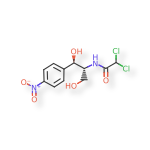
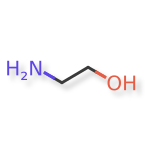
Details
| Stereochemistry | ABSOLUTE |
| Molecular Formula | C11H12Cl2N2O5.C4H6O4.C2H7NO |
| Molecular Weight | 502.301 |
| Optical Activity | UNSPECIFIED |
| Defined Stereocenters | 2 / 2 |
| E/Z Centers | 0 |
| Charge | 0 |
SHOW SMILES / InChI
SMILES
NCCO.OC(=O)CCC(O)=O.OC[C@@H](NC(=O)C(Cl)Cl)[C@H](O)C1=CC=C(C=C1)[N+]([O-])=O
InChI
InChIKey=GLOVPJIOQKHINH-UONRGADFSA-N
InChI=1S/C11H12Cl2N2O5.C4H6O4.C2H7NO/c12-10(13)11(18)14-8(5-16)9(17)6-1-3-7(4-2-6)15(19)20;5-3(6)1-2-4(7)8;3-1-2-4/h1-4,8-10,16-17H,5H2,(H,14,18);1-2H2,(H,5,6)(H,7,8);4H,1-3H2/t8-,9-;;/m1../s1
| Molecular Formula | C2H7NO |
| Molecular Weight | 61.0831 |
| Charge | 0 |
| Count |
|
| Stereochemistry | ACHIRAL |
| Additional Stereochemistry | No |
| Defined Stereocenters | 0 / 0 |
| E/Z Centers | 0 |
| Optical Activity | NONE |
| Molecular Formula | C11H12Cl2N2O5 |
| Molecular Weight | 323.129 |
| Charge | 0 |
| Count |
|
| Stereochemistry | ABSOLUTE |
| Additional Stereochemistry | No |
| Defined Stereocenters | 2 / 2 |
| E/Z Centers | 0 |
| Optical Activity | UNSPECIFIED |
| Molecular Formula | C4H6O4 |
| Molecular Weight | 118.088 |
| Charge | 0 |
| Count |
|
| Stereochemistry | ACHIRAL |
| Additional Stereochemistry | No |
| Defined Stereocenters | 0 / 0 |
| E/Z Centers | 0 |
| Optical Activity | NONE |
Chloramphenicol is a broad-spectrum antibiotic that was first isolated from
Streptomyces venezuelae in 1947. The drug was subsequently chemically synthesized. It has both a bacteriostatic and bactericidal effect; in the usual therapeutic concentrations it is bacteriostatic. Chloramphenicol is used for the treatment of serious gram-negative, gram-positive, and anaerobic infections. It is especially useful in the treatment of meningitis, typhoid fever, and cystic fibrosis. It should be reserved for infections for which other drugs are ineffective or contraindicated. Chloramphenicol, a small inhibitor of bacterial protein synthesis, is active against a variety of bacteria and readily enters the CSF. It has been used extensively in the last decades for the treatment of bacterial meningitis. In industrialized countries, chloramphenicol is restricted mostly to topical uses because of the risk of induction of aplastic anemia. However, it remains a valuable reserve antibiotic for patients with allergy to β-lactam antibiotics or with CNS infections caused by multiresistant pathogens.
Originator
Approval Year
Targets
| Primary Target | Pharmacology | Condition | Potency |
|---|---|---|---|
Target ID: intestinal esterase |
|||
Target ID: CHEMBL2363135 |
Conditions
| Condition | Modality | Targets | Highest Phase | Product |
|---|---|---|---|---|
| Curative | CHLOROPTIC Approved UseIndications and Usage In accord with the concepts in the Warning Box and this section, chloramphenicolmust be used only in those serious infections for which less potentially dangerous drugs are ineffective or contraindicated. However, chloramphenicol may be chosen to initiate antibiotic therapy on the clinical impression that one of the conditions below is believed to be present; in vitro sensitivity tests should be performed concurrently so that the drug may be discontinued as soon as possible if less potentially dangerous agents are indicated by such tests. The decision to continue use of chloramphenicol rather than another antibiotic when both are suggested by in vitro studies to be effective against a specific pathogen should be based upon severity of the infection, susceptibility of the pathogen to the various antimicrobial drugs, efficacy of the various drugs in the infection, and the important additional concepts contained in the Warning Box above. 1. Acute infections caused by Salmonella typhi* It is not recommended for the routine treatment of the typhoid carrier state. 2. Serious infections caused by susceptible strains in accordance with the concepts expressed above: a) Salmonella species b) H. influenzae, specially meningeal infections c) Rickettsia d) Lymphogranuloma-psittacosis group e) Various gram-negative bacteria causing bacteremia, meningitis, or other serious gram-negative infections f) Other susceptible organisms which have been demonstrated to be resistant to all other appropriate antimicrobial agents. 3. Cystic fibrosis regimens *In treatment of typhoid fever some authorities recommend that chloramphenicol be administered at therapeutic levels for 8 to 10 days after the patient has become afebrile to lessen the possibility of relapse. Launch Date1968 |
Cmax
| Value | Dose | Co-administered | Analyte | Population |
|---|---|---|---|---|
16.9 μg/mL EXPERIMENT https://pubmed.ncbi.nlm.nih.gov/2713219/ |
500 mg 4 times / day multiple, oral dose: 500 mg route of administration: Oral experiment type: MULTIPLE co-administered: |
CHLORAMPHENICOL blood | Homo sapiens population: UNHEALTHY age: ADULT sex: MALE food status: UNKNOWN |
AUC
| Value | Dose | Co-administered | Analyte | Population |
|---|---|---|---|---|
59.1 μg × h/mL EXPERIMENT https://pubmed.ncbi.nlm.nih.gov/2713219/ |
500 mg 4 times / day multiple, oral dose: 500 mg route of administration: Oral experiment type: MULTIPLE co-administered: |
CHLORAMPHENICOL blood | Homo sapiens population: UNHEALTHY age: ADULT sex: MALE food status: UNKNOWN |
T1/2
| Value | Dose | Co-administered | Analyte | Population |
|---|---|---|---|---|
3.5 h EXPERIMENT https://pubmed.ncbi.nlm.nih.gov/2713219/ |
500 mg 4 times / day multiple, oral dose: 500 mg route of administration: Oral experiment type: MULTIPLE co-administered: |
CHLORAMPHENICOL blood | Homo sapiens population: UNHEALTHY age: ADULT sex: MALE food status: UNKNOWN |
|
5.1 h EXPERIMENT https://pubmed.ncbi.nlm.nih.gov/7463235/ |
25 mg/kg 4 times / day multiple, intravenous dose: 25 mg/kg route of administration: Intravenous experiment type: MULTIPLE co-administered: |
CHLORAMPHENICOL serum | Homo sapiens population: UNHEALTHY age: CHILD sex: UNKNOWN food status: UNKNOWN |
|
2.2 h EXPERIMENT https://pubmed.ncbi.nlm.nih.gov/7463235/ |
25 mg/kg 4 times / day multiple, intravenous dose: 25 mg/kg route of administration: Intravenous experiment type: MULTIPLE co-administered: |
CHLORAMPHENICOL SUCCINATE serum | Homo sapiens population: UNHEALTHY age: CHILD sex: UNKNOWN food status: UNKNOWN |
Doses
| Dose | Population | Adverse events |
|---|---|---|
0.5 % 4 times / day multiple, ophthalmic Recommended Dose: 0.5 %, 4 times / day Route: ophthalmic Route: multiple Dose: 0.5 %, 4 times / day Sources: |
unhealthy, 0.5 - 12 years Health Status: unhealthy Age Group: 0.5 - 12 years Sex: unknown Sources: |
Other AEs: Swollen eyelid... |
0.25 g 1 times / 3 months multiple, intramuscular Recommended Dose: 0.25 g, 1 times / 3 months Route: intramuscular Route: multiple Dose: 0.25 g, 1 times / 3 months Sources: |
unhealthy, 11 years |
Disc. AE: Aplastic anemia... AEs leading to discontinuation/dose reduction: Aplastic anemia (grade 4, 1 patient) Sources: |
70 mg/kg 1 times / day steady, intravenous Recommended Dose: 70 mg/kg, 1 times / day Route: intravenous Route: steady Dose: 70 mg/kg, 1 times / day Sources: |
unhealthy, 15 years |
Disc. AE: Hyperlactatemia... AEs leading to discontinuation/dose reduction: Hyperlactatemia (1 patient) Sources: |
3 g 1 times / day multiple, intravenous Recommended Dose: 3 g, 1 times / day Route: intravenous Route: multiple Dose: 3 g, 1 times / day Sources: |
unhealthy, 23 years |
Disc. AE: Aplastic anemia... AEs leading to discontinuation/dose reduction: Aplastic anemia (grade 5, 1 patient) Sources: |
2.5 g 1 times / day multiple, intravenous Recommended Dose: 2.5 g, 1 times / day Route: intravenous Route: multiple Dose: 2.5 g, 1 times / day Sources: |
unhealthy, 27 years |
Disc. AE: Aplastic anemia... AEs leading to discontinuation/dose reduction: Aplastic anemia (grade 4, 1 patient) Sources: |
1 g 1 times / day multiple, parenteral Recommended Dose: 1 g, 1 times / day Route: parenteral Route: multiple Dose: 1 g, 1 times / day Sources: |
unhealthy, 39 years |
Disc. AE: Aplastic anemia... AEs leading to discontinuation/dose reduction: Aplastic anemia (grade 4, 1 patient) Sources: |
750 mg 4 times / day steady, intravenous Recommended Dose: 750 mg, 4 times / day Route: intravenous Route: steady Dose: 750 mg, 4 times / day Sources: |
unhealthy, 54 years |
Disc. AE: Aplastic anemia... AEs leading to discontinuation/dose reduction: Aplastic anemia (grade 5, 1 patient) Sources: |
4 g 1 times / day multiple, intravenous Recommended Dose: 4 g, 1 times / day Route: intravenous Route: multiple Dose: 4 g, 1 times / day Sources: |
unhealthy, 61 years |
Disc. AE: Aplastic anemia... AEs leading to discontinuation/dose reduction: Aplastic anemia (grade 5, 1 patient) Sources: |
1 g 1 times / day multiple, intramuscular Recommended Dose: 1 g, 1 times / day Route: intramuscular Route: multiple Dose: 1 g, 1 times / day Sources: |
unhealthy, 68 years |
Disc. AE: Aplastic anemia... AEs leading to discontinuation/dose reduction: Aplastic anemia (grade 4, 1 patient) Sources: |
2 g 1 times / day multiple, parenteral Recommended Dose: 2 g, 1 times / day Route: parenteral Route: multiple Dose: 2 g, 1 times / day Sources: |
unhealthy, 71 years |
Disc. AE: Aplastic anemia... AEs leading to discontinuation/dose reduction: Aplastic anemia (grade 5, 1 patient) Sources: |
3 % 1 times / day multiple, topical Recommended Dose: 3 %, 1 times / day Route: topical Route: multiple Dose: 3 %, 1 times / day Sources: |
unhealthy, adult Health Status: unhealthy Age Group: adult Sex: unknown Sources: |
AEs
| AE | Significance | Dose | Population |
|---|---|---|---|
| Swollen eyelid | 1 patient | 0.5 % 4 times / day multiple, ophthalmic Recommended Dose: 0.5 %, 4 times / day Route: ophthalmic Route: multiple Dose: 0.5 %, 4 times / day Sources: |
unhealthy, 0.5 - 12 years Health Status: unhealthy Age Group: 0.5 - 12 years Sex: unknown Sources: |
| Aplastic anemia | grade 4, 1 patient Disc. AE |
0.25 g 1 times / 3 months multiple, intramuscular Recommended Dose: 0.25 g, 1 times / 3 months Route: intramuscular Route: multiple Dose: 0.25 g, 1 times / 3 months Sources: |
unhealthy, 11 years |
| Hyperlactatemia | 1 patient Disc. AE |
70 mg/kg 1 times / day steady, intravenous Recommended Dose: 70 mg/kg, 1 times / day Route: intravenous Route: steady Dose: 70 mg/kg, 1 times / day Sources: |
unhealthy, 15 years |
| Aplastic anemia | grade 5, 1 patient Disc. AE |
3 g 1 times / day multiple, intravenous Recommended Dose: 3 g, 1 times / day Route: intravenous Route: multiple Dose: 3 g, 1 times / day Sources: |
unhealthy, 23 years |
| Aplastic anemia | grade 4, 1 patient Disc. AE |
2.5 g 1 times / day multiple, intravenous Recommended Dose: 2.5 g, 1 times / day Route: intravenous Route: multiple Dose: 2.5 g, 1 times / day Sources: |
unhealthy, 27 years |
| Aplastic anemia | grade 4, 1 patient Disc. AE |
1 g 1 times / day multiple, parenteral Recommended Dose: 1 g, 1 times / day Route: parenteral Route: multiple Dose: 1 g, 1 times / day Sources: |
unhealthy, 39 years |
| Aplastic anemia | grade 5, 1 patient Disc. AE |
750 mg 4 times / day steady, intravenous Recommended Dose: 750 mg, 4 times / day Route: intravenous Route: steady Dose: 750 mg, 4 times / day Sources: |
unhealthy, 54 years |
| Aplastic anemia | grade 5, 1 patient Disc. AE |
4 g 1 times / day multiple, intravenous Recommended Dose: 4 g, 1 times / day Route: intravenous Route: multiple Dose: 4 g, 1 times / day Sources: |
unhealthy, 61 years |
| Aplastic anemia | grade 4, 1 patient Disc. AE |
1 g 1 times / day multiple, intramuscular Recommended Dose: 1 g, 1 times / day Route: intramuscular Route: multiple Dose: 1 g, 1 times / day Sources: |
unhealthy, 68 years |
| Aplastic anemia | grade 5, 1 patient Disc. AE |
2 g 1 times / day multiple, parenteral Recommended Dose: 2 g, 1 times / day Route: parenteral Route: multiple Dose: 2 g, 1 times / day Sources: |
unhealthy, 71 years |
Overview
| CYP3A4 | CYP2C9 | CYP2D6 | hERG |
|---|---|---|---|
OverviewOther
| Other Inhibitor | Other Substrate | Other Inducer |
|---|---|---|
Drug as perpetrator
| Target | Modality | Activity | Metabolite | Clinical evidence |
|---|---|---|---|---|
| no [IC50 375.9 uM] | ||||
Page: Product Information Sheet in Japanese) 18 |
no | |||
Page: Product Information Sheet in Japanese) 18 |
no | |||
Page: Product Information Sheet in Japanese) 18 |
no | |||
Page: Product Information Sheet in Japanese) 18 |
no | |||
Page: Product Information Sheet in Japanese) 18 |
no | |||
Page: Product Information Sheet in Japanese) 18 |
yes [IC50 32 uM] | |||
| yes [IC50 48.1 uM] |
PubMed
| Title | Date | PubMed |
|---|---|---|
| UV-induced increase in RNA polymerase activity in Xanthomonas oryzae pathovar oryzae. | 2001-08 |
|
| A novel heat shock protein plays an important role in thermal stress management in cyanobacteria. | 2001-07-06 |
|
| Antibacterial activity of 4,5-dihydroxy-2-cyclopentan-1-one (DHCP) and cloning of a gene conferring DHCP resistance in Escherichia coli. | 2001-07 |
|
| Decreased susceptibility to ciprofloxacin in Salmonella enterica serotype typhi, United Kingdom. | 2001-06-01 |
|
| Secretion of the virulence-associated Campylobacter invasion antigens from Campylobacter jejuni requires a stimulatory signal. | 2001-06-01 |
|
| Cloning and functional analysis of a phosphopantetheinyl transferase superfamily gene associated with jadomycin biosynthesis in Streptomyces venezuelae ISP5230. | 2001-06 |
|
| Distribution of resistance genes tet(M), aph3'-III, catpC194 and the integrase gene of Tn1545 in clinical Streptococcus pneumoniae harbouring erm(B) and mef(A) genes in Spain. | 2001-06 |
|
| External quality assessment of antimicrobial susceptibility testing in Europe. | 2001-06 |
|
| Screening of antibiotic resistant inhibitors from local plant materials against two different strains of Pseudomonas aeruginosa. | 2001-06 |
|
| Drug resistant Haemophilus influenzae from respiratory tract infection in a tertiary care hospital in north India. | 2001-05-24 |
|
| Clinical prevalence, antimicrobial susceptibility, and geographic resistance patterns of enterococci: results from the SENTRY Antimicrobial Surveillance Program, 1997-1999. | 2001-05-15 |
|
| Worldwide prevalence of antimicrobial resistance in Streptococcus pneumoniae, Haemophilus influenzae, and Moraxella catarrhalis in the SENTRY Antimicrobial Surveillance Program, 1997-1999. | 2001-05-15 |
|
| Methicillin-resistant staphylococci and ofloxacin-resistant bacteria from clinically healthy conjunctivas. | 2001-05-08 |
|
| Clostridium sordelii corneal ulcer. | 2001-05-08 |
|
| Neisseria meningitidis with decreased susceptibility to penicillin in Ontario, Canada 1997-2000. | 2001-05-01 |
|
| Successful treatment of vancomycin-resistant Enterococcus endocarditis with oral linezolid. | 2001-05-01 |
|
| Increased mitochondrial-encoded gene transcription in immortal DF-1 cells. | 2001-05-01 |
|
| Induction of complement sensitivity in Escherichia coli by citric acid and low pH. | 2001-05 |
|
| Natural antibiotic susceptibility of Klebsiella pneumoniae, K. oxytoca, K. planticola, K. ornithinolytica and K. terrigena strains. | 2001-05 |
|
| In vitro susceptibility of Vibrio spp. isolated from the environment. | 2001-05 |
|
| High prevalence of carriage of antibiotic-resistant Streptococcus pneumoniae in children in Kampala Uganda. | 2001-05 |
|
| In vitro susceptibility to 15 antibiotics of vibrios isolated from penaeid shrimps in Northwestern Mexico. | 2001-05 |
|
| Carriage of antibiotic-resistant bacteria by healthy children. | 2001-05 |
|
| Comparative study of the influence of melatonin and vitamin E on the surface characteristics of Escherichia coli. | 2001-05 |
|
| Plasmid transfer and susceptibility to antibiotics in the halophilic phototrophs Rhodovibrio salinarum and Rhodothalassium salexigens. | 2001-04-01 |
|
| Disposition kinetics of florfenicol in goats by using two analytical methods. | 2001-04 |
|
| Prevalence of penicillin-resistant Streptococcus pneumoniae in Kuwait. | 2001-04 |
|
| Antimicrobial resistance of Streptococcus pneumoniae at a university hospital in Saudi Arabia. | 2001-04 |
|
| Strain differences in haematological response to chloramphenicol succinate in mice: implications for toxicological research. | 2001-04 |
|
| Randomised controlled trial of ketorolac in the management of corneal abrasions. | 2001-04 |
|
| [Susceptibility of non-typhi Salmonella spp. at the Galdakao Hospital (1992-1998)]. | 2001-03 |
|
| Analysis of a conserved hydrophobic pocket important for the thermostability of Bacillus pumilus chloramphenicol acetyltransferase (CAT-86). | 2001-03 |
|
| Occurrence of the vanA and vanC2/C3 genes in Enterococcus species isolated from poultry sources in Malaysia. | 2001-03 |
|
| Antimicrobial susceptibilities of Erysipelothrix rhusiopathiae isolated from pigs with swine erysipelas in Japan, 1988-1998. | 2001-03 |
|
| Antimicrobial susceptibility of Listeria monocytogenes isolated from meningoencephalitis in sheep. | 2001-03 |
|
| Antimicrobial resistance of Enterococci in Lebanon. | 2001-03 |
|
| Liposome-mediated DNA uptake and transient expression in Thermotoga. | 2001-02 |
|
| Molecular epidemiology of multiple drug resistant type 6B Streptococcus pneumoniae in the Northern Territory and Queensland, Australia. | 2001-02 |
|
| Interaction of human aldehyde dehydrogenase with aromatic substrates and ligands. | 2001-01-30 |
|
| A limited loss of DNA compaction accompanying the release of cytoplasm from cells of Escherichia coli. | 2001-01 |
|
| Chloramphenicol treatment for vancomycin-resistant Enterococcus faecium bacteremia. | 2001-01 |
|
| Survey of yeast mastitis in dairy herds of small-type farms in the Lublin region, Poland. | 2001 |
|
| Carbon and nitrogen removal from a wastewater of an industrial dairy laboratory with a coupled anaerobic filter-sequencing batch reactor system. | 2001 |
|
| Numerical methods for handling uncertainty in microarray data: an example analyzing perturbed mitochondrial function in yeast. | 2001 |
|
| A simple classification method for residual antibiotics using E. coli cells transformed by the calcium chloride method and drug resistance plasmid DNA. | 2001 |
|
| Amplification of the Escherichia coli lacZ gene in Bacillus subtilis and its expression on a by-product growth medium. | 2001 |
|
| Prevalence of serotypes and molecular epidemiology of Streptococcus pneumoniae strains isolated from children in Beijing, China: identification of two novel multiply-resistant clones. | 2001 |
|
| Molecular epidemiology and mutations at gyrA and parC genes of ciprofloxacin-resistant Escherichia coli isolates from a Taiwan medical center. | 2001 |
|
| In vitro activity of 19 antimicrobial agents against enterococci from healthy subjects and hospitalized patients and use of an ace gene probe from Enterococcus faecalis for species identification. | 2001 |
|
| Variation in clonality and antibiotic-resistance genes among multiresistant Salmonella enterica serotype typhimurium phage-type U302 (MR U302) from humans, animals, and foods. | 2001 |
Patents
Sample Use Guides
| Substance Class |
Chemical
Created
by
admin
on
Edited
Mon Mar 31 18:10:24 GMT 2025
by
admin
on
Mon Mar 31 18:10:24 GMT 2025
|
| Record UNII |
FMO6OC31WV
|
| Record Status |
Validated (UNII)
|
| Record Version |
|
-
Download
| Name | Type | Language | ||
|---|---|---|---|---|
|
Preferred Name | English | ||
|
Common Name | English | ||
|
Systematic Name | English |
| Code System | Code | Type | Description | ||
|---|---|---|---|---|---|
|
131801044
Created by
admin on Mon Mar 31 18:10:24 GMT 2025 , Edited by admin on Mon Mar 31 18:10:24 GMT 2025
|
PRIMARY | |||
|
FMO6OC31WV
Created by
admin on Mon Mar 31 18:10:24 GMT 2025 , Edited by admin on Mon Mar 31 18:10:24 GMT 2025
|
PRIMARY | |||
|
20369-85-1
Created by
admin on Mon Mar 31 18:10:24 GMT 2025 , Edited by admin on Mon Mar 31 18:10:24 GMT 2025
|
PRIMARY |
| Related Record | Type | Details | ||
|---|---|---|---|---|
|
|
PARENT -> SALT/SOLVATE | |||
|
|
PARENT -> SALT/SOLVATE |