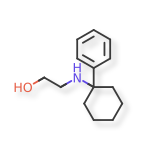
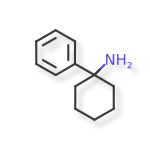
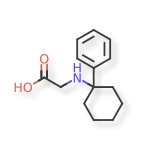
Details
| Stereochemistry | ACHIRAL |
| Molecular Formula | C16H25NO |
| Molecular Weight | 247.3758 |
| Optical Activity | NONE |
| Defined Stereocenters | 0 / 0 |
| E/Z Centers | 0 |
| Charge | 0 |
SHOW SMILES / InChI
SMILES
CCOCCNC1(CCCCC1)C2=CC=CC=C2
InChI
InChIKey=PRQVCBDFWYTXDD-UHFFFAOYSA-N
InChI=1S/C16H25NO/c1-2-18-14-13-17-16(11-7-4-8-12-16)15-9-5-3-6-10-15/h3,5-6,9-10,17H,2,4,7-8,11-14H2,1H3
| Molecular Formula | C16H25NO |
| Molecular Weight | 247.3758 |
| Charge | 0 |
| Count |
|
| Stereochemistry | ACHIRAL |
| Additional Stereochemistry | No |
| Defined Stereocenters | 0 / 0 |
| E/Z Centers | 0 |
| Optical Activity | NONE |
Approval Year
PubMed
| Title | Date | PubMed |
|---|---|---|
| Investigations on the cytochrome P450 (CYP) isoenzymes involved in the metabolism of the designer drugs N-(1-phenyl cyclohexyl)-2-ethoxyethanamine and N-(1-phenylcyclohexyl)-2-methoxyethanamine. | 2009-02-01 |
|
| New designer drugs N-(1-phenylcyclohexyl)-2-ethoxyethanamine (PCEEA) and N-(1-phenylcyclohexyl)-2-methoxyethanamine (PCMEA): Studies on their metabolism and toxicological detection in rat urine using gas chromatographic/mass spectrometric techniques. | 2008-03 |
| Substance Class |
Chemical
Created
by
admin
on
Edited
Wed Apr 02 05:46:57 GMT 2025
by
admin
on
Wed Apr 02 05:46:57 GMT 2025
|
| Record UNII |
HR7BX09IBP
|
| Record Status |
Validated (UNII)
|
| Record Version |
|
-
Download
| Name | Type | Language | ||
|---|---|---|---|---|
|
Preferred Name | English | ||
|
Systematic Name | English | ||
|
Common Name | English | ||
|
Systematic Name | English |
| Code System | Code | Type | Description | ||
|---|---|---|---|---|---|
|
DTXSID601342483
Created by
admin on Wed Apr 02 05:46:57 GMT 2025 , Edited by admin on Wed Apr 02 05:46:57 GMT 2025
|
PRIMARY | |||
|
1072895-05-6
Created by
admin on Wed Apr 02 05:46:57 GMT 2025 , Edited by admin on Wed Apr 02 05:46:57 GMT 2025
|
PRIMARY | |||
|
46839345
Created by
admin on Wed Apr 02 05:46:57 GMT 2025 , Edited by admin on Wed Apr 02 05:46:57 GMT 2025
|
PRIMARY | |||
|
HR7BX09IBP
Created by
admin on Wed Apr 02 05:46:57 GMT 2025 , Edited by admin on Wed Apr 02 05:46:57 GMT 2025
|
PRIMARY |
| Related Record | Type | Details | ||
|---|---|---|---|---|
|
METABOLIC ENZYME -> SUBSTRATE |
|
||
|
METABOLIC ENZYME -> SUBSTRATE |
|
||
|
METABOLIC ENZYME -> SUBSTRATE |
MAJOR
|
||
|
METABOLIC ENZYME -> SUBSTRATE |
|

| Related Record | Type | Details | ||
|---|---|---|---|---|
|
METABOLITE -> PARENT |
This metabolite was detected in rat urine. However, according to the journal acticle, “The authors' experience in metabolism and analytical studies on rats and humans support the assumption that the metabolites found in rat urine should also be present in human urine. Therefore, it can be concluded that the procedure described here should also be applicable for human urine screening for PCEEA and/or PCMEA in clinical or forensic cases. However, their differentiation would only be possible through detection of the respective parent drug or unique metabolites.”
URINE
|
||
|
METABOLITE -> PARENT |
This metabolite was detected in rat urine. However, according to this journal acticle, “The authors' experience in metabolism and analytical studies on rats and humans support the assumption that the metabolites found in rat urine should also be present in human urine. Therefore, it can be concluded that the procedure described here should also be applicable for human urine screening for PCEEA and/or PCMEA in clinical or forensic cases. However, their differentiation would only be possible through detection of the respective parent drug or unique metabolites.”
URINE
|
||
|
METABOLITE -> PARENT |
This metabolite was detected in rat urine. However, according to this journal acticle, “The authors' experience in metabolism and analytical studies on rats and humans support the assumption that the metabolites found in rat urine should also be present in human urine. Therefore, it can be concluded that the procedure described here should also be applicable for human urine screening for PCEEA and/or PCMEA in clinical or forensic cases. However, their differentiation would only be possible through detection of the respective parent drug or unique metabolites.”
URINE
|