Details
| Stereochemistry | ABSOLUTE |
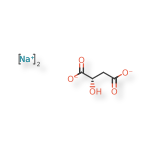
| Molecular Formula | C4H6O5 |
| Molecular Weight | 134.0874 |
| Optical Activity | ( - ) |
| Defined Stereocenters | 1 / 1 |
| E/Z Centers | 0 |
| Charge | 0 |
SHOW SMILES / InChI
SMILES
O[C@@H](CC(O)=O)C(O)=O
InChI
InChIKey=BJEPYKJPYRNKOW-REOHCLBHSA-N
InChI=1S/C4H6O5/c5-2(4(8)9)1-3(6)7/h2,5H,1H2,(H,6,7)(H,8,9)/t2-/m0/s1
| Molecular Formula | C4H6O5 |
| Molecular Weight | 134.0874 |
| Charge | 0 |
| Count |
|
| Stereochemistry | ABSOLUTE |
| Additional Stereochemistry | No |
| Defined Stereocenters | 1 / 1 |
| E/Z Centers | 0 |
| Optical Activity | UNSPECIFIED |
L-Malic acid is a tart-tasting organic dicarboxylic acid that plays a role in many sour or tart foods. L-Malic acid is the naturally occurring form, whereas a mixture of L- and D-malic acid is produced synthetically. In humans, L-malic acid is both derived from food sources and synthesized in the body through the citric acid cycle or Krebs cycle which takes place in the mitochondria. L-Malate's importance to the production of energy in the body during both aerobic and anaerobic conditions is well established. Under aerobic conditions, the oxidation of L-malate to oxaloacetate provides reducing equivalents to the mitochondria through the malate-aspartate redox shuttle. During anaerobic conditions, where a buildup of excess of reducing equivalents inhibits glycolysis, L-malic acid's simultaneous reduction to succinate and oxidation to oxaloacetate is capable of removing the accumulating reducing equivalents. This allows L-malic acid to reverse hypoxia's inhibition of glycolysis and energy production. In studies on rats it has been found that only tissue malate is depleted following exhaustive physical activity. Notably, the administration of malic acid to rats has been shown to elevate mitochondrial malate and increase mitochondrial respiration and energy production. L-Malic acid is the source of extreme tartness in United States-produced confectionery, the so-called extreme candy. It is also used with or in place of the less sour citric acid in sour sweets. These sweets are sometimes labeled with a warning stating that excessive consumption can cause irritation of the mouth. The quantitative determination of L-malic acid is especially important in the manufacture of wine, beer, bread, fruit and vegetable products, as well as in cosmetics and pharmaceuticals. It is one of the most important fruit acids, and has the highest concentration of all acids in wine. In the wine industry, the level of L-malic acid is monitored, along with L-lactic acid, during malolactic fermentation. Malic acid is approved for use as a food additive in the EU, US and Australia and New Zealand. Malic acid, when added to food products, is denoted by E number E296.
Approval Year
PubMed
| Title | Date | PubMed |
|---|---|---|
| Assimilation of D-malate by Rhodobacter capsulatus E1F1. | 2001-09 |
|
| Structural analyses of a malate dehydrogenase with a variable active site. | 2001-08-17 |
|
| Alteration of the specificity of malate dehydrogenase by chemical modulation of an active site arginine. | 2001-08-17 |
|
| Characterization of a novel complex from halophilic archaebacteria, which displays chaperone-like activities in vitro. | 2001-08-10 |
|
| Effect of an antidiabetic extract of Catharanthus roseus on enzymic activities in streptozotocin induced diabetic rats. | 2001-08 |
|
| Carbohydrate deprivation reduces NADPH-production in fish liver but not in adipose tissue. | 2001-08 |
|
| Metabolic flux analysis for succinic acid production by recombinant Escherichia coli with amplified malic enzyme activity. | 2001-07-20 |
|
| [Properties of gluconeogenesis enzymes from flatworms]. | 2001-07-17 |
|
| pH-dependent investigations of vanadium(V)-peroxo-malate complexes from aqueous solutions. In search of biologically relevant vanadium(V)-peroxo species. | 2001-07-16 |
|
| The first examples of (S)-2-hydroxyacid dehydrogenases catalyzing the transfer of the pro-4S hydrogen of NADH are found in the archaea. | 2001-07-09 |
|
| Transcriptome meets metabolome: hierarchical and metabolic regulation of the glycolytic pathway. | 2001-07-06 |
|
| Relationships between inhibition constants, inhibitor concentrations for 50% inhibition and types of inhibition: new ways of analysing data. | 2001-07-01 |
|
| Malo-ethanolic fermentation in grape must by recombinant strains of Saccharomyces cerevisiae. | 2001-07 |
|
| Thyroid hormone--sympathetic interaction and adaptive thermogenesis are thyroid hormone receptor isoform--specific. | 2001-07 |
|
| Massive sequence comparisons as a help in annotating genomic sequences. | 2001-07 |
|
| Altered expression and function of mitochondrial beta-oxidation enzymes in juvenile intrauterine-growth-retarded rat skeletal muscle. | 2001-07 |
|
| An NMR-based metabonomic approach to the investigation of coelomic fluid biochemistry in earthworms under toxic stress. | 2001-06-29 |
|
| [Lactate and malate dehydrogenase activity in the sterlet and Russian sturgeon under conditions of the widespread muscular pathology]. | 2001-06-27 |
|
| Tricarboxylic acid cycle enzymes of the ectomycorrhizal basidiomycete, Suillus bovinus. | 2001-06-26 |
|
| Myoadenylate deaminase deficiency does not affect muscle anaplerosis during exhaustive exercise in humans. | 2001-06-15 |
|
| Histochemical study of acute and chronic intraperitoneal nicotine effects on several glycolytic and Krebs cycle dehydrogenase activities in the frontoparietal cortex and subcortical nuclei of the rat brain. | 2001-06-15 |
|
| Enzymatic computing. | 2001-06-02 |
|
| The effect of nucleotides and mitochondrial chaperonin 10 on the structure and chaperone activity of mitochondrial chaperonin 60. | 2001-06 |
|
| Two-dimensional electrophoresis and characterization of antigens from Paracoccidioides brasiliensis. | 2001-06 |
|
| Inducible and constitutive expression using new plasmid and integrative expression vectors for Thermus sp. | 2001-06 |
|
| Aluminum speciation studies in biological fluids. Part 7. A quantitative investigation of aluminum(III)-malate complex equilibria and their potential implications for aluminum metabolism and toxicity. | 2001-06 |
|
| Oral almotriptan vs. oral sumatriptan in the abortive treatment of migraine: a double-blind, randomized, parallel-group, optimum-dose comparison. | 2001-06 |
|
| Energetic determinants of tyrosine phosphorylation of focal adhesion proteins during hypoxia/reoxygenation of kidney proximal tubules. | 2001-06 |
|
| A pre-genetic study of the isoforms of malic enzyme associated with lipid accumulation in Mucor circinelloides. | 2001-06 |
|
| An NMR and enzyme study of the carbon metabolism of Neisseria meningitidis. | 2001-06 |
|
| Determination of organic acids and inorganic anions in wine by isotachophoresis on a planar chip. | 2001-05-04 |
|
| Total synthesis of (-)-rosmarinecine by intramolecular cycloaddition of (S)-malic acid derived pyrroline N-oxide. | 2001-05-03 |
|
| Production of beta-thujaplicin in Cupressus lusitanica suspension cultures fed with organic acids and monoterpenes. | 2001-05 |
|
| Induction of a peroxisomal malate dehydrogenase isoform in liver of starved rats. | 2001-05 |
|
| Partial amino acid catabolism leading to the formation of alanine in Periophthalmodon schlosseri (mudskipper): a strategy that facilitates the use of amino acids as an energy source during locomotory activity on land. | 2001-05 |
|
| New phenolic constituents from the fruit juice of Phyllanthus emblica. | 2001-05 |
|
| Magnesium ameliorates aluminum rhizotoxicity in soybean by increasing citric acid production and exudation by roots. | 2001-05 |
|
| Comprehensive chemical profiling of gramineous plant root exudates using high-resolution NMR and MS. | 2001-05 |
|
| Cloning and functional characterization of the 5' flanking region of the human mitochondrial malic enzyme gene. Regulatory role of Sp1 and AP-2. | 2001-05 |
|
| Possible involvement of protein phosphorylation in aluminum-responsive malate efflux from wheat root apex. | 2001-05 |
|
| Aluminum activates a citrate-permeable anion channel in the aluminum-sensitive zone of the maize root apex. A comparison between an aluminum- sensitive and an aluminum-resistant cultivar. | 2001-05 |
|
| Survey of normal appearing mouse strain which lacks malic enzyme and Nad+-linked glycerol phosphate dehydrogenase: normal pancreatic beta cell function, but abnormal metabolite pattern in skeletal muscle. | 2001-04 |
|
| Single-cell dissection and microdroplet chemistry. | 2001-04 |
|
| Physiological basis of reduced AL tolerance in ditelosomic lines of Chinese Spring wheat. | 2001-04 |
|
| Inhibiting expression of a tomato ripening-associated membrane protein increases organic acids and reduces sugar levels of fruit. | 2001-04 |
|
| Reevaluating the free-ion activity model of trace metal toxicity toward higher plants: experimental evidence with copper and zinc. | 2001-04 |
|
| Non-photosynthetic 'malic enzyme' from maize: a constituvely expressed enzyme that responds to plant defence inducers. | 2001-03 |
|
| Variation of isoenzyme and RAPD patterns in Candida albicans morphological mutants with altered colony ultrastructure. | 2001 |
|
| Metabolic regulation of pH in plant cells: role of cytoplasmic pH in defense reaction and secondary metabolism. | 2001 |
|
| Final report on the safety assessment of Malic Acid and Sodium Malate. | 2001 |
Patents
Sample Use Guides
Apply Acerbine solution (malic acid, salicylic acid, benzoic acid) to the wound or damaged skin two or more times daily or moisten the dressing again. Once scar formation begins, one application a day is generally sufficient.
Route of Administration:
Topical
Of various yeasts tested in the conversion of fumaric to L-malic acid, Saccharomyces bayanus had the highest activity of fumarase. Cells permeabilized with 0.2% (w/v) CTAB for 5 min gave maximum enzyme activity. Under non-growth conditions, fumarase activity in the permeabilized cells was four times higher (271 U/g) than that of the intact cells (67 U/g). The proposed mathematical model for the batch production of L-malic acid was validated at different initial fumaric acid concentrations. The average conversion of fumaric acid was up to 82% and gave 21, 40, 83 and 175 mM L-malic acid from respectively, 25, 50, 100 and 210 mM: fumaric acid.
| Substance Class |
Chemical
Created
by
admin
on
Edited
Mon Mar 31 17:35:42 GMT 2025
by
admin
on
Mon Mar 31 17:35:42 GMT 2025
|
| Record UNII |
J3TZF807X5
|
| Record Status |
Validated (UNII)
|
| Record Version |
|
-
Download
| Name | Type | Language | ||
|---|---|---|---|---|
|
Preferred Name | English | ||
|
Common Name | English | ||
|
Common Name | English | ||
|
Systematic Name | English | ||
|
Common Name | English | ||
|
Common Name | English | ||
|
Systematic Name | English | ||
|
Common Name | English | ||
|
Common Name | English | ||
|
Code | English | ||
|
Code | English | ||
|
Common Name | English | ||
|
Common Name | English | ||
|
Common Name | English | ||
|
Common Name | English | ||
|
Common Name | English | ||
|
Common Name | English |
| Classification Tree | Code System | Code | ||
|---|---|---|---|---|
|
DSLD |
2323 (Number of products:281)
Created by
admin on Mon Mar 31 17:35:42 GMT 2025 , Edited by admin on Mon Mar 31 17:35:42 GMT 2025
|
||
|
JECFA EVALUATION |
(-)-MALIC ACID
Created by
admin on Mon Mar 31 17:35:42 GMT 2025 , Edited by admin on Mon Mar 31 17:35:42 GMT 2025
|
| Code System | Code | Type | Description | ||
|---|---|---|---|---|---|
|
100000129340
Created by
admin on Mon Mar 31 17:35:42 GMT 2025 , Edited by admin on Mon Mar 31 17:35:42 GMT 2025
|
PRIMARY | |||
|
J3TZF807X5
Created by
admin on Mon Mar 31 17:35:42 GMT 2025 , Edited by admin on Mon Mar 31 17:35:42 GMT 2025
|
PRIMARY | |||
|
15589
Created by
admin on Mon Mar 31 17:35:42 GMT 2025 , Edited by admin on Mon Mar 31 17:35:42 GMT 2025
|
PRIMARY | |||
|
C45678
Created by
admin on Mon Mar 31 17:35:42 GMT 2025 , Edited by admin on Mon Mar 31 17:35:42 GMT 2025
|
CONCEPT | Industrial Aid | ||
|
222656
Created by
admin on Mon Mar 31 17:35:42 GMT 2025 , Edited by admin on Mon Mar 31 17:35:42 GMT 2025
|
PRIMARY | |||
|
9232
Created by
admin on Mon Mar 31 17:35:42 GMT 2025 , Edited by admin on Mon Mar 31 17:35:42 GMT 2025
|
PRIMARY | |||
|
6650
Created by
admin on Mon Mar 31 17:35:42 GMT 2025 , Edited by admin on Mon Mar 31 17:35:42 GMT 2025
|
PRIMARY | |||
|
165
Created by
admin on Mon Mar 31 17:35:42 GMT 2025 , Edited by admin on Mon Mar 31 17:35:42 GMT 2025
|
PRIMARY | |||
|
DTXSID30273987
Created by
admin on Mon Mar 31 17:35:42 GMT 2025 , Edited by admin on Mon Mar 31 17:35:42 GMT 2025
|
PRIMARY | |||
|
30797
Created by
admin on Mon Mar 31 17:35:42 GMT 2025 , Edited by admin on Mon Mar 31 17:35:42 GMT 2025
|
PRIMARY | |||
|
C84394
Created by
admin on Mon Mar 31 17:35:42 GMT 2025 , Edited by admin on Mon Mar 31 17:35:42 GMT 2025
|
PRIMARY | |||
|
SUB38365
Created by
admin on Mon Mar 31 17:35:42 GMT 2025 , Edited by admin on Mon Mar 31 17:35:42 GMT 2025
|
PRIMARY | |||
|
1427053
Created by
admin on Mon Mar 31 17:35:42 GMT 2025 , Edited by admin on Mon Mar 31 17:35:42 GMT 2025
|
PRIMARY | RxNorm | ||
|
J3TZF807X5
Created by
admin on Mon Mar 31 17:35:42 GMT 2025 , Edited by admin on Mon Mar 31 17:35:42 GMT 2025
|
PRIMARY | |||
|
202-601-5
Created by
admin on Mon Mar 31 17:35:42 GMT 2025 , Edited by admin on Mon Mar 31 17:35:42 GMT 2025
|
PRIMARY | |||
|
97-67-6
Created by
admin on Mon Mar 31 17:35:42 GMT 2025 , Edited by admin on Mon Mar 31 17:35:42 GMT 2025
|
PRIMARY | |||
|
m7041
Created by
admin on Mon Mar 31 17:35:42 GMT 2025 , Edited by admin on Mon Mar 31 17:35:42 GMT 2025
|
PRIMARY | Merck Index |
| Related Record | Type | Details | ||
|---|---|---|---|---|
|
|
SALT/SOLVATE -> PARENT |
|
||
|
|
SALT/SOLVATE -> PARENT |
|
||
|
|
SALT/SOLVATE -> PARENT |
|
||
|
|
SALT/SOLVATE -> PARENT | |||
|
|
SALT/SOLVATE -> PARENT |
|
||
|
|
SALT/SOLVATE -> PARENT |
|
||
|
|
SALT/SOLVATE -> PARENT |
|
||
|
|
SALT/SOLVATE -> PARENT |