


Details
| Stereochemistry | ABSOLUTE |
| Molecular Formula | C24H25NO4.C6H12O7 |
| Molecular Weight | 587.6149 |
| Optical Activity | UNSPECIFIED |
| Defined Stereocenters | 7 / 7 |
| E/Z Centers | 0 |
| Charge | 0 |
SHOW SMILES / InChI
SMILES
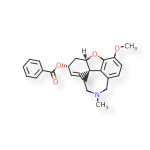
OC[C@@H](O)[C@@H](O)[C@H](O)[C@@H](O)C(O)=O.COC1=CC=C2CN(C)CC[C@@]34C=C[C@@H](C[C@@H]3OC1=C24)OC(=O)C5=CC=CC=C5
InChI
InChIKey=YOMFDYFCNHSIAU-MXJKWOHVSA-N
InChI=1S/C24H25NO4.C6H12O7/c1-25-13-12-24-11-10-18(28-23(26)16-6-4-3-5-7-16)14-20(24)29-22-19(27-2)9-8-17(15-25)21(22)24;7-1-2(8)3(9)4(10)5(11)6(12)13/h3-11,18,20H,12-15H2,1-2H3;2-5,7-11H,1H2,(H,12,13)/t18-,20-,24-;2-,3-,4+,5-/m01/s1
| Molecular Formula | C6H12O7 |
| Molecular Weight | 196.1553 |
| Charge | 0 |
| Count |
|
| Stereochemistry | ABSOLUTE |
| Additional Stereochemistry | No |
| Defined Stereocenters | 4 / 4 |
| E/Z Centers | 0 |
| Optical Activity | UNSPECIFIED |
| Molecular Formula | C24H25NO4 |
| Molecular Weight | 391.4596 |
| Charge | 0 |
| Count |
|
| Stereochemistry | ABSOLUTE |
| Additional Stereochemistry | No |
| Defined Stereocenters | 3 / 3 |
| E/Z Centers | 0 |
| Optical Activity | UNSPECIFIED |
DescriptionSources: http://www.accessdata.fda.gov/drugsatfda_docs/label/2015/021169s031-021224s029-021615s022lbl.pdfCurator's Comment: description was created based on several sources, including
https://www.ncbi.nlm.nih.gov/mesh/68005702 |
https://www.ncbi.nlm.nih.gov/pubmed/12177686
Sources: http://www.accessdata.fda.gov/drugsatfda_docs/label/2015/021169s031-021224s029-021615s022lbl.pdf
Curator's Comment: description was created based on several sources, including
https://www.ncbi.nlm.nih.gov/mesh/68005702 |
https://www.ncbi.nlm.nih.gov/pubmed/12177686
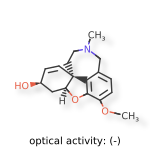
Galantamine (RAZADYNE®, galantamine hydrobromide) is a benzazepine derived from norbelladine. It is found in Galanthus and other Amaryllidaceae. It is a reversible, competitive acetylcholinesterase inhibitor that is used for the treatment of mild to moderate dementia of the Alzheimer’s type. Although the etiology of cognitive impairment in Alzheimer’s disease is not fully understood, it has been reported that acetylcholine-producing neurons degenerate in the brains of patients with Alzheimer’s disease. The degree of this cholinergic loss has been correlated with degree of cognitive impairment and density of amyloid plaques (a neuropathological hallmark of Alzheimer’s disease). While the precise mechanism of galantamine’s (RAZADYNE®, galantamine hydrobromide) action is unknown, it is postulated to exert its therapeutic effect by enhancing cholinergic function. This is accomplished by increasing the concentration of acetylcholine through reversible inhibition of its hydrolysis by acetylcholinesterase. If this mechanism is correct, galantamine’s (RAZADYNE®, galantamine hydrobromide) effect may lessen as the disease process advances and fewer cholinergic neurons remain functionally intact. There is no evidence that galantamine (RAZADYNE®, galantamine hydrobromide) alters the course of the underlying dementing process.
CNS Activity
Approval Year
Targets
| Primary Target | Pharmacology | Condition | Potency |
|---|---|---|---|
| 0.35 µM [IC50] |
Conditions
| Condition | Modality | Targets | Highest Phase | Product |
|---|---|---|---|---|
| Palliative | RAZADYNE Approved UseGalantamine hydrobromide is a cholinesterase inhibitor indicated for the treatment of mild to moderate dementia of the Alzheimer’s type. Launch Date2001 |
Cmax
| Value | Dose | Co-administered | Analyte | Population |
|---|---|---|---|---|
84.3 ng/mL EXPERIMENT https://pubmed.ncbi.nlm.nih.gov/16238894 |
24 mg single, oral dose: 24 mg route of administration: Oral experiment type: SINGLE co-administered: |
GALANTAMINE plasma | Homo sapiens population: HEALTHY age: ADULT sex: MALE food status: FASTED |
AUC
| Value | Dose | Co-administered | Analyte | Population |
|---|---|---|---|---|
1050 ng × h/mL EXPERIMENT https://pubmed.ncbi.nlm.nih.gov/16238894 |
24 mg single, oral dose: 24 mg route of administration: Oral experiment type: SINGLE co-administered: |
GALANTAMINE plasma | Homo sapiens population: HEALTHY age: ADULT sex: MALE food status: FASTED |
T1/2
| Value | Dose | Co-administered | Analyte | Population |
|---|---|---|---|---|
8.53 h EXPERIMENT https://pubmed.ncbi.nlm.nih.gov/16238894 |
24 mg single, oral dose: 24 mg route of administration: Oral experiment type: SINGLE co-administered: |
GALANTAMINE plasma | Homo sapiens population: HEALTHY age: ADULT sex: MALE food status: FASTED |
Funbound
| Value | Dose | Co-administered | Analyte | Population |
|---|---|---|---|---|
82% |
GALANTAMINE plasma | Homo sapiens population: UNKNOWN age: UNKNOWN sex: UNKNOWN food status: UNKNOWN |
Doses
| Dose | Population | Adverse events |
|---|---|---|
8 mg 2 times / day steady, oral Dose: 8 mg, 2 times / day Route: oral Route: steady Dose: 8 mg, 2 times / day Sources: |
unhealthy, 90 years |
Disc. AE: Nightmares... AEs leading to discontinuation/dose reduction: Nightmares (1 patient) Sources: |
32 mg 1 times / day steady, oral Highest studied dose Dose: 32 mg, 1 times / day Route: oral Route: steady Dose: 32 mg, 1 times / day Sources: |
unhealthy, adult Health Status: unhealthy Age Group: adult Sex: unknown Sources: |
Other AEs: Nausea, Vomiting... Other AEs: Nausea (42%) Sources: Vomiting (21%) Diarrhea (16%) Anorexia (15%) Weight loss (8%) Dizziness (15%) |
AEs
| AE | Significance | Dose | Population |
|---|---|---|---|
| Nightmares | 1 patient Disc. AE |
8 mg 2 times / day steady, oral Dose: 8 mg, 2 times / day Route: oral Route: steady Dose: 8 mg, 2 times / day Sources: |
unhealthy, 90 years |
| Anorexia | 15% | 32 mg 1 times / day steady, oral Highest studied dose Dose: 32 mg, 1 times / day Route: oral Route: steady Dose: 32 mg, 1 times / day Sources: |
unhealthy, adult Health Status: unhealthy Age Group: adult Sex: unknown Sources: |
| Dizziness | 15% | 32 mg 1 times / day steady, oral Highest studied dose Dose: 32 mg, 1 times / day Route: oral Route: steady Dose: 32 mg, 1 times / day Sources: |
unhealthy, adult Health Status: unhealthy Age Group: adult Sex: unknown Sources: |
| Diarrhea | 16% | 32 mg 1 times / day steady, oral Highest studied dose Dose: 32 mg, 1 times / day Route: oral Route: steady Dose: 32 mg, 1 times / day Sources: |
unhealthy, adult Health Status: unhealthy Age Group: adult Sex: unknown Sources: |
| Vomiting | 21% | 32 mg 1 times / day steady, oral Highest studied dose Dose: 32 mg, 1 times / day Route: oral Route: steady Dose: 32 mg, 1 times / day Sources: |
unhealthy, adult Health Status: unhealthy Age Group: adult Sex: unknown Sources: |
| Nausea | 42% | 32 mg 1 times / day steady, oral Highest studied dose Dose: 32 mg, 1 times / day Route: oral Route: steady Dose: 32 mg, 1 times / day Sources: |
unhealthy, adult Health Status: unhealthy Age Group: adult Sex: unknown Sources: |
| Weight loss | 8% | 32 mg 1 times / day steady, oral Highest studied dose Dose: 32 mg, 1 times / day Route: oral Route: steady Dose: 32 mg, 1 times / day Sources: |
unhealthy, adult Health Status: unhealthy Age Group: adult Sex: unknown Sources: |
Overview
| CYP3A4 | CYP2C9 | CYP2D6 | hERG |
|---|---|---|---|
OverviewOther
| Other Inhibitor | Other Substrate | Other Inducer |
|---|---|---|
Drug as perpetrator
| Target | Modality | Activity | Metabolite | Clinical evidence |
|---|---|---|---|---|
| inconclusive [Activation 15.8489 uM] | ||||
| no [IC50 >10 uM] | ||||
| no [IC50 >10 uM] | ||||
| no [IC50 >10 uM] | ||||
| no [IC50 >10 uM] | ||||
| no [IC50 >10 uM] | ||||
| no [IC50 >10 uM] | ||||
| no [IC50 >133 uM] | ||||
| no [IC50 >133 uM] | ||||
| no [IC50 >133 uM] | ||||
| no [IC50 >133 uM] | ||||
| no | ||||
| no | ||||
| no | ||||
Page: 4, 20, (ClinPharm) 34, 38-39 |
no | no (co-administration study) Comment: Coadministration of Galantamine (multiple doses) had no effect on the pharmacokinetics of R-/S-Warfarin (CYP2C9 substrate) Page: 4, 20, (ClinPharm) 34, 38-39 |
||
| yes [IC50 0.6 uM] | no (co-administration study) Comment: Coadministration of Galantamine (multiple doses) had no effect on the pharmacokinetics of Digoxin (P-gp substrate) Page: 4, 20, (ClinPharm) 38, 40 |
Drug as victim
| Target | Modality | Activity | Metabolite | Clinical evidence |
|---|---|---|---|---|
Page: 2, 4, 19-20, (ClinPharm) 15, 38, 42-23, 45 |
major [Km 187 uM] | yes (co-administration study) Comment: Vmax = 5.2 nmol/mg protein/h (Pharmacogenetics, 9, 661 (1999)); Coadministration (multiple doses) of ketoconazole (strong CYP3A4 inhibitor, CYP2D6 inhibitor) and paroxetin (strong CYP2D6 inhibitor) increased Galantamine AUC by 30% and 40%. Page: 2, 4, 19-20, (ClinPharm) 15, 38, 42-23, 45 |
||
Page: 2, 4, 19-20, (ClinPharm) 15, 38, 42-44 |
major | yes (co-administration study) Comment: Coadministration (multiple doses) of ketoconazole (strong CYP3A4 inhibitor, CYP2D6 inhibitor) increased Galantamine AUC by 30%. Coadministration of erythromycin (moderate CYP3A4 inhibitor) increased Galantamine AUC by only 10%. Page: 2, 4, 19-20, (ClinPharm) 15, 38, 42-44 |
||
| yes |
Tox targets
| Target | Modality | Activity | Metabolite | Clinical evidence |
|---|---|---|---|---|
PubMed
| Title | Date | PubMed |
|---|---|---|
| Unconventional ligands and modulators of nicotinic receptors. | 2002-12 |
|
| The cholinergic approach for the treatment of vascular dementia: evidence from pre-clinical and clinical studies. | 2002-11-27 |
|
| [Rivastigmine: a review of its clinical effectiveness]. | 2002-11-19 |
|
| [Treatment of Alzheimer's disease]. | 2002-11-19 |
|
| The rationale behind cholinergic drug treatment for dementia related to cerebrovascular disease. | 2002-11-15 |
|
| Treatment options: the latest evidence with galantamine (Reminyl). | 2002-11-15 |
|
| Use of galantamine to treat vascular dementia. | 2002-11-09 |
|
| Use of galantamine to treat vascular dementia. | 2002-11-09 |
|
| Galantamine improved cognition and global functioning in vascular dementia or Alzheimer disease with cerebrovascular disease. | 2002-11-07 |
|
| Adjuvant galantamine administration improves negative symptoms in a patient with treatment-refractory schizophrenia. | 2002-11-01 |
|
| Efficacy of galantamine in probable vascular dementia and Alzheimer's disease combined with cerebrovascular disease: a randomized trial. | 2002-11 |
|
| A nitric oxide-donating flurbiprofen derivative reduces neuroinflammation without interacting with galantamine in the rat. | 2002-10-25 |
|
| Acetylcholinesterase inhibitory activity of some Amaryllidaceae alkaloids and Narcissus extracts. | 2002-10-11 |
|
| Cognitive pharmacotherapy of Alzheimer's disease and other dementias. | 2002-10 |
|
| [Galantamine: a novel cholinergic agent for Alzheimer's disease]. | 2002-10 |
|
| The impact of journal advertisements on prescribers of cholinesterase inhibitors. | 2002-10 |
|
| Quaternary salts of E2020 analogues as acetylcholinesterase inhibitors for the reversal of neuromuscular block. | 2002-09-16 |
|
| Galantamine provides broad benefits in patients with 'advanced moderate' Alzheimer's disease (MMSE < or = 12) for up to six months. | 2002-09 |
|
| Broad therapeutic benefits in patients with probable vascular dementia or Alzheimer's disease with cerebrovascular disease after treatment with galantamine. | 2002-09 |
|
| Galantamine pharmacokinetics, safety, and tolerability profiles are similar in healthy Caucasian and Japanese subjects. | 2002-09 |
|
| Efficacy of galantamine in probable vascular dementia and Alzheimer's disease combined with cerebrovascular disease: a randomized trial. | 2002-09 |
|
| To what degree does cognitive impairment in Alzheimer's disease predict dependence of patients on caregivers? | 2002-08-19 |
|
| An efficient enantioselective synthesis of (-)-galanthamine. | 2002-08-02 |
|
| [Nicotinic Receptor, galantamine and Alzheimer disease]. | 2002-07-23 |
|
| Medical treatment of Alzheimer's disease: past, present, and future. | 2002-07 |
|
| Galantamine for treatment-resistant schizophrenia. | 2002-07 |
|
| Galanthamine as bis-functional ligand for the acetylcholinesterase. | 2002-06 |
|
| Switching cholinesterase inhibitors in patients with Alzheimer's disease. | 2002-06 |
|
| Evidence that the clinical effects of cholinesterase inhibitors are related to potency and targeting of action. | 2002-06 |
|
| The tolerability and safety of cholinesterase inhibitors in the treatment of dementia. | 2002-06 |
|
| The efficacy of cholinesterase inhibitors in treating the behavioural symptoms of dementia. | 2002-06 |
|
| [Latest therapies for treating dementia]. | 2002-05-15 |
|
| [Dementing disorders. What benefits do the new anti-dementia drugs have?]. | 2002-05-06 |
|
| Pharmacologic treatments of dementia. | 2002-05 |
|
| The nicotinic allosteric potentiating ligand galantamine facilitates synaptic transmission in the mammalian central nervous system. | 2002-05 |
|
| Efficacy of galantamine in probable vascular dementia and Alzheimer's disease combined with cerebrovascular disease: a randomised trial. | 2002-04-13 |
|
| Galantamine for vascular dementia: some answers, some questions. | 2002-04-13 |
|
| New drugs 2002, part 1. | 2002-01 |
|
| Nicotinic receptor modulation: advantages for successful Alzheimer's disease therapy. | 2002 |
|
| Clinical and cost-effectiveness of donepezil, rivastigmine, and galantamine for Alzheimer's disease. A systematic review. | 2002 |
|
| Galantamine: a pharmacoeconomic review of its use in Alzheimer's disease. | 2002 |
|
| Galantamine--a novel cholinergic drug with a unique dual mode of action for the treatment of patients with Alzheimer's disease. | 2002 |
|
| Clinical pharmacokinetics and pharmacodynamics of cholinesterase inhibitors. | 2002 |
|
| [New theory! Galantamine and nicotinic-cholinergic transmission]. | 2002 |
|
| Economic analysis of galantamine, a cholinesterase inhibitor, in the treatment of patients with mild to moderate Alzheimer's disease in the Netherlands. | 2002 |
|
| Assessment of Health Economics in Alzheimer's Disease (AHEAD): treatment with galantamine in Sweden. | 2002 |
|
| Galantamine for Alzheimer's disease. | 2002 |
|
| Cholinergic medication for neuroleptic-induced tardive dyskinesia. | 2002 |
|
| Understanding and managing behavioural symptoms in Alzheimer's disease and related dementias: focus on rivastigmine. | 2002 |
|
| A non-cholinergic, trophic action of acetylcholinesterase on hippocampal neurones in vitro: molecular mechanisms. | 2002 |
Sample Use Guides
The recommended starting dosage of RAZADYNE® tablets is 4 mg twice a day (8 mg/day). The dosage should be increased to the initial maintenance dosage of 8 mg twice a day (16 mg/day) after a minimum of 4 weeks. A further increase to 12 mg twice a day (24 mg/day) should be attempted after a minimum of 4 weeks at 8 mg twice a day (16 mg/day). Dosage increases should be based upon assessment of clinical benefit and tolerability of the previous dose.
Route of Administration:
Oral
Galanthamine was evaluated as inhibitor of human acetylcholinesterase activity from samples of postmortem human brain, fresh brain cortex biopsies and human erythrocytes. The respective galanthamine concentration exerting a half maximal effect (IC50) on acetylcholinesterase in postmortem human brain frontal cortex was 3.2 uM versus 2.8 uM in the hippocampus region. In addition, galanthamine was 10-fold less potent in inhibiting the enzyme activity from human brain that from human erythrocytes.
| Substance Class |
Chemical
Created
by
admin
on
Edited
Wed Apr 02 03:26:29 GMT 2025
by
admin
on
Wed Apr 02 03:26:29 GMT 2025
|
| Record UNII |
LN7PMJ4P57
|
| Record Status |
Validated (UNII)
|
| Record Version |
|
-
Download
| Name | Type | Language | ||
|---|---|---|---|---|
|
Official Name | English | ||
|
Preferred Name | English | ||
|
Common Name | English | ||
|
Systematic Name | English | ||
|
Common Name | English | ||
|
Code | English | ||
|
Code | English | ||
|
Common Name | English | ||
|
Common Name | English |
| Code System | Code | Type | Description | ||
|---|---|---|---|---|---|
|
155491118
Created by
admin on Wed Apr 02 03:26:29 GMT 2025 , Edited by admin on Wed Apr 02 03:26:29 GMT 2025
|
PRIMARY | PUBCHEM | ||
|
300000056194
Created by
admin on Wed Apr 02 03:26:29 GMT 2025 , Edited by admin on Wed Apr 02 03:26:29 GMT 2025
|
PRIMARY | |||
|
MN-102
Created by
admin on Wed Apr 02 03:26:29 GMT 2025 , Edited by admin on Wed Apr 02 03:26:29 GMT 2025
|
PRIMARY | |||
|
LN7PMJ4P57
Created by
admin on Wed Apr 02 03:26:29 GMT 2025 , Edited by admin on Wed Apr 02 03:26:29 GMT 2025
|
PRIMARY | |||
|
C211785
Created by
admin on Wed Apr 02 03:26:29 GMT 2025 , Edited by admin on Wed Apr 02 03:26:29 GMT 2025
|
PRIMARY | |||
|
1542321-58-3
Created by
admin on Wed Apr 02 03:26:29 GMT 2025 , Edited by admin on Wed Apr 02 03:26:29 GMT 2025
|
PRIMARY |
| Related Record | Type | Details | ||
|---|---|---|---|---|
|
PARENT -> SALT/SOLVATE |
|
| Related Record | Type | Details | ||
|---|---|---|---|---|
|
METABOLITE ACTIVE -> PRODRUG |
|
| Related Record | Type | Details | ||
|---|---|---|---|---|
|
ACTIVE MOIETY |
|