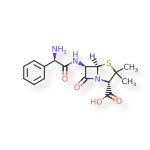
Details
| Stereochemistry | ABSOLUTE |
| Molecular Formula | C22H29N3O6S.C13H19NO4S |
| Molecular Weight | 748.906 |
| Optical Activity | UNSPECIFIED |
| Defined Stereocenters | 4 / 4 |
| E/Z Centers | 0 |
| Charge | 0 |
SHOW SMILES / InChI
SMILES
CCCN(CCC)S(=O)(=O)C1=CC=C(C=C1)C(O)=O.CC(C)(C)C(=O)OCOC(=O)[C@@H]2N3[C@H](SC2(C)C)[C@H](NC(=O)[C@H](N)C4=CC=CC=C4)C3=O
InChI
InChIKey=LKZFWYIOFQDUMO-GLCLSGQWSA-N
InChI=1S/C22H29N3O6S.C13H19NO4S/c1-21(2,3)20(29)31-11-30-19(28)15-22(4,5)32-18-14(17(27)25(15)18)24-16(26)13(23)12-9-7-6-8-10-12;1-3-9-14(10-4-2)19(17,18)12-7-5-11(6-8-12)13(15)16/h6-10,13-15,18H,11,23H2,1-5H3,(H,24,26);5-8H,3-4,9-10H2,1-2H3,(H,15,16)/t13-,14-,15+,18-;/m1./s1
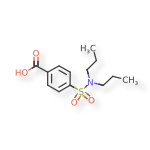
| Molecular Formula | C13H19NO4S |
| Molecular Weight | 285.359 |
| Charge | 0 |
| Count |
|
| Stereochemistry | ACHIRAL |
| Additional Stereochemistry | No |
| Defined Stereocenters | 0 / 0 |
| E/Z Centers | 0 |
| Optical Activity | NONE |
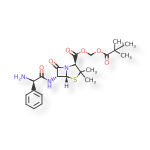
| Molecular Formula | C22H29N3O6S |
| Molecular Weight | 463.547 |
| Charge | 0 |
| Count |
|
| Stereochemistry | ABSOLUTE |
| Additional Stereochemistry | No |
| Defined Stereocenters | 4 / 4 |
| E/Z Centers | 0 |
| Optical Activity | UNSPECIFIED |
Ampicillin is a penicillin beta-lactam antibiotic. The following gram-negative and gram-positive bacteria have been shown in in vitro studies to be susceptible to ampicillin: Hemolytic and nonhemolytic streptococci, Streptococcus pneumoniae, Nonpenicillinase-producing staphylococci, Clostridium spp., B. anthracis, Listeria monocytogenes, most strains of enterococci, H. influenzae, N. gonorrhoeae, N. meningitidis, Proteus mirabilis, many strains of Salmonella, Shigella, and E. coli. Ampicillin is indicated in the treatment of bacterial meningitis, septicemia, endocarditis, urinary tract, gastrointestinal, respiratory tract infections caused by susceptible strains of the designated organisms.
Approval Year
Targets
| Primary Target | Pharmacology | Condition | Potency |
|---|---|---|---|
Target ID: CHEMBL2354204 |
|||
Conditions
| Condition | Modality | Targets | Highest Phase | Product |
|---|---|---|---|---|
| Curative | AMPICILLIN SODIUM Approved UseAmpicillin is indicated in the treatment of bacterial meningitis, septicemia, endocarditis, urinary tract, gastrointestinal, respiratory tracti nfections caused by susceptible strains of bacteria (Hemolytic and nonhemolytic streptococci, Streptococcus pneumoniae, Nonpenicillinase-producing staphylococci, Clostridium spp., B. anthracis, Listeria monocytogenes, most strains of enterococci, H. influenzae, N. gonorrhoeae, N. meningitidis, Proteus mirabilis, many strains of Salmonella, Shigella, and E. coli.) |
Cmax
| Value | Dose | Co-administered | Analyte | Population |
|---|---|---|---|---|
15.04 μg/mL EXPERIMENT https://pubmed.ncbi.nlm.nih.gov/20399996 |
1500 mg single, oral dose: 1500 mg route of administration: Oral experiment type: SINGLE co-administered: PROBENECID |
AMPICILLIN plasma | Homo sapiens population: HEALTHY age: ADULT sex: MALE food status: FASTED |
|
129.5 μg/mL |
2000 mg single, intravenous dose: 2000 mg route of administration: Intravenous experiment type: SINGLE co-administered: SULBACTAM |
AMPICILLIN plasma | Homo sapiens population: UNKNOWN age: ADULT sex: UNKNOWN food status: UNKNOWN |
AUC
| Value | Dose | Co-administered | Analyte | Population |
|---|---|---|---|---|
58.74 μg × h/mL EXPERIMENT https://pubmed.ncbi.nlm.nih.gov/20399996 |
1500 mg single, oral dose: 1500 mg route of administration: Oral experiment type: SINGLE co-administered: PROBENECID |
AMPICILLIN plasma | Homo sapiens population: HEALTHY age: ADULT sex: MALE food status: FASTED |
T1/2
| Value | Dose | Co-administered | Analyte | Population |
|---|---|---|---|---|
1.82 h EXPERIMENT https://pubmed.ncbi.nlm.nih.gov/20399996 |
1500 mg single, oral dose: 1500 mg route of administration: Oral experiment type: SINGLE co-administered: PROBENECID |
AMPICILLIN plasma | Homo sapiens population: HEALTHY age: ADULT sex: MALE food status: FASTED |
|
1 h |
2000 mg single, intravenous dose: 2000 mg route of administration: Intravenous experiment type: SINGLE co-administered: SULBACTAM |
AMPICILLIN plasma | Homo sapiens population: UNKNOWN age: ADULT sex: UNKNOWN food status: UNKNOWN |
Funbound
| Value | Dose | Co-administered | Analyte | Population |
|---|---|---|---|---|
72% |
AMPICILLIN serum | Homo sapiens population: UNKNOWN age: UNKNOWN sex: UNKNOWN food status: UNKNOWN |
Doses
| Dose | Population | Adverse events |
|---|---|---|
650 mg 3 times / day multiple, intravenous Studied dose Dose: 650 mg, 3 times / day Route: intravenous Route: multiple Dose: 650 mg, 3 times / day Sources: |
unhealthy, 11 to 18 months Health Status: unhealthy Age Group: 11 to 18 months Sex: M+F Sources: |
Disc. AE: Skin rash... AEs leading to discontinuation/dose reduction: Skin rash (25%) Sources: |
5 g 3 times / day multiple, intravenous Highest studied dose Dose: 5 g, 3 times / day Route: intravenous Route: multiple Dose: 5 g, 3 times / day Sources: |
unhealthy, adult Health Status: unhealthy Age Group: adult Sex: M+F Sources: |
|
0.5 g 1 times / day single, intramuscular Recommended Dose: 0.5 g, 1 times / day Route: intramuscular Route: single Dose: 0.5 g, 1 times / day Sources: |
healthy, adult Health Status: healthy Age Group: adult Sex: M Sources: |
Other AEs: Injection site pain... Other AEs: Injection site pain Sources: |
1 g 1 times / day single, intramuscular Studied dose Dose: 1 g, 1 times / day Route: intramuscular Route: single Dose: 1 g, 1 times / day Sources: |
healthy, adult Health Status: healthy Age Group: adult Sex: M Sources: |
Other AEs: Injection site pain, Creatine phosphokinase increased... Other AEs: Injection site pain (grade 3-4, 100%) Sources: Creatine phosphokinase increased (100%) |
2 g 1 times / day single, intramuscular Studied dose Dose: 2 g, 1 times / day Route: intramuscular Route: single Dose: 2 g, 1 times / day Sources: |
unhealthy, mean age 25.8 years Health Status: unhealthy Age Group: mean age 25.8 years Sex: M+F Sources: |
Other AEs: Injection site pain, Rash... Other AEs: Injection site pain (1%) Sources: Rash (1%) Diarrhea (5%) Fatigue (3%) Chills (1%) Headache (1%) AST increased (3%) Bilirubin increased (1%) Creatinine increased (1%) |
2 g 3 times / day multiple, intravenous Studied dose Dose: 2 g, 3 times / day Route: intravenous Route: multiple Dose: 2 g, 3 times / day Sources: |
unhealthy, mean age 27.1 years Health Status: unhealthy Age Group: mean age 27.1 years Sex: F Sources: |
Other AEs: Chest pain, Flatulence... Other AEs: Chest pain (5%) Sources: Flatulence (5%) Diarrhea (10%) Injection site pain (5%) |
2 g 3 times / day multiple, intravenous Studied dose Dose: 2 g, 3 times / day Route: intravenous Route: multiple Dose: 2 g, 3 times / day Sources: |
unhealthy, mean age 27.4 years Health Status: unhealthy Age Group: mean age 27.4 years Sex: M+F Sources: |
Other AEs: Injection site pain, Phlebitis... Other AEs: Injection site pain (0.8%) Sources: Phlebitis (5.3%) Chest pain (0.8%) Diarrhea (6.8%) Vomiting (0.8%) Retention of urine (0.8%) Rash (0.8%) Epistaxis (0.8%) Edema (0.8%) |
2 g 3 times / day multiple, intravenous Studied dose Dose: 2 g, 3 times / day Route: intravenous Route: multiple Dose: 2 g, 3 times / day Sources: |
unhealthy, mean age 60.1 years Health Status: unhealthy Age Group: mean age 60.1 years Sex: M+F Sources: |
Other AEs: Thrombophlebitis, Nausea... Other AEs: Thrombophlebitis (6.7%) Sources: Nausea (6.7%) Diarrhea (6.7%) Rash (6.7%) Blood eosinophils increased (6.7%) AST increased (6.7%) ALT increased (13.3%) GGT increased (13.3%) Alkaline phosphatase increased (6.7%) |
AEs
| AE | Significance | Dose | Population |
|---|---|---|---|
| Skin rash | 25% Disc. AE |
650 mg 3 times / day multiple, intravenous Studied dose Dose: 650 mg, 3 times / day Route: intravenous Route: multiple Dose: 650 mg, 3 times / day Sources: |
unhealthy, 11 to 18 months Health Status: unhealthy Age Group: 11 to 18 months Sex: M+F Sources: |
| Injection site pain | 0.5 g 1 times / day single, intramuscular Recommended Dose: 0.5 g, 1 times / day Route: intramuscular Route: single Dose: 0.5 g, 1 times / day Sources: |
healthy, adult Health Status: healthy Age Group: adult Sex: M Sources: |
|
| Creatine phosphokinase increased | 100% | 1 g 1 times / day single, intramuscular Studied dose Dose: 1 g, 1 times / day Route: intramuscular Route: single Dose: 1 g, 1 times / day Sources: |
healthy, adult Health Status: healthy Age Group: adult Sex: M Sources: |
| Injection site pain | grade 3-4, 100% | 1 g 1 times / day single, intramuscular Studied dose Dose: 1 g, 1 times / day Route: intramuscular Route: single Dose: 1 g, 1 times / day Sources: |
healthy, adult Health Status: healthy Age Group: adult Sex: M Sources: |
| Bilirubin increased | 1% | 2 g 1 times / day single, intramuscular Studied dose Dose: 2 g, 1 times / day Route: intramuscular Route: single Dose: 2 g, 1 times / day Sources: |
unhealthy, mean age 25.8 years Health Status: unhealthy Age Group: mean age 25.8 years Sex: M+F Sources: |
| Chills | 1% | 2 g 1 times / day single, intramuscular Studied dose Dose: 2 g, 1 times / day Route: intramuscular Route: single Dose: 2 g, 1 times / day Sources: |
unhealthy, mean age 25.8 years Health Status: unhealthy Age Group: mean age 25.8 years Sex: M+F Sources: |
| Creatinine increased | 1% | 2 g 1 times / day single, intramuscular Studied dose Dose: 2 g, 1 times / day Route: intramuscular Route: single Dose: 2 g, 1 times / day Sources: |
unhealthy, mean age 25.8 years Health Status: unhealthy Age Group: mean age 25.8 years Sex: M+F Sources: |
| Headache | 1% | 2 g 1 times / day single, intramuscular Studied dose Dose: 2 g, 1 times / day Route: intramuscular Route: single Dose: 2 g, 1 times / day Sources: |
unhealthy, mean age 25.8 years Health Status: unhealthy Age Group: mean age 25.8 years Sex: M+F Sources: |
| Injection site pain | 1% | 2 g 1 times / day single, intramuscular Studied dose Dose: 2 g, 1 times / day Route: intramuscular Route: single Dose: 2 g, 1 times / day Sources: |
unhealthy, mean age 25.8 years Health Status: unhealthy Age Group: mean age 25.8 years Sex: M+F Sources: |
| Rash | 1% | 2 g 1 times / day single, intramuscular Studied dose Dose: 2 g, 1 times / day Route: intramuscular Route: single Dose: 2 g, 1 times / day Sources: |
unhealthy, mean age 25.8 years Health Status: unhealthy Age Group: mean age 25.8 years Sex: M+F Sources: |
| AST increased | 3% | 2 g 1 times / day single, intramuscular Studied dose Dose: 2 g, 1 times / day Route: intramuscular Route: single Dose: 2 g, 1 times / day Sources: |
unhealthy, mean age 25.8 years Health Status: unhealthy Age Group: mean age 25.8 years Sex: M+F Sources: |
| Fatigue | 3% | 2 g 1 times / day single, intramuscular Studied dose Dose: 2 g, 1 times / day Route: intramuscular Route: single Dose: 2 g, 1 times / day Sources: |
unhealthy, mean age 25.8 years Health Status: unhealthy Age Group: mean age 25.8 years Sex: M+F Sources: |
| Diarrhea | 5% | 2 g 1 times / day single, intramuscular Studied dose Dose: 2 g, 1 times / day Route: intramuscular Route: single Dose: 2 g, 1 times / day Sources: |
unhealthy, mean age 25.8 years Health Status: unhealthy Age Group: mean age 25.8 years Sex: M+F Sources: |
| Diarrhea | 10% | 2 g 3 times / day multiple, intravenous Studied dose Dose: 2 g, 3 times / day Route: intravenous Route: multiple Dose: 2 g, 3 times / day Sources: |
unhealthy, mean age 27.1 years Health Status: unhealthy Age Group: mean age 27.1 years Sex: F Sources: |
| Chest pain | 5% | 2 g 3 times / day multiple, intravenous Studied dose Dose: 2 g, 3 times / day Route: intravenous Route: multiple Dose: 2 g, 3 times / day Sources: |
unhealthy, mean age 27.1 years Health Status: unhealthy Age Group: mean age 27.1 years Sex: F Sources: |
| Flatulence | 5% | 2 g 3 times / day multiple, intravenous Studied dose Dose: 2 g, 3 times / day Route: intravenous Route: multiple Dose: 2 g, 3 times / day Sources: |
unhealthy, mean age 27.1 years Health Status: unhealthy Age Group: mean age 27.1 years Sex: F Sources: |
| Injection site pain | 5% | 2 g 3 times / day multiple, intravenous Studied dose Dose: 2 g, 3 times / day Route: intravenous Route: multiple Dose: 2 g, 3 times / day Sources: |
unhealthy, mean age 27.1 years Health Status: unhealthy Age Group: mean age 27.1 years Sex: F Sources: |
| Chest pain | 0.8% | 2 g 3 times / day multiple, intravenous Studied dose Dose: 2 g, 3 times / day Route: intravenous Route: multiple Dose: 2 g, 3 times / day Sources: |
unhealthy, mean age 27.4 years Health Status: unhealthy Age Group: mean age 27.4 years Sex: M+F Sources: |
| Edema | 0.8% | 2 g 3 times / day multiple, intravenous Studied dose Dose: 2 g, 3 times / day Route: intravenous Route: multiple Dose: 2 g, 3 times / day Sources: |
unhealthy, mean age 27.4 years Health Status: unhealthy Age Group: mean age 27.4 years Sex: M+F Sources: |
| Epistaxis | 0.8% | 2 g 3 times / day multiple, intravenous Studied dose Dose: 2 g, 3 times / day Route: intravenous Route: multiple Dose: 2 g, 3 times / day Sources: |
unhealthy, mean age 27.4 years Health Status: unhealthy Age Group: mean age 27.4 years Sex: M+F Sources: |
| Injection site pain | 0.8% | 2 g 3 times / day multiple, intravenous Studied dose Dose: 2 g, 3 times / day Route: intravenous Route: multiple Dose: 2 g, 3 times / day Sources: |
unhealthy, mean age 27.4 years Health Status: unhealthy Age Group: mean age 27.4 years Sex: M+F Sources: |
| Rash | 0.8% | 2 g 3 times / day multiple, intravenous Studied dose Dose: 2 g, 3 times / day Route: intravenous Route: multiple Dose: 2 g, 3 times / day Sources: |
unhealthy, mean age 27.4 years Health Status: unhealthy Age Group: mean age 27.4 years Sex: M+F Sources: |
| Retention of urine | 0.8% | 2 g 3 times / day multiple, intravenous Studied dose Dose: 2 g, 3 times / day Route: intravenous Route: multiple Dose: 2 g, 3 times / day Sources: |
unhealthy, mean age 27.4 years Health Status: unhealthy Age Group: mean age 27.4 years Sex: M+F Sources: |
| Vomiting | 0.8% | 2 g 3 times / day multiple, intravenous Studied dose Dose: 2 g, 3 times / day Route: intravenous Route: multiple Dose: 2 g, 3 times / day Sources: |
unhealthy, mean age 27.4 years Health Status: unhealthy Age Group: mean age 27.4 years Sex: M+F Sources: |
| Phlebitis | 5.3% | 2 g 3 times / day multiple, intravenous Studied dose Dose: 2 g, 3 times / day Route: intravenous Route: multiple Dose: 2 g, 3 times / day Sources: |
unhealthy, mean age 27.4 years Health Status: unhealthy Age Group: mean age 27.4 years Sex: M+F Sources: |
| Diarrhea | 6.8% | 2 g 3 times / day multiple, intravenous Studied dose Dose: 2 g, 3 times / day Route: intravenous Route: multiple Dose: 2 g, 3 times / day Sources: |
unhealthy, mean age 27.4 years Health Status: unhealthy Age Group: mean age 27.4 years Sex: M+F Sources: |
| ALT increased | 13.3% | 2 g 3 times / day multiple, intravenous Studied dose Dose: 2 g, 3 times / day Route: intravenous Route: multiple Dose: 2 g, 3 times / day Sources: |
unhealthy, mean age 60.1 years Health Status: unhealthy Age Group: mean age 60.1 years Sex: M+F Sources: |
| GGT increased | 13.3% | 2 g 3 times / day multiple, intravenous Studied dose Dose: 2 g, 3 times / day Route: intravenous Route: multiple Dose: 2 g, 3 times / day Sources: |
unhealthy, mean age 60.1 years Health Status: unhealthy Age Group: mean age 60.1 years Sex: M+F Sources: |
| AST increased | 6.7% | 2 g 3 times / day multiple, intravenous Studied dose Dose: 2 g, 3 times / day Route: intravenous Route: multiple Dose: 2 g, 3 times / day Sources: |
unhealthy, mean age 60.1 years Health Status: unhealthy Age Group: mean age 60.1 years Sex: M+F Sources: |
| Alkaline phosphatase increased | 6.7% | 2 g 3 times / day multiple, intravenous Studied dose Dose: 2 g, 3 times / day Route: intravenous Route: multiple Dose: 2 g, 3 times / day Sources: |
unhealthy, mean age 60.1 years Health Status: unhealthy Age Group: mean age 60.1 years Sex: M+F Sources: |
| Blood eosinophils increased | 6.7% | 2 g 3 times / day multiple, intravenous Studied dose Dose: 2 g, 3 times / day Route: intravenous Route: multiple Dose: 2 g, 3 times / day Sources: |
unhealthy, mean age 60.1 years Health Status: unhealthy Age Group: mean age 60.1 years Sex: M+F Sources: |
| Diarrhea | 6.7% | 2 g 3 times / day multiple, intravenous Studied dose Dose: 2 g, 3 times / day Route: intravenous Route: multiple Dose: 2 g, 3 times / day Sources: |
unhealthy, mean age 60.1 years Health Status: unhealthy Age Group: mean age 60.1 years Sex: M+F Sources: |
| Nausea | 6.7% | 2 g 3 times / day multiple, intravenous Studied dose Dose: 2 g, 3 times / day Route: intravenous Route: multiple Dose: 2 g, 3 times / day Sources: |
unhealthy, mean age 60.1 years Health Status: unhealthy Age Group: mean age 60.1 years Sex: M+F Sources: |
| Rash | 6.7% | 2 g 3 times / day multiple, intravenous Studied dose Dose: 2 g, 3 times / day Route: intravenous Route: multiple Dose: 2 g, 3 times / day Sources: |
unhealthy, mean age 60.1 years Health Status: unhealthy Age Group: mean age 60.1 years Sex: M+F Sources: |
| Thrombophlebitis | 6.7% | 2 g 3 times / day multiple, intravenous Studied dose Dose: 2 g, 3 times / day Route: intravenous Route: multiple Dose: 2 g, 3 times / day Sources: |
unhealthy, mean age 60.1 years Health Status: unhealthy Age Group: mean age 60.1 years Sex: M+F Sources: |
PubMed
| Title | Date | PubMed |
|---|---|---|
| Highly efficient synthesis of ampicillin in an "aqueous solution-precipitate" system: repetitive addition of substrates in a semicontinuous process. | 2001-06-05 |
|
| Clinical prevalence, antimicrobial susceptibility, and geographic resistance patterns of enterococci: results from the SENTRY Antimicrobial Surveillance Program, 1997-1999. | 2001-05-15 |
|
| Ampicillin-resistant Escherichia coli in gestational pyelonephritis: increased occurrence and association with the colonization factor Dr adhesin. | 2001-05-15 |
|
| Treatment of foodborne listeriosis. | 2001-05-15 |
|
| Ureidopenicillins and risk of Clostridium difficile infection. | 2001-05 |
|
| Carriage of antibiotic-resistant bacteria by healthy children. | 2001-05 |
|
| Antibiotic resistance and antibiotic sensitivity based treatment in Helicobacter pylori infection: advantages and outcome. | 2001-05 |
|
| Study of the in vitro activity of amoxicillin/clavulanic acid and other beta-lactam antibiotics against Escherichia coli isolated from urine specimens. | 2001-04-20 |
|
| Sepsis and multiple brain abscesses caused by Salmonella paratyphi B in an infant: successful treatment with sulbactam-ampicillin and surgical drainage. | 2001-04-12 |
|
| Emergence of vancomycin-resistant enterococci. | 2001-04-11 |
|
| Simultaneous determination of five beta-lactam antibiotics in bovine milk using liquid chromatography coupled with electrospray ionization tandem mass spectrometry. | 2001-04-01 |
|
| Enterobacter spp. infections complicating the course of HIV disease. | 2001-04 |
|
| Prevalence of penicillin-resistant Streptococcus pneumoniae in Kuwait. | 2001-04 |
|
| Antimicrobial resistance of Streptococcus pneumoniae at a university hospital in Saudi Arabia. | 2001-04 |
|
| Antibiotic use and development of resistance in blood culture isolates: 8 years of experience from a cancer referral center. | 2001-04 |
|
| Infant botulism: case reports and review. | 2001-04 |
|
| The isolation and characterization of Campylobacter jejuni subsp. jejuni from domestic geese (Anser anser). | 2001-04 |
|
| Antibiotic resistance among Listeria, including Listeria monocytogenes, in retail foods. | 2001-04 |
|
| [Clinical characteristics of beta-lactamase negative ampicillin resistant Haemophilus influenzae (BLNAR) in respiratory tract]. | 2001-04 |
|
| [Combination therapy against vancomycin-resistant enterococci]. | 2001-04 |
|
| [Beta-lactamase negative ampicillin-resistant Haemophilus influenzae(BLNAR)]. | 2001-04 |
|
| [Beta-lactam and macrolide resistance in Streptococcus pneumoniae]. | 2001-04 |
|
| [Vancomycin-resistant enterococci(VRE)]. | 2001-04 |
|
| Use of antibiotics to treat bacteriuria of pregnancy in the Nordic countries. Which antibiotics are appropriate to treat bacteriuria of pregnancy? | 2001-04 |
|
| Expanding the genetic code: selection of efficient suppressors of four-base codons and identification of "shifty" four-base codons with a library approach in Escherichia coli. | 2001-03-30 |
|
| [Prevalence of Moraxella catarrhalis colonization in asymptomatic carriers under 6 years of age]. | 2001-03-29 |
|
| Antimicrobial susceptibilities of Erysipelothrix rhusiopathiae isolated from pigs with swine erysipelas in Japan, 1988-1998. | 2001-03 |
|
| Standard case management of pneumonia in hospitalized children in Uruguay, 1997 to 1998. | 2001-03 |
|
| Antibiotic-resistant bacteria in pediatric chronic sinusitis. | 2001-03 |
|
| Neonatal sepsis and mortality in a regional hospital in Trinidad: aetiology and risk factors. | 2001-03 |
|
| Antimicrobial resistance of Enterococci in Lebanon. | 2001-03 |
|
| Screening method for identification of beta-lactams in bovine urine by use of liquid chromatography and a microbial inhibition test. | 2001-03 |
|
| Fulminant pneumonia due to Aeromonas hydrophila in a man with chronic renal failure and liver cirrhosis. | 2001-02 |
|
| Serogroups and antimicrobial susceptibility of non-typhoidal salmonellas in children. | 2001-02 |
|
| Enterococcus faecalis resistant to vancomycin and teicoplanin (VanA phenotype) isolated from a bone marrow transplanted patient in Brazil. | 2001-02 |
|
| Multicenter evaluation of resistance patterns of Klebsiella pneumoniae, Escherichia coli, Salmonella spp and Shigella spp isolated from clinical specimens in Brazil: RESISTNET Surveillance Program. | 2001-02 |
|
| Spectrophotometric determination of ampicillin, dicluxacillin, flucloxacillin and amoxicillin antibiotic drugs: ion-pair formation with molybdenum and thiocyanate. | 2001-02 |
|
| Novel quantitative assays for estimating the antimicrobial activity of fresh garlic juice. | 2001-02 |
|
| Illegal abortions in Addis Ababa, Ethiopia. | 2001-01 |
|
| A simple classification method for residual antibiotics using E. coli cells transformed by the calcium chloride method and drug resistance plasmid DNA. | 2001 |
|
| Molecular epidemiology and mutations at gyrA and parC genes of ciprofloxacin-resistant Escherichia coli isolates from a Taiwan medical center. | 2001 |
|
| In vitro activity of 19 antimicrobial agents against enterococci from healthy subjects and hospitalized patients and use of an ace gene probe from Enterococcus faecalis for species identification. | 2001 |
|
| A multicenter study of the antimicrobial susceptibility of Haemophilus influenzae, Streptococcus pneumoniae, and Moraxella catarrhalis isolated from patients with community-acquired lower respiratory tract infections in 1999 in Portugal. | 2001 |
|
| Variation in clonality and antibiotic-resistance genes among multiresistant Salmonella enterica serotype typhimurium phage-type U302 (MR U302) from humans, animals, and foods. | 2001 |
|
| Ampicillin-resistant enterococci in a Swedish university hospital: nosocomial spread and risk factors for infection. | 2001 |
|
| Superantigen antagonist peptides. | 2001 |
|
| Antibiotic susceptibility, serum response and surface properties of Klebsiella species. | 2001 |
|
| Survey of transcripts in the adult Drosophila brain. | 2001 |
|
| [Achromobacter xylosoxidans bacteremia in a patient with community-acquired pneumonia]. | 2001 |
|
| Acute interstitial nephritis following ampicillin hypersensitivity. | 1975-01-18 |
Patents
Sample Use Guides
Ampicillin Dosage and Administration
This insert is for a Pharmacy Bulk Package and is intended for preparing IV admixtures only. Dosage recommendations for intramuscular or direct intravenous injection are for informational purposes only.
Infections of the respiratory tract and soft tissues.
Patients weighing 40 kg (88 lbs) or more: 250 to 500 mg every 6 hours.
Patients weighing less than 40 kg (88 lbs): 25 to 50 mg/kg/day in equally divided doses at 6- to 8- hour intervals.
Infections of the gastrointestinal and genitourinary tracts (including those caused by Neisseria gonorrhoeae in females).
Patients weighing 40 kg (88 lbs) or more: 500 mg every 6 hours.
Patients weighing less than 40 kg (88 lbs): 50 mg/kg/day in equally divided doses at 6- to 8- hour intervals.
In the treatment of chronic urinary tract and intestinal infections, frequent bacteriological and clinical appraisal is necessary. Smaller doses than those recommended above should not be used. Higher doses should be used for stubborn or severe infections. In stubborn infections, therapy may be required for several weeks. It may be necessary to continue clinical and/or bacteriological follow-up for several months after cessation of therapy.
Urethritis in males due to N. gonorrhoeae.
Adults – Two doses of 500 mg each at an interval of 8 to 12 hours. Treatment may be repeated if necessary or extended if required.
In the treatment of complications of gonorrheal urethritis, such as prostatitis and epididymitis, prolonged and intensive therapy is recommended. Cases of gonorrhea with a suspected primary lesion of syphilis should have darkfield examinations before receiving treatment. In all other cases where concomitant syphilis is suspected, monthly serological tests should be made for a minimum of four months.
The doses for the preceding infections may be given by either the intramuscular or intravenous route. A change to oral Ampicillin may be made when appropriate.
Bacterial Meningitis
Adults and children – 150 to 200 mg/kg/day in equally divided doses every 3 to 4 hours. (Treatment may be initiated with intravenous drip therapy and continued with intramuscular injections.) The doses for other infections may be given by either the intravenous or intramuscular route.
Septicemia
Adults and children – 150 to 200 mg/kg/day. Start with intravenous administration for at least three days and continue with the intramuscular route every 3 to 4 hours.
Treatment of all infections should be continued for a minimum of 48 to 72 hours beyond the time that the patient becomes asymptomatic or evidence of bacterial eradication has been obtained. A minimum of 10-days treatment is recommended for any infection caused by Group A beta-hemolytic streptococci to help prevent the occurrence of acute rheumatic fever or acute glomerulonephritis.
Route of Administration:
Other
| Substance Class |
Chemical
Created
by
admin
on
Edited
Mon Mar 31 18:04:08 GMT 2025
by
admin
on
Mon Mar 31 18:04:08 GMT 2025
|
| Record UNII |
M3MYK6R22U
|
| Record Status |
Validated (UNII)
|
| Record Version |
|
-
Download
| Name | Type | Language | ||
|---|---|---|---|---|
|
Official Name | English | ||
|
Preferred Name | English |
| Classification Tree | Code System | Code | ||
|---|---|---|---|---|
|
NCI_THESAURUS |
C1500
Created by
admin on Mon Mar 31 18:04:08 GMT 2025 , Edited by admin on Mon Mar 31 18:04:08 GMT 2025
|
| Code System | Code | Type | Description | ||
|---|---|---|---|---|---|
|
42190-91-0
Created by
admin on Mon Mar 31 18:04:08 GMT 2025 , Edited by admin on Mon Mar 31 18:04:08 GMT 2025
|
PRIMARY | |||
|
C012649
Created by
admin on Mon Mar 31 18:04:08 GMT 2025 , Edited by admin on Mon Mar 31 18:04:08 GMT 2025
|
PRIMARY | |||
|
M3MYK6R22U
Created by
admin on Mon Mar 31 18:04:08 GMT 2025 , Edited by admin on Mon Mar 31 18:04:08 GMT 2025
|
PRIMARY | |||
|
DTXSID00195021
Created by
admin on Mon Mar 31 18:04:08 GMT 2025 , Edited by admin on Mon Mar 31 18:04:08 GMT 2025
|
PRIMARY | |||
|
300000055007
Created by
admin on Mon Mar 31 18:04:08 GMT 2025 , Edited by admin on Mon Mar 31 18:04:08 GMT 2025
|
PRIMARY | |||
|
65322
Created by
admin on Mon Mar 31 18:04:08 GMT 2025 , Edited by admin on Mon Mar 31 18:04:08 GMT 2025
|
PRIMARY | |||
|
C66441
Created by
admin on Mon Mar 31 18:04:08 GMT 2025 , Edited by admin on Mon Mar 31 18:04:08 GMT 2025
|
PRIMARY |
| Related Record | Type | Details | ||
|---|---|---|---|---|
|
|
PARENT -> SALT/SOLVATE | |||
|
|
PARENT -> SALT/SOLVATE |
| Related Record | Type | Details | ||
|---|---|---|---|---|
|
|
ACTIVE MOIETY |