


Details
| Stereochemistry | RACEMIC |
| Molecular Formula | C21H27NO.HI |
| Molecular Weight | 437.3576 |
| Optical Activity | ( + / - ) |
| Defined Stereocenters | 0 / 1 |
| E/Z Centers | 0 |
| Charge | 0 |
SHOW SMILES / InChI
SMILES
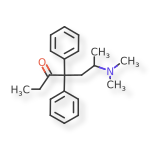
I.CCC(=O)C(CC(C)N(C)C)(C1=CC=CC=C1)C2=CC=CC=C2
InChI
InChIKey=BUQLQYUUFYFANQ-UHFFFAOYSA-N
InChI=1S/C21H27NO.HI/c1-5-20(23)21(16-17(2)22(3)4,18-12-8-6-9-13-18)19-14-10-7-11-15-19;/h6-15,17H,5,16H2,1-4H3;1H
| Molecular Formula | HI |
| Molecular Weight | 127.91241 |
| Charge | 0 |
| Count |
|
| Stereochemistry | ACHIRAL |
| Additional Stereochemistry | No |
| Defined Stereocenters | 0 / 0 |
| E/Z Centers | 0 |
| Optical Activity | NONE |
| Molecular Formula | C21H27NO |
| Molecular Weight | 309.4452 |
| Charge | 0 |
| Count |
|
| Stereochemistry | RACEMIC |
| Additional Stereochemistry | No |
| Defined Stereocenters | 0 / 1 |
| E/Z Centers | 0 |
| Optical Activity | ( + / - ) |
DescriptionCurator's Comment: description was created based on several sources, including:
http://www.accessdata.fda.gov/drugsatfda_docs/label/2016/006134s040s041lbl.pdf | https://www.drugs.com/pro/diskets.html
Curator's Comment: description was created based on several sources, including:
http://www.accessdata.fda.gov/drugsatfda_docs/label/2016/006134s040s041lbl.pdf | https://www.drugs.com/pro/diskets.html
Methadone, sold under the brand names Dolophine among others, is an synthetic opioid that is used as the hydrochloride to treat pain and as maintenance therapy or to help with detoxification in people with opioid dependence. Methadone hydrochloride is a mu-agonist; a synthetic opioid analgesic with multiple actions qualitatively similar to those of morphine. Some data also indicate that methadone acts as an antagonist at the NMDA-receptor. The contribution of NMDA receptor antagonism to methadone’s efficacy is unknown. Most common adverse reactions are: lightheadedness, dizziness, sedation, nausea, vomiting, and sweating. Avoid use mixed agonist/antagonist and partial agonist opioid analgesics with DOLOPHINE because they may reduce analgesic effect of DOLOPHINE or precipitate withdrawal symptoms.
Approval Year
Targets
| Primary Target | Pharmacology | Condition | Potency |
|---|---|---|---|
Target ID: CHEMBL233 |
3.51 nM [Ki] |
Conditions
| Condition | Modality | Targets | Highest Phase | Product |
|---|---|---|---|---|
| Palliative | DOLOPHINE HYDROCHLORIDE Approved UseFor the treatment of moderate to severe pain not responsive to non-narcotic analgesics. For detoxification treatment of opioid addiction (heroin or other morphine-like drugs). For maintenance treatment of opioid addiction (heroin or other morphine-like drugs), in conjunction with appropriate social and medical services. Note – Outpatient maintenance and outpatient detoxification treatment may be provided only by Opioid Treatment Programs (OTPs) certified by the Federal Substance Abuse and Mental Health Services Administration (SAMHSA) and registered by the Drug Enforcement Administration (DEA). This does not preclude the maintenance treatment of a patient with concurrent opioid addiction who is hospitalized for conditions other than opioid addiction and who requires temporary maintenance during the critical period of his/her stay, or of a patient whose enrollment has been verified in a program which has been certified for maintenance treatment with methadone. Launch Date1947 |
|||
| Palliative | DOLOPHINE HYDROCHLORIDE Approved UseFor the treatment of moderate to severe pain not responsive to non-narcotic analgesics. For detoxification treatment of opioid addiction (heroin or other morphine-like drugs). For maintenance treatment of opioid addiction (heroin or other morphine-like drugs), in conjunction with appropriate social and medical services. Note – Outpatient maintenance and outpatient detoxification treatment may be provided only by Opioid Treatment Programs (OTPs) certified by the Federal Substance Abuse and Mental Health Services Administration (SAMHSA) and registered by the Drug Enforcement Administration (DEA). This does not preclude the maintenance treatment of a patient with concurrent opioid addiction who is hospitalized for conditions other than opioid addiction and who requires temporary maintenance during the critical period of his/her stay, or of a patient whose enrollment has been verified in a program which has been certified for maintenance treatment with methadone. Launch Date1947 |
Cmax
| Value | Dose | Co-administered | Analyte | Population |
|---|---|---|---|---|
494 ng/mL EXPERIMENT https://pubmed.ncbi.nlm.nih.gov/15151520/ |
76 mg 1 times / day steady-state, oral dose: 76 mg route of administration: Oral experiment type: STEADY-STATE co-administered: |
METHADONE plasma | Homo sapiens population: UNHEALTHY age: ADULT sex: FEMALE / MALE food status: UNKNOWN |
|
40.2 ng/mL EXPERIMENT https://pubmed.ncbi.nlm.nih.gov/22621465/ |
10 mg single, oral dose: 10 mg route of administration: Oral experiment type: SINGLE co-administered: |
METHADONE plasma | Homo sapiens population: HEALTHY age: ADULT sex: FEMALE / MALE food status: FASTED |
|
548 ng/mL EXPERIMENT https://pubmed.ncbi.nlm.nih.gov/8641323/ |
0.89 mg/kg 1 times / day steady-state, oral dose: 0.89 mg/kg route of administration: Oral experiment type: STEADY-STATE co-administered: |
METHADONE plasma | Homo sapiens population: UNHEALTHY age: ADULT sex: FEMALE / MALE food status: FED |
|
54 ng/mL EXPERIMENT https://pubmed.ncbi.nlm.nih.gov/8641323/ |
0.89 mg/kg 1 times / day steady-state, oral dose: 0.89 mg/kg route of administration: Oral experiment type: STEADY-STATE co-administered: |
2-ETHYLIDENE-1,5-DIMETHYL-3,3-DIPHENYLPYRROLIDINE plasma | Homo sapiens population: UNHEALTHY age: ADULT sex: FEMALE / MALE food status: FED |
AUC
| Value | Dose | Co-administered | Analyte | Population |
|---|---|---|---|---|
8.27 μg × h/mL EXPERIMENT https://pubmed.ncbi.nlm.nih.gov/15151520/ |
76 mg 1 times / day steady-state, oral dose: 76 mg route of administration: Oral experiment type: STEADY-STATE co-administered: |
METHADONE plasma | Homo sapiens population: UNHEALTHY age: ADULT sex: FEMALE / MALE food status: UNKNOWN |
|
1073 ng × h/mL EXPERIMENT https://pubmed.ncbi.nlm.nih.gov/22621465/ |
10 mg single, oral dose: 10 mg route of administration: Oral experiment type: SINGLE co-administered: |
METHADONE plasma | Homo sapiens population: HEALTHY age: ADULT sex: FEMALE / MALE food status: FASTED |
|
8.54 mg × h/L EXPERIMENT https://pubmed.ncbi.nlm.nih.gov/8641323/ |
0.89 mg/kg 1 times / day steady-state, oral dose: 0.89 mg/kg route of administration: Oral experiment type: STEADY-STATE co-administered: |
METHADONE plasma | Homo sapiens population: UNHEALTHY age: ADULT sex: FEMALE / MALE food status: FED |
|
0.61 mg × h/L EXPERIMENT https://pubmed.ncbi.nlm.nih.gov/8641323/ |
0.89 mg/kg 1 times / day steady-state, oral dose: 0.89 mg/kg route of administration: Oral experiment type: STEADY-STATE co-administered: |
2-ETHYLIDENE-1,5-DIMETHYL-3,3-DIPHENYLPYRROLIDINE plasma | Homo sapiens population: UNHEALTHY age: ADULT sex: FEMALE / MALE food status: FED |
T1/2
| Value | Dose | Co-administered | Analyte | Population |
|---|---|---|---|---|
39 h EXPERIMENT https://pubmed.ncbi.nlm.nih.gov/15151520/ |
76 mg 1 times / day steady-state, oral dose: 76 mg route of administration: Oral experiment type: STEADY-STATE co-administered: |
METHADONE plasma | Homo sapiens population: UNHEALTHY age: ADULT sex: FEMALE / MALE food status: UNKNOWN |
|
39.3 h EXPERIMENT https://pubmed.ncbi.nlm.nih.gov/22621465/ |
10 mg single, oral dose: 10 mg route of administration: Oral experiment type: SINGLE co-administered: |
METHADONE plasma | Homo sapiens population: HEALTHY age: ADULT sex: FEMALE / MALE food status: FASTED |
|
31.2 h EXPERIMENT https://pubmed.ncbi.nlm.nih.gov/8641323/ |
0.89 mg/kg 1 times / day steady-state, oral dose: 0.89 mg/kg route of administration: Oral experiment type: STEADY-STATE co-administered: |
METHADONE plasma | Homo sapiens population: UNHEALTHY age: ADULT sex: FEMALE / MALE food status: FED |
Doses
| Dose | Population | Adverse events |
|---|---|---|
10 mg 3 times / day multiple, intravenous Recommended Dose: 10 mg, 3 times / day Route: intravenous Route: multiple Dose: 10 mg, 3 times / day Sources: |
pregnant, adult Health Status: pregnant Age Group: adult Sex: F Sources: |
Other AEs: Withdrawal syndrome neonatal... Other AEs: Withdrawal syndrome neonatal Sources: |
10 mg 3 times / day multiple, intravenous Recommended Dose: 10 mg, 3 times / day Route: intravenous Route: multiple Dose: 10 mg, 3 times / day Sources: |
unhealthy, adult Health Status: unhealthy Age Group: adult Sources: |
Other AEs: Respiratory depression, Addiction... Other AEs: Respiratory depression (grade 5) Sources: Addiction QT interval prolonged (grade 5) |
20 mg single, oral Recommended Dose: 20 mg Route: oral Route: single Dose: 20 mg Sources: |
unhealthy, adult Health Status: unhealthy Age Group: adult Sources: |
Other AEs: Respiratory depression, QT interval prolonged... Other AEs: Respiratory depression (grade 5) Sources: QT interval prolonged Arrhythmia (serious) |
AEs
| AE | Significance | Dose | Population |
|---|---|---|---|
| Withdrawal syndrome neonatal | 10 mg 3 times / day multiple, intravenous Recommended Dose: 10 mg, 3 times / day Route: intravenous Route: multiple Dose: 10 mg, 3 times / day Sources: |
pregnant, adult Health Status: pregnant Age Group: adult Sex: F Sources: |
|
| Addiction | 10 mg 3 times / day multiple, intravenous Recommended Dose: 10 mg, 3 times / day Route: intravenous Route: multiple Dose: 10 mg, 3 times / day Sources: |
unhealthy, adult Health Status: unhealthy Age Group: adult Sources: |
|
| QT interval prolonged | grade 5 | 10 mg 3 times / day multiple, intravenous Recommended Dose: 10 mg, 3 times / day Route: intravenous Route: multiple Dose: 10 mg, 3 times / day Sources: |
unhealthy, adult Health Status: unhealthy Age Group: adult Sources: |
| Respiratory depression | grade 5 | 10 mg 3 times / day multiple, intravenous Recommended Dose: 10 mg, 3 times / day Route: intravenous Route: multiple Dose: 10 mg, 3 times / day Sources: |
unhealthy, adult Health Status: unhealthy Age Group: adult Sources: |
| QT interval prolonged | 20 mg single, oral Recommended Dose: 20 mg Route: oral Route: single Dose: 20 mg Sources: |
unhealthy, adult Health Status: unhealthy Age Group: adult Sources: |
|
| Respiratory depression | grade 5 | 20 mg single, oral Recommended Dose: 20 mg Route: oral Route: single Dose: 20 mg Sources: |
unhealthy, adult Health Status: unhealthy Age Group: adult Sources: |
| Arrhythmia | serious | 20 mg single, oral Recommended Dose: 20 mg Route: oral Route: single Dose: 20 mg Sources: |
unhealthy, adult Health Status: unhealthy Age Group: adult Sources: |
Overview
| CYP3A4 | CYP2C9 | CYP2D6 | hERG |
|---|---|---|---|
OverviewOther
| Other Inhibitor | Other Substrate | Other Inducer |
|---|---|---|
Drug as perpetrator
| Target | Modality | Activity | Metabolite | Clinical evidence |
|---|---|---|---|---|
Page: 8.0 |
major [Inhibition 0.6 uM] | |||
| no | ||||
| no | ||||
| no | ||||
| no | ||||
Page: 8.0 |
unlikely | |||
| yes [Ki 100 uM] | ||||
| yes [Ki 2.5 uM] |
Drug as victim
| Target | Modality | Activity | Metabolite | Clinical evidence |
|---|---|---|---|---|
| no | ||||
| no | ||||
| no | ||||
| no | ||||
| no | ||||
| no | ||||
| no | ||||
| no | ||||
| yes | ||||
| yes | yes (co-administration study) Comment: CYP450 inducers: concomitant administration of rifampin resulted in a marked reduction in serum methadone levels and a concurrent appearance of withdrawal symptoms; phenytoin administration resulted in an approximately 50% reduction in methadone exposure and withdrawal symptoms occurred concurrently. CYP450 inhibitors: Repeat dose administration of oral voriconazole increased the peak plasma concentration (Cmax) and AUC of (R)-methadone by 31% and 47%, respectively, in subjects receiving a methadone maintenance dose. The Cmax and AUC of (S)-methadone increased by 65% and 103%, respectively Page: 29.0 |
|||
| yes | yes (co-administration study) Comment: CYP450 inducers: concomitant administration of rifampin resulted in a marked reduction in serum methadone levels and a concurrent appearance of withdrawal symptoms; phenytoin administration resulted in an approximately 50% reduction in methadone exposure and withdrawal symptoms occurred concurrently. CYP450 inhibitors: Repeat dose administration of oral voriconazole increased the peak plasma concentration (Cmax) and AUC of (R)-methadone by 31% and 47%, respectively, in subjects receiving a methadone maintenance dose. The Cmax and AUC of (S)-methadone increased by 65% and 103%, respectively Page: 29.0 |
|||
| yes | yes (co-administration study) Comment: CYP450 inducers: concomitant administration of rifampin resulted in a marked reduction in serum methadone levels and a concurrent appearance of withdrawal symptoms; phenytoin administration resulted in an approximately 50% reduction in methadone exposure and withdrawal symptoms occurred concurrently. CYP450 inhibitors: Repeat dose administration of oral voriconazole increased the peak plasma concentration (Cmax) and AUC of (R)-methadone by 31% and 47%, respectively, in subjects receiving a methadone maintenance dose. The Cmax and AUC of (S)-methadone increased by 65% and 103%, respectively Page: 29.0 |
|||
| yes | yes (co-administration study) Comment: CYP450 inducers: concomitant administration of rifampin resulted in a marked reduction in serum methadone levels and a concurrent appearance of withdrawal symptoms; phenytoin administration resulted in an approximately 50% reduction in methadone exposure and withdrawal symptoms occurred concurrently. CYP450 inhibitors: Repeat dose administration of oral voriconazole increased the peak plasma concentration (Cmax) and AUC of (R)-methadone by 31% and 47%, respectively, in subjects receiving a methadone maintenance dose. The Cmax and AUC of (S)-methadone increased by 65% and 103%, respectively Page: 29.0 |
|||
| yes | yes (co-administration study) Comment: CYP450 inducers: concomitant administration of rifampin resulted in a marked reduction in serum methadone levels and a concurrent appearance of withdrawal symptoms; phenytoin administration resulted in an approximately 50% reduction in methadone exposure and withdrawal symptoms occurred concurrently. CYP450 inhibitors: Repeat dose administration of oral voriconazole increased the peak plasma concentration (Cmax) and AUC of (R)-methadone by 31% and 47%, respectively, in subjects receiving a methadone maintenance dose. The Cmax and AUC of (S)-methadone increased by 65% and 103%, respectively Page: 29.0 |
Tox targets
| Target | Modality | Activity | Metabolite | Clinical evidence |
|---|---|---|---|---|
PubMed
| Title | Date | PubMed |
|---|---|---|
| Frequency of high-risk use of QT-prolonging medications. | 2006-06 |
|
| Changes in HIV risk behaviors among patients receiving combined pharmacological and behavioral interventions for heroin and cocaine dependence. | 2006-05 |
|
| Variables associated with perceived sleep disorders in methadone maintenance treatment (MMT) patients. | 2006-04-28 |
|
| Methadone treatment of chronic non-malignant pain and opioid dependence--a long-term follow-up. | 2006-04 |
|
| Does naltrexone treatment lead to depression? Findings from a randomized controlled trial in subjects with opioid dependence. | 2006-01 |
|
| Bradycardia during methadone therapy in an infant. | 2006-01 |
|
| A randomized controlled trial of interim methadone maintenance. | 2006-01 |
|
| Factors associated with methadone maintenance therapy use among a cohort of polysubstance using injection drug users in Vancouver. | 2005-12-12 |
|
| QT prolongation and torsades de pointes among methadone users: reports to the FDA spontaneous reporting system. | 2005-11 |
|
| [Torsades de pointes during methadone treatment]. | 2005-10 |
|
| Methadone doses of 100 mg or greater are more effective than lower doses at suppressing heroin self-administration in opioid-dependent volunteers. | 2005-10 |
|
| QT prolongation and syncope with methadone, doxepin, and a beta-blocker. | 2005-10 |
|
| Central sleep apnea in stable methadone maintenance treatment patients. | 2005-09 |
|
| [Methadone-induced heart arrhythmia]. | 2005-08-11 |
|
| Methadone-induced bradycardia. | 2005-07 |
|
| Neuropsychological functioning in methadone maintenance patients versus abstinent heroin abusers. | 2005-06-01 |
|
| Methadone-induced Torsade de pointes tachycardias. | 2005-05-14 |
|
| Effects of buprenorphine on cardiac repolarization in a patient with methadone-related torsade de pointes. | 2005-04 |
|
| Torsades de pointes with methadone. | 2005-04 |
|
| Measurement of QTc in patients receiving chronic methadone therapy. | 2005-04 |
|
| Methadone-related Torsades de Pointes in a sickle cell patient treated for chronic pain. | 2005-04 |
|
| Dextromethorphan-induced delirium and possible methadone interaction. | 2005-03 |
|
| [Methadone and sleep apnea syndrome]. | 2005-03 |
|
| Caution with nalbuphine in patients on long-term opioids. | 2005-03 |
|
| Methadone versus buprenorphine with contingency management or performance feedback for cocaine and opioid dependence. | 2005-02 |
|
| Methadone maintenance and male sexual dysfunction. | 2005 |
|
| Cocaine-related torsade de pointes in a methadone maintenance patient. | 2005 |
|
| Adipocyte-derived hormones in heroin addicts: the influence of methadone maintenance treatment. | 2005 |
|
| QTc interval prolongation in patients on long-term methadone maintenance therapy. | 2005 |
|
| Obsessive-compulsive symptoms precipitated by methadone tapering. | 2004-12 |
|
| [Routine ECG in methadone-assisted rehabilitation is wrong prioritization]. | 2004-11-18 |
|
| Methadone-induced torsade de pointes in a patient with normal baseline QT interval. | 2004-10-09 |
|
| Oral methadone for cancer pain: no indication of Q-T interval prolongation or torsades de pointes. | 2004-10 |
|
| Intravenous ketamine infusion as an adjuvant to morphine in a 2-year-old with severe cancer pain from metastatic neuroblastoma. | 2004-10 |
|
| [Preclinical management of accidental methadone intoxication of a 4-year-old girl. Antagonist or intubation?]. | 2004-10 |
|
| [Long QT and torsade de pointes in a patient with acquired human immunodeficiency virus infection in multitherapy with drugs affecting cytochrome P450]. | 2004-09 |
|
| Epidural clonidine, bupivacaine and methadone as the sole analgesic agent after thoracotomy for lung resection. | 2004-09 |
|
| [Life-threatening, recurrent arrhythmia in patients on high-dose methadone treatment: torsade de pointes]. | 2004-08-30 |
|
| Methadone metabolism by human placenta. | 2004-08-01 |
|
| QT interval prolongation in patients on methadone with concomitant drugs. | 2004-08 |
|
| Directly observed therapy for the management of HIV-infected patients in a methadone program. | 2004-06-01 |
|
| The effect of quinidine, used as a probe for the involvement of P-glycoprotein, on the intestinal absorption and pharmacodynamics of methadone. | 2004-05 |
|
| Agonist-like or antagonist-like treatment for cocaine dependence with methadone for heroin dependence: two double-blind randomized clinical trials. | 2004-05 |
|
| Cost effectiveness of disulfiram: treating cocaine use in methadone-maintained patients. | 2004-04 |
|
| [Development of transmural myocardial infarction in young persons with intact coronary arteries during methadone use for the treatment of heroine addiction]. | 2004 |
|
| Relationship between prescribing and risk of opiate overdose among drug users in and out of maintenance treatment. | 2004 |
|
| Tiagabine increases cocaine-free urines in cocaine-dependent methadone-treated patients: results of a randomized pilot study. | 2003-11 |
|
| QT prolongation and Torsades de Pointes in patients infected with human immunodeficiency virus and treated with methadone. | 2003-10-15 |
|
| [Torsade de pointes: a severe and unknown adverse effect in a patient taking methadone]. | 2003-10-08 |
|
| Reversible spastic paraparesis induced by high-dose intravenous methadone. | 2001-02 |
Sample Use Guides
Chronic pain: oral initial dose - 2.5 mg every 8 to 12 hours; Intravenous initial dose: 2.5 mg to 10 mg every 8 to 12 hours
Opiate withdrawal: Initial dose - 20 to 30 mg orally; an additional 5 to 10 mg may be given orally after 2 to 4 hours if withdrawal symptoms have not been suppressed or if symptoms reappear.
-Maximum initial dose: 30 mg
-Maximum day 1 dose: 40 mg
Route of Administration:
Other
| Substance Class |
Chemical
Created
by
admin
on
Edited
Mon Mar 31 20:55:55 GMT 2025
by
admin
on
Mon Mar 31 20:55:55 GMT 2025
|
| Record UNII |
MS4P249SDR
|
| Record Status |
Validated (UNII)
|
| Record Version |
|
-
Download
| Name | Type | Language | ||
|---|---|---|---|---|
|
Preferred Name | English | ||
|
Common Name | English |
| Code System | Code | Type | Description | ||
|---|---|---|---|---|---|
|
MS4P249SDR
Created by
admin on Mon Mar 31 20:55:55 GMT 2025 , Edited by admin on Mon Mar 31 20:55:55 GMT 2025
|
PRIMARY | |||
|
171389978
Created by
admin on Mon Mar 31 20:55:55 GMT 2025 , Edited by admin on Mon Mar 31 20:55:55 GMT 2025
|
PRIMARY | |||
|
16896-75-6
Created by
admin on Mon Mar 31 20:55:55 GMT 2025 , Edited by admin on Mon Mar 31 20:55:55 GMT 2025
|
PRIMARY |
| Related Record | Type | Details | ||
|---|---|---|---|---|
|
PARENT -> SALT/SOLVATE |
|
| Related Record | Type | Details | ||
|---|---|---|---|---|
|
ACTIVE MOIETY |
|