


Details
| Stereochemistry | ACHIRAL |
| Molecular Formula | C22H30N2O2S.ClH |
| Molecular Weight | 423.012 |
| Optical Activity | NONE |
| Defined Stereocenters | 0 / 0 |
| E/Z Centers | 0 |
| Charge | 0 |
SHOW SMILES / InChI
SMILES
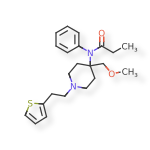
Cl.CCC(=O)N(C1=CC=CC=C1)C2(COC)CCN(CCC3=CC=CS3)CC2
InChI
InChIKey=WZGGBYJHSKVKGO-UHFFFAOYSA-N
InChI=1S/C22H30N2O2S.ClH/c1-3-21(25)24(19-8-5-4-6-9-19)22(18-26-2)12-15-23(16-13-22)14-11-20-10-7-17-27-20;/h4-10,17H,3,11-16,18H2,1-2H3;1H
| Molecular Formula | ClH |
| Molecular Weight | 36.461 |
| Charge | 0 |
| Count |
|
| Stereochemistry | ACHIRAL |
| Additional Stereochemistry | No |
| Defined Stereocenters | 0 / 0 |
| E/Z Centers | 0 |
| Optical Activity | NONE |
| Molecular Formula | C22H30N2O2S |
| Molecular Weight | 386.551 |
| Charge | 0 |
| Count |
|
| Stereochemistry | ACHIRAL |
| Additional Stereochemistry | No |
| Defined Stereocenters | 0 / 0 |
| E/Z Centers | 0 |
| Optical Activity | NONE |
DescriptionSources: http://www.drugbank.ca/drugs/DB00708Curator's Comment: Description was created based on several sources, including
http://www.accessdata.fda.gov/drugsatfda_docs/label/2014/019050s032lbl.pdf
Sources: http://www.drugbank.ca/drugs/DB00708
Curator's Comment: Description was created based on several sources, including
http://www.accessdata.fda.gov/drugsatfda_docs/label/2014/019050s032lbl.pdf
Sufentanil is a synthetic opioid analgesic. Sufentanil interacts predominately with the opioid mu-receptor. These mu-binding sites are discretely distributed in the human brain, spinal cord, and other tissues. In clinical settings, sufentanil exerts its principal pharmacologic effects on the central nervous system. Its primary actions of therapeutic value are analgesia and sedation. Sufentanil may increase the patient's tolerance for pain and decrease the perception of suffering, although the presence of the pain itself may still be recognized. In addition to analgesia, alterations in mood, euphoria and dysphoria, and drowsiness commonly occur. Sufentanil depresses the respiratory centers, depresses the cough reflex, and constricts the pupils. Opiate receptors are coupled with G-protein receptors and function as both positive and negative regulators of synaptic transmission via G-proteins that activate effector proteins. Binding of the opiate stimulates the exchange of GTP for GDP on the G-protein complex. As the effector system is adenylate cyclase and cAMP located at the inner surface of the plasma membrane, opioids decrease intracellular cAMP by inhibiting adenylate cyclase. Subsequently, the release of nociceptive neurotransmitters such as substance P, GABA, dopamine, acetylcholine and noradrenaline is inhibited. Opioids also inhibit the release of vasopressin, somatostatin, insulin and glucagon. Sufentanil's analgesic activity is, most likely, due to its conversion to morphine. Opioids open calcium-dependent inwardly rectifying potassium channels (OP1 receptor agonist). This results in hyperpolarization and reduced neuronal excitability. Sufentanil is used as an analgesic adjunct in anesthesia and as a primary anesthetic drug in procedures requiring assisted ventilation and in the relief of pain.
CNS Activity
Approval Year
Targets
| Primary Target | Pharmacology | Condition | Potency |
|---|---|---|---|
Target ID: CHEMBL233 Sources: http://www.drugbank.ca/drugs/DB00708 |
|||
Target ID: CHEMBL4187 |
49.0 µM [IC50] | ||
Target ID: CHEMBL2097171 |
Conditions
| Condition | Modality | Targets | Highest Phase | Product |
|---|---|---|---|---|
| Palliative | SUFENTA PRESERVATIVE FREE Approved UseSufentanil Citrate Injection is indicated for intravenous administration in adults and pediatric patients:
as an analgesic adjunct in the maintenance of balanced general anesthesia in patients who are intubated and ventilated.
as a primary anesthetic agent for the induction and maintenance of anesthesia with 100% oxygen in patients undergoing major surgical procedures, in patients who are intubated and ventilated, such as cardiovascular surgery or neurosurgical procedures in the sitting position, to provide favorable myocardial and cerebral oxygen balance or when extended postoperative ventilation is anticipated.
Sufentanil Citrate Injection is indicated for epidural administration as an analgesic combined with low dose (usually 12.5 mg per administration) bupivacaine during labor and vaginal delivery. Launch Date1984 |
Cmax
| Value | Dose | Co-administered | Analyte | Population |
|---|---|---|---|---|
63.1 pg/mL |
30 μg single, sublingual dose: 30 μg route of administration: Sublingual experiment type: SINGLE co-administered: |
SUFENTANIL plasma | Homo sapiens population: UNKNOWN age: ADULT sex: UNKNOWN food status: UNKNOWN |
AUC
| Value | Dose | Co-administered | Analyte | Population |
|---|---|---|---|---|
278 pg × h/mL |
30 μg single, sublingual dose: 30 μg route of administration: Sublingual experiment type: SINGLE co-administered: |
SUFENTANIL plasma | Homo sapiens population: UNKNOWN age: ADULT sex: UNKNOWN food status: UNKNOWN |
T1/2
| Value | Dose | Co-administered | Analyte | Population |
|---|---|---|---|---|
13.4 h |
30 μg single, sublingual dose: 30 μg route of administration: Sublingual experiment type: SINGLE co-administered: |
SUFENTANIL plasma | Homo sapiens population: UNKNOWN age: ADULT sex: UNKNOWN food status: UNKNOWN |
Funbound
| Value | Dose | Co-administered | Analyte | Population |
|---|---|---|---|---|
7% |
30 μg single, sublingual dose: 30 μg route of administration: Sublingual experiment type: SINGLE co-administered: |
SUFENTANIL plasma | Homo sapiens population: UNKNOWN age: ADULT sex: UNKNOWN food status: UNKNOWN |
Doses
| Dose | Population | Adverse events |
|---|---|---|
0.4 mg/kg single, intranasal MTD Dose: 0.4 mg/kg Route: intranasal Route: single Dose: 0.4 mg/kg Sources: |
unknown, 18 - 65 years Health Status: unknown Age Group: 18 - 65 years Sex: unknown Sources: |
Other AEs: Nausea, Hypotension... |
30 ug single, oral Recommended |
unhealthy, adult |
Disc. AE: Pruritus, Dizziness... AEs leading to discontinuation/dose reduction: Pruritus (1 patient) Sources: Dizziness (1 patient) |
AEs
| AE | Significance | Dose | Population |
|---|---|---|---|
| Hypotension | 0.4 mg/kg single, intranasal MTD Dose: 0.4 mg/kg Route: intranasal Route: single Dose: 0.4 mg/kg Sources: |
unknown, 18 - 65 years Health Status: unknown Age Group: 18 - 65 years Sex: unknown Sources: |
|
| Nausea | 0.4 mg/kg single, intranasal MTD Dose: 0.4 mg/kg Route: intranasal Route: single Dose: 0.4 mg/kg Sources: |
unknown, 18 - 65 years Health Status: unknown Age Group: 18 - 65 years Sex: unknown Sources: |
|
| Dizziness | 1 patient Disc. AE |
30 ug single, oral Recommended |
unhealthy, adult |
| Pruritus | 1 patient Disc. AE |
30 ug single, oral Recommended |
unhealthy, adult |
Overview
| CYP3A4 | CYP2C9 | CYP2D6 | hERG |
|---|---|---|---|
OverviewOther
| Other Inhibitor | Other Substrate | Other Inducer |
|---|---|---|
Drug as victim
| Target | Modality | Activity | Metabolite | Clinical evidence |
|---|---|---|---|---|
Page: 4.0 |
no | |||
Page: 4.0 |
no | |||
| yes | yes (co-administration study) Comment: Co-administration of a single dose of sufentanil sublingual tablet 15 mcg with a strong CYP3A4 inhibitor, ketoconazole, results in 77% and 19% greater AUCinf and Cmax values of sufentanil, respectively, compared to its administration alone Page: 19.0 |
PubMed
| Title | Date | PubMed |
|---|---|---|
| Interaction of morphine, fentanyl, sufentanil, alfentanil, and loperamide with the efflux drug transporter P-glycoprotein. | 2002-04 |
|
| Alfentanil and sufentanil in fast-track anesthesia for coronary artery bypass graft surgery. | 2002-04 |
|
| Ropivacaine 2 mg/mL vs. bupivacaine 1.25 mg/mL with sufentanil using patient-controlled epidural analgesia in labour. | 2002-03 |
|
| Up-and-down allocation. | 2002-03 |
|
| Total intravenous anesthesia for intraoperative monitoring of the motor pathways: an integral view combining clinical and experimental data. | 2002-03 |
|
| Pharmacokinetics of a 24-hour intravenous ketoprofen infusion in children. | 2002-02 |
|
| Compatibility of ropivacaine with morphine, sufentanil, fentanyl, or clonidine. | 2002-02 |
|
| Small-dose selective spinal anesthesia for short-duration outpatient laparoscopy: recovery characteristics compared with desflurane anesthesia. | 2002-02 |
|
| Dosing of intrathecal sufentanil. | 2002-01-19 |
|
| Cost-effectiveness of analgesia after Caesarean section. A comparison of intrathecal morphine and epidural PCA. | 2002-01 |
|
| Sufentanil potentiates the inhibitory effect of epinephrine on intestinal motility. | 2002-01 |
|
| Cost containment in obstetric analgesia. | 2002-01 |
|
| Epinephrine reduces the sedative side effects of epidural sufentanil for labour analgesia. | 2002-01 |
|
| A systematic review of adjuncts for intravenous regional anesthesia for surgical procedures. | 2002-01 |
|
| Epidural administration of low-dose morphine combined with clonidine for postoperative analgesia after lumbar disc surgery. | 2002-01 |
|
| Hydromorphone for acute and chronic pain. | 2002 |
|
| Subarachnoid sufentanil for early postoperative pain management in orthopedic patients: more disadvantages than benefits? | 2001-12 |
|
| Pharmacokinetics of sufentanil in patients undergoing coronary artery bypass graft surgery. | 2001-12 |
|
| Comparison of continuous epidural infusion of ropivacaine and sufentanil with intravenous patient-controlled analgesia after total hip replacement. | 2001-12 |
|
| Patient-controlled epidural analgesia after abdominal surgery: ropivacaine versus bupivacaine. | 2001-12 |
|
| Neostigmine combined with bupivacaine, clonidine, and sufentanil for spinal labor analgesia. | 2001-12 |
|
| The continuous recording of blood pressure in patients undergoing carotid surgery under remifentanil versus sufentanil analgesia. | 2001-12 |
|
| [Low concentration Ropivacaine in labor epidural analgesia. A prospective study on obstetric and neonatal outcome]. | 2001-12 |
|
| Effects of intrathecal sufentanil on plasma oxytocin and cortisol concentrations in women during the first stage of labor. | 2001-11-15 |
|
| Vibration sense testing with a 128-Hz tuning fork as a tool to determine recovery from epidural neuraxial block. | 2001-11-15 |
|
| [Obstetric analgesia in patients with Klippel-Trenaunay syndrome]. | 2001-11 |
|
| Double-blinded, single-blinded, or just blind? | 2001-11 |
|
| Postoperative analgesia by epidural methylprednisolone after posterolateral thoracotomy. | 2001-10 |
|
| Obstetric anesthesia and analgesia: options for pain relief during childbirth. | 2001-10 |
|
| Combined spinal-epidural versus epidural labor analgesia. | 2001-10 |
|
| Stability of sufentanil in human plasma samples. | 2001-10 |
|
| Effect of nitrous oxide on the bispectral index and the 95% spectral edge frequency of the electroencephalogram during surgery. | 2001-10 |
|
| Levobupivacaine combined with sufentanil and epinephrine for intrathecal labor analgesia: a comparison with racemic bupivacaine. | 2001-10 |
|
| The role of drug-lipid interactions on the disposition of liposome-formulated opioid analgesics in vitro and in vivo. | 2001-10 |
|
| A comparison of fentanyl, sufentanil, and remifentanil for fast-track cardiac anesthesia. | 2001-10 |
|
| A high rate of epidural analgesia with bupivacaine-sufentanil is consistent with a low rate of caesarean section and instrumental deliveries. | 2001-10 |
|
| Effect of epidural analgesia on the fetal heart rate. | 2001-10 |
|
| Sufentanil: an overview of its use for acute pain management. | 2001-09 |
|
| [Sufentanil vs morphine combined with ropivacaine for thoracic epidural analgesia in major abdominal surgery]. | 2001-09 |
|
| Xenon anaesthesia for laparoscopic cholecystectomy in a patient with Eisenmenger's syndrome. | 2001-06 |
|
| Oesophageal Doppler monitoring overestimates cardiac output during lumbar epidural anaesthesia. | 2001-06 |
|
| Recovery after remifentanil and sufentanil for analgesia and sedation of mechanically ventilated patients after trauma or major surgery. | 2001-06 |
|
| Small-dose selective spinal anaesthesia for short-duration outpatient gynaecological laparoscopy: recovery characteristics compared with propofol anaesthesia. | 2001-04 |
|
| Effects of fentanyl, alfentanil, remifentanil and sufentanil on loss of consciousness and bispectral index during propofol induction of anaesthesia. | 2001-04 |
|
| A comparison of motor block between ropivacaine and bupivacaine for continuous labor epidural analgesia. | 2001-02 |
|
| Intrathecal sufentanil and morphine for post-thoracotomy pain relief. | 2001-02 |
|
| Clinical interpretation of pharmacokinetic and pharmacodynamic propofol-opioid interactions. | 2001 |
|
| Liver and renal function after volatile induction and maintenance of anesthesia (VIMA) with sevoflurane versus TIVA with sufentanil-midazolam for CABG surgery. | 2001 |
|
| [Hyperoxia-induced liberation of big-endothelin into jugular venous blood of electric neurosurgical patients]. | 2001 |
|
| Right vs left side thoracoscopic sympathectomy: effects of CO2 insufflation on haemodynamics. | 2001 |
Patents
Sample Use Guides
ANALGESIC DOSAGES
Incremental or Infusion: 1 to 2 mcg/kg (expected duration of anesthesia 1 to 2 hours).
Incremental or Infusion: 2 to 8 mcg/kg (expected duration of anesthesia 2 to 8 hours).
ANESTHETIC DOSAGES
Incremental or Infusion: 8 to 30 mcg/kg (anesthetic doses). At this anesthetic dosage range Sufentanil is generally administered as a slow injection, as an infusion, or as an injection followed by an infusion.
Route of Administration:
Intravenous
| Substance Class |
Chemical
Created
by
admin
on
Edited
Wed Apr 02 11:22:38 GMT 2025
by
admin
on
Wed Apr 02 11:22:38 GMT 2025
|
| Record UNII |
MX47GT2KWL
|
| Record Status |
Validated (UNII)
|
| Record Version |
|
-
Download
| Name | Type | Language | ||
|---|---|---|---|---|
|
Preferred Name | English | ||
|
Common Name | English | ||
|
Systematic Name | English | ||
|
Systematic Name | English |
| Code System | Code | Type | Description | ||
|---|---|---|---|---|---|
|
164790-60-7
Created by
admin on Wed Apr 02 11:22:38 GMT 2025 , Edited by admin on Wed Apr 02 11:22:38 GMT 2025
|
PRIMARY | |||
|
18463211
Created by
admin on Wed Apr 02 11:22:38 GMT 2025 , Edited by admin on Wed Apr 02 11:22:38 GMT 2025
|
PRIMARY | |||
|
MX47GT2KWL
Created by
admin on Wed Apr 02 11:22:38 GMT 2025 , Edited by admin on Wed Apr 02 11:22:38 GMT 2025
|
PRIMARY |
| Related Record | Type | Details | ||
|---|---|---|---|---|
|
PARENT -> SALT/SOLVATE |
|
| Related Record | Type | Details | ||
|---|---|---|---|---|
|
ACTIVE MOIETY |
|