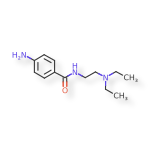
Details
| Stereochemistry | ACHIRAL |
| Molecular Formula | C13H21N3O.ClH |
| Molecular Weight | 271.786 |
| Optical Activity | NONE |
| Defined Stereocenters | 0 / 0 |
| E/Z Centers | 0 |
| Charge | 0 |
SHOW SMILES / InChI
SMILES
Cl.CCN(CC)CCNC(=O)C1=CC=C(N)C=C1
InChI
InChIKey=ABTXGJFUQRCPNH-UHFFFAOYSA-N
InChI=1S/C13H21N3O.ClH/c1-3-16(4-2)10-9-15-13(17)11-5-7-12(14)8-6-11;/h5-8H,3-4,9-10,14H2,1-2H3,(H,15,17);1H
| Molecular Formula | C13H21N3O |
| Molecular Weight | 235.3253 |
| Charge | 0 |
| Count |
|
| Stereochemistry | ACHIRAL |
| Additional Stereochemistry | No |
| Defined Stereocenters | 0 / 0 |
| E/Z Centers | 0 |
| Optical Activity | NONE |
| Molecular Formula | ClH |
| Molecular Weight | 36.461 |
| Charge | 0 |
| Count |
|
| Stereochemistry | ACHIRAL |
| Additional Stereochemistry | No |
| Defined Stereocenters | 0 / 0 |
| E/Z Centers | 0 |
| Optical Activity | NONE |
Procainamide is a derivative of procaine with less CNS action. Procainamide hydrochloride injection is indicated for the treatment of documented ventricular arrhythmias, such as sustained ventricular tachycardia, that, in the judgement of the physician, are life threatening. Because of the proarrhythmic effects of procainamide, its use with lesser arrhythmias is generally not recommended. Treatment of patients with asymptomatic ventricular premature contractions should be avoided. Procainamide (PA) increases the effective refractory period of the atria, and to a lesser extent the bundle of His-Purkinje system and ventricles of the heart. It reduces impulse conduction velocity in the atria, His-Purkinje fibers, and ventricular muscle, but has variable effects on the atrioventricular (A-V) node, a direct slowing action and a weaker vagolytic effect, which may speed A-V conduction slightly. Myocardial excitability is reduced in the atria, Purkinje fibers, papillary muscles, and ventricles by an increase in the threshold for excitation, combined with inhibition of ectopic pacemaker activity by retardation of the slow phase of diastolic depolarization, thus decreasing automaticity especially in ectopic sites. Contractility of the undamaged heart is usually not affected by therapeutic concentrations, although slight reduction of cardiac output may occur, and may be significant in the presence of myocardial damage. Therapeutic levels of PA may exert vagolytic effects and produce slight acceleration of heart rate, while high or toxic concentrations may prolong A-V conduction time or induce A-V block, or even cause abnormal automaticity and spontaneous firing by unknown mechanisms. Procainamide is sodium channel blocker. It stabilizes the neuronal membrane by inhibiting the ionic fluxes required for the initiation and conduction of impulses thereby effecting local anesthetic action.
Originator
Approval Year
Targets
| Primary Target | Pharmacology | Condition | Potency |
|---|---|---|---|
Target ID: CHEMBL2331043 |
Conditions
| Condition | Modality | Targets | Highest Phase | Product |
|---|---|---|---|---|
| Primary | PROCAINAMIDE HYDROCHLORIDE Approved UseProcainamide hydrochloride injection is indicated for the treatment of documented ventricular arrhythmias, such as sustained ventricular tachycardia, that, in the judgement of the physician, are life-threatening. Because of the proarrhythmic effects of procainamide, its use with lesser arrhythmias is generally not recommended. Treatment of patients with asymptomatic ventricular premature contractions should be avoided. Initiation of procainamide treatment, as with other antiarrhythmic agents used to treat life-threatening arrhythmias, should be carried out in the hospital. Antiarrhythmic drugs have not been shown to enhance survival in patients with ventricular arrhythmias. Launch Date1986 |
Cmax
| Value | Dose | Co-administered | Analyte | Population |
|---|---|---|---|---|
1.211 μg/mL |
1000 mg single, oral dose: 1000 mg route of administration: Oral experiment type: SINGLE co-administered: |
PROCAINAMIDE plasma | Homo sapiens population: HEALTHY age: ADULT sex: FEMALE / MALE food status: FASTED |
|
1.303 μg/mL |
1000 mg single, oral dose: 1000 mg route of administration: Oral experiment type: SINGLE co-administered: |
PROCAINAMIDE plasma | Homo sapiens population: HEALTHY age: ADULT sex: FEMALE / MALE food status: FASTED |
|
0.514 μg/mL |
1000 mg single, oral dose: 1000 mg route of administration: Oral experiment type: SINGLE co-administered: |
ACECAINIDE plasma | Homo sapiens population: HEALTHY age: ADULT sex: FEMALE / MALE food status: FASTED |
|
0.581 μg/mL |
1000 mg single, oral dose: 1000 mg route of administration: Oral experiment type: SINGLE co-administered: |
ACECAINIDE plasma | Homo sapiens population: HEALTHY age: ADULT sex: FEMALE / MALE food status: FASTED |
AUC
| Value | Dose | Co-administered | Analyte | Population |
|---|---|---|---|---|
18.22 μg × h/mL |
1000 mg single, oral dose: 1000 mg route of administration: Oral experiment type: SINGLE co-administered: |
PROCAINAMIDE plasma | Homo sapiens population: HEALTHY age: ADULT sex: FEMALE / MALE food status: FASTED |
|
18.34 μg × h/mL |
1000 mg single, oral dose: 1000 mg route of administration: Oral experiment type: SINGLE co-administered: |
PROCAINAMIDE plasma | Homo sapiens population: HEALTHY age: ADULT sex: FEMALE / MALE food status: FASTED |
|
15.165 μg × h/mL |
1000 mg single, oral dose: 1000 mg route of administration: Oral experiment type: SINGLE co-administered: |
ACECAINIDE plasma | Homo sapiens population: HEALTHY age: ADULT sex: FEMALE / MALE food status: FASTED |
|
15.897 μg × h/mL |
1000 mg single, oral dose: 1000 mg route of administration: Oral experiment type: SINGLE co-administered: |
ACECAINIDE plasma | Homo sapiens population: HEALTHY age: ADULT sex: FEMALE / MALE food status: FASTED |
Doses
| Dose | Population | Adverse events |
|---|---|---|
4100 mg steady, oral MTD |
unhealthy, 25-79 |
Disc. AE: Nausea, Vomiting... AEs leading to discontinuation/dose reduction: Nausea Sources: Vomiting Insomnia Epigastric pain |
1 g single, intravenous Recommended Dose: 1 g Route: intravenous Route: single Dose: 1 g Sources: |
unhealthy Health Status: unhealthy Sources: |
Disc. AE: Agranulocytosis... Other AEs: Bone marrow depression, Neutropenia... AEs leading to discontinuation/dose reduction: Agranulocytosis (grade 4, 0.5%) Other AEs:Bone marrow depression (0.5%) Sources: Neutropenia (0.5%) Hypoplastic anemia (0.5%) Thrombocytopenia (0.5%) |
AEs
| AE | Significance | Dose | Population |
|---|---|---|---|
| Epigastric pain | Disc. AE | 4100 mg steady, oral MTD |
unhealthy, 25-79 |
| Insomnia | Disc. AE | 4100 mg steady, oral MTD |
unhealthy, 25-79 |
| Nausea | Disc. AE | 4100 mg steady, oral MTD |
unhealthy, 25-79 |
| Vomiting | Disc. AE | 4100 mg steady, oral MTD |
unhealthy, 25-79 |
| Bone marrow depression | 0.5% | 1 g single, intravenous Recommended Dose: 1 g Route: intravenous Route: single Dose: 1 g Sources: |
unhealthy Health Status: unhealthy Sources: |
| Hypoplastic anemia | 0.5% | 1 g single, intravenous Recommended Dose: 1 g Route: intravenous Route: single Dose: 1 g Sources: |
unhealthy Health Status: unhealthy Sources: |
| Neutropenia | 0.5% | 1 g single, intravenous Recommended Dose: 1 g Route: intravenous Route: single Dose: 1 g Sources: |
unhealthy Health Status: unhealthy Sources: |
| Thrombocytopenia | 0.5% | 1 g single, intravenous Recommended Dose: 1 g Route: intravenous Route: single Dose: 1 g Sources: |
unhealthy Health Status: unhealthy Sources: |
| Agranulocytosis | grade 4, 0.5% Disc. AE |
1 g single, intravenous Recommended Dose: 1 g Route: intravenous Route: single Dose: 1 g Sources: |
unhealthy Health Status: unhealthy Sources: |
Overview
| CYP3A4 | CYP2C9 | CYP2D6 | hERG |
|---|---|---|---|
Drug as perpetrator
| Target | Modality | Activity | Metabolite | Clinical evidence |
|---|---|---|---|---|
| weak [IC50 <1000 uM] | ||||
| yes [IC50 51.3 uM] | ||||
| yes [Ki 178.1 uM] | ||||
| yes [Ki 217 uM] | ||||
| yes [Ki 50 uM] | ||||
| yes [Ki 738 uM] |
Drug as victim
| Target | Modality | Activity | Metabolite | Clinical evidence |
|---|---|---|---|---|
| yes [Km 1280 uM] | yes (co-administration study) Comment: MATE1-HEK293 cells (5.0 mcM procainamide), Uptake = 47.6 mcL/mg protein/15 min, Vmax = 7.56 nmol/mg protein/2 min; Coadministration of Cimetidine (300 mg QID 3 Days & 1 hr before/5 hr after Procainamide on Day 4) increased Procainamide (500 mg QD on Day 4)/N-acetylprocaineamide AUC by 40%, 26% and N-acetylprocainamide Cmax by 33%. |
|||
| yes [Km 1580 uM] | yes (co-administration study) Comment: MATE2-K-HEK293 cells (5.0 mcM procainamide), Uptake = 26.5 mcL/mg protein/15 min, Vmax = 6.77 nmol/mg protein/2 min; Coadministration of Cimetidine (300 mg QID 3 Days & 1 hr before/5 hr after Procainamide on Day 4) increased Procainamide (500 mg QD on Day 4)/N-acetylprocaineamide AUC by 40%, 26% and N-acetylprocainamide Cmax by 33%. |
|||
| yes | ||||
| yes | ||||
| yes | yes (co-administration study) Comment: OCT2-HEK293 cells, Active uptake = 114 pmo/mg protein; Coadministration of Cimetidine (300 mg QID 3 Days & 1 hr before/5 hr after Procainamide on Day 4) increased Procainamide (500 mg QD on Day 4)/N-acetylprocaineamide AUC by 40%, 26% and N-acetylprocainamide Cmax by 33%. |
Tox targets
| Target | Modality | Activity | Metabolite | Clinical evidence |
|---|---|---|---|---|
PubMed
| Title | Date | PubMed |
|---|---|---|
| Reactive metabolites and adverse drug reactions: clinical considerations. | 2003-06 |
|
| Evaluation of hydralazine and procainamide effects on fibroblast membrane fluidity. | 2003-05 |
|
| [Cardiac arrhythmias during pregnancy--what to do?]. | 2003-05 |
|
| Prediction of in vivo hepatic clearance from in vitro data using cryopreserved human hepatocytes. | 2003-05 |
|
| Reactivation of tumor suppressor genes by the cardiovascular drugs hydralazine and procainamide and their potential use in cancer therapy. | 2003-05 |
|
| Role of fibrillation cycle length in spontaneous and drug-induced termination of human atrial fibrillation. | 2003-05 |
|
| Procainamide and quinidine inhibition of the human hepatic degradation of meperidine in vitro. | 2003-04 |
|
| Cardiac arrhythmias in pregnancy: clinical and therapeutic considerations. | 2003-04 |
|
| A patient with chaotic atrial tachycardia. | 2003-04 |
|
| Solution and solid state properties of a set of procaine and procainamide derivatives. | 2003-04 |
|
| Ibutilide versus amiodarone in atrial fibrillation: a double-blinded, randomized study. | 2003-04 |
|
| Electrocardiographic manifestations: wide complex tachycardia due to accessory pathway. | 2003-04 |
|
| Inhaled nitric oxide modifies left ventricular diastolic stress in the presence of vasoactive agents in heart failure. | 2003-03-15 |
|
| Comparison of the effect of class IA antiarrhythmic drugs on transmembrane potassium currents in rabbit ventricular myocytes. | 2003-03 |
|
| Hydralazine may induce autoimmunity by inhibiting extracellular signal-regulated kinase pathway signaling. | 2003-03 |
|
| Atrial fibrillation after ondansetron for the prevention and treatment of postoperative nausea and vomiting: a case report. | 2003-03 |
|
| Left atrial size after cardioversion for atrial fibrillation: effect of external direct current shock. | 2003-03 |
|
| Amiodarone-induced systemic lupus erythematosus. | 2003-02 |
|
| Unusual case of antiphospholipid antibody syndrome presenting with extensive cutaneous infarcts in a patient on long-term procainamide therapy. | 2003-02 |
|
| Differential usage of IkappaBalpha and IkappaBbeta in regulation of apoptosis versus gene expression. | 2003-01-31 |
|
| Fluoroquinolones in the elderly: safety considerations. | 2003 |
|
| Investigation of water mobility and diffusivity in hydrating micronized low-substituted hydroxypropyl cellulose, hydroxypropylmethyl cellulose, and hydroxypropyl cellulose matrix tablets by magnetic resonance imaging (MRI). | 2002-12 |
|
| The cation transporters rOCT1 and rOCT2 interact with bicarbonate but play only a minor role for amantadine uptake into rat renal proximal tubules. | 2002-12 |
|
| Diagnosing pericarditis. | 2002-11-01 |
|
| Fever unmasking the Brugada syndrome. | 2002-11 |
|
| Atrial fibrillation in pregnancy associated with oral terbutaline. | 2002-11 |
|
| Anti-arrhythmic efficacy of nifekalant hydrochloride, a pure class III anti-arrhythmic agent, in patients with healed myocardial infarction and inducible sustained ventricular tachycardia. | 2002-11 |
|
| Lack of association between arylamine N-acetyltransferase 2 (NAT2) polymorphism and systemic lupus erythematosus. | 2002-10 |
|
| Purification and characterization of acetylcholinesterase from cotton aphid (Aphis gossypii Glover). | 2002-09 |
|
| Maintaining stability of sinus rhythm in atrial fibrillation: antiarrhythmic drugs versus ablation. | 2002-09 |
|
| Functional characterization of mouse cation transporter mOCT2 compared with mOCT1. | 2002-08-23 |
|
| Comparison of the effects of four antiarrhythmic treatments for familial ventricular arrhythmias in Boxers. | 2002-08-15 |
|
| Syncope with ST-segment abnormalities resembling Brugada syndrome due to reversible myocardial ischemia. | 2002-08 |
|
| Comparison of the in vivo electrophysiological and proarrhythmic effects of amiodarone with those of a selective class III drug, sematilide, using a canine chronic atrioventricular block model. | 2002-08 |
|
| On the diversity of oxidative bioactivation reactions on nitrogen-containing xenobiotics. | 2002-08 |
|
| Improvement of Drosophila acetylcholinesterase stability by elimination of a free cysteine. | 2002-07-30 |
|
| Influence of midazolam on pharmacokinetic parameters of procainamide in rabbits. | 2002-07-26 |
|
| Quantification of pilsicainide in serum by capillary electrophoresis. | 2002-07-20 |
|
| Effects of procainamide on transmural ventricular repolarisation. | 2002-07 |
|
| Atrial fibrillation: a new explanation of the old phenomenon. | 2002-07 |
|
| cDNA cloning, functional characterization, and tissue distribution of an alternatively spliced variant of organic cation transporter hOCT2 predominantly expressed in the human kidney. | 2002-07 |
|
| Stacking for nonaqueous capillary electrophoresis. | 2002-06 |
|
| Intrapericardial therapeutics: a pharmacodynamic and pharmacokinetic comparison between pericardial and intravenous procainamide delivery. | 2002-06 |
|
| The case of the slandered Halloween cupcake: survival after massive pediatric procainamide overdose. | 2002-06 |
|
| Reduction of cisplatin hepatotoxicity by procainamide hydrochloride in rats. | 2002-05-10 |
|
| Demethylation of ITGAL (CD11a) regulatory sequences in systemic lupus erythematosus. | 2002-05 |
|
| Effects of a typical I(Kr) channel blocker sematilide on the relationship between ventricular repolarization, refractoriness and onset of torsades de pointes. | 2002-04 |
|
| Cardiac manifestations of the antiphospholipid antibody syndrome: a review. | 2002-04 |
|
| [The value of transesophageal echocardiography for determination of tactics of cardioversion of atrial fibrillation]. | 2002 |
|
| [Drug allergy among patients suffering from nasal polyps]. | 2001 |
Patents
Sample Use Guides
For treatment of arrhythmias associated with anesthesia or surgical operation, the suggested dose is 100 to 500 mg by intramuscular injection.
intravenous dose: Initial Loading Infusion is 20 mg/mL in 50 mL
Route of Administration:
Other
| Substance Class |
Chemical
Created
by
admin
on
Edited
Mon Mar 31 17:47:53 GMT 2025
by
admin
on
Mon Mar 31 17:47:53 GMT 2025
|
| Record UNII |
SI4064O0LX
|
| Record Status |
Validated (UNII)
|
| Record Version |
|
-
Download
| Name | Type | Language | ||
|---|---|---|---|---|
|
Preferred Name | English | ||
|
Common Name | English | ||
|
Common Name | English | ||
|
Common Name | English | ||
|
Common Name | English | ||
|
Common Name | English | ||
|
Common Name | English | ||
|
Common Name | English | ||
|
Brand Name | English | ||
|
Brand Name | English | ||
|
Common Name | English | ||
|
Common Name | English | ||
|
Common Name | English | ||
|
Common Name | English | ||
|
Common Name | English | ||
|
Systematic Name | English | ||
|
Common Name | English | ||
|
Common Name | English | ||
|
Common Name | English | ||
|
Brand Name | English | ||
|
Code | English | ||
|
Common Name | English | ||
|
Common Name | English | ||
|
Brand Name | English |
| Classification Tree | Code System | Code | ||
|---|---|---|---|---|
|
NCI_THESAURUS |
C47793
Created by
admin on Mon Mar 31 17:47:53 GMT 2025 , Edited by admin on Mon Mar 31 17:47:53 GMT 2025
|
||
|
NCI_THESAURUS |
C93038
Created by
admin on Mon Mar 31 17:47:53 GMT 2025 , Edited by admin on Mon Mar 31 17:47:53 GMT 2025
|
| Code System | Code | Type | Description | ||
|---|---|---|---|---|---|
|
DTXSID2049422
Created by
admin on Mon Mar 31 17:47:53 GMT 2025 , Edited by admin on Mon Mar 31 17:47:53 GMT 2025
|
PRIMARY | |||
|
757279
Created by
admin on Mon Mar 31 17:47:53 GMT 2025 , Edited by admin on Mon Mar 31 17:47:53 GMT 2025
|
PRIMARY | |||
|
PROCAINAMIDE HYDROCHLORIDE
Created by
admin on Mon Mar 31 17:47:53 GMT 2025 , Edited by admin on Mon Mar 31 17:47:53 GMT 2025
|
PRIMARY | Description: A white to yellowish white, crystalline powder; odourless. Solubility: Very soluble in water; freely soluble in ethanol (~750 g/l) TS; very slightly soluble in ether R. Category: Antiarrhythmic. Storage: Procainamide hydrochloride should be kept in a tightly closed container, protected from light. Additional information: Procainamide hydrochloride is hygroscopic. Even in the absence of light, Procainamide hydrochloride is gradually degraded on exposure to a humid atmosphere, the decomposition being faster at higher temperatures. Definition: Procainamide hydrochloride contains not less than 98.0% and not more than 101.0% of C13H21N3O,HCl, calculated with reference to the dried substance. | ||
|
100000085081
Created by
admin on Mon Mar 31 17:47:53 GMT 2025 , Edited by admin on Mon Mar 31 17:47:53 GMT 2025
|
PRIMARY | |||
|
SI4064O0LX
Created by
admin on Mon Mar 31 17:47:53 GMT 2025 , Edited by admin on Mon Mar 31 17:47:53 GMT 2025
|
PRIMARY | |||
|
66068
Created by
admin on Mon Mar 31 17:47:53 GMT 2025 , Edited by admin on Mon Mar 31 17:47:53 GMT 2025
|
PRIMARY | |||
|
155056
Created by
admin on Mon Mar 31 17:47:53 GMT 2025 , Edited by admin on Mon Mar 31 17:47:53 GMT 2025
|
PRIMARY | RxNorm | ||
|
8429
Created by
admin on Mon Mar 31 17:47:53 GMT 2025 , Edited by admin on Mon Mar 31 17:47:53 GMT 2025
|
PRIMARY | |||
|
SUB04045MIG
Created by
admin on Mon Mar 31 17:47:53 GMT 2025 , Edited by admin on Mon Mar 31 17:47:53 GMT 2025
|
PRIMARY | |||
|
CHEMBL640
Created by
admin on Mon Mar 31 17:47:53 GMT 2025 , Edited by admin on Mon Mar 31 17:47:53 GMT 2025
|
PRIMARY | |||
|
614-39-1
Created by
admin on Mon Mar 31 17:47:53 GMT 2025 , Edited by admin on Mon Mar 31 17:47:53 GMT 2025
|
PRIMARY | |||
|
DBSALT000724
Created by
admin on Mon Mar 31 17:47:53 GMT 2025 , Edited by admin on Mon Mar 31 17:47:53 GMT 2025
|
PRIMARY | |||
|
SI4064O0LX
Created by
admin on Mon Mar 31 17:47:53 GMT 2025 , Edited by admin on Mon Mar 31 17:47:53 GMT 2025
|
PRIMARY | |||
|
210-381-7
Created by
admin on Mon Mar 31 17:47:53 GMT 2025 , Edited by admin on Mon Mar 31 17:47:53 GMT 2025
|
PRIMARY | |||
|
C47687
Created by
admin on Mon Mar 31 17:47:53 GMT 2025 , Edited by admin on Mon Mar 31 17:47:53 GMT 2025
|
PRIMARY | |||
|
m9144
Created by
admin on Mon Mar 31 17:47:53 GMT 2025 , Edited by admin on Mon Mar 31 17:47:53 GMT 2025
|
PRIMARY | Merck Index | ||
|
1563502
Created by
admin on Mon Mar 31 17:47:53 GMT 2025 , Edited by admin on Mon Mar 31 17:47:53 GMT 2025
|
PRIMARY |
| Related Record | Type | Details | ||
|---|---|---|---|---|
|
|
PARENT -> SALT/SOLVATE |
|