


Details
| Stereochemistry | ACHIRAL |
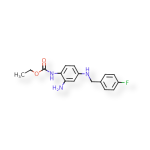
| Molecular Formula | C16H18FN3O2.2ClH |
| Molecular Weight | 376.253 |
| Optical Activity | NONE |
| Defined Stereocenters | 0 / 0 |
| E/Z Centers | 0 |
| Charge | 0 |
SHOW SMILES / InChI
SMILES
Cl.Cl.CCOC(=O)NC1=CC=C(NCC2=CC=C(F)C=C2)C=C1N
InChI
InChIKey=WSGFOWNASITQHJ-UHFFFAOYSA-N
InChI=1S/C16H18FN3O2.2ClH/c1-2-22-16(21)20-15-8-7-13(9-14(15)18)19-10-11-3-5-12(17)6-4-11;;/h3-9,19H,2,10,18H2,1H3,(H,20,21);2*1H
| Molecular Formula | C16H18FN3O2 |
| Molecular Weight | 303.3314 |
| Charge | 0 |
| Count |
|
| Stereochemistry | ACHIRAL |
| Additional Stereochemistry | No |
| Defined Stereocenters | 0 / 0 |
| E/Z Centers | 0 |
| Optical Activity | NONE |
| Molecular Formula | ClH |
| Molecular Weight | 36.461 |
| Charge | 0 |
| Count |
|
| Stereochemistry | ACHIRAL |
| Additional Stereochemistry | No |
| Defined Stereocenters | 0 / 0 |
| E/Z Centers | 0 |
| Optical Activity | NONE |
DescriptionCurator's Comment: description was created based on several sources, including https://www.ncbi.nlm.nih.gov/pubmed/21686305; https://www.ncbi.nlm.nih.gov/pubmed/?term=22221318
Curator's Comment: description was created based on several sources, including https://www.ncbi.nlm.nih.gov/pubmed/21686305; https://www.ncbi.nlm.nih.gov/pubmed/?term=22221318
Ezogabine (U.S. adopted name) or retigabine (international nonproprietary name) is one of a family of aminopyrroles with anticonvulsant activity. It is used as an adjunctive treatment for partial epilepsies in treatment-experienced adult patients. The drug was approved by the European Medicines Agency under the trade name Trobalt and by the United States Food and Drug Administration (FDA), under the trade name Potiga. The mechanism by which ezogabine exerts its therapeutic effects has not been fully elucidated. In vitro studies indicate that ezogabine enhances transmembrane potassium currents mediated by the KCNQ (Kv7.2 to 7.5) family of ion channels. By activating KCNQ channels, ezogabine is thought to stabilize the resting membrane potential and reduce brain excitability. This mechanism of action is unique among antiepileptic drugs, and may hold promise for the treatment of other neurologic conditions, including migraine, tinnitus and neuropathic pain. In vitro studies suggest that ezogabine may also exert therapeutic effects through augmentation of GABA-mediated currents.
Approval Year
Targets
| Primary Target | Pharmacology | Condition | Potency |
|---|---|---|---|
Target ID: CHEMBL2363063 |
1.6 µM [EC50] |
Conditions
| Condition | Modality | Targets | Highest Phase | Product |
|---|---|---|---|---|
| Secondary | POTIGA Approved UseIndicated as adjunctive treatment of partial-onset seizures in patients aged 18 years and older who have responded inadequately to several alternative treatments and for whom the benefits outweigh the risk of retinal abnormalities and potential decline in visual acuity Launch Date2011 |
Cmax
| Value | Dose | Co-administered | Analyte | Population |
|---|---|---|---|---|
414 ng/mL |
100 mg single, oral dose: 100 mg route of administration: Oral experiment type: SINGLE co-administered: |
EZOGABINE plasma | Homo sapiens population: HEALTHY age: ADULT sex: MALE food status: UNKNOWN |
|
498 ng/mL |
100 mg 2 times / day multiple, oral dose: 100 mg route of administration: Oral experiment type: MULTIPLE co-administered: |
EZOGABINE plasma | Homo sapiens population: HEALTHY age: ADULT sex: MALE food status: UNKNOWN |
|
819 ng/mL |
200 mg single, oral dose: 200 mg route of administration: Oral experiment type: SINGLE co-administered: |
EZOGABINE plasma | Homo sapiens population: HEALTHY age: ADULT sex: MALE food status: UNKNOWN |
|
978 ng/mL |
200 mg 2 times / day multiple, oral dose: 200 mg route of administration: Oral experiment type: MULTIPLE co-administered: |
EZOGABINE plasma | Homo sapiens population: HEALTHY age: ADULT sex: MALE food status: UNKNOWN |
|
842 ng/mL |
250 mg single, oral dose: 250 mg route of administration: Oral experiment type: SINGLE co-administered: |
EZOGABINE plasma | Homo sapiens population: HEALTHY age: ADULT sex: MALE food status: UNKNOWN |
|
993 ng/mL |
250 mg 2 times / day multiple, oral dose: 250 mg route of administration: Oral experiment type: MULTIPLE co-administered: |
EZOGABINE plasma | Homo sapiens population: HEALTHY age: ADULT sex: MALE food status: UNKNOWN |
|
551.9 ng/mL |
200 mg single, oral dose: 200 mg route of administration: Oral experiment type: SINGLE co-administered: |
EZOGABINE plasma | Homo sapiens population: HEALTHY age: ADULT sex: FEMALE / MALE food status: HIGH-FAT |
|
561 ng/mL |
200 mg single, oral dose: 200 mg route of administration: Oral experiment type: SINGLE co-administered: |
EZOGABINE plasma | Homo sapiens population: HEALTHY age: ADULT sex: FEMALE / MALE food status: FASTED |
|
938.7 ng/mL |
400 mg single, oral dose: 400 mg route of administration: Oral experiment type: SINGLE co-administered: |
EZOGABINE plasma | Homo sapiens population: HEALTHY age: ADULT sex: MALE food status: HIGH-FAT |
|
728.8 ng/mL |
400 mg single, oral dose: 400 mg route of administration: Oral experiment type: SINGLE co-administered: |
EZOGABINE plasma | Homo sapiens population: HEALTHY age: ADULT sex: MALE food status: FASTED |
AUC
| Value | Dose | Co-administered | Analyte | Population |
|---|---|---|---|---|
1831 ng × h/mL |
100 mg single, oral dose: 100 mg route of administration: Oral experiment type: SINGLE co-administered: |
EZOGABINE plasma | Homo sapiens population: HEALTHY age: ADULT sex: MALE food status: UNKNOWN |
|
1914 ng × h/mL |
100 mg 2 times / day multiple, oral dose: 100 mg route of administration: Oral experiment type: MULTIPLE co-administered: |
EZOGABINE plasma | Homo sapiens population: HEALTHY age: ADULT sex: MALE food status: UNKNOWN |
|
5134 ng × h/mL |
200 mg single, oral dose: 200 mg route of administration: Oral experiment type: SINGLE co-administered: |
EZOGABINE plasma | Homo sapiens population: HEALTHY age: ADULT sex: MALE food status: UNKNOWN |
|
5279 ng × h/mL |
200 mg 2 times / day multiple, oral dose: 200 mg route of administration: Oral experiment type: MULTIPLE co-administered: |
EZOGABINE plasma | Homo sapiens population: HEALTHY age: ADULT sex: MALE food status: UNKNOWN |
|
5136 ng × h/mL |
250 mg single, oral dose: 250 mg route of administration: Oral experiment type: SINGLE co-administered: |
EZOGABINE plasma | Homo sapiens population: HEALTHY age: ADULT sex: MALE food status: UNKNOWN |
|
5184 ng × h/mL |
250 mg 2 times / day multiple, oral dose: 250 mg route of administration: Oral experiment type: MULTIPLE co-administered: |
EZOGABINE plasma | Homo sapiens population: HEALTHY age: ADULT sex: MALE food status: UNKNOWN |
|
3972.5 ng × h/mL |
200 mg single, oral dose: 200 mg route of administration: Oral experiment type: SINGLE co-administered: |
EZOGABINE plasma | Homo sapiens population: HEALTHY age: ADULT sex: FEMALE / MALE food status: HIGH-FAT |
|
4393.8 ng × h/mL |
200 mg single, oral dose: 200 mg route of administration: Oral experiment type: SINGLE co-administered: |
EZOGABINE plasma | Homo sapiens population: HEALTHY age: ADULT sex: FEMALE / MALE food status: FASTED |
|
7895.9 ng × h/mL |
400 mg single, oral dose: 400 mg route of administration: Oral experiment type: SINGLE co-administered: |
EZOGABINE plasma | Homo sapiens population: HEALTHY age: ADULT sex: MALE food status: HIGH-FAT |
|
7355.9 ng × h/mL |
400 mg single, oral dose: 400 mg route of administration: Oral experiment type: SINGLE co-administered: |
EZOGABINE plasma | Homo sapiens population: HEALTHY age: ADULT sex: MALE food status: FASTED |
T1/2
| Value | Dose | Co-administered | Analyte | Population |
|---|---|---|---|---|
8.4 h |
100 mg single, oral dose: 100 mg route of administration: Oral experiment type: SINGLE co-administered: |
EZOGABINE plasma | Homo sapiens population: HEALTHY age: ADULT sex: MALE food status: UNKNOWN |
|
7.2 h |
100 mg 2 times / day multiple, oral dose: 100 mg route of administration: Oral experiment type: MULTIPLE co-administered: |
EZOGABINE plasma | Homo sapiens population: HEALTHY age: ADULT sex: MALE food status: UNKNOWN |
|
7.4 h |
200 mg single, oral dose: 200 mg route of administration: Oral experiment type: SINGLE co-administered: |
EZOGABINE plasma | Homo sapiens population: HEALTHY age: ADULT sex: MALE food status: UNKNOWN |
|
7 h |
200 mg 2 times / day multiple, oral dose: 200 mg route of administration: Oral experiment type: MULTIPLE co-administered: |
EZOGABINE plasma | Homo sapiens population: HEALTHY age: ADULT sex: MALE food status: UNKNOWN |
|
7.9 h |
250 mg single, oral dose: 250 mg route of administration: Oral experiment type: SINGLE co-administered: |
EZOGABINE plasma | Homo sapiens population: HEALTHY age: ADULT sex: MALE food status: UNKNOWN |
|
6.8 h |
250 mg 2 times / day multiple, oral dose: 250 mg route of administration: Oral experiment type: MULTIPLE co-administered: |
EZOGABINE plasma | Homo sapiens population: HEALTHY age: ADULT sex: MALE food status: UNKNOWN |
|
6.28 h |
400 mg single, oral dose: 400 mg route of administration: Oral experiment type: SINGLE co-administered: |
EZOGABINE plasma | Homo sapiens population: HEALTHY age: ADULT sex: MALE food status: HIGH-FAT |
|
7.57 h |
400 mg single, oral dose: 400 mg route of administration: Oral experiment type: SINGLE co-administered: |
EZOGABINE plasma | Homo sapiens population: HEALTHY age: ADULT sex: MALE food status: FASTED |
Overview
| CYP3A4 | CYP2C9 | CYP2D6 | hERG |
|---|---|---|---|
OverviewOther
Drug as perpetrator
| Target | Modality | Activity | Metabolite | Clinical evidence |
|---|---|---|---|---|
| likely | ||||
| no | ||||
| no | ||||
| no | ||||
| no | ||||
| no | ||||
| no | ||||
| no | ||||
| no | ||||
| no | ||||
| no | ||||
| no | ||||
| no | ||||
| no |
Drug as victim
| Target | Modality | Activity | Metabolite | Clinical evidence |
|---|---|---|---|---|
| no evidence | ||||
| no | ||||
| no | ||||
| no | ||||
| no | ||||
| no | ||||
| no | ||||
| no | ||||
| yes | ||||
| yes | ||||
| yes | ||||
| yes | no (pharmacogenomic study) Comment: AUC of the acetylated metabolite was higher in subjects with UGT1A1*28 mutation versus subjects with UGT1A1 wildtype. The differences in PK parameters do not warrant dose change recommendations. Page: 14.0 |
Tox targets
| Target | Modality | Activity | Metabolite | Clinical evidence |
|---|---|---|---|---|
PubMed
| Title | Date | PubMed |
|---|---|---|
| Expression and function of K(v)7 channels in murine myometrium throughout oestrous cycle. | 2009-03 |
|
| Antiepileptogenic and antiictogenic effects of retigabine under conditions of rapid kindling: an ontogenic study. | 2008-10 |
|
| Retigabine, the specific KCNQ channel opener, blocks ectopic discharges in axotomized sensory fibres. | 2008-09-15 |
|
| Bimodal effects of the Kv7 channel activator retigabine on vascular K+ currents. | 2008-09 |
|
| Expression profile and characterisation of a truncated KCNQ5 splice variant. | 2008-07-11 |
|
| Retigabine reduces the excitability of unmyelinated peripheral human axons. | 2008-06 |
|
| Nervous system KV7 disorders: breakdown of a subthreshold brake. | 2008-04-01 |
|
| Gateways to clinical trials. | 2008-03 |
|
| The KCNQ/M-current modulates arterial baroreceptor function at the sensory terminal in rats. | 2008-02-01 |
|
| The mechanisms of neurodegenerative processes and current pharmacotherapy of Alzheimer's disease. | 2008-02 |
|
| Effect of the new antiepileptic drug retigabine in a rodent model of mania. | 2008-01 |
|
| The effectiveness of anticonvulsants in psychiatric disorders. | 2008 |
|
| A tale of switched functions: from cyclooxygenase inhibition to M-channel modulation in new diphenylamine derivatives. | 2007-12-26 |
|
| Retigabine: has the orphan found a home? | 2007-12-01 |
|
| Peripheral nerve hyperexcitability due to dominant-negative KCNQ2 mutations. | 2007-11-27 |
|
| Pharmacological comparison of anticonvulsant drugs in animal models of persistent pain and anxiety. | 2007-10 |
|
| The neuronal KCNQ channel opener retigabine inhibits locomotor activity and reduces forebrain excitatory responses to the psychostimulants cocaine, methylphenidate and phencyclidine. | 2007-09-10 |
|
| Amitriptyline is a potent blocker of human Kv1.1 and Kv7.2/7.3 channels. | 2007-05 |
|
| Phenytoin- and carbamazepine-resistant spontaneous bursting in rat entorhinal cortex is blocked by retigabine in vitro. | 2007-05 |
|
| Recruitment of apical dendritic T-type Ca2+ channels by backpropagating spikes underlies de novo intrinsic bursting in hippocampal epileptogenesis. | 2007-04-15 |
|
| Inactivation as a new regulatory mechanism for neuronal Kv7 channels. | 2007-04-15 |
|
| Randomized, multicenter, dose-ranging trial of retigabine for partial-onset seizures. | 2007-04-10 |
|
| Kv7.2-7.5 voltage-gated potassium channel (KCNQ2-5) opener, retigabine, reduces capsaicin-induced visceral pain in mice. | 2007-02-14 |
|
| Retigabine. | 2007-01 |
|
| Progress report on new antiepileptic drugs: a summary of the Eigth Eilat Conference (EILAT VIII). | 2007-01 |
|
| Somatodendritic Kv7/KCNQ/M channels control interspike interval in hippocampal interneurons. | 2006-11-22 |
|
| Antidystonic effects of Kv7 (KCNQ) channel openers in the dt sz mutant, an animal model of primary paroxysmal dystonia. | 2006-11 |
|
| The acrylamide (S)-1 differentially affects Kv7 (KCNQ) potassium channels. | 2006-11 |
|
| Kv7/KCNQ/M-channels in rat glutamatergic hippocampal axons and their role in regulation of excitability and transmitter release. | 2006-10-01 |
|
| An exploratory open trial on safety and efficacy of the anticonvulsant retigabine in acute manic patients. | 2006-10 |
|
| Retigabine-induced population primary afferent hyperpolarisation in vitro. | 2006-09 |
|
| The KCNQ channel opener retigabine inhibits the activity of mesencephalic dopaminergic systems of the rat. | 2006-09 |
|
| Ionic mechanisms of autorhythmic firing in rat cerebellar Golgi cells. | 2006-08-01 |
|
| Retigabine and flupirtine exert neuroprotective actions in organotypic hippocampal cultures. | 2006-08 |
|
| New antiepileptic drugs that are second generation to existing antiepileptic drugs. | 2006-06 |
|
| N-Glucuronidation of the antiepileptic drug retigabine: results from studies with human volunteers, heterologously expressed human UGTs, human liver, kidney, and liver microsomal membranes of Crigler-Najjar type II. | 2006-06 |
|
| Diverse mechanisms of antiepileptic drugs in the development pipeline. | 2006-06 |
|
| KCNQ channels mediate IKs, a slow K+ current regulating excitability in the rat node of Ranvier. | 2006-05-15 |
|
| KCNQ/Kv7 channel regulation of hippocampal gamma-frequency firing in the absence of synaptic transmission. | 2006-05 |
|
| Gateways to clinical trials. | 2006-04 |
|
| Pulmonary vasoconstrictor action of KCNQ potassium channel blockers. | 2006-02-20 |
|
| A spontaneous mutation involving Kcnq2 (Kv7.2) reduces M-current density and spike frequency adaptation in mouse CA1 neurons. | 2006-02-15 |
|
| The role of Gilbert's syndrome and frequent NAT2 slow acetylation polymorphisms in the pharmacokinetics of retigabine. | 2006-01-13 |
|
| [Voltage-activated potassium channels of the inhibitory interneurons of the hippocampus in culture]. | 2006 |
|
| Retigabine: in partial seizures. | 2006 |
|
| Effects of M-current modulators on the excitability of immature rat spinal sensory and motor neurones. | 2005-12 |
|
| Effects of retigabine on the neurodegeneration and extracellular glutamate changes induced by 4-aminopyridine in rat hippocampus in vivo. | 2005-12 |
|
| Retigabine: bending potassium channels to our will. | 2005-09-22 |
|
| Effects of anticonvulsants on soman-induced epileptiform activity in the guinea-pig in vitro hippocampus. | 2005-08-22 |
|
| Ion channel defects in idiopathic epilepsies. | 2005 |
Sample Use Guides
Potiga should be given orally in 3 equally divided doses daily, with or without food. The initial dosage should be 100 mg 3 times daily (300 mg per day) and should be increased gradually at weekly intervals by no more than 50 mg 3 times daily (increase in the daily dose of no more than 150 mg per day) up to a maintenance dosage of 200 mg to 400 mg 3 times daily (600 mg to 1,200 mg per day), based on individual patient response and tolerability.
Route of Administration:
Oral
KCNQ4 channels, stably expressed in HEK293 cells, were activated by retigabine (ezogabine) in a reversible and concentration-dependent manner in the concentration range 0.1-10 uM. Retigabine shifted the KCNQ4 channel activation curves towards more negative potentials by about 10 mV.
| Substance Class |
Chemical
Created
by
admin
on
Edited
Mon Mar 31 23:26:51 GMT 2025
by
admin
on
Mon Mar 31 23:26:51 GMT 2025
|
| Record UNII |
WV9W9019AP
|
| Record Status |
Validated (UNII)
|
| Record Version |
|
-
Download
| Name | Type | Language | ||
|---|---|---|---|---|
|
Preferred Name | English | ||
|
Common Name | English | ||
|
Common Name | English | ||
|
Systematic Name | English | ||
|
Systematic Name | English | ||
|
Common Name | English |
| Code System | Code | Type | Description | ||
|---|---|---|---|---|---|
|
WV9W9019AP
Created by
admin on Mon Mar 31 23:26:51 GMT 2025 , Edited by admin on Mon Mar 31 23:26:51 GMT 2025
|
PRIMARY | |||
|
6918229
Created by
admin on Mon Mar 31 23:26:51 GMT 2025 , Edited by admin on Mon Mar 31 23:26:51 GMT 2025
|
PRIMARY | |||
|
m5229
Created by
admin on Mon Mar 31 23:26:51 GMT 2025 , Edited by admin on Mon Mar 31 23:26:51 GMT 2025
|
PRIMARY | Merck Index | ||
|
DTXSID00164616
Created by
admin on Mon Mar 31 23:26:51 GMT 2025 , Edited by admin on Mon Mar 31 23:26:51 GMT 2025
|
PRIMARY | |||
|
150812-13-8
Created by
admin on Mon Mar 31 23:26:51 GMT 2025 , Edited by admin on Mon Mar 31 23:26:51 GMT 2025
|
PRIMARY |
| Related Record | Type | Details | ||
|---|---|---|---|---|
|
|
PARENT -> SALT/SOLVATE |
|
| Related Record | Type | Details | ||
|---|---|---|---|---|
|
|
ACTIVE MOIETY |
|