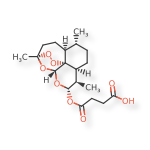
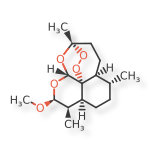
Details
| Stereochemistry | ABSOLUTE |
| Molecular Formula | C15H24O5 |
| Molecular Weight | 284.3481 |
| Optical Activity | UNSPECIFIED |
| Defined Stereocenters | 8 / 8 |
| E/Z Centers | 0 |
| Charge | 0 |
SHOW SMILES / InChI
SMILES
C[C@@H]1CC[C@H]2[C@@H](C)[C@H](O)O[C@@H]3O[C@@]4(C)CC[C@@H]1[C@@]23OO4
InChI
InChIKey=BJDCWCLMFKKGEE-KDTBHNEXSA-N
InChI=1S/C15H24O5/c1-8-4-5-11-9(2)12(16)17-13-15(11)10(8)6-7-14(3,18-13)19-20-15/h8-13,16H,4-7H2,1-3H3/t8-,9-,10+,11+,12-,13-,14-,15-/m1/s1
| Molecular Formula | C15H24O5 |
| Molecular Weight | 284.3481 |
| Charge | 0 |
| Count |
|
| Stereochemistry | ABSOLUTE |
| Additional Stereochemistry | No |
| Defined Stereocenters | 8 / 8 |
| E/Z Centers | 0 |
| Optical Activity | UNSPECIFIED |
DescriptionSources: https://www.cdc.gov/malaria/diagnosis_treatment/artesunate.htmlhttps://www.ncbi.nlm.nih.gov/pubmed/11231359 | https://www.ncbi.nlm.nih.gov/pubmed/9241384 | https://www.ncbi.nlm.nih.gov/pubmed/1966574http://www.ema.europa.eu/docs/en_GB/document_library/EPAR_-_Product_Information/human/001199/WC500118113.pdfCurator's Comment: Description was created based on several sources, including
http://www.ema.europa.eu/ema/index.jsp?curl=pages/medicines/human/medicines/001199/human_med_001450.jsp&mid=WC0b01ac058001d124 | https://www.hpra.ie/docs/default-source/3rd-party-documents/educational-materials/eurartesim_hcp-guide.pdf?sfvrsn=4 | https://www.ncbi.nlm.nih.gov/pubmed/20649950
Sources: https://www.cdc.gov/malaria/diagnosis_treatment/artesunate.htmlhttps://www.ncbi.nlm.nih.gov/pubmed/11231359 | https://www.ncbi.nlm.nih.gov/pubmed/9241384 | https://www.ncbi.nlm.nih.gov/pubmed/1966574http://www.ema.europa.eu/docs/en_GB/document_library/EPAR_-_Product_Information/human/001199/WC500118113.pdf
Curator's Comment: Description was created based on several sources, including
http://www.ema.europa.eu/ema/index.jsp?curl=pages/medicines/human/medicines/001199/human_med_001450.jsp&mid=WC0b01ac058001d124 | https://www.hpra.ie/docs/default-source/3rd-party-documents/educational-materials/eurartesim_hcp-guide.pdf?sfvrsn=4 | https://www.ncbi.nlm.nih.gov/pubmed/20649950
Artenimol (dihydroartemisinin) is a derivate of antimalarial compound artemisinin. Artenimol (dihydroartemisinin) is able to reach high concentrations within the parasitized erythrocytes. Its endoperoxide bridge is thought to be essential for its antimalarial activity, causing free-radical damage to parasite membrane systems including:
• Inhibition of falciparum sarcoplasmic-endoplasmic reticulum calcium ATPase, • Interference with mitochondrial electron transport • Interference with parasite transport proteins • Disruption of parasite mitochondrial function. Dihydroartemisinin in combination with piperaquine tetraphosphate (Eurartesim, EMA-approved in 2011) is indicated for the treatment of uncomplicated Plasmodium falciparum malaria. The formulation meets WHO recommendations, which advise combination treatment for Plasmodium falciparum malaria to reduce the risk of resistance development, with artemisinin-based preparations regarded as the ‘policy standard’. However, experimental testing demonstrates that, due to its intrinsic chemical instability, dihydroartemisinin is not suitable to be used in pharmaceutical formulations. In addition, data show that the currently available dihydroartemisinin preparations fail to meet the internationally accepted stability requirements.
CNS Activity
Sources: https://www.ncbi.nlm.nih.gov/pmc/articles/PMC148951/https://www.ncbi.nlm.nih.gov/pubmed/12499215
Curator's Comment: Active metabolite of artesunate was detected in CSF after intravenous administration of artesunate.
Originator
Sources: https://www.ncbi.nlm.nih.gov/pubmed/8891104Journal of traditional Chinese medicine = Chung i tsa chih ying wen pan (1982), 2, (2), 99-103.http://adisinsight.springer.com/drugs/800023198
Curator's Comment: Indicated originators are originators of Dihydroartemisinin/piperaquine formulation. Originator of Dihydroartemisinin is unknown.
Approval Year
Targets
| Primary Target | Pharmacology | Condition | Potency |
|---|---|---|---|
Target ID: CHEMBL613064 |
|||
Target ID: P06685 Gene ID: 24211.0 Gene Symbol: Atp1a1 Target Organism: Rattus norvegicus (Rat) |
|||
Target ID: CHEMBL364 |
4.1 nM [IC50] | ||
Target ID: CHEMBL612889 |
|||
Target ID: CHEMBL612653 |
|||
Target ID: CHEMBL2311221 |
|||
Target ID: CHEMBL2366043 |
|||
Target ID: CHEMBL364 |
Conditions
| Condition | Modality | Targets | Highest Phase | Product |
|---|---|---|---|---|
| Primary | Sodium artesunate Approved UsePlasmodium falciparum malaria |
|||
| Curative | Eurartesim Approved UseEurartesim tablets (piperaquine tetraphosphate in combination with dihydroartemisinin) are indicated for the treatment of uncomplicated Plasmodium falciparum malaria in adults, children and infants aged ≥6 months and weighing ≥5kg. Launch Date2011 |
|||
| Curative | Unknown Approved UseAlthough not FDA-approved for use in the United States, artesunate is used as the treatment of choice for severe malaria by the World Health Organization (WHO) over quinidine. |
|||
| Curative | Unknown Approved UseUnknown |
|||
| Primary | Unknown Approved UseUnknown |
|||
| Primary | Unknown Approved UseUnknown |
|||
| Primary | Unknown Approved UseUnknown |
|||
| Primary | Unknown Approved UseUnknown |
Cmax
| Value | Dose | Co-administered | Analyte | Population |
|---|---|---|---|---|
3.3 μg/mL |
2.4 mg/kg multiple, intravenous dose: 2.4 mg/kg route of administration: Intravenous experiment type: MULTIPLE co-administered: |
ARTESUNATE plasma | Homo sapiens population: UNHEALTHY age: UNKNOWN sex: UNKNOWN food status: UNKNOWN |
|
3.1 μg/mL |
2.4 mg/kg multiple, intravenous dose: 2.4 mg/kg route of administration: Intravenous experiment type: MULTIPLE co-administered: |
ARTENIMOL plasma | Homo sapiens population: UNHEALTHY age: UNKNOWN sex: UNKNOWN food status: UNKNOWN |
AUC
| Value | Dose | Co-administered | Analyte | Population |
|---|---|---|---|---|
0.7 μg × h/mL |
2.4 mg/kg multiple, intravenous dose: 2.4 mg/kg route of administration: Intravenous experiment type: MULTIPLE co-administered: |
ARTESUNATE plasma | Homo sapiens population: UNHEALTHY age: UNKNOWN sex: UNKNOWN food status: UNKNOWN |
|
3.5 μg × h/mL |
2.4 mg/kg multiple, intravenous dose: 2.4 mg/kg route of administration: Intravenous experiment type: MULTIPLE co-administered: |
ARTENIMOL plasma | Homo sapiens population: UNHEALTHY age: UNKNOWN sex: UNKNOWN food status: UNKNOWN |
T1/2
| Value | Dose | Co-administered | Analyte | Population |
|---|---|---|---|---|
0.3 h |
2.4 mg/kg multiple, intravenous dose: 2.4 mg/kg route of administration: Intravenous experiment type: MULTIPLE co-administered: |
ARTESUNATE plasma | Homo sapiens population: UNHEALTHY age: UNKNOWN sex: UNKNOWN food status: UNKNOWN |
|
1.3 h |
2.4 mg/kg multiple, intravenous dose: 2.4 mg/kg route of administration: Intravenous experiment type: MULTIPLE co-administered: |
ARTENIMOL plasma | Homo sapiens population: UNHEALTHY age: UNKNOWN sex: UNKNOWN food status: UNKNOWN |
Funbound
| Value | Dose | Co-administered | Analyte | Population |
|---|---|---|---|---|
7% |
2.4 mg/kg multiple, intravenous dose: 2.4 mg/kg route of administration: Intravenous experiment type: MULTIPLE co-administered: |
ARTESUNATE plasma | Homo sapiens population: UNHEALTHY age: UNKNOWN sex: UNKNOWN food status: UNKNOWN |
|
7% |
2.4 mg/kg multiple, intravenous dose: 2.4 mg/kg route of administration: Intravenous experiment type: MULTIPLE co-administered: |
ARTENIMOL plasma | Homo sapiens population: UNHEALTHY age: UNKNOWN sex: UNKNOWN food status: UNKNOWN |
Doses
| Dose | Population | Adverse events |
|---|---|---|
2.4 mg/kg 1 times / day multiple, intravenous Recommended Dose: 2.4 mg/kg, 1 times / day Route: intravenous Route: multiple Dose: 2.4 mg/kg, 1 times / day Sources: |
unhealthy, 1-72 years Health Status: unhealthy Age Group: 1-72 years Sex: M+F Sources: |
Other AEs: Anemia, Transaminases increased... Other AEs: Anemia (65%) Sources: Transaminases increased (27%) Thrombocytopenia (18%) Hyperbilirubinemia (14%) Acute renal failure (10%) Leukocytosis (10%) Acute respiratory distress syndrome (8%) Lymphopenia (7%) Neutropenia (5%) Disseminated intravascular coagulation (3%) Creatinine increased (3%) Pneumonia (3%) Pulmonary edema (3%) Diarrhea (3%) |
100 mg 1 times / day multiple, oral Studied dose Dose: 100 mg, 1 times / day Route: oral Route: multiple Dose: 100 mg, 1 times / day Sources: |
unhealthy, 15-35 years Health Status: unhealthy Age Group: 15-35 years Sex: M Sources: |
Other AEs: Nausea, Dizziness... Other AEs: Nausea (grade 1, 45%) Sources: Dizziness (grade 1, 52%) Vomiting (grade 1, 26%) Convulsions (grade 1, 3%) Bradycardia (grade 1, 23%) |
2.4 mg/kg 1 times / day multiple, intravenous|oral Recommended Dose: 2.4 mg/kg, 1 times / day Route: intravenous|oral Route: multiple Dose: 2.4 mg/kg, 1 times / day Sources: |
unhealthy, 2-87 years Health Status: unhealthy Age Group: 2-87 years Sex: M+F Sources: |
Other AEs: Acute renal failure, Hemoglobinuria... Other AEs: Acute renal failure (8.9%) Sources: Hemoglobinuria (6.7%) Jaundice (2.3%) |
25 mg/kg 2 times / 3 weeks multiple, intravenous Highest studied dose Dose: 25 mg/kg, 2 times / 3 weeks Route: intravenous Route: multiple Dose: 25 mg/kg, 2 times / 3 weeks Sources: |
unhealthy, 58 years Health Status: unhealthy Age Group: 58 years Sex: M+F Sources: |
DLT: Nausea, Vomiting... Dose limiting toxicities: Nausea (grade 3, 1 patient) Sources: Vomiting (grade 3, 1 patient) ALT increased (grade 3-4, 1 patient) Neutropenic infection (grade 3-4, 1 patient) |
18 mg/kg 2 times / 3 weeks multiple, intravenous MTD Dose: 18 mg/kg, 2 times / 3 weeks Route: intravenous Route: multiple Dose: 18 mg/kg, 2 times / 3 weeks Sources: |
unhealthy, 58 years Health Status: unhealthy Age Group: 58 years Sex: M+F Sources: |
DLT: Hypersensitivity reaction... Dose limiting toxicities: Hypersensitivity reaction (grade 3, 1 patient) Sources: |
12 mg/kg 2 times / 3 weeks multiple, intravenous Studied dose Dose: 12 mg/kg, 2 times / 3 weeks Route: intravenous Route: multiple Dose: 12 mg/kg, 2 times / 3 weeks Sources: |
unhealthy, 58 years Health Status: unhealthy Age Group: 58 years Sex: M+F Sources: |
DLT: Neutropenic fever... Dose limiting toxicities: Neutropenic fever (grade 3, 1 patient) Sources: |
AEs
| AE | Significance | Dose | Population |
|---|---|---|---|
| Acute renal failure | 10% | 2.4 mg/kg 1 times / day multiple, intravenous Recommended Dose: 2.4 mg/kg, 1 times / day Route: intravenous Route: multiple Dose: 2.4 mg/kg, 1 times / day Sources: |
unhealthy, 1-72 years Health Status: unhealthy Age Group: 1-72 years Sex: M+F Sources: |
| Leukocytosis | 10% | 2.4 mg/kg 1 times / day multiple, intravenous Recommended Dose: 2.4 mg/kg, 1 times / day Route: intravenous Route: multiple Dose: 2.4 mg/kg, 1 times / day Sources: |
unhealthy, 1-72 years Health Status: unhealthy Age Group: 1-72 years Sex: M+F Sources: |
| Hyperbilirubinemia | 14% | 2.4 mg/kg 1 times / day multiple, intravenous Recommended Dose: 2.4 mg/kg, 1 times / day Route: intravenous Route: multiple Dose: 2.4 mg/kg, 1 times / day Sources: |
unhealthy, 1-72 years Health Status: unhealthy Age Group: 1-72 years Sex: M+F Sources: |
| Thrombocytopenia | 18% | 2.4 mg/kg 1 times / day multiple, intravenous Recommended Dose: 2.4 mg/kg, 1 times / day Route: intravenous Route: multiple Dose: 2.4 mg/kg, 1 times / day Sources: |
unhealthy, 1-72 years Health Status: unhealthy Age Group: 1-72 years Sex: M+F Sources: |
| Transaminases increased | 27% | 2.4 mg/kg 1 times / day multiple, intravenous Recommended Dose: 2.4 mg/kg, 1 times / day Route: intravenous Route: multiple Dose: 2.4 mg/kg, 1 times / day Sources: |
unhealthy, 1-72 years Health Status: unhealthy Age Group: 1-72 years Sex: M+F Sources: |
| Creatinine increased | 3% | 2.4 mg/kg 1 times / day multiple, intravenous Recommended Dose: 2.4 mg/kg, 1 times / day Route: intravenous Route: multiple Dose: 2.4 mg/kg, 1 times / day Sources: |
unhealthy, 1-72 years Health Status: unhealthy Age Group: 1-72 years Sex: M+F Sources: |
| Diarrhea | 3% | 2.4 mg/kg 1 times / day multiple, intravenous Recommended Dose: 2.4 mg/kg, 1 times / day Route: intravenous Route: multiple Dose: 2.4 mg/kg, 1 times / day Sources: |
unhealthy, 1-72 years Health Status: unhealthy Age Group: 1-72 years Sex: M+F Sources: |
| Disseminated intravascular coagulation | 3% | 2.4 mg/kg 1 times / day multiple, intravenous Recommended Dose: 2.4 mg/kg, 1 times / day Route: intravenous Route: multiple Dose: 2.4 mg/kg, 1 times / day Sources: |
unhealthy, 1-72 years Health Status: unhealthy Age Group: 1-72 years Sex: M+F Sources: |
| Pneumonia | 3% | 2.4 mg/kg 1 times / day multiple, intravenous Recommended Dose: 2.4 mg/kg, 1 times / day Route: intravenous Route: multiple Dose: 2.4 mg/kg, 1 times / day Sources: |
unhealthy, 1-72 years Health Status: unhealthy Age Group: 1-72 years Sex: M+F Sources: |
| Pulmonary edema | 3% | 2.4 mg/kg 1 times / day multiple, intravenous Recommended Dose: 2.4 mg/kg, 1 times / day Route: intravenous Route: multiple Dose: 2.4 mg/kg, 1 times / day Sources: |
unhealthy, 1-72 years Health Status: unhealthy Age Group: 1-72 years Sex: M+F Sources: |
| Neutropenia | 5% | 2.4 mg/kg 1 times / day multiple, intravenous Recommended Dose: 2.4 mg/kg, 1 times / day Route: intravenous Route: multiple Dose: 2.4 mg/kg, 1 times / day Sources: |
unhealthy, 1-72 years Health Status: unhealthy Age Group: 1-72 years Sex: M+F Sources: |
| Anemia | 65% | 2.4 mg/kg 1 times / day multiple, intravenous Recommended Dose: 2.4 mg/kg, 1 times / day Route: intravenous Route: multiple Dose: 2.4 mg/kg, 1 times / day Sources: |
unhealthy, 1-72 years Health Status: unhealthy Age Group: 1-72 years Sex: M+F Sources: |
| Lymphopenia | 7% | 2.4 mg/kg 1 times / day multiple, intravenous Recommended Dose: 2.4 mg/kg, 1 times / day Route: intravenous Route: multiple Dose: 2.4 mg/kg, 1 times / day Sources: |
unhealthy, 1-72 years Health Status: unhealthy Age Group: 1-72 years Sex: M+F Sources: |
| Acute respiratory distress syndrome | 8% | 2.4 mg/kg 1 times / day multiple, intravenous Recommended Dose: 2.4 mg/kg, 1 times / day Route: intravenous Route: multiple Dose: 2.4 mg/kg, 1 times / day Sources: |
unhealthy, 1-72 years Health Status: unhealthy Age Group: 1-72 years Sex: M+F Sources: |
| Bradycardia | grade 1, 23% | 100 mg 1 times / day multiple, oral Studied dose Dose: 100 mg, 1 times / day Route: oral Route: multiple Dose: 100 mg, 1 times / day Sources: |
unhealthy, 15-35 years Health Status: unhealthy Age Group: 15-35 years Sex: M Sources: |
| Vomiting | grade 1, 26% | 100 mg 1 times / day multiple, oral Studied dose Dose: 100 mg, 1 times / day Route: oral Route: multiple Dose: 100 mg, 1 times / day Sources: |
unhealthy, 15-35 years Health Status: unhealthy Age Group: 15-35 years Sex: M Sources: |
| Convulsions | grade 1, 3% | 100 mg 1 times / day multiple, oral Studied dose Dose: 100 mg, 1 times / day Route: oral Route: multiple Dose: 100 mg, 1 times / day Sources: |
unhealthy, 15-35 years Health Status: unhealthy Age Group: 15-35 years Sex: M Sources: |
| Nausea | grade 1, 45% | 100 mg 1 times / day multiple, oral Studied dose Dose: 100 mg, 1 times / day Route: oral Route: multiple Dose: 100 mg, 1 times / day Sources: |
unhealthy, 15-35 years Health Status: unhealthy Age Group: 15-35 years Sex: M Sources: |
| Dizziness | grade 1, 52% | 100 mg 1 times / day multiple, oral Studied dose Dose: 100 mg, 1 times / day Route: oral Route: multiple Dose: 100 mg, 1 times / day Sources: |
unhealthy, 15-35 years Health Status: unhealthy Age Group: 15-35 years Sex: M Sources: |
| Jaundice | 2.3% | 2.4 mg/kg 1 times / day multiple, intravenous|oral Recommended Dose: 2.4 mg/kg, 1 times / day Route: intravenous|oral Route: multiple Dose: 2.4 mg/kg, 1 times / day Sources: |
unhealthy, 2-87 years Health Status: unhealthy Age Group: 2-87 years Sex: M+F Sources: |
| Hemoglobinuria | 6.7% | 2.4 mg/kg 1 times / day multiple, intravenous|oral Recommended Dose: 2.4 mg/kg, 1 times / day Route: intravenous|oral Route: multiple Dose: 2.4 mg/kg, 1 times / day Sources: |
unhealthy, 2-87 years Health Status: unhealthy Age Group: 2-87 years Sex: M+F Sources: |
| Acute renal failure | 8.9% | 2.4 mg/kg 1 times / day multiple, intravenous|oral Recommended Dose: 2.4 mg/kg, 1 times / day Route: intravenous|oral Route: multiple Dose: 2.4 mg/kg, 1 times / day Sources: |
unhealthy, 2-87 years Health Status: unhealthy Age Group: 2-87 years Sex: M+F Sources: |
| Nausea | grade 3, 1 patient DLT |
25 mg/kg 2 times / 3 weeks multiple, intravenous Highest studied dose Dose: 25 mg/kg, 2 times / 3 weeks Route: intravenous Route: multiple Dose: 25 mg/kg, 2 times / 3 weeks Sources: |
unhealthy, 58 years Health Status: unhealthy Age Group: 58 years Sex: M+F Sources: |
| Vomiting | grade 3, 1 patient DLT |
25 mg/kg 2 times / 3 weeks multiple, intravenous Highest studied dose Dose: 25 mg/kg, 2 times / 3 weeks Route: intravenous Route: multiple Dose: 25 mg/kg, 2 times / 3 weeks Sources: |
unhealthy, 58 years Health Status: unhealthy Age Group: 58 years Sex: M+F Sources: |
| ALT increased | grade 3-4, 1 patient DLT |
25 mg/kg 2 times / 3 weeks multiple, intravenous Highest studied dose Dose: 25 mg/kg, 2 times / 3 weeks Route: intravenous Route: multiple Dose: 25 mg/kg, 2 times / 3 weeks Sources: |
unhealthy, 58 years Health Status: unhealthy Age Group: 58 years Sex: M+F Sources: |
| Neutropenic infection | grade 3-4, 1 patient DLT |
25 mg/kg 2 times / 3 weeks multiple, intravenous Highest studied dose Dose: 25 mg/kg, 2 times / 3 weeks Route: intravenous Route: multiple Dose: 25 mg/kg, 2 times / 3 weeks Sources: |
unhealthy, 58 years Health Status: unhealthy Age Group: 58 years Sex: M+F Sources: |
| Hypersensitivity reaction | grade 3, 1 patient DLT |
18 mg/kg 2 times / 3 weeks multiple, intravenous MTD Dose: 18 mg/kg, 2 times / 3 weeks Route: intravenous Route: multiple Dose: 18 mg/kg, 2 times / 3 weeks Sources: |
unhealthy, 58 years Health Status: unhealthy Age Group: 58 years Sex: M+F Sources: |
| Neutropenic fever | grade 3, 1 patient DLT |
12 mg/kg 2 times / 3 weeks multiple, intravenous Studied dose Dose: 12 mg/kg, 2 times / 3 weeks Route: intravenous Route: multiple Dose: 12 mg/kg, 2 times / 3 weeks Sources: |
unhealthy, 58 years Health Status: unhealthy Age Group: 58 years Sex: M+F Sources: |
PubMed
| Title | Date | PubMed |
|---|---|---|
| Untargeted Proteomics and Systems-Based Mechanistic Investigation of Artesunate in Human Bronchial Epithelial Cells. | 2015-10-19 |
|
| Utilization of human nuclear receptors as an early counter screen for off-target activity: a case study with a compendium of 615 known drugs. | 2015-06 |
|
| Delayed anemia after treatment with injectable artesunate in the Democratic Republic of the Congo: a manageable issue. | 2014-10 |
|
| Artesunate induces apoptosis through caspase-dependent and -independent mitochondrial pathways in human myelodysplastic syndrome SKM-1 cells. | 2014-08-05 |
|
| Dihydroartemisinin-piperaquine for treating uncomplicated Plasmodium falciparum malaria. | 2014-01-20 |
|
| Artesunate-mefloquine combination therapy in acute Plasmodium falciparum malaria in young children: a field study regarding neurological and neuropsychiatric safety. | 2010-10-21 |
|
| In Tanzania, hemolysis after a single dose of primaquine coadministered with an artemisinin is not restricted to glucose-6-phosphate dehydrogenase-deficient (G6PD A-) individuals. | 2010-05 |
|
| Factors determining sensitivity or resistance of tumor cell lines towards artesunate. | 2010-04-15 |
|
| The neurological assessment in young children treated with artesunate monotherapy or artesunate-mefloquine combination therapy for uncomplicated Plasmodium falciparum malaria. | 2009-09-02 |
|
| Combination treatment of malignant B cells using the anti-CD20 antibody rituximab and the anti-malarial artesunate. | 2009-07 |
|
| Auditory assessment of patients with acute uncomplicated Plasmodium falciparum malaria treated with three-day mefloquine-artesunate on the north-western border of Thailand. | 2008-11-06 |
|
| Adding artesunate to sulphadoxine-pyrimethamine greatly improves the treatment efficacy in children with uncomplicated falciparum malaria on the coast of Benin, West Africa. | 2007-12-21 |
|
| Treatment of experimental nephrotic syndrome with artesunate. | 2007-07-31 |
|
| Artesunate in the treatment of metastatic uveal melanoma--first experiences. | 2005-12 |
|
| Glutathione-related enzymes contribute to resistance of tumor cells and low toxicity in normal organs to artesunate. | 2005-03-31 |
|
| Mechanistic perspectives for 1,2,4-trioxanes in anti-cancer therapy. | 2005-03-29 |
|
| Randomized control trial of quinine and artesunate in complicated malaria. | 2004-04 |
|
| Identification of human cytochrome P(450)s that metabolise anti-parasitic drugs and predictions of in vivo drug hepatic clearance from in vitro data. | 2003-09 |
|
| Penetration of dihydroartemisinin into cerebrospinal fluid after administration of intravenous artesunate in severe falciparum malaria. | 2003-01 |
|
| Artesunate and mefloquine given simultaneously for three days via a prepacked blister is equally effective and tolerated as a standard sequential treatment of uncomplicated acute Plasmodium falciparum malaria: randomized, double-blind study in Thailand. | 2002-11 |
|
| Diuretic effect of sodium artesunate in patients with malaria. | 2002-11 |
|
| Effects of sodium artesunate, a new antimalarial drug, on renal function. | 2001-03 |
|
| Monotherapy with sodium artesunate for uncomplicated falciparum malaria in Thailand: a comparison of 5- and 7-day regimens. | 1997-09-30 |
|
| [Effects of sodium artesunate on electrical properties and Na+,K(+)-ATPase activities of mouse small intestine]. | 1990-07 |
|
| Antimalarial agents, 2. Artesunate, an inhibitor of cytochrome oxidase activity in Plasmodium berghei. | 1986-01-01 |
Sample Use Guides
In Vivo Use Guide
Curator's Comment: Oral route is possible: One group of 45 patients received 400 mg of Sodium artesunate on the first day of treatment and then 200 mg daily for 4 days for a total of 1200 mg (group I: 5-day treatment). A second group of 46 patients received 400 mg of Sodium artesunate on the first day of treatment and then 200 mg daily for 6 days for a total of 1600 mg (group II: 7-day treatment). 5- or 7-day regimens of sodium artesunate with a total dose of 1200-1600 mg are effective and safe in treating falciparum malaria acquired in Thailand.
https://www.ncbi.nlm.nih.gov/pubmed/9241384
Artesunate can be used orally, by intravenous or intramuscular injection or as a suppository. As an injection, artesunate 2.4mg/kg bw i.v or i.m. given on admission (time =0), then at 12hr and 24hr, then once a day.
Route of Administration:
Other
| Substance Class |
Chemical
Created
by
admin
on
Edited
Mon Mar 31 21:36:20 GMT 2025
by
admin
on
Mon Mar 31 21:36:20 GMT 2025
|
| Record UNII |
X0UIV26ABX
|
| Record Status |
Validated (UNII)
|
| Record Version |
|
-
Download
| Name | Type | Language | ||
|---|---|---|---|---|
|
Preferred Name | English | ||
|
Common Name | English | ||
|
Common Name | English | ||
|
Common Name | English | ||
|
Code | English |
| Code System | Code | Type | Description | ||
|---|---|---|---|---|---|
|
81496-81-3
Created by
admin on Mon Mar 31 21:36:20 GMT 2025 , Edited by admin on Mon Mar 31 21:36:20 GMT 2025
|
PRIMARY | |||
|
DBMET00793
Created by
admin on Mon Mar 31 21:36:20 GMT 2025 , Edited by admin on Mon Mar 31 21:36:20 GMT 2025
|
PRIMARY | |||
|
11358077
Created by
admin on Mon Mar 31 21:36:20 GMT 2025 , Edited by admin on Mon Mar 31 21:36:20 GMT 2025
|
PRIMARY | |||
|
X0UIV26ABX
Created by
admin on Mon Mar 31 21:36:20 GMT 2025 , Edited by admin on Mon Mar 31 21:36:20 GMT 2025
|
PRIMARY | |||
|
2584841
Created by
admin on Mon Mar 31 21:36:20 GMT 2025 , Edited by admin on Mon Mar 31 21:36:20 GMT 2025
|
PRIMARY | |||
|
758682
Created by
admin on Mon Mar 31 21:36:20 GMT 2025 , Edited by admin on Mon Mar 31 21:36:20 GMT 2025
|
PRIMARY | |||
|
DTXSID5045962
Created by
admin on Mon Mar 31 21:36:20 GMT 2025 , Edited by admin on Mon Mar 31 21:36:20 GMT 2025
|
PRIMARY |
| Related Record | Type | Details | ||
|---|---|---|---|---|
|
BINDER->LIGAND |
|

| Related Record | Type | Details | ||
|---|---|---|---|---|
|
PRODRUG -> METABOLITE ACTIVE |
ratio of alpha to beta DIHYDROARTEMISININ is 3.5
PLASMA
|
||
|
PARENT -> METABOLITE |
|