


Details
| Stereochemistry | ABSOLUTE |
| Molecular Formula | C17H21NO4.ClH |
| Molecular Weight | 339.814 |
| Optical Activity | UNSPECIFIED |
| Defined Stereocenters | 4 / 4 |
| E/Z Centers | 0 |
| Charge | 0 |
SHOW SMILES / InChI
SMILES
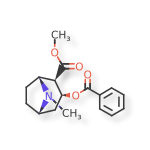
Cl.COC(=O)[C@@H]1[C@H]2CC[C@@H](C[C@@H]1OC(=O)C3=CC=CC=C3)N2C
InChI
InChIKey=PIQVDUKEQYOJNR-VZXSFKIWSA-N
InChI=1S/C17H21NO4.ClH/c1-18-12-8-9-13(18)15(17(20)21-2)14(10-12)22-16(19)11-6-4-3-5-7-11;/h3-7,12-15H,8-10H2,1-2H3;1H/t12-,13+,14-,15+;/m0./s1
| Molecular Formula | C17H21NO4 |
| Molecular Weight | 303.3529 |
| Charge | 0 |
| Count |
|
| Stereochemistry | ABSOLUTE |
| Additional Stereochemistry | No |
| Defined Stereocenters | 4 / 4 |
| E/Z Centers | 0 |
| Optical Activity | UNSPECIFIED |
| Molecular Formula | ClH |
| Molecular Weight | 36.461 |
| Charge | 0 |
| Count |
|
| Stereochemistry | ACHIRAL |
| Additional Stereochemistry | No |
| Defined Stereocenters | 0 / 0 |
| E/Z Centers | 0 |
| Optical Activity | NONE |
DescriptionCurator's Comment: description was created based on several sources, including
https://www.ncbi.nlm.nih.gov/pubmed/11895133 | https://www.ncbi.nlm.nih.gov/pubmed/12067559 | https://www.ncbi.nlm.nih.gov/pubmed/17255098 | https://www.ncbi.nlm.nih.gov/pubmed/19897082
Curator's Comment: description was created based on several sources, including
https://www.ncbi.nlm.nih.gov/pubmed/11895133 | https://www.ncbi.nlm.nih.gov/pubmed/12067559 | https://www.ncbi.nlm.nih.gov/pubmed/17255098 | https://www.ncbi.nlm.nih.gov/pubmed/19897082
Cocaine is an alkaloid ester extracted from the leaves of plants including coca. Cocaine is a local anesthetic and vasoconstrictor and is clinically used for that purpose, particularly in the eye, ear, nose, and throat. It also has powerful central nervous system effects similar to the amphetamines and is a drug of abuse. Cocaine, like amphetamines, acts by multiple mechanisms on brain catecholaminergic neurons; the mechanism of its reinforcing effects is thought to involve inhibition of dopamine uptake. Cocaine is addictive due to its effect on the reward pathway in the brain. After a short period of use, there is a high risk that dependence will occur. Its use also increases the risk of stroke, myocardial infarction, lung problems in those who smoke it, blood infections, and sudden cardiac death. Cocaine sold on the street is commonly mixed with local anesthetics, cornstarch, quinine, or sugar which can result in additional toxicity. Following repeated doses, a person may have decreased the ability to feel pleasure and be very physically tired. Cocaine acts by inhibiting the reuptake of serotonin, norepinephrine, and dopamine. This results in greater concentrations of these three neurotransmitters in the brain. It can easily cross the blood-brain barrier and may lead to the breakdown of the barrier.
CNS Activity
Originator
Approval Year
Targets
| Primary Target | Pharmacology | Condition | Potency |
|---|---|---|---|
Target ID: CHEMBL313 |
155.0 nM [Ki] | ||
Target ID: CHEMBL304 |
108.0 nM [Ki] | ||
Target ID: CHEMBL338 |
274.0 nM [Ki] |
Conditions
| Condition | Modality | Targets | Highest Phase | Product |
|---|---|---|---|---|
| Primary | Cocaine Approved UseINDICATIONS AND USAGE. Cocaine hydrochloride topical solution is indicated for the introduction of local (topical) anesthesia of accessible mucous membranes of the oral, laryngeal and nasal cavities. |
|||
| Primary | Cocaine Approved UseINDICATIONS AND USAGE. Cocaine hydrochloride topical solution is indicated for the introduction of local (topical) anesthesia of accessible mucous membranes of the oral, laryngeal and nasal cavities. |
Cmax
| Value | Dose | Co-administered | Analyte | Population |
|---|---|---|---|---|
550 ng/mL EXPERIMENT https://pubmed.ncbi.nlm.nih.gov/7242115/ |
100 mg single, intravenous dose: 100 mg route of administration: Intravenous experiment type: SINGLE co-administered: |
COCAINE plasma | Homo sapiens population: UNHEALTHY age: ADULT sex: MALE food status: UNKNOWN |
AUC
| Value | Dose | Co-administered | Analyte | Population |
|---|---|---|---|---|
840 ng × h/mL EXPERIMENT https://pubmed.ncbi.nlm.nih.gov/7242115/ |
100 mg single, intravenous dose: 100 mg route of administration: Intravenous experiment type: SINGLE co-administered: |
COCAINE plasma | Homo sapiens population: UNHEALTHY age: ADULT sex: MALE food status: UNKNOWN |
T1/2
| Value | Dose | Co-administered | Analyte | Population |
|---|---|---|---|---|
78.9 min EXPERIMENT https://pubmed.ncbi.nlm.nih.gov/7242115/ |
100 mg single, intravenous dose: 100 mg route of administration: Intravenous experiment type: SINGLE co-administered: |
COCAINE plasma | Homo sapiens population: UNHEALTHY age: ADULT sex: MALE food status: UNKNOWN |
Doses
| Dose | Population | Adverse events |
|---|---|---|
25 mg single, intravenous Dose: 25 mg Route: intravenous Route: single Dose: 25 mg Sources: |
healthy, 30-43 years |
|
32 mg single, intranasal Dose: 32 mg Route: intranasal Route: single Dose: 32 mg Sources: |
healthy, 30-43 years |
|
42 mg single, respiratory Dose: 42 mg Route: respiratory Route: single Dose: 42 mg Sources: |
healthy, 30-43 years |
|
8 % single, intranasal Highest studied dose Dose: 8 % Route: intranasal Route: single Dose: 8 % Sources: |
unhealthy, 45 years (range: 17- 83 years) Health Status: unhealthy Age Group: 45 years (range: 17- 83 years) Sex: M+F Sources: |
Other AEs: Headache, Epistaxis... Other AEs: Headache (1.5%) Sources: Epistaxis (0.7%) Anxiety (0.7%) Foreign body sensation in eyes (0.4%) Facial pain (0.4%) Neck pain (0.4%) Dizziness (0.4%) Nasal congestion (0.4%) |
2 g single, oral Overdose |
unhealthy, adult |
Other AEs: Adverse event... |
160 mg single, intranasal Recommended Dose: 160 mg Route: intranasal Route: single Dose: 160 mg Sources: |
unhealthy, adult Health Status: unhealthy Age Group: adult Sources: |
Other AEs: Drug abuse... Other AEs: Drug abuse Sources: |
AEs
| AE | Significance | Dose | Population |
|---|---|---|---|
| Dizziness | 0.4% | 8 % single, intranasal Highest studied dose Dose: 8 % Route: intranasal Route: single Dose: 8 % Sources: |
unhealthy, 45 years (range: 17- 83 years) Health Status: unhealthy Age Group: 45 years (range: 17- 83 years) Sex: M+F Sources: |
| Facial pain | 0.4% | 8 % single, intranasal Highest studied dose Dose: 8 % Route: intranasal Route: single Dose: 8 % Sources: |
unhealthy, 45 years (range: 17- 83 years) Health Status: unhealthy Age Group: 45 years (range: 17- 83 years) Sex: M+F Sources: |
| Foreign body sensation in eyes | 0.4% | 8 % single, intranasal Highest studied dose Dose: 8 % Route: intranasal Route: single Dose: 8 % Sources: |
unhealthy, 45 years (range: 17- 83 years) Health Status: unhealthy Age Group: 45 years (range: 17- 83 years) Sex: M+F Sources: |
| Nasal congestion | 0.4% | 8 % single, intranasal Highest studied dose Dose: 8 % Route: intranasal Route: single Dose: 8 % Sources: |
unhealthy, 45 years (range: 17- 83 years) Health Status: unhealthy Age Group: 45 years (range: 17- 83 years) Sex: M+F Sources: |
| Neck pain | 0.4% | 8 % single, intranasal Highest studied dose Dose: 8 % Route: intranasal Route: single Dose: 8 % Sources: |
unhealthy, 45 years (range: 17- 83 years) Health Status: unhealthy Age Group: 45 years (range: 17- 83 years) Sex: M+F Sources: |
| Anxiety | 0.7% | 8 % single, intranasal Highest studied dose Dose: 8 % Route: intranasal Route: single Dose: 8 % Sources: |
unhealthy, 45 years (range: 17- 83 years) Health Status: unhealthy Age Group: 45 years (range: 17- 83 years) Sex: M+F Sources: |
| Epistaxis | 0.7% | 8 % single, intranasal Highest studied dose Dose: 8 % Route: intranasal Route: single Dose: 8 % Sources: |
unhealthy, 45 years (range: 17- 83 years) Health Status: unhealthy Age Group: 45 years (range: 17- 83 years) Sex: M+F Sources: |
| Headache | 1.5% | 8 % single, intranasal Highest studied dose Dose: 8 % Route: intranasal Route: single Dose: 8 % Sources: |
unhealthy, 45 years (range: 17- 83 years) Health Status: unhealthy Age Group: 45 years (range: 17- 83 years) Sex: M+F Sources: |
| Adverse event | grade 5 | 2 g single, oral Overdose |
unhealthy, adult |
| Drug abuse | 160 mg single, intranasal Recommended Dose: 160 mg Route: intranasal Route: single Dose: 160 mg Sources: |
unhealthy, adult Health Status: unhealthy Age Group: adult Sources: |
Overview
| CYP3A4 | CYP2C9 | CYP2D6 | hERG |
|---|---|---|---|
OverviewOther
Drug as perpetrator
| Target | Modality | Activity | Metabolite | Clinical evidence |
|---|---|---|---|---|
| no | ||||
| no | ||||
| no | ||||
| no | ||||
| no | ||||
| no | ||||
| no | ||||
| no | ||||
| no | ||||
| no | ||||
| no | ||||
| no | ||||
| no | ||||
| no | ||||
| yes [IC50 1.2 uM] | unlikely (co-administration study) Comment: the relatively low plasma concentrations of cocaine resulting from therapeutic doses of GOPRELTO are not expected to raise significant drug-drug interaction concerns Sources: https://www.accessdata.fda.gov/drugsatfda_docs/nda/2017/209963Orig1s000ClinPharmR.pdf#page=27 Page: 27.0 |
|||
| yes [IC50 7.85 uM] | unlikely (co-administration study) Comment: the relatively low plasma concentrations of cocaine resulting from therapeutic doses of GOPRELTO are not expected to raise significant drug-drug interaction concerns Sources: https://www.accessdata.fda.gov/drugsatfda_docs/nda/2017/209963Orig1s000ClinPharmR.pdf#page=27 Page: 27.0 |
|||
| yes [Ki 85 uM] | ||||
| yes [Ki >1000 uM] |
Drug as victim
| Target | Modality | Activity | Metabolite | Clinical evidence |
|---|---|---|---|---|
| no | ||||
| no | ||||
| no | ||||
| no | ||||
| no | ||||
| no | ||||
| no | ||||
| yes | ||||
| yes | ||||
| yes |
Tox targets
| Target | Modality | Activity | Metabolite | Clinical evidence |
|---|---|---|---|---|
PubMed
| Title | Date | PubMed |
|---|---|---|
| Using eye movement desensitization and reprocessing to reduce cocaine cravings. | 2000-01 |
|
| Effects of prenatal cocaine/crack and other drug exposure on electroencephalographic sleep studies at birth and one year. | 2000-01 |
|
| Cocaine induces apoptosis in fetal myocardial cells through a mitochondria-dependent pathway. | 2000-01 |
|
| Effects of AMPA/kainate glutamate receptor antagonists on cocaine-induced convulsions and lethality in mice. | 1999-12-15 |
|
| Brief report: frequency of maternal cocaine use during pregnancy and infant neurobehavioral outcome. | 1999-12 |
|
| Nasolacrimal duct obstruction and orbital cellulitis associated with chronic intranasal cocaine abuse. | 1999-12 |
|
| Severe avascular necrosis of the nasal chambers secondary to cocaine abuse. | 1999-12 |
|
| Comparative effects of sodium bicarbonate and sodium chloride on reversing cocaine-induced changes in the electrocardiogram. | 1999-12 |
|
| Cocaine-induced acute renal failure without rhabdomyolysis. | 1999-12 |
|
| Alcohol plus cocaine prenatally is more deleterious than either drug alone. | 1999-11-24 |
|
| The effect of prenatal cocaine exposure on neurobehavioral outcome: a meta-analysis. | 1999-11-24 |
|
| Selective alpha 7 nicotinic receptor stimulation normalizes chronic cocaine-induced loss of hippocampal sensory inhibition in C3H mice. | 1999-11-15 |
|
| Dopamine transporter mRNA in autopsy studies of chronic cocaine users. | 1999-11-10 |
|
| Chronic inhaled cocaine abuse may predispose to the development of pancreatic adenocarcinoma. | 1999-11 |
|
| The effects of cocaine on mood and sleep in cocaine-dependent males. | 1999-11 |
|
| The effects of benzamide analogues on cocaine self-administration in rhesus monkeys. | 1999-11 |
|
| Pramipexole treatment for cocaine cravings. | 1999-11 |
|
| Level of in utero cocaine exposure and neonatal ultrasound findings. | 1999-11 |
|
| A role for the bed nucleus of the stria terminalis, but not the amygdala, in the effects of corticotropin-releasing factor on stress-induced reinstatement of cocaine seeking. | 1999-10-15 |
|
| Serotonin(2C) receptors appear to mediate genetic sensitivity to cocaine-induced convulsions. | 1999-10 |
|
| Prenatal cocaine and neuromotor outcome at four months: effect of duration of exposure. | 1999-10 |
|
| Antagonism of 5-hydroxytryptamine(4) receptors attenuates hyperactivity induced by cocaine: putative role for 5-hydroxytryptamine(4) receptors in the nucleus accumbens shell. | 1999-10 |
|
| Effects of the long-acting monoamine reuptake inhibitor indatraline on cocaine self-administration in rhesus monkeys. | 1999-10 |
|
| Postoperative anisocoria in a patient undergoing endoscopic sinus surgery. | 1999-09-28 |
|
| [Centrofacial necrosis secondary to cocaine use]. | 1999-09-24 |
|
| Cocaine-induced erythrocytosis and increase in von Willebrand factor: evidence for drug-related blood doping and prothrombotic effects. | 1999-09-13 |
|
| Rapid induction of behavioral and neurochemical tolerance to cocaethylene, a model compound for agonist therapy of cocaine dependence. | 1999-09-01 |
|
| Urticarial vasculitis following cocaine use. | 1999-09 |
|
| Homozygosity at the dopamine DRD3 receptor gene in cocaine dependence. | 1999-09 |
|
| Effects of chronic 'Binge' cocaine administration on plasma ACTH and corticosterone levels in mice deficient in DARPP-32. | 1999-09 |
|
| Long-term changes in connexin32 gap junction protein and mRNA expression following cocaine self-administration in rats. | 1999-09 |
|
| Cocaine induced myocardial infarction. | 1999-09 |
|
| Association of depressive symptoms during abstinence with the subjective high produced by cocaine. | 1999-09 |
|
| Preclinical evaluation of newly approved and potential antiepileptic drugs against cocaine-induced seizures. | 1999-09 |
|
| Acute injection of drugs with low addictive potential (delta(9)-tetrahydrocannabinol, 3,4-methylenedioxymethamphetamine, lysergic acid diamide) causes a much higher c-fos expression in limbic brain areas than highly addicting drugs (cocaine and morphine). | 1999-08-25 |
|
| Amlodipine treatment of cocaine dependence. | 1999-08-07 |
|
| A case of mutism subsequent to cocaine abuse. | 1999-08-06 |
|
| Prolonged perioperative myocardial ischemia in a young male: due to topical intranasal cocaine? | 1999-08 |
|
| Comparison of dopamine receptor antagonists on hyperlocomotion induced by cocaine, amphetamine, MK-801 and the dopamine D1 agonist C-APB in mice. | 1999-08 |
|
| Role of cocaethylene in toxic symptoms due to repeated subcutaneous cocaine administration modified by oral doses of ethanol. | 1999-08 |
|
| Sex and menstrual cycle differences in the subjective effects from smoked cocaine in humans. | 1999-08 |
|
| Cocaine-induced hypertension: role of the peripheral sympathetic system. | 1999-08 |
|
| Distinct features of seizures induced by cocaine and amphetamine analogs. | 1999-07-21 |
|
| The effects of continuous cocaine dose on the induction of behavioral tolerance and dopamine autoreceptor function. | 1999-07-09 |
|
| pH-dependent cocaine-induced cardiotoxicity. | 1999-07 |
|
| Effects of dopamine receptor antagonists (D1 and D2) on the demand for smoked cocaine base in rhesus monkeys. | 1999-06 |
|
| U69593, a kappa-opioid agonist, decreases cocaine self-administration and decreases cocaine-produced drug-seeking. | 1999-06 |
|
| Microbial keratitis following cocaine abuse in a soft contact lens wearer. | 1999-04 |
|
| Gender differences in treatment-seeking cocaine abusers--implications for treatment and prognosis. | 1999 |
|
| Dose-related neurobehavioral effects of chronic cocaine use. | 1999 |
Patents
Sample Use Guides
Cocaine HCl 10% topical solution, up to 4 mL, is applied for 20 minutes via cotton pledget(s)
Route of Administration:
Topical
Neuronal cultures were prepared from 18-day-old Sprague–Dawley rat fetuses. Cultures were used for neurotoxicity experiments after 12 days in culture. To assess any toxic effects of cocaine per se, 10 mL aliquots of three different dilutions of the cocaine stock solution (0.1–10 mM final concentration in the medium) were added to cell cultures. Appropriate vehicle controls (same volume of solvent added) were included for each group.
| Substance Class |
Chemical
Created
by
admin
on
Edited
Mon Mar 31 17:47:17 GMT 2025
by
admin
on
Mon Mar 31 17:47:17 GMT 2025
|
| Record UNII |
XH8T8T6WZH
|
| Record Status |
Validated (UNII)
|
| Record Version |
|
-
Download
| Name | Type | Language | ||
|---|---|---|---|---|
|
Preferred Name | English | ||
|
Common Name | English | ||
|
Common Name | English | ||
|
Brand Name | English | ||
|
Common Name | English | ||
|
Code | English | ||
|
Common Name | English | ||
|
Common Name | English | ||
|
Systematic Name | English | ||
|
Common Name | English | ||
|
Common Name | English | ||
|
Common Name | English | ||
|
Common Name | English | ||
|
Common Name | English | ||
|
Common Name | English | ||
|
Common Name | English | ||
|
Common Name | English | ||
|
Common Name | English | ||
|
Brand Name | English | ||
|
Code | English | ||
|
Code | English | ||
|
Common Name | English | ||
|
Common Name | English | ||
|
Systematic Name | English | ||
|
Code | English | ||
|
Common Name | English |
| Classification Tree | Code System | Code | ||
|---|---|---|---|---|
|
DEA NO. |
9041
Created by
admin on Mon Mar 31 17:47:17 GMT 2025 , Edited by admin on Mon Mar 31 17:47:17 GMT 2025
|
||
|
NCI_THESAURUS |
C47795
Created by
admin on Mon Mar 31 17:47:17 GMT 2025 , Edited by admin on Mon Mar 31 17:47:17 GMT 2025
|
| Code System | Code | Type | Description | ||
|---|---|---|---|---|---|
|
613010
Created by
admin on Mon Mar 31 17:47:17 GMT 2025 , Edited by admin on Mon Mar 31 17:47:17 GMT 2025
|
PRIMARY | |||
|
m3710
Created by
admin on Mon Mar 31 17:47:17 GMT 2025 , Edited by admin on Mon Mar 31 17:47:17 GMT 2025
|
PRIMARY | Merck Index | ||
|
100000088571
Created by
admin on Mon Mar 31 17:47:17 GMT 2025 , Edited by admin on Mon Mar 31 17:47:17 GMT 2025
|
PRIMARY | |||
|
DBSALT001521
Created by
admin on Mon Mar 31 17:47:17 GMT 2025 , Edited by admin on Mon Mar 31 17:47:17 GMT 2025
|
PRIMARY | |||
|
1143008
Created by
admin on Mon Mar 31 17:47:17 GMT 2025 , Edited by admin on Mon Mar 31 17:47:17 GMT 2025
|
PRIMARY | |||
|
DTXSID2048903
Created by
admin on Mon Mar 31 17:47:17 GMT 2025 , Edited by admin on Mon Mar 31 17:47:17 GMT 2025
|
PRIMARY | |||
|
C81016
Created by
admin on Mon Mar 31 17:47:17 GMT 2025 , Edited by admin on Mon Mar 31 17:47:17 GMT 2025
|
PRIMARY | |||
|
SUB13417MIG
Created by
admin on Mon Mar 31 17:47:17 GMT 2025 , Edited by admin on Mon Mar 31 17:47:17 GMT 2025
|
PRIMARY | |||
|
XH8T8T6WZH
Created by
admin on Mon Mar 31 17:47:17 GMT 2025 , Edited by admin on Mon Mar 31 17:47:17 GMT 2025
|
PRIMARY | |||
|
656832
Created by
admin on Mon Mar 31 17:47:17 GMT 2025 , Edited by admin on Mon Mar 31 17:47:17 GMT 2025
|
PRIMARY | |||
|
53-21-4
Created by
admin on Mon Mar 31 17:47:17 GMT 2025 , Edited by admin on Mon Mar 31 17:47:17 GMT 2025
|
PRIMARY | |||
|
81985
Created by
admin on Mon Mar 31 17:47:17 GMT 2025 , Edited by admin on Mon Mar 31 17:47:17 GMT 2025
|
PRIMARY | RxNorm | ||
|
XH8T8T6WZH
Created by
admin on Mon Mar 31 17:47:17 GMT 2025 , Edited by admin on Mon Mar 31 17:47:17 GMT 2025
|
PRIMARY | |||
|
200-167-1
Created by
admin on Mon Mar 31 17:47:17 GMT 2025 , Edited by admin on Mon Mar 31 17:47:17 GMT 2025
|
PRIMARY | |||
|
25263
Created by
admin on Mon Mar 31 17:47:17 GMT 2025 , Edited by admin on Mon Mar 31 17:47:17 GMT 2025
|
PRIMARY | |||
|
CHEMBL370805
Created by
admin on Mon Mar 31 17:47:17 GMT 2025 , Edited by admin on Mon Mar 31 17:47:17 GMT 2025
|
PRIMARY |
| Related Record | Type | Details | ||
|---|---|---|---|---|
|
|
PARENT -> SALT/SOLVATE |
|
| Related Record | Type | Details | ||
|---|---|---|---|---|
|
IMPURITY -> PARENT |
CHROMATOGRAPHIC PURITY (HPLC/UV)
EP
|
||
|
IMPURITY -> PARENT |
CHROMATOGRAPHIC PURITY (HPLC/UV)
EP
|
||
|
IMPURITY -> PARENT |
CHROMATOGRAPHIC PURITY (HPLC/UV)
EP
|
| Related Record | Type | Details | ||
|---|---|---|---|---|
|
|
ACTIVE MOIETY |
|