


Details
| Stereochemistry | ACHIRAL |
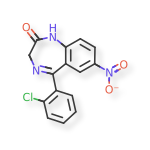
| Molecular Formula | C15H10ClN3O3.ClH |
| Molecular Weight | 352.172 |
| Optical Activity | NONE |
| Defined Stereocenters | 0 / 0 |
| E/Z Centers | 0 |
| Charge | 0 |
SHOW SMILES / InChI
SMILES
Cl.[O-][N+](=O)C1=CC=C2NC(=O)CN=C(C3=CC=CC=C3Cl)C2=C1
InChI
InChIKey=VWRNQDQMIQNCOC-UHFFFAOYSA-N
InChI=1S/C15H10ClN3O3.ClH/c16-12-4-2-1-3-10(12)15-11-7-9(19(21)22)5-6-13(11)18-14(20)8-17-15;/h1-7H,8H2,(H,18,20);1H
| Molecular Formula | C15H10ClN3O3 |
| Molecular Weight | 315.711 |
| Charge | 0 |
| Count |
|
| Stereochemistry | ACHIRAL |
| Additional Stereochemistry | No |
| Defined Stereocenters | 0 / 0 |
| E/Z Centers | 0 |
| Optical Activity | NONE |
| Molecular Formula | ClH |
| Molecular Weight | 36.461 |
| Charge | 0 |
| Count |
|
| Stereochemistry | ACHIRAL |
| Additional Stereochemistry | No |
| Defined Stereocenters | 0 / 0 |
| E/Z Centers | 0 |
| Optical Activity | NONE |
Clonazepam, a benzodiazepine, is used primarily as an anticonvulsant in the treatment of absence seizures, petit mal variant seizures (Lennox-Gastaut syndrome), akinetic and myoclonic seizures, and nocturnal myoclonus. Klonopin is the brand name for Clonazepam, an anxiolytic and anticonvulsant. The precise mechanism by which clonazepam exerts its antiseizure
and antipanic effects is unknown, although it is believed to be related to its ability to
enhance the activity of gamma aminobutyric acid (GABA), the major inhibitory
neurotransmitter in the central nervous system. Allosteric interactions between central benzodiazepine receptors and gamma-aminobutyric acid (GABA) receptors potentiate the effects of GABA. As GABA is an inhibitory neurotransmitter, this results in increased inhibition of the ascending reticular activating system. Benzodiazepines, in this way, block the cortical and limbic arousal that occurs following stimulation of the reticular pathways.
Originator
Approval Year
Targets
| Primary Target | Pharmacology | Condition | Potency |
|---|---|---|---|
| 0.06 nM [EC50] | |||
Target ID: CHEMBL2095172 |
57.0 µM [EC50] | ||
Target ID: CHEMBL2111413 |
40.0 µM [EC50] |
Conditions
| Condition | Modality | Targets | Highest Phase | Product |
|---|---|---|---|---|
| Primary | KLONOPIN Approved UseINDICATIONS & USAGE Seizure Disorders: Clonazepam tablets, USP are useful alone or as an adjunct in the treatment of the Lennox-Gastaut syndrome (petit mal variant), akinetic and . In patients with absence seizures (petit mal) who have failed to respond to succinimides, clonazepam may be useful. In some studies, up to 30% of patients have shown a loss of anticonvulsant activity, often within 3 months of administration. In some cases, dosage adjustment may reestablish efficacy.
Panic Disorder: Clonazepam tablets, USP are indicated for the treatment of panic disorder, with or without agoraphobia, as defined in DSM-IV. Panic disorder is characterized by the occurrence of unexpected panic attacks and associated concern about having additional attacks, worry about the implications or consequences of the attacks, and/or a significant change in behavior related to the attacks. The efficacy of clonazepam was established in two 6- to 9-week trials in panic disorder patients whose diagnoses corresponded to the DSM-IIIR category of panic disorder. Panic disorder (DSM-IV) is characterized by recurrent unexpected panic attacks, ie, a discrete period of intense fear or discomfort in which four (or more) of the following symptoms develop abruptly and reach a peak within 10 minutes: (1) palpitations, pounding heart or accelerated heart rate; (2) sweating; (3) trembling or shaking; (4) sensations of shortness of breath or smothering; (5) feeling of choking; (6) chest pain or discomfort; (7) nausea or abdominal distress; (8) feeling dizzy, unsteady, lightheaded or faint; (9) derealization (feelings of unreality) or depersonalization (being detached from oneself); (10) fear of losing control; (11) fear of dying; (12) paresthesias (numbness or tingling sensations); (13) chills or hot flushes. The effectiveness of clonazepam in long-term use, that is, for more than 9 weeks, has not been systematically studied in controlled clinical trials. The physician who elects to use clonazepam for extended periods should periodically reevaluate the long-term usefulness of the drug for the individual patient. Launch Date1975 |
|||
| Primary | KLONOPIN Approved UseINDICATIONS & USAGE Seizure Disorders: Clonazepam tablets, USP are useful alone or as an adjunct in the treatment of the Lennox-Gastaut syndrome (petit mal variant), akinetic and . In patients with absence seizures (petit mal) who have failed to respond to succinimides, clonazepam may be useful. In some studies, up to 30% of patients have shown a loss of anticonvulsant activity, often within 3 months of administration. In some cases, dosage adjustment may reestablish efficacy.
Panic Disorder: Clonazepam tablets, USP are indicated for the treatment of panic disorder, with or without agoraphobia, as defined in DSM-IV. Panic disorder is characterized by the occurrence of unexpected panic attacks and associated concern about having additional attacks, worry about the implications or consequences of the attacks, and/or a significant change in behavior related to the attacks. The efficacy of clonazepam was established in two 6- to 9-week trials in panic disorder patients whose diagnoses corresponded to the DSM-IIIR category of panic disorder. Panic disorder (DSM-IV) is characterized by recurrent unexpected panic attacks, ie, a discrete period of intense fear or discomfort in which four (or more) of the following symptoms develop abruptly and reach a peak within 10 minutes: (1) palpitations, pounding heart or accelerated heart rate; (2) sweating; (3) trembling or shaking; (4) sensations of shortness of breath or smothering; (5) feeling of choking; (6) chest pain or discomfort; (7) nausea or abdominal distress; (8) feeling dizzy, unsteady, lightheaded or faint; (9) derealization (feelings of unreality) or depersonalization (being detached from oneself); (10) fear of losing control; (11) fear of dying; (12) paresthesias (numbness or tingling sensations); (13) chills or hot flushes. The effectiveness of clonazepam in long-term use, that is, for more than 9 weeks, has not been systematically studied in controlled clinical trials. The physician who elects to use clonazepam for extended periods should periodically reevaluate the long-term usefulness of the drug for the individual patient. Launch Date1975 |
Cmax
| Value | Dose | Co-administered | Analyte | Population |
|---|---|---|---|---|
2.3 ng/mL |
0.5 mg single, oral dose: 0.5 mg route of administration: Oral experiment type: SINGLE co-administered: |
CLONAZEPAM plasma | Homo sapiens population: HEALTHY age: ADULT sex: FEMALE / MALE food status: UNKNOWN |
|
3 ng/mL |
0.5 mg 3 times / day steady-state, oral dose: 0.5 mg route of administration: Oral experiment type: STEADY-STATE co-administered: |
CLONAZEPAM plasma | Homo sapiens population: UNHEALTHY age: ADULT sex: FEMALE / MALE food status: UNKNOWN |
AUC
| Value | Dose | Co-administered | Analyte | Population |
|---|---|---|---|---|
102 ng × h/mL |
0.5 mg single, oral dose: 0.5 mg route of administration: Oral experiment type: SINGLE co-administered: |
CLONAZEPAM plasma | Homo sapiens population: HEALTHY age: ADULT sex: FEMALE / MALE food status: UNKNOWN |
|
339 ng × h/mL |
0.5 mg 3 times / day steady-state, oral dose: 0.5 mg route of administration: Oral experiment type: STEADY-STATE co-administered: |
CLONAZEPAM plasma | Homo sapiens population: UNHEALTHY age: ADULT sex: FEMALE / MALE food status: UNKNOWN |
T1/2
| Value | Dose | Co-administered | Analyte | Population |
|---|---|---|---|---|
40 h |
0.5 mg 3 times / day steady-state, oral dose: 0.5 mg route of administration: Oral experiment type: STEADY-STATE co-administered: |
CLONAZEPAM plasma | Homo sapiens population: UNHEALTHY age: ADULT sex: FEMALE / MALE food status: UNKNOWN |
Funbound
| Value | Dose | Co-administered | Analyte | Population |
|---|---|---|---|---|
15% |
0.5 mg single, oral dose: 0.5 mg route of administration: Oral experiment type: SINGLE co-administered: |
CLONAZEPAM plasma | Homo sapiens population: HEALTHY age: ADULT sex: FEMALE / MALE food status: UNKNOWN |
Doses
| Dose | Population | Adverse events |
|---|---|---|
2 mg single, intramuscular Dose: 2 mg Route: intramuscular Route: single Dose: 2 mg Sources: |
healthy, 30 years (range: 23–50 years) Health Status: healthy Age Group: 30 years (range: 23–50 years) Sex: M+F Sources: |
|
2 mg single, intravenous Dose: 2 mg Route: intravenous Route: single Dose: 2 mg Sources: |
healthy, 30 years (range: 23–50 years) Health Status: healthy Age Group: 30 years (range: 23–50 years) Sex: M+F Sources: |
|
2 mg single, oral |
healthy, 30 years (range: 23–50 years) Health Status: healthy Age Group: 30 years (range: 23–50 years) Sex: M+F Sources: |
|
1.5 mg 1 times / day multiple, oral Recommended Dose: 1.5 mg, 1 times / day Route: oral Route: multiple Dose: 1.5 mg, 1 times / day Sources: |
unhealthy Health Status: unhealthy Sources: |
Disc. AE: Somnolence, Depression... AEs leading to discontinuation/dose reduction: Somnolence (7%) Sources: Depression (4%) Nervousness (1%) Dizziness (1%) Ataxia (1%) Intellectual disability (1%) |
6 mg 1 times / day steady, oral Studied dose Dose: 6 mg, 1 times / day Route: oral Route: steady Dose: 6 mg, 1 times / day Sources: |
unhealthy |
AEs
| AE | Significance | Dose | Population |
|---|---|---|---|
| Ataxia | 1% Disc. AE |
1.5 mg 1 times / day multiple, oral Recommended Dose: 1.5 mg, 1 times / day Route: oral Route: multiple Dose: 1.5 mg, 1 times / day Sources: |
unhealthy Health Status: unhealthy Sources: |
| Dizziness | 1% Disc. AE |
1.5 mg 1 times / day multiple, oral Recommended Dose: 1.5 mg, 1 times / day Route: oral Route: multiple Dose: 1.5 mg, 1 times / day Sources: |
unhealthy Health Status: unhealthy Sources: |
| Intellectual disability | 1% Disc. AE |
1.5 mg 1 times / day multiple, oral Recommended Dose: 1.5 mg, 1 times / day Route: oral Route: multiple Dose: 1.5 mg, 1 times / day Sources: |
unhealthy Health Status: unhealthy Sources: |
| Nervousness | 1% Disc. AE |
1.5 mg 1 times / day multiple, oral Recommended Dose: 1.5 mg, 1 times / day Route: oral Route: multiple Dose: 1.5 mg, 1 times / day Sources: |
unhealthy Health Status: unhealthy Sources: |
| Depression | 4% Disc. AE |
1.5 mg 1 times / day multiple, oral Recommended Dose: 1.5 mg, 1 times / day Route: oral Route: multiple Dose: 1.5 mg, 1 times / day Sources: |
unhealthy Health Status: unhealthy Sources: |
| Somnolence | 7% Disc. AE |
1.5 mg 1 times / day multiple, oral Recommended Dose: 1.5 mg, 1 times / day Route: oral Route: multiple Dose: 1.5 mg, 1 times / day Sources: |
unhealthy Health Status: unhealthy Sources: |
Overview
| CYP3A4 | CYP2C9 | CYP2D6 | hERG |
|---|---|---|---|
Drug as perpetrator
| Target | Modality | Activity | Metabolite | Clinical evidence |
|---|---|---|---|---|
| no | ||||
| no | ||||
| no | ||||
| weak | ||||
| yes |
Drug as victim
| Target | Modality | Activity | Metabolite | Clinical evidence |
|---|---|---|---|---|
| no | ||||
| yes | ||||
| yes | yes (pharmacogenomic study) Comment: The statistical analysis displayed significant association between the patients’ CYP3A4 expression and the stable plasma concentrations of clonazepam normalized by the dose and the patient’s bodyweight. |
PubMed
| Title | Date | PubMed |
|---|---|---|
| Interaction of GYKI 52466, a selective non-competitive antagonist of AMPA/kainate receptors, with conventional antiepileptic drugs in amygdala-kindled seizures in rats. | 2002-01-15 |
|
| Spectrofluorimetric determination of vigabatrin and gabapentin in urine and dosage forms through derivatization with fluorescamine. | 2002-01-01 |
|
| Effects of commonly used benzodiazepines on the fetus, the neonate, and the nursing infant. | 2002-01 |
|
| Roles for mitochondrial and reverse mode Na+/Ca2+ exchange and the plasmalemma Ca2+ ATPase in post-tetanic potentiation at crayfish neuromuscular junctions. | 2001-12-15 |
|
| Pharmacoepidemiologic investigation of a clonazepam-carbamazepine interaction by mixed effect modeling using routine clinical pharmacokinetic data in Japanese patients. | 2001-12 |
|
| Pharmacological characterization of the 6 Hz psychomotor seizure model of partial epilepsy. | 2001-12 |
|
| Direct LC analysis of five benzodiazepines in human urine and plasma using an ADS restricted access extraction column. | 2001-12 |
|
| Determination of benzodiazepines in human hair by on-line high-performance liquid chromatography using a restricted access extraction column. | 2001-11-15 |
|
| [Piracetam in the treatment of a patient with idiopathic cortical myoclonus]. | 2001-11-10 |
|
| Stiff leg syndrome: case report. | 2001-11 |
|
| Fast orthostatic tremor in Parkinson's disease mimicking primary orthostatic tremor. | 2001-11 |
|
| Selective, high-resolution fluorescence imaging of mitochondrial Ca2+ concentration. | 2001-11 |
|
| West syndrome: the Philippine experience. | 2001-11 |
|
| Kinetic and pharmacological properties of GABA(A) receptors in single thalamic neurons and GABA(A) subunit expression. | 2001-11 |
|
| Increased [Mg2+]o reduces Ca2+ influx and disruption of mitochondrial membrane potential during reoxygenation. | 2001-11 |
|
| Successful use of methadone in the treatment of chronic neuropathic pain arising from burn injuries: a case-study. | 2001-11 |
|
| Nutritional parameters modify muricidal behavior of male Wistar rats: preventive effects of amino acids and 4' Cl diazepam. | 2001-10-26 |
|
| Evaluation of in vitro percutaneous absorption of lorazepam and clonazepam from hydro-alcoholic gel formulations. | 2001-10-09 |
|
| Population pharmacokinetic analysis resulting in a tool for dose individualization of busulphan in bone marrow transplantation recipients. | 2001-10 |
|
| Influence of age and comedication on steady-state clonazepam serum level-dose ratios in Japanese epileptic patients. | 2001-10 |
|
| Diazepam inhibits HIV-1 Tat-induced migration of human microglia. | 2001-10 |
|
| 2-Arylpyrazolo[1,5-a]pyrimidin-3-yl acetamides. New potent and selective peripheral benzodiazepine receptor ligands. | 2001-10 |
|
| Effect of clonazepam treatment on antipsychotic drug-induced Meige syndrome and changes in plasma levels of GABA, HVA, and MHPG during treatment. | 2001-10 |
|
| A successful clonazepam treatment without tolerance in a patient with spontaneous oral dyskinesia. | 2001-10 |
|
| [Treatment and long-term follow-up of post-anoxic myoclonus]. | 2001-09-23 |
|
| Effect of midazolam on interleukin-6 mRNA expression in human peripheral blood mononuclear cells in the absence of lipopolysaccharide. | 2001-09-21 |
|
| Evaluation of polymeric nanoparticles composed of cholic acid and methoxy poly(ethylene glycol). | 2001-09-11 |
|
| [Involuntary movement disorders as first manifestation of systemic lupus erythematosus: case report]. | 2001-09 |
|
| [Efficacy of anticonvulsants on acute encephalitis with refractory, repetitive partial seizures (AERRPS)]. | 2001-09 |
|
| Topiramate as a mood stabilizer. | 2001-09 |
|
| Hyperekplexia in neonates. | 2001-09 |
|
| Spectrofluorimetric determination of vigabatrin and gabapentin in dosage forms and spiked plasma samples through derivatization with 4-chloro-7-nitrobenzo-2-oxa-1,3-diazole. | 2001-08-15 |
|
| Gamma irradiation effects on stability of poly(lactide-co-glycolide) microspheres containing clonazepam. | 2001-08-10 |
|
| [Primary orthostatic tremor: slow harmonic component as responsible of inestability]. | 2001-08-04 |
|
| Burning mouth syndrome after taking clonazepam. | 2001-08-04 |
|
| Role of clonazepam in the treatment of idiopathic downbeat nystagmus. | 2001-08 |
|
| Benzodiazepines protect against ethanol-induced gastric mucosal damage in vitro. | 2001-08 |
|
| Carbamazepine treatment of corticosteroid-induced mood disorder. | 2001-08 |
|
| Nonconvulsive status epilepticus associated with cephalosporins in patients with renal failure. | 2001-08 |
|
| Smoking and panic disorder. | 2001-08 |
|
| A 28-year-old woman with panic disorder. | 2001-07-25 |
|
| Case report: unexplained syncope explained. | 2001-07 |
|
| Infantile status epilepticus in Tunisia. Clinical, etiological and prognostic aspects. | 2001-07 |
|
| Involuntary movements in infantile cobalamin deficiency appearing after treatment. | 2001-07 |
|
| Sleep disorders. | 2001-02 |
|
| Pharmacological options for the treatment of Tourette's disorder. | 2001 |
|
| Burning mouth syndrome. | 2001 |
|
| Psychiatric disorders associated with Cushing's syndrome. Epidemiology, pathophysiology and treatment. | 2001 |
|
| LSD-induced Hallucinogen Persisting Perception Disorder treated with clonazepam: two case reports. | 2001 |
|
| Sleep disorders in patients with Parkinson's disease: epidemiology and management. | 2001 |
Patents
Sample Use Guides
Seizure Disorders: Adults: The initial dose for adults with seizure disorders should not
exceed 1.5 mg/day divided into three doses. Dosage may be increased in increments of
0.5 to 1 mg every 3 days until seizures are adequately controlled or until side effects
preclude any further increase. Maintenance dosage must be individualized for each
patient depending upon response. Maximum recommended daily dose is 20 mg. Clonazepam is available as a tablet or an orally disintegrating tablet (wafer). The tablets
should be administered with water by swallowing the tablet whole. The orally
disintegrating tablet should be administered as follows: After opening the pouch, peel
back the foil on the blister. Do not push tablet through foil. Immediately upon opening
the blister, using dry hands, remove the tablet and place it in the mouth. Tablet
disintegration occurs rapidly in saliva so it can be easily swallowed with or without water.
Route of Administration:
Oral
| Substance Class |
Chemical
Created
by
admin
on
Edited
Wed Apr 02 11:07:40 GMT 2025
by
admin
on
Wed Apr 02 11:07:40 GMT 2025
|
| Record UNII |
XXQ3A82WUX
|
| Record Status |
Validated (UNII)
|
| Record Version |
|
-
Download
| Name | Type | Language | ||
|---|---|---|---|---|
|
Common Name | English | ||
|
Preferred Name | English | ||
|
Systematic Name | English |
| Code System | Code | Type | Description | ||
|---|---|---|---|---|---|
|
300000038751
Created by
admin on Wed Apr 02 11:07:40 GMT 2025 , Edited by admin on Wed Apr 02 11:07:40 GMT 2025
|
PRIMARY | |||
|
61321-60-6
Created by
admin on Wed Apr 02 11:07:40 GMT 2025 , Edited by admin on Wed Apr 02 11:07:40 GMT 2025
|
PRIMARY | |||
|
67937833
Created by
admin on Wed Apr 02 11:07:40 GMT 2025 , Edited by admin on Wed Apr 02 11:07:40 GMT 2025
|
PRIMARY | |||
|
XXQ3A82WUX
Created by
admin on Wed Apr 02 11:07:40 GMT 2025 , Edited by admin on Wed Apr 02 11:07:40 GMT 2025
|
PRIMARY |
| Related Record | Type | Details | ||
|---|---|---|---|---|
|
PARENT -> SALT/SOLVATE |
|
| Related Record | Type | Details | ||
|---|---|---|---|---|
|
ACTIVE MOIETY |
|