Details
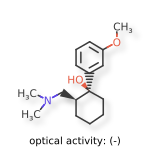
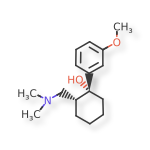
| Stereochemistry | ABSOLUTE |
| Molecular Formula | C16H25NO2 |
| Molecular Weight | 263.3752 |
| Optical Activity | ( + ) |
| Defined Stereocenters | 2 / 2 |
| E/Z Centers | 0 |
| Charge | 0 |
SHOW SMILES / InChI
SMILES
COC1=CC(=CC=C1)[C@@]2(O)CCCC[C@@H]2CN(C)C
InChI
InChIKey=TVYLLZQTGLZFBW-ZBFHGGJFSA-N
InChI=1S/C16H25NO2/c1-17(2)12-14-7-4-5-10-16(14,18)13-8-6-9-15(11-13)19-3/h6,8-9,11,14,18H,4-5,7,10,12H2,1-3H3/t14-,16+/m1/s1
| Molecular Formula | C16H25NO2 |
| Molecular Weight | 263.3752 |
| Charge | 0 |
| Count |
|
| Stereochemistry | ABSOLUTE |
| Additional Stereochemistry | No |
| Defined Stereocenters | 2 / 2 |
| E/Z Centers | 0 |
| Optical Activity | UNSPECIFIED |
DescriptionCurator's Comment: description was created based on several sources, including
https://www.drugs.com/tramadol.html | https://www.drugbank.ca/drugs/DB00193 | http://reference.medscape.com/drug/ultram-er-tramadol-343324 |
Curator's Comment: description was created based on several sources, including
https://www.drugs.com/tramadol.html | https://www.drugbank.ca/drugs/DB00193 | http://reference.medscape.com/drug/ultram-er-tramadol-343324 |
Tramadol (sold under the brand name Ultram) is a narcotic analgesic proposed for moderate to severe pain. Tramadol and its O-desmethyl metabolite (M1) are selective, weak OP3-receptor agonists. Opiate receptors are coupled with G-protein receptors and function as both positive and negative regulators of synaptic transmission via G-proteins that activate effector proteins. As the effector system is adenylate cyclase and cAMP located at the inner surface of the plasma membrane, opioids decrease intracellular cAMP by inhibiting adenylate cyclase. Subsequently, the release of nociceptive neurotransmitters such as substance P, GABA, dopamine, acetylcholine, and noradrenaline is inhibited. The analgesic properties of Tramadol can be attributed to norepinephrine and serotonin reuptake blockade in the CNS, which inhibits pain transmission in the spinal cord. The (+) enantiomer has the higher affinity for the OP3 receptor and preferentially inhibits serotonin uptake and enhances serotonin release. The (-) enantiomer preferentially inhibits norepinephrine reuptake by stimulating alpha(2)-adrenergic receptors. Tramadol is used primarily to treat mild-severe pain, both acute and chronic. Its analgesic effects take about one hour to come into effect and 2 h to 4 h to peak after oral administration with an immediate-release formulation. On a dose-by-dose basis, tramadol has about one-tenth the potency of morphine and is approximately equally potent when compared to pethidine and codeine. The most common adverse effects of tramadol include nausea, dizziness, dry mouth, indigestion, abdominal pain, vertigo, vomiting, constipation, drowsiness, and headache. Compared to other opioids, respiratory depression and constipation are considered less of a problem with tramadol.
Originator
Approval Year
Targets
| Primary Target | Pharmacology | Condition | Potency |
|---|---|---|---|
Target ID: CHEMBL233 |
1300.0 nM [EC50] | ||
Target ID: CHEMBL237 |
14.0 nM [Ki] | ||
Target ID: CHEMBL236 |
9.4 nM [Ki] | ||
Target ID: CHEMBL228 |
1493.0 nM [IC50] | ||
Target ID: CHEMBL222 |
3861.0 nM [IC50] |
Conditions
| Condition | Modality | Targets | Highest Phase | Product |
|---|---|---|---|---|
| Primary | ULTRAM Approved UseTramadol hydrochloride extended-release tablets are indicated for the management of moderate to moderately severe chronic pain in adults who require around-the-clock treatment of their pain for an extended period of time. Launch Date1995 |
|||
| Primary | ULTRAM Approved UseTramadol hydrochloride extended-release tablets are indicated for the management of moderate to moderately severe chronic pain in adults who require around-the-clock treatment of their pain for an extended period of time. Launch Date1995 |
|||
| Primary | ULTRAM Approved UseTramadol hydrochloride extended-release tablets are indicated for the management of moderate to moderately severe chronic pain in adults who require around-the-clock treatment of their pain for an extended period of time. Launch Date1995 |
Cmax
| Value | Dose | Co-administered | Analyte | Population |
|---|---|---|---|---|
332 ng/mL |
200 mg 1 times / day steady-state, oral dose: 200 mg route of administration: Oral experiment type: STEADY-STATE co-administered: |
TRAMADOL plasma | Homo sapiens population: HEALTHY age: ADULT sex: UNKNOWN food status: FASTED |
|
70 ng/mL |
200 mg 1 times / day steady-state, oral dose: 200 mg route of administration: Oral experiment type: STEADY-STATE co-administered: |
O-DESMETHYLTRAMADOL plasma | Homo sapiens population: HEALTHY age: ADULT sex: UNKNOWN food status: FASTED |
AUC
| Value | Dose | Co-administered | Analyte | Population |
|---|---|---|---|---|
5678 ng × h/mL |
200 mg 1 times / day steady-state, oral dose: 200 mg route of administration: Oral experiment type: STEADY-STATE co-administered: |
TRAMADOL plasma | Homo sapiens population: HEALTHY age: ADULT sex: UNKNOWN food status: FASTED |
|
1319 ng × h/mL |
200 mg 1 times / day steady-state, oral dose: 200 mg route of administration: Oral experiment type: STEADY-STATE co-administered: |
O-DESMETHYLTRAMADOL plasma | Homo sapiens population: HEALTHY age: ADULT sex: UNKNOWN food status: FASTED |
Funbound
| Value | Dose | Co-administered | Analyte | Population |
|---|---|---|---|---|
80% |
200 mg 1 times / day steady-state, oral dose: 200 mg route of administration: Oral experiment type: STEADY-STATE co-administered: |
TRAMADOL plasma | Homo sapiens population: HEALTHY age: ADULT sex: UNKNOWN food status: FASTED |
Overview
| CYP3A4 | CYP2C9 | CYP2D6 | hERG |
|---|---|---|---|
Drug as victim
| Target | Modality | Activity | Metabolite | Clinical evidence |
|---|---|---|---|---|
| unlikely | ||||
| yes | ||||
| yes | likely (co-administration study) Comment: Coadministration of quinidine, a selective inhibitor of CYP2D6, with tramadol ER resulted in a 50 60% increase in tramadol exposure; pharmacogenomic studies were also conducted: rapid conversion to active metabolite results in higher than expected serum M1 levels. Individuals who are ultra-rapid metabolizers should not use drug. Page: 5.0 |
|||
| yes | likely (co-administration study) Comment: The concomitant use of ULTRAM with cytochrome P450 3A4 inhibitors, such as macrolide antibiotics (e.g., erythromycin), azole-antifungal agents (e.g., ketoconazole), and protease inhibitors (e.g., ritonavir) or discontinuation of a cytochrome P450 3A4 inducer such as rifampin, carbamazepine, and phenytoin, may result in an increase in tramadol plasma concentrations; Concomitant administration of tramadol immediate-release tablets with cimetidine, a weak CPY3A4 inhibitor, does not result in clinically significant changes in tramadol pharmacokinetics; Page: 5.0 |
Tox targets
| Target | Modality | Activity | Metabolite | Clinical evidence |
|---|---|---|---|---|
PubMed
| Title | Date | PubMed |
|---|---|---|
| Patient reporting of potential adverse drug reactions: a methodological study. | 2002-03 |
|
| Tramadol has no effect on cortical renal blood flow--despite increased serum catecholamine levels--in anesthetized rats: implications for analgesia in renal insufficiency. | 2002-03 |
|
| Tramadol infusion for postthoracotomy pain relief: a placebo-controlled comparison with epidural morphine. | 2002-03 |
|
| Meeting the therapeutic challenge of the patient with osteoarthritis. | 2002-02-09 |
|
| How to taper tramadol dose. | 2002-02 |
|
| New, non-NSAID alternative. | 2002-02 |
|
| Randomized clinical trial of Ligasure versus open haemorrhoidectomy. | 2002-02 |
|
| Combination analgesic efficacy: individual patient data meta-analysis of single-dose oral tramadol plus acetaminophen in acute postoperative pain. | 2002-02 |
|
| [Recovery of lung function after laparoscopic cholecystectomy: the role of postoperative pain]. | 2002-02 |
|
| The addition of tramadol to lidocaine does not reduce tourniquet and postoperative pain during iv regional anesthesia. | 2002-02 |
|
| Pharmacological treatment of postoperative shivering: a quantitative systematic review of randomized controlled trials. | 2002-02 |
|
| The role of tricyclic antidepressants and tramadol in palliative care. | 2002-02 |
|
| In vivo microdialysis and conditioned place preference studies in rats are consistent with abuse potential of tramadol. | 2002-02 |
|
| Monocomponent chemoembolization in oral and oropharyngeal cancer using an aqueous crystal suspension of cisplatin. | 2002-01-21 |
|
| Stereoselectivity in renal clearance of trans-tramadol and its active metabolite, trans-O-demethyltramadol. | 2002-01 |
|
| Concordance between tramadol and dextromethorphan parent/metabolite ratios: the influence of CYP2D6 and non-CYP2D6 pathways on biotransformation. | 2002-01 |
|
| Use of nonopioid analgesics and adjunctive agents in the management of pain in rheumatic diseases. | 2002-01 |
|
| A systematic review of adjuncts for intravenous regional anesthesia for surgical procedures. | 2002-01 |
|
| Physical compatibility and in vivo evaluation of drug mixtures for subcutaneous infusion to cancer patients in palliative care. | 2002-01 |
|
| Direct chiral assay of tramadol and detection of the phase II metabolite O-demethyl tramadol glucuronide in human urine using capillary electrophoresis with laser-induced native fluorescence detection. | 2001-12-05 |
|
| Nefopam reduces thermal hypersensitivity in acute and postoperative pain models in the rat. | 2001-12 |
|
| Analgesic efficacy of tramadol if coadministered with ondansetron. | 2001-12 |
|
| Plasma glucose-lowering effect of tramadol in streptozotocin-induced diabetic rats. | 2001-12 |
|
| Acetaminophen, aspirin, or Ibuprofen in combination analgesic products. | 2001-11-13 |
|
| Gas chromatographic method using nitrogen-phosphorus detection for the measurement of tramadol and its O-desmethyl metabolite in plasma and brain tissue of mice and rats. | 2001-11-05 |
|
| A comparison of tramadol, amitriptyline, and meperidine for postepidural anesthetic shivering in parturients. | 2001-11 |
|
| [Analysis of prehospital analgesia administered to victims with traumatic injuries]. | 2001-10-06 |
|
| Urinary disorders on tramadol. | 2001-10 |
|
| Distribution of enantiomers of trans-tramadol and trans-O-demethyltramadol in central nervous system of rats. | 2001-10 |
|
| Inhibition by tramadol of muscarinic receptor-induced responses in cultured adrenal medullary cells and in Xenopus laevis oocytes expressing cloned M1 receptors. | 2001-10 |
|
| Investigation of racial variations in the metabolism of tramadol. | 2001-09-14 |
|
| Psychosomatic reactions to a stressful environment and an attempt at pharmacological modification. | 2001-09-06 |
|
| Ketorolac vs tramadol in the treatment of postoperative pain during maxillofacial surgery. | 2001-09 |
|
| Multidimensional on-line solid-phase extraction (SPE) using restricted access materials (RAM) in combination with molecular imprinted polymers (MIP). | 2001-09 |
|
| Intravenous regional anaesthesia using lignocaine and tramadol. | 2001-09 |
|
| Tramadol/acetaminophen combination tablets and codeine/acetaminophen combination capsules for the management of chronic pain: a comparative trial. | 2001-09 |
|
| Managing postoperative pain. | 2001-09 |
|
| Effects of chronic tramadol on pre- and post-synaptic measures of monoamine function. | 2001-09 |
|
| [Non-opioid analgesics in cancer pain]. | 2001-09 |
|
| [Clinical remission of an HLA B27-positive sacroiliitis on vegan diet]. | 2001-08 |
|
| Association of Dental Anaesthetists. Summer Scientific Meeting Stirling, Scotland 8-9 June, 2001. ADA meeting report. | 2001-07 |
|
| Analgesic efficacy of tramadol 2 mg kg(-1) for paediatric day-case adenoidectomy. | 2001-04 |
|
| Pharmacokinetics of enantiomers of trans-tramadol and its active metabolite, trans-O-demethyltramadol, in human subjects. | 2001-01 |
|
| WHO Expert Committee on Drug Dependence. Thirty-second report. | 2001 |
|
| Interactions between systemic analgesics. | 2001 |
|
| Control of non-malignant chronic pain conditions in Japan and the possible future role of tramadol. | 2001 |
|
| Postanaesthetic shivering: epidemiology, pathophysiology, and approaches to prevention and management. | 2001 |
|
| Transition between anesthesia and post-operative analgesia: relevance of intra-operative administration of analgesics. | 2001 |
|
| Tramadol and acetaminophen tablets for dental pain. | 2001 |
|
| Single-dose dipyrone for acute postoperative pain. | 2001 |
Sample Use Guides
Chronic: 25 mg PO every morning initially; increased by 25-50 mg/day every 3 days up to 50-100 mg PO q4-6hr PRN; not to exceed 400 mg/day
Acute: 50-100 mg PO q4-6hr PRN; not to exceed 400 mg/day
Route of Administration:
Oral
A malignancy of A549 and PC-9 cells was detected after treatment of 2 μM tramadol for different time (0, 7, 14, or 28 d).
The effect of tramadol on the invasion of A549 and PC-9 cells was performed using transwell chambers (6.5 mm diameter and 8 μm pore size; Millipore, Billerica, MA, USA). After treated with 2 μM tramadol for various time, cells were plated onto the Matrigel-coated upper part of the transwell chamber, fetal bovine serum (FBS) medium (20%) was added to the lower wells as a chemoattractant. 48 hours later, non-invading cells were removed, the invaded cells were fixed with 4% paraformaldehyde for 30 min and stained with 1% crystal violet for 30 min. The number of stained cells on the undersurface of the polycarbonate membranes was then counted visually in five random image fields at 200 × magnifications using a microscope (Olympus, Lake Success, NY, USA).
| Substance Class |
Chemical
Created
by
admin
on
Edited
Mon Mar 31 23:10:32 GMT 2025
by
admin
on
Mon Mar 31 23:10:32 GMT 2025
|
| Record UNII |
0NG5TTM63P
|
| Record Status |
Validated (UNII)
|
| Record Version |
|
-
Download
| Name | Type | Language | ||
|---|---|---|---|---|
|
Preferred Name | English | ||
|
Common Name | English | ||
|
Common Name | English | ||
|
Common Name | English |
| Code System | Code | Type | Description | ||
|---|---|---|---|---|---|
|
DTXSID401167150
Created by
admin on Mon Mar 31 23:10:32 GMT 2025 , Edited by admin on Mon Mar 31 23:10:32 GMT 2025
|
PRIMARY | |||
|
33741
Created by
admin on Mon Mar 31 23:10:32 GMT 2025 , Edited by admin on Mon Mar 31 23:10:32 GMT 2025
|
PRIMARY | |||
|
75725
Created by
admin on Mon Mar 31 23:10:32 GMT 2025 , Edited by admin on Mon Mar 31 23:10:32 GMT 2025
|
PRIMARY | |||
|
123154-38-1
Created by
admin on Mon Mar 31 23:10:32 GMT 2025 , Edited by admin on Mon Mar 31 23:10:32 GMT 2025
|
PRIMARY | |||
|
0NG5TTM63P
Created by
admin on Mon Mar 31 23:10:32 GMT 2025 , Edited by admin on Mon Mar 31 23:10:32 GMT 2025
|
PRIMARY |
| Related Record | Type | Details | ||
|---|---|---|---|---|
|
TARGET -> AGONIST | |||
|
TARGET -> INHIBITOR | |||
|
|
ENANTIOMER -> ENANTIOMER |
|
||
|
RACEMATE -> ENANTIOMER |
Agonist of the ?. opioid receptor and inhibits serotonin reuptake.
|