


Details
| Stereochemistry | ABSOLUTE |
| Molecular Formula | C23H21F7N4O3 |
| Molecular Weight | 534.4267 |
| Optical Activity | ( + ) |
| Defined Stereocenters | 3 / 3 |
| E/Z Centers | 0 |
| Charge | 0 |
SHOW SMILES / InChI
SMILES
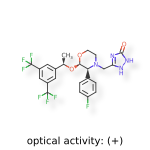
C[C@@H](O[C@H]1OCCN(CC2=NC(=O)NN2)[C@H]1C3=CC=C(F)C=C3)C4=CC(=CC(=C4)C(F)(F)F)C(F)(F)F
InChI
InChIKey=ATALOFNDEOCMKK-OITMNORJSA-N
InChI=1S/C23H21F7N4O3/c1-12(14-8-15(22(25,26)27)10-16(9-14)23(28,29)30)37-20-19(13-2-4-17(24)5-3-13)34(6-7-36-20)11-18-31-21(35)33-32-18/h2-5,8-10,12,19-20H,6-7,11H2,1H3,(H2,31,32,33,35)/t12-,19+,20-/m1/s1
| Molecular Formula | C23H21F7N4O3 |
| Molecular Weight | 534.4267 |
| Charge | 0 |
| Count |
|
| Stereochemistry | ABSOLUTE |
| Additional Stereochemistry | No |
| Defined Stereocenters | 3 / 3 |
| E/Z Centers | 0 |
| Optical Activity | UNSPECIFIED |
DescriptionSources: http://www.drugbank.ca/drugs/DB06717http://www.accessdata.fda.gov/drugsatfda_docs/label/2014/021549s024lbl.pdfCurator's Comment: Description was created based on several sources, including
http://www.accessdata.fda.gov/drugsatfda_docs/label/2015/021549s025lbl.pdf
Sources: http://www.drugbank.ca/drugs/DB06717http://www.accessdata.fda.gov/drugsatfda_docs/label/2014/021549s024lbl.pdf
Curator's Comment: Description was created based on several sources, including
http://www.accessdata.fda.gov/drugsatfda_docs/label/2015/021549s025lbl.pdf
Aprepitant (brand name: Emend (the brand name used in all English-speaking countries an antiemetic, is a substance P/neurokinin 1 (NK1) receptor antagonist which, in combination with other antiemetic agents, is indicated for the prevention of acute and delayed nausea and vomiting associated with initial and repeat courses of highly emetogenic cancer chemotherapy. Aprepitant has little or no affinity for serotonin (5-HT3), dopamine, and corticosteroid receptors, the targets of existing therapies for chemotherapy-induced nausea and vomiting. Aprepitant has been shown to inhibit emesis induced by cytotoxic chemotherapeutic agents, such as cisplatin, via central actions. Animal and human Positron Emission Tomography (PET) studies with aprepitant have shown that it crosses the blood brain barrier and occupies brain NK1 receptors.
CNS Activity
Sources: http://www.drugbank.ca/drugs/DB06717 | https://www.ncbi.nlm.nih.gov/pubmed/20533894https://books.google.ru/books?id=2Q5hCgAAQBAJ&pg=PA511&lpg=PA511&dq=APREPITANT+cross+blood-brain+barrier&source=bl&ots=m3M7oiKhRG&sig=XYqQqYahVA75LV6-afbUX4FUWGw&hl=ru&sa=X&ved=0ahUKEwiw_NTP6ezPAhXKPRoKHTOzDeEQ6AEINDAD#v=onepage&q=APREPITANT%20cross%20blood-brain%20barrier&f=false
Curator's Comment: Fosaprepitant is a prodrug of Aprepitant. Animal and human Positron Emission Tomography (PET) studies with Aprepitant have shown that it crosses the blood brain barrier and occupies brain NK1 receptors.
Originator
Sources: http://adisinsight.springer.com/drugs/800023866https://www.ono.co.jp/eng/cn/contents/sm_cn_050228.pdf
Curator's Comment: # Merck & Ono Pharmaceutical
Approval Year
Targets
| Primary Target | Pharmacology | Condition | Potency |
|---|---|---|---|
Target ID: CHEMBL249 |
|||
Target ID: CHEMBL249 |
Conditions
| Condition | Modality | Targets | Highest Phase | Product |
|---|---|---|---|---|
| Preventing | EMEND Approved Use1.1 Prevention of Chemotherapy Induced Nausea and Vomiting (CINV) EMEND, in combination with other antiemetic agents, is indicated for the: prevention of acute and delayed nausea and vomiting associated with initial and repeat courses of highly emetogenic cancer chemotherapy (HEC) including high-dose cisplatin; prevention of nausea and vomiting associated with initial and repeat courses of moderately emetogenic cancer chemotherapy (MEC). Prevention of Postoperative Nausea and Vomiting (PONV): EMEND is indicated for the prevention of postoperative nausea and vomiting Launch Date2006 |
|||
| Preventing | EMEND Approved Use1.1 Prevention of Chemotherapy Induced Nausea and Vomiting (CINV) EMEND, in combination with other antiemetic agents, is indicated for the: prevention of acute and delayed nausea and vomiting associated with initial and repeat courses of highly emetogenic cancer chemotherapy (HEC) including high-dose cisplatin; prevention of nausea and vomiting associated with initial and repeat courses of moderately emetogenic cancer chemotherapy (MEC). Prevention of Postoperative Nausea and Vomiting (PONV): EMEND is indicated for the prevention of postoperative nausea and vomiting Launch Date2006 |
|||
| Secondary | EMEND Approved UseEMEND® is a substance P/neurokinin 1 (NK1) receptor antagonist, indicated:
• in combination with other antiemetic agents in patients 12 years of age and older and patients less than 12 years of age who weight at least 30 kg for prevention of:
• acute and delayed nausea and vomiting associated with initial and repeat courses of highly emetogenic cancer chemotherapy (HEC) including high-dose cisplatin (1.1)
• nausea and vomiting associated with initial and repeat courses of moderately emetogenic cancer chemotherapy (MEC) (1.1)
• for prevention of postoperative nausea and vomiting (PONV) in adults (1.2) Launch Date2008 |
|||
| Preventing | EMEND Approved UseEMEND® is a substance P/neurokinin 1 (NK1) receptor antagonist, indicated:
• in combination with other antiemetic agents in patients 12 years of age and older and patients less than 12 years of age who weight at least 30 kg for prevention of:
• acute and delayed nausea and vomiting associated with initial and repeat courses of highly emetogenic cancer chemotherapy (HEC) including high-dose cisplatin (1.1)
• nausea and vomiting associated with initial and repeat courses of moderately emetogenic cancer chemotherapy (MEC) (1.1)
• for prevention of postoperative nausea and vomiting (PONV) in adults (1.2) Launch Date2008 |
Cmax
| Value | Dose | Co-administered | Analyte | Population |
|---|---|---|---|---|
6.1 μg/mL |
130 mg single, intravenous dose: 130 mg route of administration: Intravenous experiment type: SINGLE co-administered: |
APREPITANT plasma | Homo sapiens population: HEALTHY age: UNKNOWN sex: UNKNOWN food status: UNKNOWN |
|
4.3 μg/mL |
100 mg single, intravenous dose: 100 mg route of administration: Intravenous experiment type: SINGLE co-administered: |
APREPITANT plasma | Homo sapiens population: HEALTHY age: UNKNOWN sex: UNKNOWN food status: UNKNOWN |
|
1354 ng/mL |
125 mg single, oral dose: 125 mg route of administration: Oral experiment type: SINGLE co-administered: |
APREPITANT plasma | Homo sapiens population: UNKNOWN age: UNKNOWN sex: UNKNOWN food status: UNKNOWN |
AUC
| Value | Dose | Co-administered | Analyte | Population |
|---|---|---|---|---|
43.9 μg × h/mL |
130 mg single, intravenous dose: 130 mg route of administration: Intravenous experiment type: SINGLE co-administered: |
APREPITANT plasma | Homo sapiens population: HEALTHY age: UNKNOWN sex: UNKNOWN food status: UNKNOWN |
|
27.8 μg × h/mL |
100 mg single, intravenous dose: 100 mg route of administration: Intravenous experiment type: SINGLE co-administered: |
APREPITANT plasma | Homo sapiens population: HEALTHY age: UNKNOWN sex: UNKNOWN food status: UNKNOWN |
|
27759 ng × h/mL |
125 mg single, oral dose: 125 mg route of administration: Oral experiment type: SINGLE co-administered: |
APREPITANT plasma | Homo sapiens population: UNKNOWN age: UNKNOWN sex: UNKNOWN food status: UNKNOWN |
|
44578 ng × h/mL EXPERIMENT https://pubmed.ncbi.nlm.nih.gov/17525168/ |
100 mg single, intravenous dose: 100 mg route of administration: Intravenous experiment type: SINGLE co-administered: |
FOSAPREPITANT plasma | Homo sapiens population: HEALTHY age: ADULT sex: FEMALE / MALE food status: FASTED |
T1/2
| Value | Dose | Co-administered | Analyte | Population |
|---|---|---|---|---|
14 h |
125 mg single, oral dose: 125 mg route of administration: Oral experiment type: SINGLE co-administered: |
APREPITANT plasma | Homo sapiens population: UNKNOWN age: UNKNOWN sex: UNKNOWN food status: UNKNOWN |
|
2.2 min EXPERIMENT https://pubmed.ncbi.nlm.nih.gov/17525168/ |
100 mg single, intravenous dose: 100 mg route of administration: Intravenous experiment type: SINGLE co-administered: |
FOSAPREPITANT plasma | Homo sapiens population: HEALTHY age: ADULT sex: FEMALE / MALE food status: FASTED |
Funbound
| Value | Dose | Co-administered | Analyte | Population |
|---|---|---|---|---|
5% EXPERIMENT https://pubmed.ncbi.nlm.nih.gov/17525168/ |
100 mg single, intravenous dose: 100 mg route of administration: Intravenous experiment type: SINGLE co-administered: |
FOSAPREPITANT plasma | Homo sapiens population: HEALTHY age: ADULT sex: FEMALE / MALE food status: FASTED |
Doses
| Dose | Population | Adverse events |
|---|---|---|
150 mg single, intravenous Recommended Dose: 150 mg Route: intravenous Route: single Dose: 150 mg Sources: |
healthy, 33 |
Disc. AE: Dyspnea... AEs leading to discontinuation/dose reduction: Dyspnea (2%) Sources: |
150 mg single, intravenous Recommended Dose: 150 mg Route: intravenous Route: single Dose: 150 mg Sources: |
unhealthy Health Status: unhealthy Sources: |
Disc. AE: Hypersensitivity reaction, Anaphylaxis... AEs leading to discontinuation/dose reduction: Hypersensitivity reaction Sources: Anaphylaxis Anaphylactic shock Infusion site reactions Thrombophlebitis Necrosis Vasculitis |
AEs
| AE | Significance | Dose | Population |
|---|---|---|---|
| Dyspnea | 2% Disc. AE |
150 mg single, intravenous Recommended Dose: 150 mg Route: intravenous Route: single Dose: 150 mg Sources: |
healthy, 33 |
| Anaphylactic shock | Disc. AE | 150 mg single, intravenous Recommended Dose: 150 mg Route: intravenous Route: single Dose: 150 mg Sources: |
unhealthy Health Status: unhealthy Sources: |
| Anaphylaxis | Disc. AE | 150 mg single, intravenous Recommended Dose: 150 mg Route: intravenous Route: single Dose: 150 mg Sources: |
unhealthy Health Status: unhealthy Sources: |
| Hypersensitivity reaction | Disc. AE | 150 mg single, intravenous Recommended Dose: 150 mg Route: intravenous Route: single Dose: 150 mg Sources: |
unhealthy Health Status: unhealthy Sources: |
| Infusion site reactions | Disc. AE | 150 mg single, intravenous Recommended Dose: 150 mg Route: intravenous Route: single Dose: 150 mg Sources: |
unhealthy Health Status: unhealthy Sources: |
| Necrosis | Disc. AE | 150 mg single, intravenous Recommended Dose: 150 mg Route: intravenous Route: single Dose: 150 mg Sources: |
unhealthy Health Status: unhealthy Sources: |
| Thrombophlebitis | Disc. AE | 150 mg single, intravenous Recommended Dose: 150 mg Route: intravenous Route: single Dose: 150 mg Sources: |
unhealthy Health Status: unhealthy Sources: |
| Vasculitis | Disc. AE | 150 mg single, intravenous Recommended Dose: 150 mg Route: intravenous Route: single Dose: 150 mg Sources: |
unhealthy Health Status: unhealthy Sources: |
Overview
| CYP3A4 | CYP2C9 | CYP2D6 | hERG |
|---|---|---|---|
OverviewOther
| Other Inhibitor | Other Substrate | Other Inducer |
|---|---|---|
Drug as perpetrator
| Target | Modality | Activity | Metabolite | Clinical evidence |
|---|---|---|---|---|
| moderate | yes (co-administration study) Comment: 2.3 to 3.3 fold increase in mean AUC of orally coadministered midazolam; Page: 7.0 |
|||
| no | ||||
| unlikely | ||||
| unlikely | ||||
| unlikely | ||||
| weak [IC50 44.7 uM] | ||||
| weak [IC50 >100 uM] | ||||
| weak [IC50 >100 uM] | ||||
| weak [IC50 >100 uM] | ||||
| weak [IC50 >100 uM] | ||||
| weak [Ki 108 uM] | ||||
| weak [Ki 66 uM] | ||||
| weak | yes (co-administration study) Comment: fosaprepitant increased the AUC of midazolam by 1.8-fold; fosaprepitant increased diltiazem AUC by 1.4-fold Page: 15, 16 |
|||
| yes | ||||
| yes | ||||
| yes | weak (co-administration study) Comment: no effect of drug on the plasma AUC of R(+) and S(-) warfarin; coadministration with tolbutamide (substrate) decreased AUC of tolbutamide by 23% (Day 4), 28% (Day 8), and 15% (Day 15); Page: 7.0 |
|||
| yes | yes (co-administration study) Comment: oral aprepitant decreased the AUC of tolbutamide by 23% on Day 4; fosaprepitant/aprepitant decreased warfarin exposure and prolongation of prothrombin time Page: 9, 15 |
|||
| yes | yes (co-administration study) Comment: fosaprepitant/aprepitant increased pimozide exposure; fosaprepitant/aprepitant increased midazolam exposure; fosaprepitant/aprepitant increased dexamethazone exposure; ifosaprepitant/aprepitant increased methylprednisolone exposure Page: 8.0 |
Drug as victim
| Target | Modality | Activity | Metabolite | Clinical evidence |
|---|---|---|---|---|
| major | yes (co-administration study) Comment: coadministration with ketoconazole (inhibitor) increased AUC of aprepitant by ~5-fold; coadministration with rifampin (inducer) decreased AUC of aprepitant by ~ 11-fold; Page: 2.0 |
|||
| major | yes (co-administration study) Comment: ketoconazole completely inhibited metabolism of MK-0869 Page: 8, 12 |
|||
| minor | ||||
| minor | ||||
| minor | ||||
| no | ||||
| no | ||||
| no | ||||
| no | ||||
| no | ||||
| no | ||||
| weak | no (co-administration study) Comment: lack of interaction between aprepitant with digoxin in clinical drug interaction study Page: 72.0 |
PubMed
| Title | Date | PubMed |
|---|---|---|
| Utilization of human nuclear receptors as an early counter screen for off-target activity: a case study with a compendium of 615 known drugs. | 2015-06 |
|
| Systems pharmacological analysis of drugs inducing stevens-johnson syndrome and toxic epidermal necrolysis. | 2015-05-18 |
|
| Use of high-dose cisplatin with aprepitant in an outpatient setting. | 2012-07 |
|
| [The efficacy of aprepitant and palonosetron on cisplatin doublet in lung cancer]. | 2011-10 |
|
| Differential time course of action of 5-HT3 and NK1 receptor antagonists when used with highly and moderately emetogenic chemotherapy (HEC and MEC). | 2011-09 |
|
| Palonosetron plus 3-day aprepitant and dexamethasone to prevent nausea and vomiting in patients receiving highly emetogenic chemotherapy. | 2011-08 |
|
| Pemirolast reduces cisplatin-induced kaolin intake in rats. | 2011-07-01 |
|
| [Retrospective analysis of antiemetic effect in patients receiving cisplatin]. | 2011-07 |
|
| The involvement of TRPA1 channel activation in the inflammatory response evoked by topical application of cinnamaldehyde to mice. | 2011-06-20 |
|
| Single-dose fosaprepitant for the prevention of chemotherapy-induced nausea and vomiting associated with cisplatin therapy: randomized, double-blind study protocol--EASE. | 2011-04-10 |
|
| Discovery and biological characterization of (2R,4S)-1'-acetyl-N-{(1R)-1-[3,5-bis(trifluoromethyl)phenyl]ethyl}-2-(4-fluoro-2-methylphenyl)-N-methyl-4,4'-bipiperidine-1-carboxamide as a new potent and selective neurokinin 1 (NK1) receptor antagonist clinical candidate. | 2011-02-24 |
|
| Multicenter, phase II, placebo-controlled, double-blind, randomized study of aprepitant in Japanese patients receiving high-dose cisplatin. | 2010-11 |
|
| Fosaprepitant and aprepitant: an update of the evidence for their place in the prevention of chemotherapy-induced nausea and vomiting. | 2010-10-21 |
|
| Pharmacokinetic evaluation of fosaprepitant dimeglumine. | 2010-10 |
|
| Recent trends in the impurity profile of pharmaceuticals. | 2010-07 |
|
| Case report: delirium due to a diltiazem-fentanyl CYP3A4 drug interaction. | 2010-04-23 |
|
| Lack of effect of aprepitant or its prodrug fosaprepitant on QTc intervals in healthy subjects. | 2009-08 |
|
| Fosaprepitant dimeglumine (MK-0517 or L-785,298), an intravenous neurokinin-1 antagonist for the prevention of chemotherapy induced nausea and vomiting. | 2008-12 |
|
| Fosaprepitant: a neurokinin-1 receptor antagonist for the prevention of chemotherapy-induced nausea and vomiting. | 2008-11 |
|
| Characterization of the occurrence of ifosfamide-induced neurotoxicity with concomitant aprepitant. | 2008-09 |
|
| Metalloelastase in lungs and alveolar macrophages is modulated by extracellular substance P in mice. | 2008-07 |
|
| Prevention of chemotherapy-induced nausea and vomiting: focus on fosaprepitant. | 2008-04 |
|
| Fosaprepitant (MK-0517): a neurokinin-1 receptor antagonist for the prevention of chemotherapy-induced nausea and vomiting. | 2007-12 |
|
| Tolerability of fosaprepitant and bioequivalency to aprepitant in healthy subjects. | 2007-07 |
|
| Antiemetic neurokinin-1 antagonist aprepitant and ifosfamide-induced encephalopathy. | 2007-04 |
|
| Central neurocircuitry associated with emesis. | 2001-12-03 |
|
| Phosphorylated morpholine acetal human neurokinin-1 receptor antagonists as water-soluble prodrugs. | 2000-03-23 |
|
| Structural optimization affording 2-(R)-(1-(R)-3, 5-bis(trifluoromethyl)phenylethoxy)-3-(S)-(4-fluoro)phenyl-4- (3-oxo-1,2,4-triazol-5-yl)methylmorpholine, a potent, orally active, long-acting morpholine acetal human NK-1 receptor antagonist. | 1998-11-05 |
Patents
Sample Use Guides
In Vivo Use Guide
Curator's Comment: can also be infused IV http://www.accessdata.fda.gov/drugsatfda_docs/label/2016/206197Orig1s000lbl.pdf
Prevention of Chemotherapy Induced Nausea and Vomiting (CINV)
• Recommended dosage of EMEND in adults and pediatric patients 12 years of age and older and patients less than 12 years of age who weigh at least 30 kg, and who can swallow oral capsules, is
125 mg on Day 1 and 80 mg on Days 2 and 3.
• Administer EMEND orally 1 hour prior to chemotherapy on Days 1, 2, and 3. If no chemotherapy is given on Days 2 and 3, administer EMEND in morning.
PONV
• Recommended oral EMEND dosage in adults is 40 mg within 3 hours prior to induction of anesthesia.
Route of Administration:
Oral
In Vitro Use Guide
Curator's Comment: Aprepitant suppressed HIV Bal infection of macrophages. Treatment with aprepitant (10(-6) M) inhibited infection of macrophages with the AZT- resistant viruses (A018, A012) by 0.7 log(10). Aprepitant also suppressed infection of macrophages with RT inhibitor-resistant virus (TC 49 and TC 60) by 0.5 log(10). Furthermore, aprepitant significantly enhanced the anti-HIV activity of antiretrovirals (AZT, Efavirenz, and Indinavir) in HIV Bal-infected macrophages, and aprepitant inhibited CCR5 expression on macrophages, ranging from 50.5 to 29.6%. Donor heterogeneity was observed in antiviral activity and CCR5 receptor expression.
Aprepitant (active moiety of Fosaprepitant) showed robust human osteosarcoma cell line MG-63 growth inhibition, with 50.78% inhibition at 30 uM and 97.25% at 60 uM.
| Substance Class |
Chemical
Created
by
admin
on
Edited
Mon Mar 31 18:03:33 GMT 2025
by
admin
on
Mon Mar 31 18:03:33 GMT 2025
|
| Record UNII |
1NF15YR6UY
|
| Record Status |
Validated (UNII)
|
| Record Version |
|
-
Download
| Name | Type | Language | ||
|---|---|---|---|---|
|
Preferred Name | English | ||
|
Official Name | English | ||
|
Code | English | ||
|
Code | English | ||
|
Common Name | English | ||
|
Common Name | English | ||
|
Common Name | English | ||
|
Common Name | English | ||
|
Common Name | English | ||
|
Common Name | English | ||
|
Common Name | English | ||
|
Brand Name | English | ||
|
Systematic Name | English | ||
|
Common Name | English | ||
|
Code | English | ||
|
Brand Name | English | ||
|
Common Name | English | ||
|
Common Name | English | ||
|
Code | English | ||
|
Common Name | English | ||
|
Code | English | ||
|
Common Name | English | ||
|
Common Name | English |
| Classification Tree | Code System | Code | ||
|---|---|---|---|---|
|
WHO-VATC |
QA04AD12
Created by
admin on Mon Mar 31 18:03:34 GMT 2025 , Edited by admin on Mon Mar 31 18:03:34 GMT 2025
|
||
|
EMA ASSESSMENT REPORTS |
EMEND (AUTHORIZED: POSTOPERATIVE NAUSEA AND VOMITTING)
Created by
admin on Mon Mar 31 18:03:34 GMT 2025 , Edited by admin on Mon Mar 31 18:03:34 GMT 2025
|
||
|
NDF-RT |
N0000175786
Created by
admin on Mon Mar 31 18:03:34 GMT 2025 , Edited by admin on Mon Mar 31 18:03:34 GMT 2025
|
||
|
EMA ASSESSMENT REPORTS |
EMEND (AUTHORIZED: VOMITTING)
Created by
admin on Mon Mar 31 18:03:34 GMT 2025 , Edited by admin on Mon Mar 31 18:03:34 GMT 2025
|
||
|
LIVERTOX |
NBK548897
Created by
admin on Mon Mar 31 18:03:34 GMT 2025 , Edited by admin on Mon Mar 31 18:03:34 GMT 2025
|
||
|
NDF-RT |
N0000010262
Created by
admin on Mon Mar 31 18:03:34 GMT 2025 , Edited by admin on Mon Mar 31 18:03:34 GMT 2025
|
||
|
NCI_THESAURUS |
C267
Created by
admin on Mon Mar 31 18:03:34 GMT 2025 , Edited by admin on Mon Mar 31 18:03:34 GMT 2025
|
||
|
WHO-ATC |
A04AD12
Created by
admin on Mon Mar 31 18:03:34 GMT 2025 , Edited by admin on Mon Mar 31 18:03:34 GMT 2025
|
| Code System | Code | Type | Description | ||
|---|---|---|---|---|---|
|
LL-96
Created by
admin on Mon Mar 31 18:03:34 GMT 2025 , Edited by admin on Mon Mar 31 18:03:34 GMT 2025
|
PRIMARY | |||
|
1041904
Created by
admin on Mon Mar 31 18:03:34 GMT 2025 , Edited by admin on Mon Mar 31 18:03:34 GMT 2025
|
PRIMARY | |||
|
N0000185506
Created by
admin on Mon Mar 31 18:03:34 GMT 2025 , Edited by admin on Mon Mar 31 18:03:34 GMT 2025
|
PRIMARY | Cytochrome P450 3A4 Inducers [MoA] | ||
|
135413536
Created by
admin on Mon Mar 31 18:03:34 GMT 2025 , Edited by admin on Mon Mar 31 18:03:34 GMT 2025
|
PRIMARY | |||
|
3490
Created by
admin on Mon Mar 31 18:03:34 GMT 2025 , Edited by admin on Mon Mar 31 18:03:34 GMT 2025
|
PRIMARY | |||
|
N0000182141
Created by
admin on Mon Mar 31 18:03:34 GMT 2025 , Edited by admin on Mon Mar 31 18:03:34 GMT 2025
|
PRIMARY | Cytochrome P450 3A4 Inhibitors [MoA] | ||
|
APREPITANT
Created by
admin on Mon Mar 31 18:03:34 GMT 2025 , Edited by admin on Mon Mar 31 18:03:34 GMT 2025
|
PRIMARY | |||
|
C49173
Created by
admin on Mon Mar 31 18:03:34 GMT 2025 , Edited by admin on Mon Mar 31 18:03:34 GMT 2025
|
PRIMARY | |||
|
N0000185507
Created by
admin on Mon Mar 31 18:03:34 GMT 2025 , Edited by admin on Mon Mar 31 18:03:34 GMT 2025
|
PRIMARY | Cytochrome P450 2C9 Inducers [MoA] | ||
|
230
Created by
admin on Mon Mar 31 18:03:34 GMT 2025 , Edited by admin on Mon Mar 31 18:03:34 GMT 2025
|
PRIMARY | |||
|
m2011
Created by
admin on Mon Mar 31 18:03:34 GMT 2025 , Edited by admin on Mon Mar 31 18:03:34 GMT 2025
|
PRIMARY | Merck Index | ||
|
170729-80-3
Created by
admin on Mon Mar 31 18:03:34 GMT 2025 , Edited by admin on Mon Mar 31 18:03:34 GMT 2025
|
PRIMARY | |||
|
8050
Created by
admin on Mon Mar 31 18:03:34 GMT 2025 , Edited by admin on Mon Mar 31 18:03:34 GMT 2025
|
PRIMARY | |||
|
DB00673
Created by
admin on Mon Mar 31 18:03:34 GMT 2025 , Edited by admin on Mon Mar 31 18:03:34 GMT 2025
|
PRIMARY | |||
|
1NF15YR6UY
Created by
admin on Mon Mar 31 18:03:34 GMT 2025 , Edited by admin on Mon Mar 31 18:03:34 GMT 2025
|
PRIMARY | |||
|
499361
Created by
admin on Mon Mar 31 18:03:34 GMT 2025 , Edited by admin on Mon Mar 31 18:03:34 GMT 2025
|
PRIMARY | |||
|
CHEMBL1471
Created by
admin on Mon Mar 31 18:03:34 GMT 2025 , Edited by admin on Mon Mar 31 18:03:34 GMT 2025
|
PRIMARY | |||
|
SUB20017
Created by
admin on Mon Mar 31 18:03:34 GMT 2025 , Edited by admin on Mon Mar 31 18:03:34 GMT 2025
|
PRIMARY | |||
|
C114556
Created by
admin on Mon Mar 31 18:03:34 GMT 2025 , Edited by admin on Mon Mar 31 18:03:34 GMT 2025
|
PRIMARY | |||
|
748825
Created by
admin on Mon Mar 31 18:03:34 GMT 2025 , Edited by admin on Mon Mar 31 18:03:34 GMT 2025
|
PRIMARY | |||
|
100000089541
Created by
admin on Mon Mar 31 18:03:34 GMT 2025 , Edited by admin on Mon Mar 31 18:03:34 GMT 2025
|
PRIMARY | |||
|
358255
Created by
admin on Mon Mar 31 18:03:34 GMT 2025 , Edited by admin on Mon Mar 31 18:03:34 GMT 2025
|
PRIMARY | RxNorm | ||
|
DTXSID3049047
Created by
admin on Mon Mar 31 18:03:34 GMT 2025 , Edited by admin on Mon Mar 31 18:03:34 GMT 2025
|
PRIMARY | |||
|
1NF15YR6UY
Created by
admin on Mon Mar 31 18:03:34 GMT 2025 , Edited by admin on Mon Mar 31 18:03:34 GMT 2025
|
PRIMARY |
| Related Record | Type | Details | ||
|---|---|---|---|---|
|
EXCRETED UNCHANGED |
Aprepitant is eliminated primarily by metabolism; aprepitant is not renally excreted.
|
||
|
METABOLIC ENZYME -> SUBSTRATE |
MINOR
|
||
|
|
TARGET -> INHIBITOR |
|
||
|
BINDER->LIGAND |
BINDING
|
||
|
METABOLIC ENZYME -> SUBSTRATE |
MAJOR
|
||
|
METABOLIC ENZYME -> SUBSTRATE |
MINOR
|


| Related Record | Type | Details | ||
|---|---|---|---|---|
|
|
PRODRUG -> METABOLITE ACTIVE |
|
||
|
METABOLITE -> PARENT |
|
||
|
METABOLITE -> PARENT |
|
||
|
METABOLITE -> PARENT |
|
||
|
METABOLITE -> PARENT |
|
||
|
METABOLITE -> PARENT |
|

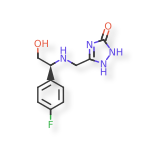
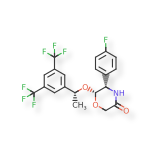
| Related Record | Type | Details | ||
|---|---|---|---|---|
|
IMPURITY -> PARENT |
CHROMATOGRAPHIC PURITY (HPLC/UV)
USP
|
||
|
IMPURITY -> PARENT |
|
||
|
|
IMPURITY -> PARENT |
|
||
|
IMPURITY -> PARENT |
CHROMATOGRAPHIC PURITY (HPLC/UV)
EP
|
||
|
IMPURITY -> PARENT |
CHROMATOGRAPHIC PURITY (HPLC/UV)
USP
|
||
|
IMPURITY -> PARENT |
CHROMATOGRAPHIC PURITY (HPLC/UV)
EP
|
||
|
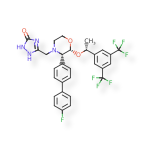
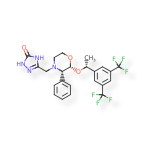
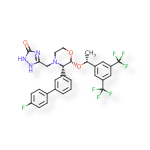
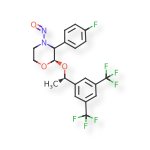
IMPURITY GENOTOXIC->PARENT |
Potentially genotoxic N-nitorso
|
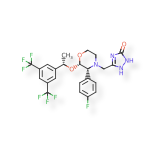
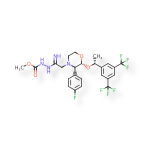
![Structure of (?S)-?-[(R)-(2-Aminoethoxy)[(1R)-1-[3,5-bis(trifluoromethyl)phenyl]ethoxy]methyl]-4-fluorobenzenemethanol](/img/f0b1d17a-844e-4aad-a4c0-4df6b5b6e655.svg "Structure of (?S)-?-[(R)-(2-Aminoethoxy)[(1R)-1-[3,5-bis(trifluoromethyl)phenyl]ethoxy]methyl]-4-fluorobenzenemethanol")
| Related Record | Type | Details | ||
|---|---|---|---|---|
|
ACTIVE MOIETY |
|
| Name | Property Type | Amount | Referenced Substance | Defining | Parameters | References |
|---|---|---|---|---|---|---|
| Volume of Distribution | PHARMACOKINETIC |
|
|
|||
| Tmax | PHARMACOKINETIC |
|
|
|||
| Biological Half-life | PHARMACOKINETIC |
|
|
|||