


Details
| Stereochemistry | ABSOLUTE |
| Molecular Formula | C29H38FN3O3 |
| Molecular Weight | 495.6287 |
| Optical Activity | UNSPECIFIED |
| Defined Stereocenters | 2 / 2 |
| E/Z Centers | 0 |
| Charge | 0 |
SHOW SMILES / InChI
SMILES
COCC(=O)O[C@]3(CCN(C)CCCC1=NC2=C(N1)C=CC=C2)CCC4=C(C=CC(F)=C4)[C@@H]3C(C)C
InChI
InChIKey=HBNPJJILLOYFJU-VMPREFPWSA-N
InChI=1S/C29H38FN3O3/c1-20(2)28-23-12-11-22(30)18-21(23)13-14-29(28,36-27(34)19-35-4)15-17-33(3)16-7-10-26-31-24-8-5-6-9-25(24)32-26/h5-6,8-9,11-12,18,20,28H,7,10,13-17,19H2,1-4H3,(H,31,32)/t28-,29-/m0/s1
| Molecular Formula | C29H38FN3O3 |
| Molecular Weight | 495.6287 |
| Charge | 0 |
| Count |
|
| Stereochemistry | ABSOLUTE |
| Additional Stereochemistry | No |
| Defined Stereocenters | 2 / 2 |
| E/Z Centers | 0 |
| Optical Activity | UNSPECIFIED |
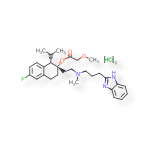
Mibefradil is a calcium channel blocker, chemically unlike other compounds in the class, that was approved by the Food and Drug Administration (FDA), U.S.A. in June 1997 for the treatment of patients with hypertension and chronic stable angina. Shortly following its introduction, mibefradil was withdrawn from the market in the U.S.A. as well as in Europe. The reason for the voluntary withdrawal of the drug by Roche laboratories was claimed to be the result of new information about potentially harmful interactions with other drugs.
Mibefradil is calcium channel blocker with moderate selectivity for T-type Ca2+ channels displaying IC50 values of 2.7 uM and 18.6 uM for T-type and L-type channels respectively. Mibefradil is a tetralol calcium channel blocking agent that inhibits the influx of calcium ions across both the T (low-voltage) and L (high-voltage) calcium channels of cardiac and vascular smooth muscle, with a greater selectivity for T channels. Vasodilation occurs in vascular smooth muscle, causing a decrease in peripheral vascular resistance and a resulting decrease in blood pressure. Mibefradil causes a slight increase in cardiac output during chronic dosing. Mibefradil slows sinus and atrioventricular (AV) node conduction, producing a slight reduction in heart rate and a slight increase in the PR interval. It has also been shown to slightly lengthen the corrected sinus node recovery time and AH interval and to raise the Wenckebach point. The mechanism by which mibefradil reduces angina is not known, but is thought to be attributed to a reduction in heart rate, total peripheral resistance (afterload), and the heart rate-systolic blood pressure product at any given level of exercise. The result of these effects is a decrease in cardiac workload and myocardial oxygen demand. Mibefradil has been repurposed from an abandoned antihypertensive to a targeted solid tumor treatment, and it has been rescued from drug-drug interactions by using short-term dose exposure. Tau is using the early success of mibefradil as a proof of concept to build a platform technology of Cav3 blockers for broad antitumor applications in combination with new targeted cancer therapies, well-established.
CNS Activity
Originator
Approval Year
Targets
| Primary Target | Pharmacology | Condition | Potency |
|---|---|---|---|
Target ID: CHEMBL1859 |
32.0 nM [IC50] | ||
Target ID: CHEMBL4641 |
1.34 µM [IC50] | ||
Target ID: CHEMBL1940 |
202.0 nM [IC50] | ||
Target ID: CHEMBL5558 |
126.0 nM [IC50] |
Conditions
| Condition | Modality | Targets | Highest Phase | Product |
|---|---|---|---|---|
| Primary | Posicor Approved UseTreatment of hypertension, angina pectoris Launch Date1997 |
|||
| Primary | Posicor Approved UseTreatment of hypertension, angina pectoris Launch Date1997 |
|||
| Primary | Unknown Approved UseUnknown |
Cmax
| Value | Dose | Co-administered | Analyte | Population |
|---|---|---|---|---|
115 ng/mL EXPERIMENT https://pubmed.ncbi.nlm.nih.gov/9811158 |
40 mg single, oral dose: 40 mg route of administration: Oral experiment type: SINGLE co-administered: |
MIBEFRADIL plasma | Homo sapiens population: HEALTHY age: ADULT sex: MALE food status: FASTED |
|
61 ng/mL EXPERIMENT https://pubmed.ncbi.nlm.nih.gov/9811158 |
80 mg single, oral dose: 80 mg route of administration: Oral experiment type: SINGLE co-administered: |
MIBEFRADIL plasma | Homo sapiens population: HEALTHY age: ADULT sex: MALE food status: FASTED |
|
495 ng/mL EXPERIMENT https://pubmed.ncbi.nlm.nih.gov/9811158 |
120 mg single, oral dose: 120 mg route of administration: Oral experiment type: SINGLE co-administered: |
MIBEFRADIL plasma | Homo sapiens population: HEALTHY age: ADULT sex: MALE food status: FASTED |
|
777 ng/mL EXPERIMENT https://pubmed.ncbi.nlm.nih.gov/9811158 |
160 mg single, oral dose: 160 mg route of administration: Oral experiment type: SINGLE co-administered: |
MIBEFRADIL plasma | Homo sapiens population: HEALTHY age: ADULT sex: MALE food status: FASTED |
|
718 ng/mL EXPERIMENT https://pubmed.ncbi.nlm.nih.gov/9811158 |
100 mg 1 times / day steady-state, oral dose: 100 mg route of administration: Oral experiment type: STEADY-STATE co-administered: |
MIBEFRADIL plasma | Homo sapiens population: HEALTHY age: ADULT sex: MALE food status: FASTED |
AUC
| Value | Dose | Co-administered | Analyte | Population |
|---|---|---|---|---|
12574 ng × h/mL EXPERIMENT https://pubmed.ncbi.nlm.nih.gov/9811158 |
100 mg 1 times / day steady-state, oral dose: 100 mg route of administration: Oral experiment type: STEADY-STATE co-administered: |
MIBEFRADIL plasma | Homo sapiens population: HEALTHY age: ADULT sex: MALE food status: FASTED |
T1/2
| Value | Dose | Co-administered | Analyte | Population |
|---|---|---|---|---|
9.8 h EXPERIMENT https://pubmed.ncbi.nlm.nih.gov/9811158 |
40 mg single, oral dose: 40 mg route of administration: Oral experiment type: SINGLE co-administered: |
MIBEFRADIL plasma | Homo sapiens population: HEALTHY age: ADULT sex: MALE food status: FASTED |
|
14.9 h EXPERIMENT https://pubmed.ncbi.nlm.nih.gov/9811158 |
80 mg single, oral dose: 80 mg route of administration: Oral experiment type: SINGLE co-administered: |
MIBEFRADIL plasma | Homo sapiens population: HEALTHY age: ADULT sex: MALE food status: FASTED |
|
13.2 h EXPERIMENT https://pubmed.ncbi.nlm.nih.gov/9811158 |
120 mg single, oral dose: 120 mg route of administration: Oral experiment type: SINGLE co-administered: |
MIBEFRADIL plasma | Homo sapiens population: HEALTHY age: ADULT sex: MALE food status: FASTED |
|
17.1 h EXPERIMENT https://pubmed.ncbi.nlm.nih.gov/9811158 |
160 mg single, oral dose: 160 mg route of administration: Oral experiment type: SINGLE co-administered: |
MIBEFRADIL plasma | Homo sapiens population: HEALTHY age: ADULT sex: MALE food status: FASTED |
|
35.4 h EXPERIMENT https://pubmed.ncbi.nlm.nih.gov/9811158 |
100 mg 1 times / day steady-state, oral dose: 100 mg route of administration: Oral experiment type: STEADY-STATE co-administered: |
MIBEFRADIL plasma | Homo sapiens population: HEALTHY age: ADULT sex: MALE food status: FASTED |
Funbound
| Value | Dose | Co-administered | Analyte | Population |
|---|---|---|---|---|
0.5% EXPERIMENT https://pubmed.ncbi.nlm.nih.gov/9811158 |
40 mg single, oral dose: 40 mg route of administration: Oral experiment type: SINGLE co-administered: |
MIBEFRADIL plasma | Homo sapiens population: HEALTHY age: ADULT sex: MALE food status: FASTED |
|
0.5% EXPERIMENT https://pubmed.ncbi.nlm.nih.gov/9811158 |
80 mg single, oral dose: 80 mg route of administration: Oral experiment type: SINGLE co-administered: |
MIBEFRADIL plasma | Homo sapiens population: HEALTHY age: ADULT sex: MALE food status: FASTED |
|
0.5% EXPERIMENT https://pubmed.ncbi.nlm.nih.gov/9811158 |
120 mg single, oral dose: 120 mg route of administration: Oral experiment type: SINGLE co-administered: |
MIBEFRADIL plasma | Homo sapiens population: HEALTHY age: ADULT sex: MALE food status: FASTED |
|
0.5% EXPERIMENT https://pubmed.ncbi.nlm.nih.gov/9811158 |
160 mg single, oral dose: 160 mg route of administration: Oral experiment type: SINGLE co-administered: |
MIBEFRADIL plasma | Homo sapiens population: HEALTHY age: ADULT sex: MALE food status: FASTED |
|
0.5% EXPERIMENT https://pubmed.ncbi.nlm.nih.gov/9811158 |
100 mg 1 times / day steady-state, oral dose: 100 mg route of administration: Oral experiment type: STEADY-STATE co-administered: |
MIBEFRADIL plasma | Homo sapiens population: HEALTHY age: ADULT sex: MALE food status: FASTED |
Doses
| Dose | Population | Adverse events |
|---|---|---|
87.5 mg 4 times / day steady, oral MTD Dose: 87.5 mg, 4 times / day Route: oral Route: steady Dose: 87.5 mg, 4 times / day Sources: |
unhealthy, 19.8 - 80.5 years Health Status: unhealthy Age Group: 19.8 - 80.5 years Sex: M+F Sources: |
DLT: Alanine aminotransferase increased, Aspartate aminotransferase increased... Dose limiting toxicities: Alanine aminotransferase increased (grade 3, 1 patient) Sources: Aspartate aminotransferase increased (grade 3, 1 patient) Sinus bradycardia (grade 1, 1 patient) |
AEs
| AE | Significance | Dose | Population |
|---|---|---|---|
| Sinus bradycardia | grade 1, 1 patient DLT, Disc. AE |
87.5 mg 4 times / day steady, oral MTD Dose: 87.5 mg, 4 times / day Route: oral Route: steady Dose: 87.5 mg, 4 times / day Sources: |
unhealthy, 19.8 - 80.5 years Health Status: unhealthy Age Group: 19.8 - 80.5 years Sex: M+F Sources: |
| Alanine aminotransferase increased | grade 3, 1 patient DLT, Disc. AE |
87.5 mg 4 times / day steady, oral MTD Dose: 87.5 mg, 4 times / day Route: oral Route: steady Dose: 87.5 mg, 4 times / day Sources: |
unhealthy, 19.8 - 80.5 years Health Status: unhealthy Age Group: 19.8 - 80.5 years Sex: M+F Sources: |
| Aspartate aminotransferase increased | grade 3, 1 patient DLT, Disc. AE |
87.5 mg 4 times / day steady, oral MTD Dose: 87.5 mg, 4 times / day Route: oral Route: steady Dose: 87.5 mg, 4 times / day Sources: |
unhealthy, 19.8 - 80.5 years Health Status: unhealthy Age Group: 19.8 - 80.5 years Sex: M+F Sources: |
Overview
| CYP3A4 | CYP2C9 | CYP2D6 | hERG |
|---|---|---|---|
OverviewOther
| Other Inhibitor | Other Substrate | Other Inducer |
|---|---|---|
Drug as perpetrator
| Target | Modality | Activity | Metabolite | Clinical evidence |
|---|---|---|---|---|
| no | ||||
| yes [IC50 0.8 uM] | yes (co-administration study) Comment: Coadministration of mibefradil increased the Cmax of midazolam 3-fold, the AUC 8- to 9-fold, and the t1/2 4-fold |
|||
| yes [IC50 1.6 uM] | ||||
| yes | ||||
| yes |
Drug as victim
| Target | Modality | Activity | Metabolite | Clinical evidence |
|---|---|---|---|---|
| yes |
Tox targets
| Target | Modality | Activity | Metabolite | Clinical evidence |
|---|---|---|---|---|
PubMed
| Title | Date | PubMed |
|---|---|---|
| T-type calcium channels in the regulation of afferent and efferent arterioles in rats. | 2004-02 |
|
| The sources and sequestration of Ca(2+) contributing to neuroeffector Ca(2+) transients in the mouse vas deferens. | 2003-12-01 |
|
| Cellular mechanism for mibefradil-induced vasodilation of renal microcirculation: studies in the isolated perfused hydronephrotic kidney. | 2003-12 |
|
| Effects of imatinib mesylate (STI571, Glivec) on the pharmacokinetics of simvastatin, a cytochrome p450 3A4 substrate, in patients with chronic myeloid leukaemia. | 2003-11-17 |
|
| The influence of calcium channel antagonists on isolated human distal radial arteries. | 2003-11 |
|
| Mechanism of active repolarization of inhibitory junction potential in murine colon. | 2003-11 |
|
| Thalamic control of visceral nociception mediated by T-type Ca2+ channels. | 2003-10-03 |
|
| Effect of mibefradil on CYP3A4 in vivo. | 2003-10 |
|
| Reversal of experimental neuropathic pain by T-type calcium channel blockers. | 2003-09 |
|
| Cav3.1 (alpha1G) T-type Ca2+ channels mediate vaso-occlusion of sickled erythrocytes in lung microcirculation. | 2003-08-22 |
|
| Mechanisms of lateral inhibition in the olfactory bulb: efficiency and modulation of spike-evoked calcium influx into granule cells. | 2003-08-20 |
|
| Spontaneous regenerative activity in mammalian retinal bipolar cells: roles of multiple subtypes of voltage-dependent Ca2+ channels. | 2003-08-15 |
|
| TGFbeta1 signaling via alphaVbeta6 integrin. | 2003-08-07 |
|
| Mibefradil: "Has the baby been thrown out with the bath water?". | 2003-07 |
|
| Effects of first and second generation calcium channel blockers on diastolic function of the failing hamster heart: relationship with coronary flow changes. | 2003-07 |
|
| A T-type calcium channel required for normal function of a mammalian mechanoreceptor. | 2003-07 |
|
| New target molecules in the drug control of blood pressure and circulation. | 2003-03 |
|
| Detection of proarrhythmia in the female rabbit heart: blinded validation. | 2003-03 |
|
| Loss of T-type calcium current in sensory neurons of rats with neuropathic pain. | 2003-01 |
|
| Regulation of ANP secretion by cardiac Na+/Ca2+ exchanger using a new controlled atrial model. | 2003-01 |
|
| Influence of R-type (Cav2.3) and t-type (Cav3.1-3.3) antagonists on nigral somatodendritic dopamine release measured by microdialysis. | 2003 |
|
| An ACTH- and ATP-regulated background K+ channel in adrenocortical cells is TREK-1. | 2002-12-20 |
|
| Selectivity of different calcium antagonists on T- and L-type calcium currents in guinea-pig ventricular myocytes. | 2002-12 |
|
| Different effects of mibefradil and amlodipine on coronary vessels and during beta-adrenergic stimulation in conscious dogs. | 2002-12 |
|
| Role of T-type calcium channels in myogenic tone of skeletal muscle resistance arteries. | 2002-12 |
|
| Effects of mibefradil on uterine contractility. | 2002-11-22 |
|
| Involvement of T-type calcium channels in the mechanism of action of 5-HT in rat glomerulosa cells: a novel signaling pathway for the 5-HT7 receptor. | 2002-11 |
|
| beta-Subunits: fine tuning of Ca(2+) channel block. | 2002-11 |
|
| Involvement of T-type calcium channels in excitatory junction potentials in rat resistance mesenteric arteries. | 2002-11 |
|
| Ca2+ entry via P/Q-type Ca2+ channels and the Na+/Ca2+ exchanger in rat and human neocortical synaptosomes. | 2002-11 |
|
| Calcium channel blockade limits transcriptional, translational and functional up-regulation of the cardiac calpain system after myocardial infarction. | 2002-10-18 |
|
| Mechanical and thermal antinociception in rats following systemic administration of mibefradil, a T-type calcium channel blocker. | 2002-10-04 |
|
| Blood pressure response to antihypertensive agents related to baseline blood pressure. | 2002-10 |
|
| Modulation by mibefradil of the histamine-induced Ca2+ entry in human aortic endothelial cells. | 2002-10 |
|
| T-channel-like pharmacological properties of high voltage-activated, nifedipine-insensitive Ca2+ currents in the rat terminal mesenteric artery. | 2002-10 |
|
| Differential involvement of Ca(2+) channels in survival and neurite outgrowth of cultured embryonic cockroach brain neurons. | 2002-09 |
|
| Evidence that action potential generation is not the exclusive determinant to trigger spontaneous myogenic contraction of guinea-pig urinary bladder smooth muscle. | 2002-09 |
|
| Local electric stimulation causes conducted calcium response in rat interlobular arteries. | 2002-09 |
|
| Neuronal T-type alpha 1H calcium channels induce neuritogenesis and expression of high-voltage-activated calcium channels in the NG108-15 cell line. | 2002-08-15 |
|
| Fractal pharmacokinetics of the drug mibefradil in the liver. | 2002-08 |
|
| The Ca(2+) channel antagonists mibefradil and pimozide inhibit cell growth via different cytotoxic mechanisms. | 2002-08 |
|
| Randomized comparison of T-type versus L-type calcium-channel blockade on exercise duration in stable angina: results of the Posicor Reduction of Ischemia During Exercise (PRIDE) trial. | 2002-07 |
|
| Selective L-type, T-type, and nonspecific calcium-channel blockers for stable angina pectoris. | 2002-07 |
|
| T-Type calcium channel alpha1G and alpha1H subunits in human retinoblastoma cells and their loss after differentiation. | 2002-07 |
|
| The role of T-type calcium channels in morphine analgesia, development of antinociceptive tolerance and dependence to morphine, and morphine abstinence syndrome. | 2002-06-28 |
|
| Voltage-dependent inward currents of interstitial cells of Cajal from murine colon and small intestine. | 2002-06-15 |
|
| A post-marketing observational study to assess the safety of mibefradil in the community in England. | 2002-06 |
|
| Impaired mechanisms of leukocyte adhesion in vitro by the calcium channel antagonist mibefradil. | 2002-05 |
|
| Impaired mechanisms of leukocyte adhesion in vitro by the calcium channel antagonist mibefradil. | 2002-05 |
|
| Emerging role of drug interaction studies in drug development: the good, the bad, and the unknown. | 2001 |
Patents
| Substance Class |
Chemical
Created
by
admin
on
Edited
Mon Mar 31 18:25:35 GMT 2025
by
admin
on
Mon Mar 31 18:25:35 GMT 2025
|
| Record UNII |
27B90X776A
|
| Record Status |
Validated (UNII)
|
| Record Version |
|
-
Download
| Name | Type | Language | ||
|---|---|---|---|---|
|
Preferred Name | English | ||
|
Official Name | English | ||
|
Common Name | English | ||
|
Common Name | English | ||
|
Common Name | English | ||
|
Common Name | English | ||
|
Systematic Name | English |
| Classification Tree | Code System | Code | ||
|---|---|---|---|---|
|
FDA ORPHAN DRUG |
224806
Created by
admin on Mon Mar 31 18:25:35 GMT 2025 , Edited by admin on Mon Mar 31 18:25:35 GMT 2025
|
||
|
FDA ORPHAN DRUG |
289209
Created by
admin on Mon Mar 31 18:25:35 GMT 2025 , Edited by admin on Mon Mar 31 18:25:35 GMT 2025
|
||
|
FDA ORPHAN DRUG |
268608
Created by
admin on Mon Mar 31 18:25:35 GMT 2025 , Edited by admin on Mon Mar 31 18:25:35 GMT 2025
|
||
|
WHO-ATC |
C08CX01
Created by
admin on Mon Mar 31 18:25:35 GMT 2025 , Edited by admin on Mon Mar 31 18:25:35 GMT 2025
|
||
|
NCI_THESAURUS |
C333
Created by
admin on Mon Mar 31 18:25:35 GMT 2025 , Edited by admin on Mon Mar 31 18:25:35 GMT 2025
|
||
|
WHO-VATC |
QC08CX01
Created by
admin on Mon Mar 31 18:25:35 GMT 2025 , Edited by admin on Mon Mar 31 18:25:35 GMT 2025
|
||
|
CFR |
21 CFR 216.24
Created by
admin on Mon Mar 31 18:25:35 GMT 2025 , Edited by admin on Mon Mar 31 18:25:35 GMT 2025
|
| Code System | Code | Type | Description | ||
|---|---|---|---|---|---|
|
SUB08940MIG
Created by
admin on Mon Mar 31 18:25:35 GMT 2025 , Edited by admin on Mon Mar 31 18:25:35 GMT 2025
|
PRIMARY | |||
|
1797
Created by
admin on Mon Mar 31 18:25:35 GMT 2025 , Edited by admin on Mon Mar 31 18:25:35 GMT 2025
|
PRIMARY | |||
|
DB01388
Created by
admin on Mon Mar 31 18:25:35 GMT 2025 , Edited by admin on Mon Mar 31 18:25:35 GMT 2025
|
PRIMARY | |||
|
D020748
Created by
admin on Mon Mar 31 18:25:35 GMT 2025 , Edited by admin on Mon Mar 31 18:25:35 GMT 2025
|
PRIMARY | |||
|
m7522
Created by
admin on Mon Mar 31 18:25:35 GMT 2025 , Edited by admin on Mon Mar 31 18:25:35 GMT 2025
|
PRIMARY | Merck Index | ||
|
83213
Created by
admin on Mon Mar 31 18:25:35 GMT 2025 , Edited by admin on Mon Mar 31 18:25:35 GMT 2025
|
PRIMARY | RxNorm | ||
|
27B90X776A
Created by
admin on Mon Mar 31 18:25:35 GMT 2025 , Edited by admin on Mon Mar 31 18:25:35 GMT 2025
|
PRIMARY | |||
|
100000081164
Created by
admin on Mon Mar 31 18:25:35 GMT 2025 , Edited by admin on Mon Mar 31 18:25:35 GMT 2025
|
PRIMARY | |||
|
2522
Created by
admin on Mon Mar 31 18:25:35 GMT 2025 , Edited by admin on Mon Mar 31 18:25:35 GMT 2025
|
PRIMARY | |||
|
116644-53-2
Created by
admin on Mon Mar 31 18:25:35 GMT 2025 , Edited by admin on Mon Mar 31 18:25:35 GMT 2025
|
PRIMARY | |||
|
60663
Created by
admin on Mon Mar 31 18:25:35 GMT 2025 , Edited by admin on Mon Mar 31 18:25:35 GMT 2025
|
PRIMARY | |||
|
DTXSID1023318
Created by
admin on Mon Mar 31 18:25:35 GMT 2025 , Edited by admin on Mon Mar 31 18:25:35 GMT 2025
|
PRIMARY | |||
|
7134
Created by
admin on Mon Mar 31 18:25:35 GMT 2025 , Edited by admin on Mon Mar 31 18:25:35 GMT 2025
|
PRIMARY | |||
|
CHEMBL45816
Created by
admin on Mon Mar 31 18:25:35 GMT 2025 , Edited by admin on Mon Mar 31 18:25:35 GMT 2025
|
PRIMARY | |||
|
C87686
Created by
admin on Mon Mar 31 18:25:35 GMT 2025 , Edited by admin on Mon Mar 31 18:25:35 GMT 2025
|
PRIMARY | |||
|
MIBEFRADIL
Created by
admin on Mon Mar 31 18:25:35 GMT 2025 , Edited by admin on Mon Mar 31 18:25:35 GMT 2025
|
PRIMARY |
| Related Record | Type | Details | ||
|---|---|---|---|---|
|
|
TARGET->WEAK INHIBITOR |
Ba2+ as the charge carrier
IC50
|
||
|
TARGET -> INHIBITOR |
Ba2+ as the charge carrier
IC50
|
||
|
|
SALT/SOLVATE -> PARENT |
|

| Related Record | Type | Details | ||
|---|---|---|---|---|
|
|
ACTIVE MOIETY |
Using Ba2+ as the charge carrier have predicted a 10- to 15-fold preference of mibefradil for T channels over L channels. However, T channel IC50values are reported to be ?1 ?M, which is much higher than expected for clinical efficacy because relevant blood levels of this drug are ?50 nM.
|
