


Details
| Stereochemistry | ABSOLUTE |
| Molecular Formula | C9H13NO3.C4H6O6 |
| Molecular Weight | 333.2913 |
| Optical Activity | ( - ) |
| Defined Stereocenters | 3 / 3 |
| E/Z Centers | 0 |
| Charge | 0 |
SHOW SMILES / InChI
SMILES
O[C@H]([C@@H](O)C(O)=O)C(O)=O.CNC[C@H](O)C1=CC=C(O)C(O)=C1
InChI
InChIKey=YLXIPWWIOISBDD-NDAAPVSOSA-N
InChI=1S/C9H13NO3.C4H6O6/c1-10-5-9(13)6-2-3-7(11)8(12)4-6;5-1(3(7)8)2(6)4(9)10/h2-4,9-13H,5H2,1H3;1-2,5-6H,(H,7,8)(H,9,10)/t9-;1-,2-/m01/s1
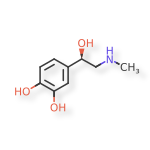
| Molecular Formula | C9H13NO3 |
| Molecular Weight | 183.2044 |
| Charge | 0 |
| Count |
|
| Stereochemistry | ABSOLUTE |
| Additional Stereochemistry | No |
| Defined Stereocenters | 1 / 1 |
| E/Z Centers | 0 |
| Optical Activity | UNSPECIFIED |
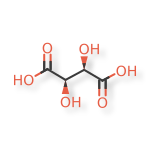
| Molecular Formula | C4H6O6 |
| Molecular Weight | 150.0868 |
| Charge | 0 |
| Count |
|
| Stereochemistry | ABSOLUTE |
| Additional Stereochemistry | No |
| Defined Stereocenters | 2 / 2 |
| E/Z Centers | 0 |
| Optical Activity | UNSPECIFIED |
Epinephrine is a sympathomimetic catecholamine. It acts as a naturally occurring agonist at both alpha and beta-adrenergic receptors. Three pharmacologic types have been identified: alpha 1-, alpha 2-, and beta-adrenergic receptors. Each of these has three subtypes, characterized by both structural and functional differences. The alpha 2 and beta receptors are coupled negatively and positively, respectively, to adenylyl cyclase via Gi or Gs regulatory proteins, and the alpha 1 receptors modulate phospholipase C via the Go protein. Subtype expression is regulated at the level of the gene, the mRNA, and the protein through various transcriptional and postsynthetic mechanisms. Through its action on alpha-adrenergic receptors, epinephrine lessens the vasodilation and increased vascular permeability that occurs during anaphylaxis, which can lead to loss of intravascular fluid volume and hypotension. Through its action on beta-adrenergic receptors, epinephrine causes bronchial smooth muscle relaxation and helps alleviate bronchospasm, wheezing and dyspnea that may occur during anaphylaxis. Epinephrine also alleviates pruritus, urticaria, and angioedema and may relieve gastrointestinal and genitourinary symptoms associated with anaphylaxis because of its relaxer effects on the smooth muscle of the stomach, intestine, uterus and urinary bladder.
Epinephrine increases glycogenolysis, reduces glucose up take by tissues, and inhibits insulin release in the pancreas, resulting in hyperglycemia and increased blood lactic acid.
Originator
Curator's Comment: Characterized some of the physical and biochemical properties of adrenal extract and laid the platform for purification of the active substance which was first achieved by John Abel in 1899 at Johns Hopkins University, Baltimore and independently by the Japanese scientist Jokichi Takamine in his own laboratory in New York City with the sponsorship of Parke-Davis & Co., and Thomas Aldrich (Parke-Davis & Co., Detroit, Michigan).
Approval Year
Targets
| Primary Target | Pharmacology | Condition | Potency |
|---|---|---|---|
Target ID: CHEMBL2331074 |
|||
Target ID: CHEMBL219 |
33.0 nM [Ki] |
Conditions
| Condition | Modality | Targets | Highest Phase | Product |
|---|---|---|---|---|
| Primary | ADRENALIN Approved UseAdrenalin® is a non-selective alpha and beta adrenergic agonist indicated for:
Emergency treatment of allergic reactions (Type 1), including anaphylaxis
Induction and maintenance of mydriasis during intraocular surgery |
|||
| Preventing | ADRENALIN Approved UseAdrenalin® is a non-selective alpha and beta adrenergic agonist indicated for:
Emergency treatment of allergic reactions (Type 1), including anaphylaxis
Induction and maintenance of mydriasis during intraocular surgery |
Cmax
| Value | Dose | Co-administered | Analyte | Population |
|---|---|---|---|---|
0.486 ng/mL |
0.3 mg single, intramuscular dose: 0.3 mg route of administration: Intramuscular experiment type: SINGLE co-administered: |
EPINEPHRINE plasma | Homo sapiens population: HEALTHY age: ADULT sex: FEMALE / MALE food status: UNKNOWN |
|
309 pg/mL EXPERIMENT https://www.ncbi.nlm.nih.gov/pubmed/26994624 |
0.3 mg single, intramuscular dose: 0.3 mg route of administration: Intramuscular experiment type: SINGLE co-administered: |
EPINEPHRINE plasma | Homo sapiens population: HEALTHY age: ADULT sex: FEMALE / MALE food status: UNKNOWN |
|
386 pg/mL EXPERIMENT https://www.ncbi.nlm.nih.gov/pubmed/26994624 |
5 mg multiple, nasal dose: 5 mg route of administration: Nasal experiment type: MULTIPLE co-administered: |
EPINEPHRINE plasma | Homo sapiens population: HEALTHY age: ADULT sex: FEMALE / MALE food status: UNKNOWN |
AUC
| Value | Dose | Co-administered | Analyte | Population |
|---|---|---|---|---|
0.724 ng × h/mL |
0.3 mg single, intramuscular dose: 0.3 mg route of administration: Intramuscular experiment type: SINGLE co-administered: |
EPINEPHRINE plasma | Homo sapiens population: HEALTHY age: ADULT sex: FEMALE / MALE food status: UNKNOWN |
|
18.3 ng × min/mL EXPERIMENT https://www.ncbi.nlm.nih.gov/pubmed/26994624 |
0.3 mg single, intramuscular dose: 0.3 mg route of administration: Intramuscular experiment type: SINGLE co-administered: |
EPINEPHRINE plasma | Homo sapiens population: HEALTHY age: ADULT sex: FEMALE / MALE food status: UNKNOWN |
|
19.4 ng × min/mL EXPERIMENT https://www.ncbi.nlm.nih.gov/pubmed/26994624 |
5 mg multiple, nasal dose: 5 mg route of administration: Nasal experiment type: MULTIPLE co-administered: |
EPINEPHRINE plasma | Homo sapiens population: HEALTHY age: ADULT sex: FEMALE / MALE food status: UNKNOWN |
Doses
| Dose | Population | Adverse events |
|---|---|---|
0.3 mg 1 times / day single, intramuscular Recommended Dose: 0.3 mg, 1 times / day Route: intramuscular Route: single Dose: 0.3 mg, 1 times / day Sources: |
healthy, 18 to 45 years old Health Status: healthy Age Group: 18 to 45 years old Sex: M+F Sources: |
Disc. AE: Ventricular extrasystoles... AEs leading to discontinuation/dose reduction: Ventricular extrasystoles (grade 1, 1.5%) Sources: |
AEs
| AE | Significance | Dose | Population |
|---|---|---|---|
| Ventricular extrasystoles | grade 1, 1.5% Disc. AE |
0.3 mg 1 times / day single, intramuscular Recommended Dose: 0.3 mg, 1 times / day Route: intramuscular Route: single Dose: 0.3 mg, 1 times / day Sources: |
healthy, 18 to 45 years old Health Status: healthy Age Group: 18 to 45 years old Sex: M+F Sources: |
Overview
| CYP3A4 | CYP2C9 | CYP2D6 | hERG |
|---|---|---|---|
Drug as perpetrator
| Target | Modality | Activity | Metabolite | Clinical evidence |
|---|---|---|---|---|
Page: 2.0 |
yes [Ki 156 uM] | |||
Page: 2.0 |
yes [Ki 42.3 uM] | |||
Page: 2.0 |
yes [Ki 707 uM] | |||
| yes | ||||
| yes | ||||
| yes |
Drug as victim
| Target | Modality | Activity | Metabolite | Clinical evidence |
|---|---|---|---|---|
| yes | ||||
| yes |
PubMed
| Title | Date | PubMed |
|---|---|---|
| Adenosine diphosphate strongly potentiates the ability of the chemokines MDC, TARC, and SDF-1 to stimulate platelet function. | 2001-02-15 |
|
| Daily cost of ophthalmic solutions for treating glaucoma in Japan. | 2001-02-13 |
|
| Key role of the P2Y(1) receptor in tissue factor-induced thrombin-dependent acute thromboembolism: studies in P2Y(1)-knockout mice and mice treated with a P2Y(1) antagonist. | 2001-02-06 |
|
| Changes in the derived central pressure waveform and pulse pressure in response to angiotensin II and noradrenaline in man. | 2001-02-01 |
|
| Circulatory support of the sick preterm infant. | 2001-02 |
|
| Molecular mechanisms controlling the rate and specificity of catechol O-methylation by human soluble catechol O-methyltransferase. | 2001-02 |
|
| Partial agonist clonidine mediates alpha(2)-AR subtypes specific regulation of cAMP accumulation in adenylyl cyclase II transfected DDT1-MF2 cells. | 2001-02 |
|
| The effects of epidural block on the distribution of lymphocyte subsets and natural-killer cell activity in patients with and without pain. | 2001-02 |
|
| Plasma melatonin concentration before and during testosterone replacement in Klinefelter's syndrome: relation to hepatic indolamine metabolism and sympathoadrenal activity. | 2001-02 |
|
| [(123)I]metaiodobenzylguanidine and [(111)In]octreotide uptake in begnign and malignant pheochromocytomas. | 2001-02 |
|
| Oral glucose augments the counterregulatory hormone response during insulin-induced hypoglycemia in humans. | 2001-02 |
|
| Troglitazone amplifies counterregulatory responses to hypoglycemia in nondiabetic subjects. | 2001-02 |
|
| Hyperinsulinemia and autonomic nervous system dysfunction in obesity: effects of weight loss. | 2001-01-30 |
|
| Embryonic epinephrine synthesis in the rat heart before innervation: association with pacemaking and conduction tissue development. | 2001-01-19 |
|
| Catecholamine inotropes as growth factors for Staphylococcus epidermidis and other coagulase-negative staphylococci. | 2001-01-15 |
|
| Epinephrine upregulates superoxide dismutase in human coronary artery endothelial cells. | 2001-01-15 |
|
| Effect of amlodipine on cardiopulmonary performance in volunteers. | 2001-01-12 |
|
| The role of nitric oxide in bradycardia of rats with obstructive cholestasis. | 2001-01-05 |
|
| Development of glaucoma after phacoemulsification for removal of cataracts in dogs: 22 cases (1987-1997). | 2001-01-01 |
|
| Synthesis and characterization of an immobilized phenylethanolamine N-methyltransferase liquid chromatographic stationary phase. | 2001-01-01 |
|
| Early neurohormonal effects of trandolapril in patients with left ventricular dysfunction and a recent acute myocardial infarction: a double-blind, randomized, placebo-controlled multicentre study. | 2001-01 |
|
| Alterations in myocardial creatinine kinase (CK) and lactate dehydrogenase (LDH) isoenzyme-distribution in a model of left ventricular dysfunction. | 2001-01 |
|
| Influence of ABO blood groups on primary hemostasis. | 2001-01 |
|
| Relationships between lipolysis induced by various lipolytic agents and hormone-sensitive lipase in rat fat cells. | 2001-01 |
|
| Contrasting clinical properties and exercise responses in obese and lean hypertensive patients. | 2001-01 |
|
| Guanabenz, an antihypertensive centrally acting alpha2-agonist, suppresses morning elevations in aggregation of human platelets. | 2001-01 |
|
| Regulation of endothelin-1 production in cultured rat vascular smooth muscle cells. | 2001-01 |
|
| Plasma concentrations and pharmacokinetics of bupivacaine with and without adrenaline following caudal anaesthesia in infants. | 2001-01 |
|
| The PlA polymorphism of glycoprotein IIIa functions as a modifier for the effect of estrogen on platelet aggregation. | 2001-01 |
|
| Reversal of Haemorrhagic Shock in Rats by Tetrahydroaminoacridine. | 2001-01 |
|
| Hormonal responses to exercise in chronic fatigue syndrome. | 2001-01 |
|
| Genitourinary injuries in the newborn. | 2001-01 |
|
| Fatalities due to anaphylactic reactions to foods. | 2001-01 |
|
| Viral croup. | 2001-01 |
|
| Effects of high extracellular [K+] and adrenaline on force development, relaxation and membrane potential in cardiac muscle from freshwater turtle and rainbow trout. | 2001-01 |
|
| Effects of human pregnancy on cardiac autonomic function above and below the ventilatory threshold. | 2001-01 |
|
| Catecholamine responses to alpha-adrenergic blockade during exercise in women acutely exposed to altitude. | 2001-01 |
|
| Adrenergic receptor activated ion transport in human fetal retinal pigment epithelium. | 2001-01 |
|
| Clonidine combined with a long acting local anesthetic does not prolong postoperative analgesia after brachial plexus block but does induce hemodynamic changes. | 2001-01 |
|
| Dexamethasone facilitates discharge after outpatient anorectal surgery. | 2001-01 |
|
| Cardiac resuscitation after incremental overdosage with lidocaine, bupivacaine, levobupivacaine, and ropivacaine in anesthetized dogs. | 2001-01 |
|
| Neurotransmitter release from bovine adrenal chromaffin cells is modulated by capacitative Ca(2+)entry driven by depleted internal Ca(2+)stores. | 2001-01 |
|
| Neonatal catecholamine levels and neurodevelopmental outcome: a cohort study. | 2001-01 |
|
| Hypoxic vasoconstriction of cyclostome systemic vessels: the antecedent of hypoxic pulmonary vasoconstriction? | 2001-01 |
|
| A single bout of exercise induces beta-adrenergic desensitization in human adipose tissue. | 2001-01 |
|
| An accidental ringblock of the great toe? | 2001-01 |
|
| Chromaffin-adrenocortical cell interactions: effects of chromaffin cell activation in adrenal cell cocultures. | 2001-01 |
|
| Central retinal artery occlusion after a local anesthetic with adrenaline on nasal mucosa. | 2000-12 |
|
| Effects of ubiquinone-10 on energy metabolism and lipid peroxidation in rats with myocardial ischemia. | 2000-07 |
|
| [Experimental anti-arrhythmic effects of a new beta-adrenergic receptor blocking agent, dl-l-(tert. butylamino)-3-[(2-propinyloxy)phenoxy]2-propanol hydrochloride (dl Kö 1400-Cl)]. | 1976-07 |
Patents
Sample Use Guides
Anaphylaxis:
o Adults and Children 30 kg (66 lbs) or more: 0.3 to 0.5 mg (0.3 to 0.5 mL) intramuscularly or subcutaneously into anterolateral aspect of the thigh every 5 to 10 minutes as necessary
o Children 30 kg (66 lbs) or less: 0.01 mg/kg (0.01 mL/kg), up to 0.3 mg (0.3 mL), intramuscularly or subcutaneously into anterolateral aspect of the thigh every 5 to 10 minutes as necessary (2.1)
Intraocular surgery: Dilute 1 mL with 100 to 1000 mL of an ophthalmic irrigation fluid, for ophthalmic irrigation or intracameral injection
Route of Administration:
Other
Treatment of primary human hepatocytes with 10μM epinephrine for 24h repressed mRNA expression of various transporters, such as the sinusoidal influx transporters NTCP, OATP1B1, OATP2B1, OAT2, OAT7 and OCT1 and the efflux transporters MRP2, MRP3 and BSEP, whereas it induced that of MDR1, but failed to alter that of BCRP.
| Substance Class |
Chemical
Created
by
admin
on
Edited
Mon Mar 31 17:49:15 GMT 2025
by
admin
on
Mon Mar 31 17:49:15 GMT 2025
|
| Record UNII |
30Q7KI53AK
|
| Record Status |
Validated (UNII)
|
| Record Version |
|
-
Download
| Name | Type | Language | ||
|---|---|---|---|---|
|
Common Name | English | ||
|
Preferred Name | English | ||
|
Common Name | English | ||
|
Common Name | English | ||
|
Common Name | English | ||
|
Common Name | English | ||
|
Common Name | English | ||
|
Common Name | English | ||
|
Common Name | English | ||
|
Brand Name | English | ||
|
Common Name | English | ||
|
Common Name | English | ||
|
Common Name | English | ||
|
Common Name | English | ||
|
Code | English | ||
|
Common Name | English | ||
|
Systematic Name | English | ||
|
Common Name | English | ||
|
Common Name | English | ||
|
Brand Name | English | ||
|
Common Name | English | ||
|
Common Name | English | ||
|
Common Name | English | ||
|
Common Name | English | ||
|
Common Name | English |
| Classification Tree | Code System | Code | ||
|---|---|---|---|---|
|
CFR |
21 CFR 341.16
Created by
admin on Mon Mar 31 17:49:15 GMT 2025 , Edited by admin on Mon Mar 31 17:49:15 GMT 2025
|
||
|
NCI_THESAURUS |
C87053
Created by
admin on Mon Mar 31 17:49:15 GMT 2025 , Edited by admin on Mon Mar 31 17:49:15 GMT 2025
|
| Code System | Code | Type | Description | ||
|---|---|---|---|---|---|
|
756755
Created by
admin on Mon Mar 31 17:49:15 GMT 2025 , Edited by admin on Mon Mar 31 17:49:15 GMT 2025
|
PRIMARY | |||
|
m4944
Created by
admin on Mon Mar 31 17:49:15 GMT 2025 , Edited by admin on Mon Mar 31 17:49:15 GMT 2025
|
PRIMARY | Merck Index | ||
|
EPINEPHRINE BITARTRATE
Created by
admin on Mon Mar 31 17:49:15 GMT 2025 , Edited by admin on Mon Mar 31 17:49:15 GMT 2025
|
PRIMARY | Other name: Adrenalin tartrate. (In certain countries the name Adrenalin is a trademark: In those countries this name may beused only when applied to the product issued by the owners of the trademark.)Description: A white to greyish white, crystalline powder; odourless.Solubility: Soluble in 3 parts of water; slightly soluble in ethanol (~750 g/l) TS; practically insoluble in ether R.Category. Sympathomimetic.Storage: Epinephrine hydrogen tartrate should be kept in a tightly closed container, protected from light.Additional information: Epinephrine hydrogen tartrate gradually darkens in colour on exposure to air and light. Even in theabsence of light, Epinephrine hydrogen tartrate is gradually degraded on exposure to a humid atmosphere, the decompositionbeing faster at higher temperatures.Definition: Epinephrine hydrogen tartrate contains not less than 98.0% and not more than 101.0% of C9H13NO3,C4H6O6,calculated with reference to the dried substance. | ||
|
200-097-1
Created by
admin on Mon Mar 31 17:49:15 GMT 2025 , Edited by admin on Mon Mar 31 17:49:15 GMT 2025
|
PRIMARY | |||
|
DBSALT000788
Created by
admin on Mon Mar 31 17:49:15 GMT 2025 , Edited by admin on Mon Mar 31 17:49:15 GMT 2025
|
PRIMARY | |||
|
30Q7KI53AK
Created by
admin on Mon Mar 31 17:49:15 GMT 2025 , Edited by admin on Mon Mar 31 17:49:15 GMT 2025
|
PRIMARY | |||
|
51-42-3
Created by
admin on Mon Mar 31 17:49:15 GMT 2025 , Edited by admin on Mon Mar 31 17:49:15 GMT 2025
|
PRIMARY | |||
|
SUB01911MIG
Created by
admin on Mon Mar 31 17:49:15 GMT 2025 , Edited by admin on Mon Mar 31 17:49:15 GMT 2025
|
PRIMARY | |||
|
203180
Created by
admin on Mon Mar 31 17:49:15 GMT 2025 , Edited by admin on Mon Mar 31 17:49:15 GMT 2025
|
PRIMARY | RxNorm | ||
|
100000087265
Created by
admin on Mon Mar 31 17:49:15 GMT 2025 , Edited by admin on Mon Mar 31 17:49:15 GMT 2025
|
PRIMARY | |||
|
SUB72751
Created by
admin on Mon Mar 31 17:49:15 GMT 2025 , Edited by admin on Mon Mar 31 17:49:15 GMT 2025
|
PRIMARY | |||
|
DTXSID3049415
Created by
admin on Mon Mar 31 17:49:15 GMT 2025 , Edited by admin on Mon Mar 31 17:49:15 GMT 2025
|
PRIMARY | |||
|
1237000
Created by
admin on Mon Mar 31 17:49:15 GMT 2025 , Edited by admin on Mon Mar 31 17:49:15 GMT 2025
|
PRIMARY | |||
|
CHEMBL679
Created by
admin on Mon Mar 31 17:49:15 GMT 2025 , Edited by admin on Mon Mar 31 17:49:15 GMT 2025
|
PRIMARY | |||
|
30Q7KI53AK
Created by
admin on Mon Mar 31 17:49:15 GMT 2025 , Edited by admin on Mon Mar 31 17:49:15 GMT 2025
|
PRIMARY | |||
|
C48021
Created by
admin on Mon Mar 31 17:49:15 GMT 2025 , Edited by admin on Mon Mar 31 17:49:15 GMT 2025
|
PRIMARY | |||
|
5815
Created by
admin on Mon Mar 31 17:49:15 GMT 2025 , Edited by admin on Mon Mar 31 17:49:15 GMT 2025
|
PRIMARY |
| Related Record | Type | Details | ||
|---|---|---|---|---|
|
|
PARENT -> SALT/SOLVATE |
|
||
|
|
PARENT -> SALT/SOLVATE |
|
| Related Record | Type | Details | ||
|---|---|---|---|---|
|
IMPURITY -> PARENT |
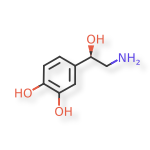
|
||
|
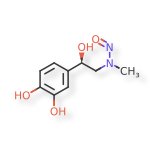
IMPURITY -> PARENT |
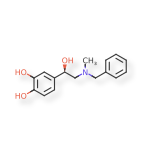
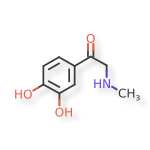
correction factors: for the calculation of content, multiply the peak areas of the following impurities by the corresponding correction factor: impurity D = 0.7; impurity E = 0.6
CHROMATOGRAPHIC PURITY (HPLC/UV)
EP
|
||
|
IMPURITY -> PARENT |
CHROMATOGRAPHIC PURITY (HPLC/UV)
EP
|
||
|
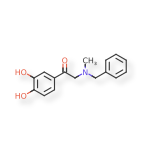
IMPURITY -> PARENT |
correction factors: for the calculation of content, multiply the peak areas of the following impurities by the corresponding correction factor: impurity D = 0.7; impurity E = 0.6
CHROMATOGRAPHIC PURITY (HPLC/UV)
EP
|
||
|
IMPURITY -> PARENT |
CHROMATOGRAPHIC PURITY (HPLC/UV)
EP
|
| Related Record | Type | Details | ||
|---|---|---|---|---|
|
|
ACTIVE MOIETY |
|