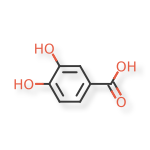
Details
| Stereochemistry | ACHIRAL |
| Molecular Formula | C7H6O4 |
| Molecular Weight | 154.1201 |
| Optical Activity | NONE |
| Defined Stereocenters | 0 / 0 |
| E/Z Centers | 0 |
| Charge | 0 |
SHOW SMILES / InChI
SMILES
OC(=O)C1=CC=C(O)C(O)=C1
InChI
InChIKey=YQUVCSBJEUQKSH-UHFFFAOYSA-N
InChI=1S/C7H6O4/c8-5-2-1-4(7(10)11)3-6(5)9/h1-3,8-9H,(H,10,11)
| Molecular Formula | C7H6O4 |
| Molecular Weight | 154.1201 |
| Charge | 0 |
| Count |
|
| Stereochemistry | ACHIRAL |
| Additional Stereochemistry | No |
| Defined Stereocenters | 0 / 0 |
| E/Z Centers | 0 |
| Optical Activity | NONE |
Protocatechuic acid (3,4-dihydroxybenzoic acid, PCA) is a simple phenolic acid. It is found in a large variety of edible plants and possesses various pharmacological activities. This bioactive compound is famous for its biological properties and pharmacological activities such as: antioxidant, antibacterial, anticancer, antiulcer, antidiabetic, antiaging, antifibrotic, antiviral, anti-inflammatory, analgesic, antiatherosclerotic, cardiac, hepatoprotective,
neurological and nephroprotective. The neuroprotective effects of PCA, extracted from Alpinia oxyphylla, on H2O2 resulted in apoptosis and oxidative stress in cultured PC12 cells. Apoptotic cell death by H2O2 was dose-dependent. Enhanced effect of PCA on protecting PC12 cells
against apoptosis, augmented glutathione (GSH)
level and an increase in catalytic activity was investigated
by flow cytometric analysis. In cytotoxic assays, PCA causes cell death in
HepG2 cancerous cell line of liver showing that
PCA stimulates the c-Jun N-terminal kinase (JNK)
and p38 subgroups of the mitogen-activated protein
kinase (MAPK) family. Treatment with
PCA decreased OVA-induced airway hyper-responsiveness
to inhaled methacholine. Cell inflammation
and mucus hypersecretion was also decreased by
PCA. Thus, PCA can be useful for treating asthma. Experimental studies strongly support the role of protocatechuic acid in the prevention of neurodegenerative processes, including Alzheimer's and Parkinson's diseases, due to its favorable influence on processes underlying cognitive and behavioral impairment, namely accumulation of the β-amyloid plaques in brain tissues, hyperphosphorylation of tau protein in neurons, excessive formation of reactive oxygen species and neuroinflammation.
CNS Activity
Approval Year
Targets
| Primary Target | Pharmacology | Condition | Potency |
|---|---|---|---|
Target ID: CHEMBL614731 |
|||
Target ID: CHEMBL2622 |
0.048 mM [IC50] | ||
Target ID: CHEMBL2039 |
300.0 µM [IC50] | ||
Target ID: CHEMBL3102 |
334.0 µM [IC50] | ||
Target ID: CHEMBL205 |
470.0 nM [Ki] |
Conditions
| Condition | Modality | Targets | Highest Phase | Product |
|---|---|---|---|---|
| Primary | Unknown Approved UseUnknown |
|||
| Preventing | Unknown Approved UseUnknown |
|||
| Primary | Unknown Approved UseUnknown |
|||
| Primary | Unknown Approved UseUnknown |
|||
| Primary | Unknown Approved UseUnknown |
|||
| Primary | Unknown Approved UseUnknown |
|||
| Primary | Unknown Approved UseUnknown |
PubMed
| Title | Date | PubMed |
|---|---|---|
| Effect of 4-coumaric and 3,4-dihydroxybenzoic acid on oxidative DNA damage in rat colonic mucosa. | 2003-05 |
|
| Antioxidant activity of 3-dehydroshikimic acid in liposomes, emulsions, and bulk oil. | 2003-04-23 |
|
| Effect of naturally occurring plant phenolics on the induction of drug metabolizing enzymes by o-toluidine. | 2003-04-15 |
|
| Elucidation of the metabolic pathway of fluorene and cometabolic pathways of phenanthrene, fluoranthene, anthracene and dibenzothiophene by Sphingomonas sp. LB126. | 2003-04 |
|
| Hydroxyl radical formation is greater in striatal core than in penumbra in a rat model of ischemic stroke. | 2003-03-15 |
|
| High-performance liquid chromatography determination of phenolic constituents in 17 varieties of cowpeas. | 2003-03-12 |
|
| Identification of the hydroxyl radical and other reactive oxygen species in human neutrophil granulocytes exposed to a fragment of the amyloid beta peptide. | 2003-03 |
|
| Phthalate catabolic gene cluster is linked to the angular dioxygenase gene in Terrabacter sp. strain DBF63. | 2003-03 |
|
| Effects of phenolic acids on human phenolsulfotransferases in relation to their antioxidant activity. | 2003-02-26 |
|
| Degradation of phenanthrene and naphthalene by a Burkholderia species strain. | 2003-02 |
|
| Redox reactions obtained by gamma irradiation of quercetin methanol solution are similar to in vivo metabolism. | 2003-02 |
|
| Photo-Fenton treatment of water containing natural phenolic pollutants. | 2003-01 |
|
| Hibiscus protocatechuic acid inhibits lipopolysaccharide-induced rat hepatic damage. | 2003-01 |
|
| Cloning of Acinetobacter calcoaceticus chromosomal region involved in catechin degradation. | 2003 |
|
| [Study on the constituents from Neonauclea sessilifolia]. | 2002-12 |
|
| Genomic analysis of the aromatic catabolic pathways from Pseudomonas putida KT2440. | 2002-12 |
|
| Efficient synthesis and cell-transfection properties of a new multivalent cationic lipid for nonviral gene delivery. | 2002-11-07 |
|
| In vitro cytotoxicity of protocatechuic acid to cultured human cells from oral tissue: involvement in oxidative stress. | 2002-11 |
|
| Inhibition of TNF-alpha induced cell death in human umbilical vein endothelial cells and Jurkat cells by protocatechuic acid. | 2002-11 |
|
| Characterization of five phyllosphere bacteria isolated from Rosa rugosa leaves, and their phenotypic and metabolic properties. | 2002-11 |
|
| Oxidation of aromatic substrates in water/goethite slurry by means of hydrogen peroxide. | 2002-11 |
|
| A trigonal-bipyramidal ferric aqua complex with a sterically hindered salen ligand as a model for the active site of protocatechuate 3,4-dioxygenase. | 2002-10-04 |
|
| Effects of L-ascorbic acid on lysyl oxidase in the formation of collagen cross-links. | 2002-10 |
|
| Sessiline, a new nitrogenous compound from the fruits of Acanthopanax sessiliflorus. | 2002-10 |
|
| Further investigation of the modifying effect of various chemopreventive agents on apoptosis and cell proliferation in human colon cancer cells. | 2002-10 |
|
| Oxidative dimers produced from protocatechuic and gallic esters in the DPPH radical scavenging reaction. | 2002-09-11 |
|
| Characterization of four olive-mill-wastewater indigenous bacterial strains capable of aerobically degrading hydroxylated and methoxylated monocyclic aromatic compounds. | 2002-09 |
|
| On the application of 4-hydroxybenzoic acid as a trapping agent to study hydroxyl radical generation during cerebral ischemia and reperfusion. | 2002-08-07 |
|
| Enhanced detection and characterization of protocatechuate 3,4-dioxygenase in Acinetobacter lwoffii K24 by proteomics using a column separation. | 2002-07-26 |
|
| Electroorganic synthesis of new benzofuro[2,3-d]pyrimidine derivatives. | 2002-07-12 |
|
| An in vitro hydroxyl radical generation assay for microdialysis sampling calibration. | 2002-07-01 |
|
| Structural characterisation of humic acid-bound PAH residues in soil by 13C-CPMAS-NMR-spectroscopy: evidence of covalent bonds. | 2002-07 |
|
| [Identification of chemical structure of antibacterial components against Legionella pneumophila in a coffee beverage]. | 2002-07 |
|
| Multiple operons connected with catabolism of aromatic compounds in Acinetobacter sp. strain ADP1 are under carbon catabolite repression. | 2002-07 |
|
| [The nature of melanin pigments from some micro- and macromycetes]. | 2002-06-19 |
|
| Antioxidant activity of prune (Prunus domestica L.) constituents and a new synergist. | 2002-06-19 |
|
| Determination of free and total phenolic acids in plant-derived foods by HPLC with diode-array detection. | 2002-06-19 |
|
| Anaerobic degradation of protocatechuate (3,4-dihydroxybenzoate) by Thauera aromatica strain AR-1. | 2002-06-18 |
|
| Peroxynitrite scavenging activities of aromatic compounds isolated from Konnyaku, Amorphophallus konjac K.Koch. | 2002-06 |
|
| Oxidation of 3,4-dihydroxybenzoic acid by means of hydrogen peroxide in aqueous goethite slurry. | 2002-06 |
|
| Phytochemical constituents from the fruits of Acanthopanax sessiliflorus. | 2002-06 |
|
| Mineralization of aromatic compounds by brown-rot basidiomycetes - mechanisms involved in initial attack on the aromatic ring. | 2002-06 |
|
| Protective effect of colored rice over white rice on Fenton reaction-based renal lipid peroxidation in rats. | 2002-05 |
|
| Absorption and metabolism of antioxidative polyphenolic compounds in red wine. | 2002-05 |
|
| Isolation from a shea cake digester of a tannin-degrading Streptococcus gallolyticus strain that decarboxylates protocatechuic and hydroxycinnamic acids, and emendation of the species. | 2002-05 |
|
| Identification of phenyldecanoic acid as a constituent of triacylglycerols and wax ester produced by Rhodococcus opacus PD630. | 2002-05 |
|
| Oxygenative cleavage of catechols including protocatechuic acid with molecular oxygen in water catalysed by water-soluble non-heme iron(III) complexes in relevance to catechol dioxygenases. | 2002-03-07 |
|
| Biodegradation of dimethylphenols by bacteria with different ring-cleavage pathways of phenolic compounds. | 2002 |
|
| Effect of natural phenols on the catalytic activity of cytochrome P450 2E1. | 2002 |
|
| Bacterial aerobic degradation of benzene, toluene, ethylbenzene and xylene. | 2002 |
Patents
Sample Use Guides
Rats: Protocatechuic acid (PCA) was administered orally at three different doses (50, 100, 200 mg/kg BW/day) to STZ-diabetic rats for 45 days. PCA at 100 mg possesses a potential antihyperglycemic effect that is comparable with glibenclamide.
Route of Administration:
Oral
| Substance Class |
Chemical
Created
by
admin
on
Edited
Wed Apr 02 18:42:22 GMT 2025
by
admin
on
Wed Apr 02 18:42:22 GMT 2025
|
| Record UNII |
36R5QJ8L4B
|
| Record Status |
Validated (UNII)
|
| Record Version |
|
-
Download
| Name | Type | Language | ||
|---|---|---|---|---|
|
Preferred Name | English | ||
|
Official Name | English | ||
|
Common Name | English | ||
|
Common Name | English | ||
|
Common Name | English | ||
|
Common Name | English | ||
|
Code | English | ||
|
Common Name | English | ||
|
Common Name | English | ||
|
Code | English |
| Code System | Code | Type | Description | ||
|---|---|---|---|---|---|
|
SUB183866
Created by
admin on Wed Apr 02 18:42:22 GMT 2025 , Edited by admin on Wed Apr 02 18:42:22 GMT 2025
|
PRIMARY | |||
|
72
Created by
admin on Wed Apr 02 18:42:22 GMT 2025 , Edited by admin on Wed Apr 02 18:42:22 GMT 2025
|
PRIMARY | |||
|
36062
Created by
admin on Wed Apr 02 18:42:22 GMT 2025 , Edited by admin on Wed Apr 02 18:42:22 GMT 2025
|
PRIMARY | |||
|
m9273
Created by
admin on Wed Apr 02 18:42:22 GMT 2025 , Edited by admin on Wed Apr 02 18:42:22 GMT 2025
|
PRIMARY | Merck Index | ||
|
202-760-0
Created by
admin on Wed Apr 02 18:42:22 GMT 2025 , Edited by admin on Wed Apr 02 18:42:22 GMT 2025
|
PRIMARY | |||
|
36R5QJ8L4B
Created by
admin on Wed Apr 02 18:42:22 GMT 2025 , Edited by admin on Wed Apr 02 18:42:22 GMT 2025
|
PRIMARY | |||
|
DTXSID4021212
Created by
admin on Wed Apr 02 18:42:22 GMT 2025 , Edited by admin on Wed Apr 02 18:42:22 GMT 2025
|
PRIMARY | |||
|
100000170044
Created by
admin on Wed Apr 02 18:42:22 GMT 2025 , Edited by admin on Wed Apr 02 18:42:22 GMT 2025
|
PRIMARY | |||
|
99-50-3
Created by
admin on Wed Apr 02 18:42:22 GMT 2025 , Edited by admin on Wed Apr 02 18:42:22 GMT 2025
|
PRIMARY | |||
|
DB03946
Created by
admin on Wed Apr 02 18:42:22 GMT 2025 , Edited by admin on Wed Apr 02 18:42:22 GMT 2025
|
PRIMARY | |||
|
Protocatechuic acid
Created by
admin on Wed Apr 02 18:42:22 GMT 2025 , Edited by admin on Wed Apr 02 18:42:22 GMT 2025
|
PRIMARY | |||
|
16631
Created by
admin on Wed Apr 02 18:42:22 GMT 2025 , Edited by admin on Wed Apr 02 18:42:22 GMT 2025
|
PRIMARY |
| Related Record | Type | Details | ||
|---|---|---|---|---|
|
PARENT -> CONSTITUENT ALWAYS PRESENT | |||
|
PARENT -> CONSTITUENT ALWAYS PRESENT |
154.5% reaction on PG synthase w/10.0 mM conc. of compound
|
||
|
PARENT -> CONSTITUENT ALWAYS PRESENT | |||
|
PARENT -> CONSTITUENT ALWAYS PRESENT |
|
||
|
PARENT -> CONSTITUENT ALWAYS PRESENT | |||
|
PARENT -> CONSTITUENT ALWAYS PRESENT | |||
|
PARENT -> CONSTITUENT ALWAYS PRESENT |

| Related Record | Type | Details | ||
|---|---|---|---|---|
|
PARENT -> METABOLITE |
|
| Related Record | Type | Details | ||
|---|---|---|---|---|
|
ACTIVE MOIETY |
Antiviral
|