


Details
| Stereochemistry | ABSOLUTE |
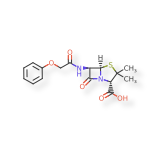
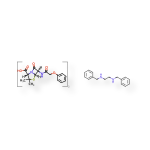
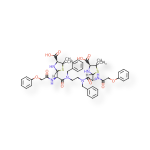
| Molecular Formula | C16H20N2.2C16H18N2O5S.4H2O |
| Molecular Weight | 1013.184 |
| Optical Activity | UNSPECIFIED |
| Defined Stereocenters | 6 / 6 |
| E/Z Centers | 0 |
| Charge | 0 |
SHOW SMILES / InChI
SMILES
O.O.O.O.C(CNCC1=CC=CC=C1)NCC2=CC=CC=C2.CC3(C)S[C@@H]4[C@H](NC(=O)COC5=CC=CC=C5)C(=O)N4[C@H]3C(O)=O.CC6(C)S[C@@H]7[C@H](NC(=O)COC8=CC=CC=C8)C(=O)N7[C@H]6C(O)=O
InChI
InChIKey=WGLORUYLLMHSJU-CJHXQPGBSA-N
InChI=1S/2C16H18N2O5S.C16H20N2.4H2O/c2*1-16(2)12(15(21)22)18-13(20)11(14(18)24-16)17-10(19)8-23-9-6-4-3-5-7-9;1-3-7-15(8-4-1)13-17-11-12-18-14-16-9-5-2-6-10-16;;;;/h2*3-7,11-12,14H,8H2,1-2H3,(H,17,19)(H,21,22);1-10,17-18H,11-14H2;4*1H2/t2*11-,12+,14-;;;;;/m11...../s1
| Molecular Formula | C16H18N2O5S |
| Molecular Weight | 350.39 |
| Charge | 0 |
| Count |
|
| Stereochemistry | ABSOLUTE |
| Additional Stereochemistry | No |
| Defined Stereocenters | 3 / 3 |
| E/Z Centers | 0 |
| Optical Activity | UNSPECIFIED |
| Molecular Formula | H2O |
| Molecular Weight | 18.0153 |
| Charge | 0 |
| Count |
|
| Stereochemistry | ACHIRAL |
| Additional Stereochemistry | No |
| Defined Stereocenters | 0 / 0 |
| E/Z Centers | 0 |
| Optical Activity | NONE |
| Molecular Formula | C16H20N2 |
| Molecular Weight | 240.3434 |
| Charge | 0 |
| Count |
|
| Stereochemistry | ACHIRAL |
| Additional Stereochemistry | No |
| Defined Stereocenters | 0 / 0 |
| E/Z Centers | 0 |
| Optical Activity | NONE |
DescriptionSources: http://www.drugbank.ca/drugs/DB00417Curator's Comment: Description was created based on several sources, including
http://www.accessdata.fda.gov/drugsatfda_docs/label/2012/064071s006lbl.pdf
Sources: http://www.drugbank.ca/drugs/DB00417
Curator's Comment: Description was created based on several sources, including
http://www.accessdata.fda.gov/drugsatfda_docs/label/2012/064071s006lbl.pdf
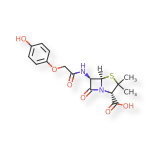
Penicillin V is a penicillin beta-lactam antibiotic used in the treatment of bacterial infections caused by susceptible, usually gram-positive, organisms. The name "penicillin" can either refer to several variants of penicillin available, or to the group of antibiotics derived from the penicillins. Penicillin V has in vitro activity against gram-positive and gram-negative aerobic and anaerobic bacteria. The bactericidal activity of Penicillin V results from the inhibition of cell wall synthesis and is mediated through Penicillin V binding to penicillin binding proteins (PBPs). Penicillin V is stable against hydrolysis by a variety of beta-lactamases, including penicillinases, and cephalosporinases and extended spectrum beta-lactamases. By binding to specific penicillin-binding proteins (PBPs) located inside the bacterial cell wall, Penicillin V inhibits the third and last stage of bacterial cell wall synthesis. Cell lysis is then mediated by bacterial cell wall autolytic enzymes such as autolysins; it is possible that Penicillin V interferes with an autolysin inhibitor. Used for the treatment of mild to moderately severe infections (e.g. dental infection, infections in the heart, middle ear infections, rheumatic fever, scarlet fever, skin infections, upper and lower respiratory tract infections) due to microorganisms.
Approval Year
Targets
| Primary Target | Pharmacology | Condition | Potency |
|---|---|---|---|
Target ID: CHEMBL352 |
|||
Target ID: Q8XJ01 Gene ID: 990276.0 Gene Symbol: pbpA Target Organism: Clostridium perfringens (strain 13 / Type A) Sources: http://www.drugbank.ca/drugs/DB00417 |
|||
Target ID: CHEMBL3512 Sources: http://www.drugbank.ca/drugs/DB00417 |
|||
Target ID: CHEMBL347 |
|||
Target ID: CHEMBL2354204 |
Conditions
| Condition | Modality | Targets | Highest Phase | Product |
|---|---|---|---|---|
| Curative | Penicillin V Approved UsePenicillin V potassium tablets and Penicillin V potassium for oral solution are indicated in the treatment of mild to moderately severe infections due to penicillin G-sensitive microorganisms. Therapy should be guided by bacteriological studies (including sensitivity tests) and by clinical response.
The following infections will usually respond to adequate dosage of Penicillin V.
Streptococcal infections (without bacteremia). Mild-to-moderate infections of the upper respiratory tract, scarlet fever, and mild erysipelas.
Pneumococcal infections. Mild to moderately severe infections of the respiratory tract.
Staphylococcal infections—penicillin G-sensitive. Mild infections of the skin and soft tissues.
Fusospirochetosis (Vincent's gingivitis and pharyngitis)—Mild to moderately severe infections of the oropharynx usually respond to therapy with oral penicillin. Launch Date1990 |
|||
| Curative | Penicillin V Approved UsePenicillin V potassium tablets and Penicillin V potassium for oral solution are indicated in the treatment of mild to moderately severe infections due to penicillin G-sensitive microorganisms. Therapy should be guided by bacteriological studies (including sensitivity tests) and by clinical response.
The following infections will usually respond to adequate dosage of Penicillin V.
Streptococcal infections (without bacteremia). Mild-to-moderate infections of the upper respiratory tract, scarlet fever, and mild erysipelas.
Pneumococcal infections. Mild to moderately severe infections of the respiratory tract.
Staphylococcal infections—penicillin G-sensitive. Mild infections of the skin and soft tissues.
Fusospirochetosis (Vincent's gingivitis and pharyngitis)—Mild to moderately severe infections of the oropharynx usually respond to therapy with oral penicillin. Launch Date1990 |
|||
| Curative | Penicillin V Approved UsePenicillin V potassium tablets and Penicillin V potassium for oral solution are indicated in the treatment of mild to moderately severe infections due to penicillin G-sensitive microorganisms. Therapy should be guided by bacteriological studies (including sensitivity tests) and by clinical response.
The following infections will usually respond to adequate dosage of Penicillin V.
Streptococcal infections (without bacteremia). Mild-to-moderate infections of the upper respiratory tract, scarlet fever, and mild erysipelas.
Pneumococcal infections. Mild to moderately severe infections of the respiratory tract.
Staphylococcal infections—penicillin G-sensitive. Mild infections of the skin and soft tissues.
Fusospirochetosis (Vincent's gingivitis and pharyngitis)—Mild to moderately severe infections of the oropharynx usually respond to therapy with oral penicillin. Launch Date1990 |
Cmax
| Value | Dose | Co-administered | Analyte | Population |
|---|---|---|---|---|
6.1 mg/L EXPERIMENT https://pubmed.ncbi.nlm.nih.gov/6811219 |
0.4 g single, oral dose: 0.4 g route of administration: Oral experiment type: SINGLE co-administered: |
PENICILLIN V POTASSIUM serum | Homo sapiens population: HEALTHY age: ADULT sex: MALE food status: FASTED |
|
15 mg/L EXPERIMENT https://pubmed.ncbi.nlm.nih.gov/6811219 |
1 g single, oral dose: 1 g route of administration: Oral experiment type: SINGLE co-administered: |
PENICILLIN V POTASSIUM serum | Homo sapiens population: HEALTHY age: ADULT sex: MALE food status: FASTED |
|
26.3 mg/L EXPERIMENT https://pubmed.ncbi.nlm.nih.gov/6811219 |
2 g single, oral dose: 2 g route of administration: Oral experiment type: SINGLE co-administered: |
PENICILLIN V POTASSIUM serum | Homo sapiens population: HEALTHY age: ADULT sex: MALE food status: FASTED |
|
35.5 mg/L EXPERIMENT https://pubmed.ncbi.nlm.nih.gov/6811219 |
3 g single, oral dose: 3 g route of administration: Oral experiment type: SINGLE co-administered: |
PENICILLIN V POTASSIUM serum | Homo sapiens population: HEALTHY age: ADULT sex: MALE food status: FASTED |
AUC
| Value | Dose | Co-administered | Analyte | Population |
|---|---|---|---|---|
6.89 mg × h/L EXPERIMENT https://pubmed.ncbi.nlm.nih.gov/6811219 |
0.4 g single, oral dose: 0.4 g route of administration: Oral experiment type: SINGLE co-administered: |
PENICILLIN V POTASSIUM serum | Homo sapiens population: HEALTHY age: ADULT sex: MALE food status: FASTED |
|
19.01 mg × h/L EXPERIMENT https://pubmed.ncbi.nlm.nih.gov/6811219 |
1 g single, oral dose: 1 g route of administration: Oral experiment type: SINGLE co-administered: |
PENICILLIN V POTASSIUM serum | Homo sapiens population: HEALTHY age: ADULT sex: MALE food status: FASTED |
|
33.36 mg × h/L EXPERIMENT https://pubmed.ncbi.nlm.nih.gov/6811219 |
2 g single, oral dose: 2 g route of administration: Oral experiment type: SINGLE co-administered: |
PENICILLIN V POTASSIUM serum | Homo sapiens population: HEALTHY age: ADULT sex: MALE food status: FASTED |
|
43.94 mg × h/L EXPERIMENT https://pubmed.ncbi.nlm.nih.gov/6811219 |
3 g single, oral dose: 3 g route of administration: Oral experiment type: SINGLE co-administered: |
PENICILLIN V POTASSIUM serum | Homo sapiens population: HEALTHY age: ADULT sex: MALE food status: FASTED |
T1/2
| Value | Dose | Co-administered | Analyte | Population |
|---|---|---|---|---|
0.52 h EXPERIMENT https://pubmed.ncbi.nlm.nih.gov/6811219 |
0.4 g single, oral dose: 0.4 g route of administration: Oral experiment type: SINGLE co-administered: |
PENICILLIN V POTASSIUM serum | Homo sapiens population: HEALTHY age: ADULT sex: MALE food status: FASTED |
|
0.78 h EXPERIMENT https://pubmed.ncbi.nlm.nih.gov/6811219 |
1 g single, oral dose: 1 g route of administration: Oral experiment type: SINGLE co-administered: |
PENICILLIN V POTASSIUM serum | Homo sapiens population: HEALTHY age: ADULT sex: MALE food status: FASTED |
|
0.91 h EXPERIMENT https://pubmed.ncbi.nlm.nih.gov/6811219 |
2 g single, oral dose: 2 g route of administration: Oral experiment type: SINGLE co-administered: |
PENICILLIN V POTASSIUM serum | Homo sapiens population: HEALTHY age: ADULT sex: MALE food status: FASTED |
|
1.05 h EXPERIMENT https://pubmed.ncbi.nlm.nih.gov/6811219 |
3 g single, oral dose: 3 g route of administration: Oral experiment type: SINGLE co-administered: |
PENICILLIN V POTASSIUM serum | Homo sapiens population: HEALTHY age: ADULT sex: MALE food status: FASTED |
Funbound
| Value | Dose | Co-administered | Analyte | Population |
|---|---|---|---|---|
20% |
unknown, oral |
PENICILLIN V POTASSIUM serum | Homo sapiens population: UNKNOWN age: UNKNOWN sex: UNKNOWN food status: UNKNOWN |
Doses
| Dose | Population | Adverse events |
|---|---|---|
10 mg/kg 4 times / day multiple, oral Recommended Dose: 10 mg/kg, 4 times / day Route: oral Route: multiple Dose: 10 mg/kg, 4 times / day Sources: |
unhealthy, 1-12 |
Disc. AE: Stomach cramps, Nausea... Other AEs: Diarrhea, Rash... AEs leading to discontinuation/dose reduction: Stomach cramps (0.46%) Other AEs:Nausea (0.46%) Diarrhea (0.8%) Sources: Rash (1.2%) Abdominal pain (0.8%) Infection (1.7%) Headache (1.2%) Vomiting (2.5%) Rhinitis (1.2%) Gastroenteritis (0.4%) Epistaxis (0.4%) Ear pain (2.1%) Cough increased (1.2%) Nausea (0.8%) |
250 mg 4 times / day multiple, oral Recommended Dose: 250 mg, 4 times / day Route: oral Route: multiple Dose: 250 mg, 4 times / day Sources: |
unhealthy, 16+ |
Disc. AE: Abdominal pain... AEs leading to discontinuation/dose reduction: Abdominal pain (1.7%) Sources: |
590 mg 3 times / day multiple, oral Recommended Dose: 590 mg, 3 times / day Route: oral Route: multiple Dose: 590 mg, 3 times / day Sources: |
unhealthy, 28+/-7.9 Health Status: unhealthy Age Group: 28+/-7.9 Sex: M+F Sources: |
Disc. AE: Nausea, Taste alteration... AEs leading to discontinuation/dose reduction: Nausea (grade 3, 0.88%) Sources: Taste alteration (grade 3, 0.88%) |
800 mg 4 times / day multiple, oral Highest studied dose Dose: 800 mg, 4 times / day Route: oral Route: multiple Dose: 800 mg, 4 times / day Sources: |
unhealthy, 30.0 (6–73) Health Status: unhealthy Age Group: 30.0 (6–73) Sex: M+F Sources: |
|
1 g 3 times / day multiple, oral Recommended Dose: 1 g, 3 times / day Route: oral Route: multiple Dose: 1 g, 3 times / day Sources: |
unhealthy, 31.0 (3–67) Health Status: unhealthy Age Group: 31.0 (3–67) Sex: M+F Sources: |
|
3 g multiple, oral Recommended Dose: 3 g Route: oral Route: multiple Dose: 3 g Sources: |
unhealthy Health Status: unhealthy Sources: |
|
250 mg 4 times / day multiple, oral Recommended Dose: 250 mg, 4 times / day Route: oral Route: multiple Dose: 250 mg, 4 times / day Sources: |
unhealthy |
Disc. AE: Rash, Vomiting... AEs leading to discontinuation/dose reduction: Rash (0.57%) Sources: Vomiting (0.57%) |
500 mg 4 times / day multiple, oral Recommended Dose: 500 mg, 4 times / day Route: oral Route: multiple Dose: 500 mg, 4 times / day Sources: |
unhealthy Health Status: unhealthy Sources: |
Disc. AE: Hypersensitivity reaction, Diarrhea, Clostridium difficile... AEs leading to discontinuation/dose reduction: Hypersensitivity reaction (serious|grade 5) Sources: Diarrhea, Clostridium difficile (mild|grade 5) |
AEs
| AE | Significance | Dose | Population |
|---|---|---|---|
| Epistaxis | 0.4% | 10 mg/kg 4 times / day multiple, oral Recommended Dose: 10 mg/kg, 4 times / day Route: oral Route: multiple Dose: 10 mg/kg, 4 times / day Sources: |
unhealthy, 1-12 |
| Gastroenteritis | 0.4% | 10 mg/kg 4 times / day multiple, oral Recommended Dose: 10 mg/kg, 4 times / day Route: oral Route: multiple Dose: 10 mg/kg, 4 times / day Sources: |
unhealthy, 1-12 |
| Nausea | 0.46% Disc. AE |
10 mg/kg 4 times / day multiple, oral Recommended Dose: 10 mg/kg, 4 times / day Route: oral Route: multiple Dose: 10 mg/kg, 4 times / day Sources: |
unhealthy, 1-12 |
| Stomach cramps | 0.46% Disc. AE |
10 mg/kg 4 times / day multiple, oral Recommended Dose: 10 mg/kg, 4 times / day Route: oral Route: multiple Dose: 10 mg/kg, 4 times / day Sources: |
unhealthy, 1-12 |
| Abdominal pain | 0.8% | 10 mg/kg 4 times / day multiple, oral Recommended Dose: 10 mg/kg, 4 times / day Route: oral Route: multiple Dose: 10 mg/kg, 4 times / day Sources: |
unhealthy, 1-12 |
| Diarrhea | 0.8% | 10 mg/kg 4 times / day multiple, oral Recommended Dose: 10 mg/kg, 4 times / day Route: oral Route: multiple Dose: 10 mg/kg, 4 times / day Sources: |
unhealthy, 1-12 |
| Nausea | 0.8% | 10 mg/kg 4 times / day multiple, oral Recommended Dose: 10 mg/kg, 4 times / day Route: oral Route: multiple Dose: 10 mg/kg, 4 times / day Sources: |
unhealthy, 1-12 |
| Cough increased | 1.2% | 10 mg/kg 4 times / day multiple, oral Recommended Dose: 10 mg/kg, 4 times / day Route: oral Route: multiple Dose: 10 mg/kg, 4 times / day Sources: |
unhealthy, 1-12 |
| Headache | 1.2% | 10 mg/kg 4 times / day multiple, oral Recommended Dose: 10 mg/kg, 4 times / day Route: oral Route: multiple Dose: 10 mg/kg, 4 times / day Sources: |
unhealthy, 1-12 |
| Rash | 1.2% | 10 mg/kg 4 times / day multiple, oral Recommended Dose: 10 mg/kg, 4 times / day Route: oral Route: multiple Dose: 10 mg/kg, 4 times / day Sources: |
unhealthy, 1-12 |
| Rhinitis | 1.2% | 10 mg/kg 4 times / day multiple, oral Recommended Dose: 10 mg/kg, 4 times / day Route: oral Route: multiple Dose: 10 mg/kg, 4 times / day Sources: |
unhealthy, 1-12 |
| Infection | 1.7% | 10 mg/kg 4 times / day multiple, oral Recommended Dose: 10 mg/kg, 4 times / day Route: oral Route: multiple Dose: 10 mg/kg, 4 times / day Sources: |
unhealthy, 1-12 |
| Ear pain | 2.1% | 10 mg/kg 4 times / day multiple, oral Recommended Dose: 10 mg/kg, 4 times / day Route: oral Route: multiple Dose: 10 mg/kg, 4 times / day Sources: |
unhealthy, 1-12 |
| Vomiting | 2.5% | 10 mg/kg 4 times / day multiple, oral Recommended Dose: 10 mg/kg, 4 times / day Route: oral Route: multiple Dose: 10 mg/kg, 4 times / day Sources: |
unhealthy, 1-12 |
| Abdominal pain | 1.7% Disc. AE |
250 mg 4 times / day multiple, oral Recommended Dose: 250 mg, 4 times / day Route: oral Route: multiple Dose: 250 mg, 4 times / day Sources: |
unhealthy, 16+ |
| Nausea | grade 3, 0.88% Disc. AE |
590 mg 3 times / day multiple, oral Recommended Dose: 590 mg, 3 times / day Route: oral Route: multiple Dose: 590 mg, 3 times / day Sources: |
unhealthy, 28+/-7.9 Health Status: unhealthy Age Group: 28+/-7.9 Sex: M+F Sources: |
| Taste alteration | grade 3, 0.88% Disc. AE |
590 mg 3 times / day multiple, oral Recommended Dose: 590 mg, 3 times / day Route: oral Route: multiple Dose: 590 mg, 3 times / day Sources: |
unhealthy, 28+/-7.9 Health Status: unhealthy Age Group: 28+/-7.9 Sex: M+F Sources: |
| Rash | 0.57% Disc. AE |
250 mg 4 times / day multiple, oral Recommended Dose: 250 mg, 4 times / day Route: oral Route: multiple Dose: 250 mg, 4 times / day Sources: |
unhealthy |
| Vomiting | 0.57% Disc. AE |
250 mg 4 times / day multiple, oral Recommended Dose: 250 mg, 4 times / day Route: oral Route: multiple Dose: 250 mg, 4 times / day Sources: |
unhealthy |
| Diarrhea, Clostridium difficile | mild|grade 5 Disc. AE |
500 mg 4 times / day multiple, oral Recommended Dose: 500 mg, 4 times / day Route: oral Route: multiple Dose: 500 mg, 4 times / day Sources: |
unhealthy Health Status: unhealthy Sources: |
| Hypersensitivity reaction | serious|grade 5 Disc. AE |
500 mg 4 times / day multiple, oral Recommended Dose: 500 mg, 4 times / day Route: oral Route: multiple Dose: 500 mg, 4 times / day Sources: |
unhealthy Health Status: unhealthy Sources: |
PubMed
| Title | Date | PubMed |
|---|---|---|
| Synthesis of novel hapten and production of generic monoclonal antibody for immunoassay of penicillins residues in milk. | 2013 |
|
| Evaluation of the sensitizing potential of antibiotics in vitro using the human cell lines THP-1 and MUTZ-LC and primary monocyte-derived dendritic cells. | 2012-08-01 |
|
| Identification of urinary microRNA profiles in rats that may diagnose hepatotoxicity. | 2012-02 |
|
| Human health risk assessment of pharmaceuticals in water: issues and challenges ahead. | 2010-11 |
|
| Prevalence of Group A b-Hemolytic Streptococcus Among Children with Tonsillopharyngitis in Kyrgyzstan: The Difficulty of Diagnostics and Therapy. | 2010-10-13 |
|
| How are antibacterials used in nursing homes? Results from a point-prevalence prescription study in 44 Norwegian nursing homes. | 2010-10 |
|
| Antibiotic prescribing practices by dentists: a review. | 2010-07-21 |
|
| Decreased Streptococcus pneumoniae susceptibility to oral antibiotics among children in rural Vietnam: a community study. | 2010-03-31 |
|
| A prospective multi-center trial of Escherichia coli extract for the prophylactic treatment of patients with chronically recurrent cystitis. | 2010-03 |
|
| Challenges of cellulitis in a lymphedematous extremity: a case report. | 2009-12-22 |
|
| [An exceptional component C3 deficiency revealed by serum protein electrophoresis]. | 2009-11-27 |
|
| Antibiotic prescribing in paediatric populations: a comparison between Viareggio, Italy and Funen, Denmark. | 2009-08 |
|
| Hypersensitivity reactions to penicillins: studies in a group of patients with negative benzylpenicillin G skin test. | 2009-06 |
|
| Specific IgG antibodies in sera in patients with penicillin allergy. | 2009-06 |
|
| The role of phenoxymethylpenicillin, amoxicillin, metronidazole and clindamycin in the management of acute dentoalveolar abscesses--a review. | 2009-04-11 |
|
| SDRIFE (baboon syndrome) induced by penicillin. | 2009-04 |
|
| Acute tonsillopharyngitis in a family practice in Mostar, Bosnia and Herzegovina. | 2009-03 |
|
| Treatment of Lyme borreliosis. | 2009 |
|
| Comparative Study of 5-Day and 10-Day Cefditoren Pivoxil Treatments for Recurrent Group A beta-Hemolytic Streptococcus pharyngitis in Children. | 2009 |
|
| Treatment and prevention of Lyme disease. | 2009 |
|
| Trends in number of consultations and antibiotic prescriptions for respiratory tract infections between 1999 and 2005 in primary healthcare in Kalmar County, Southern Sweden. | 2009 |
|
| Effects of treatment with antimicrobial agents on the human colonic microflora. | 2008-12 |
|
| Drug use in children: cohort study in three European countries. | 2008-11-24 |
|
| A randomized trial to monitor the efficacy and effectiveness by QT-NASBA of artemether-lumefantrine versus dihydroartemisinin-piperaquine for treatment and transmission control of uncomplicated Plasmodium falciparum malaria in western Kenya. | 2008-11-18 |
|
| Antistreptococcal treatment of guttate psoriasis: a controlled study. | 2008-09 |
|
| A comprehensive in vitro and in silico analysis of antibiotics that activate pregnane X receptor and induce CYP3A4 in liver and intestine. | 2008-08 |
|
| Antimicrobial susceptibility of periodontopathogenic bacteria. | 2008-05 |
|
| [Summary of the practice guideline 'Sore throat' (second revision) from the Dutch College of General Practitioners]. | 2008-02-23 |
|
| Comparative bioavailability study of two phenoxymethylpenicillin potassium tablet formulations in healthy volunteers. | 2007-12 |
|
| Evaluation of phenoxymethylpenicillin treatment of acute otitis media in children aged 2-16. | 2007-09 |
|
| Aminopenicillin-induced exanthema allows treatment with certain cephalosporins or phenoxymethyl penicillin. | 2007-07 |
|
| Leukocyte counts in urine reflect the risk of concomitant sepsis in bacteriuric infants: a retrospective cohort study. | 2007-06-13 |
|
| Dishing the dirt on asthma: What we can learn from poor hygiene. | 2007-06 |
|
| Incidence of antibiotic prescribing in dental practice in Norway and its contribution to national consumption. | 2007-06 |
|
| Meningomylocele: An update. | 2007-04 |
|
| Association of IL-10 level and IL-10 promoter SNPs with specific antibodies in penicillin-allergic patients. | 2007-03 |
|
| [Express determination of beta-lactam antibiotics in biological matter with potentiometric sensors]. | 2007 |
|
| [The microbiology of peritonsillar abscesses]. | 2007 |
|
| Hypersensitivity to penicillin V with good tolerance to other beta-lactams. | 2007 |
|
| HLA-DRB genotype and specific IgE responses in patients with allergies to penicillins. | 2006-03-20 |
|
| Clinical practice. Antibiotic allergy. | 2006-02-09 |
|
| Tigecycline: an evidence-based review of its antibacterial activity and effectiveness in complicated skin and soft tissue and intraabdominal infections. | 2006 |
|
| Comparison of a two- or three-week regimen and a review of treatment of erythema migrans with phenoxymethylpenicillin. | 2006 |
|
| Decrease of selective immunoglobulin E response to amoxicillin despite repeated administration of benzylpenicillin and penicillin V. | 2005-12 |
|
| Identification of penicillin allergenic determinants that bind IgE antibodies in the sera of subjects with penicillin allergy. | 1990-11 |
|
| Effect of drugs influencing synthesis of prostaglandins on haloperidol-induced catalepsy in rats. | 1984-07-01 |
|
| [Leukocytoclastic vasculitis due to drug allergy presenting as generalized pustular exanthema]. | 1981-09 |
|
| Assessment of the "E' book as a tool for drug monitoring. | 1981-03 |
|
| [Immune hemolytic anemia and thrombocytopenia after peroral therapy with a penicillin derivative (phenoxymethylpenicillin)]. | 1977 |
|
| [The antiviral activity of the antibiotics beromycin and carminomycin]. | 1974-02 |
Patents
Sample Use Guides
| Substance Class |
Chemical
Created
by
admin
on
Edited
Mon Mar 31 22:08:55 GMT 2025
by
admin
on
Mon Mar 31 22:08:55 GMT 2025
|
| Record UNII |
44MHH77OIC
|
| Record Status |
Validated (UNII)
|
| Record Version |
|
-
Download
| Name | Type | Language | ||
|---|---|---|---|---|
|
Preferred Name | English | ||
|
Common Name | English | ||
|
Common Name | English | ||
|
Common Name | English | ||
|
Common Name | English | ||
|
Common Name | English | ||
|
Systematic Name | English | ||
|
Common Name | English | ||
|
Common Name | English |
| Code System | Code | Type | Description | ||
|---|---|---|---|---|---|
|
44MHH77OIC
Created by
admin on Mon Mar 31 22:08:55 GMT 2025 , Edited by admin on Mon Mar 31 22:08:55 GMT 2025
|
PRIMARY | |||
|
2113728-41-7
Created by
admin on Mon Mar 31 22:08:55 GMT 2025 , Edited by admin on Mon Mar 31 22:08:55 GMT 2025
|
PRIMARY | |||
|
11954248
Created by
admin on Mon Mar 31 22:08:55 GMT 2025 , Edited by admin on Mon Mar 31 22:08:55 GMT 2025
|
PRIMARY | |||
|
DTXSID20474643
Created by
admin on Mon Mar 31 22:08:55 GMT 2025 , Edited by admin on Mon Mar 31 22:08:55 GMT 2025
|
PRIMARY | |||
|
63690-57-3
Created by
admin on Mon Mar 31 22:08:55 GMT 2025 , Edited by admin on Mon Mar 31 22:08:55 GMT 2025
|
ALTERNATIVE | |||
|
300000052020
Created by
admin on Mon Mar 31 22:08:55 GMT 2025 , Edited by admin on Mon Mar 31 22:08:55 GMT 2025
|
PRIMARY |
| Related Record | Type | Details | ||
|---|---|---|---|---|
|
|
PARENT -> SALT/SOLVATE |
|
||
|
ANHYDROUS->SOLVATE |
|
| Related Record | Type | Details | ||
|---|---|---|---|---|
|
IMPURITY -> PARENT |
|
||
|
IMPURITY -> PARENT |
|
||
|
IMPURITY -> PARENT |
|
||
|
IMPURITY -> PARENT |
|
||
|
IMPURITY -> PARENT |
|
||
|
IMPURITY -> PARENT |
|
||
|
IMPURITY -> PARENT |
|
||
|
IMPURITY -> PARENT |
|
||
|
IMPURITY -> PARENT |
PHENOXYMETHYLPENICILLIN (BENZATHINE) TETRAHYDRAT IN EP HAS THE SAME STRUCTURE AS FOR PENICILLIN V BENZATHINE TETRAHYDRATE
|
||
|
IMPURITY -> PARENT |
|
||
|
IMPURITY -> PARENT |
|
||
|
IMPURITY -> PARENT |
|
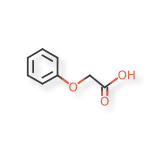
![Structure of (2R,4S)-5,5-Dimethyl-2-[[(2-phenoxyacetyl)amino]methyl]-4-thiazolidinecarboxylic acid](/img/03d53657-8a07-4be8-aa8b-53377e18adeb.svg "Structure of (2R,4S)-5,5-Dimethyl-2-[[(2-phenoxyacetyl)amino]methyl]-4-thiazolidinecarboxylic acid")
![Structure of 4-Carboxy-5,5-dimethyl-?-[(phenoxyacetyl)amino]-2-thiazolidineacetic acid, (?R,2S,4S)-](/img/a0fa2c7c-6da3-48ff-94d1-4d813578c20a.svg "Structure of 4-Carboxy-5,5-dimethyl-?-[(phenoxyacetyl)amino]-2-thiazolidineacetic acid, (?R,2S,4S)-")
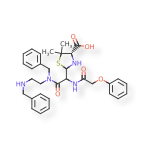
![Structure of (2S,4S)-5,5-Dimethyl-2-[[(2-phenoxyacetyl)amino]methyl]-4-thiazolidinecarboxylic acid](/img/74dbcbd7-771c-4392-a13b-ab4d6d98b0c8.svg "Structure of (2S,4S)-5,5-Dimethyl-2-[[(2-phenoxyacetyl)amino]methyl]-4-thiazolidinecarboxylic acid")
![Structure of 4-Carboxy-5,5-dimethyl-?-[(2-phenoxyacetyl)amino]-2-thiazolidineacetic acid, (?R,2R,4S)-](/img/a2e0d5a4-c3a9-48ef-afed-4049f52284a8.svg "Structure of 4-Carboxy-5,5-dimethyl-?-[(2-phenoxyacetyl)amino]-2-thiazolidineacetic acid, (?R,2R,4S)-")
![(2RS,4S)-5,5-dimethyl-2-[(2-phenoxyacetamido)methyl]-1,3-thiazolidine-4-carboxylic acid](https://drugs.ncats.io/assets/ginas/images/mixture.svg "(2RS,4S)-5,5-dimethyl-2-[(2-phenoxyacetamido)methyl]-1,3-thiazolidine-4-carboxylic acid")
| Related Record | Type | Details | ||
|---|---|---|---|---|
|
|
ACTIVE MOIETY |
|