


Details
| Stereochemistry | ACHIRAL |
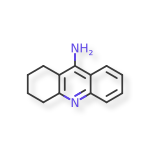
| Molecular Formula | C13H14N2 |
| Molecular Weight | 198.2637 |
| Optical Activity | NONE |
| Defined Stereocenters | 0 / 0 |
| E/Z Centers | 0 |
| Charge | 0 |
SHOW SMILES / InChI
SMILES
NC1=C2C=CC=CC2=NC3=C1CCCC3
InChI
InChIKey=YLJREFDVOIBQDA-UHFFFAOYSA-N
InChI=1S/C13H14N2/c14-13-9-5-1-3-7-11(9)15-12-8-4-2-6-10(12)13/h1,3,5,7H,2,4,6,8H2,(H2,14,15)
| Molecular Formula | C13H14N2 |
| Molecular Weight | 198.2637 |
| Charge | 0 |
| Count |
|
| Stereochemistry | ACHIRAL |
| Additional Stereochemistry | No |
| Defined Stereocenters | 0 / 0 |
| E/Z Centers | 0 |
| Optical Activity | NONE |
DescriptionSources: http://www.drugbank.ca/drugs/DB00382Curator's Comment: Description was created based on several sources, including
https://www.drugs.com/pro/cognex.html
Sources: http://www.drugbank.ca/drugs/DB00382
Curator's Comment: Description was created based on several sources, including
https://www.drugs.com/pro/cognex.html
Tacrine is a parasympathomimetic- a reversible cholinesterase inhibitor that is indicated for the treatment of mild to moderate dementia of the Alzheimer's type. An early pathophysiological feature of Alzheimer's disease that is associated with memory loss and cognitive deficits is a deficiency of acetylcholine as a result of selective loss of cholinergic neurons in the cerebral cortex, nucleus basalis, and hippocampus. Tacrine is postulated to exert its therapeutic effect by enhancing cholinergic function. This is accomplished by increasing the concentration of acetylcholine at cholinergic synapses through reversible inhibition of its hydrolysis by acetylcholinesterase. If this proposed mechanism of action is correct, tacrine's effect may lessen as the disease progresses and fewer cholinergic neurons remain functionally intact. There is no evidence that tacrine alters the course of the underlying dementing process. The mechanism of tacrine is not fully known, but it is suggested that the drug is an anticholinesterase agent which reversibly binds with and inactivates cholinesterases. This inhibits the hydrolysis of acetylcholine released from functioning cholinergic neurons, thus leading to an accumulation of acetylcholine at cholinergic synapses. The result is a prolonged effect of acetylcholine. is used for the palliative treatment of mild to moderate dementia of the Alzheimer's type. Tacrine was marketed under the trade name Cognex. Because of its liver toxicity and attendant requirement for monitoring liver function, tacrine prescriptions dropped after other acetylcholinesterase inhibitors were introduced, and its use has been largely discontinued.
CNS Activity
Approval Year
Targets
| Primary Target | Pharmacology | Condition | Potency |
|---|---|---|---|
Target ID: CHEMBL220 Sources: http://www.drugbank.ca/drugs/DB00382 |
500.0 nM [IC50] | ||
Target ID: CHEMBL1914 Sources: http://www.drugbank.ca/drugs/DB00382 |
23.0 nM [IC50] | ||
Target ID: CHEMBL2190 |
0.46 µM [IC50] |
Conditions
| Condition | Modality | Targets | Highest Phase | Product |
|---|---|---|---|---|
| Primary | Cognex Approved UseCognex® (tacrine hydrochloride capsules) is indicated for the treatment of mild to moderate dementia of the Alzheimer's type. Launch Date1993 |
Cmax
| Value | Dose | Co-administered | Analyte | Population |
|---|---|---|---|---|
15.8 ng/mL EXPERIMENT https://www.ncbi.nlm.nih.gov/pubmed/7836549 |
40 mg single, oral dose: 40 mg route of administration: Oral experiment type: SINGLE co-administered: |
TACRINE plasma | Homo sapiens population: HEALTHY age: ADULT sex: FEMALE / MALE food status: FASTED |
AUC
| Value | Dose | Co-administered | Analyte | Population |
|---|---|---|---|---|
91.8 ng × h/mL EXPERIMENT https://www.ncbi.nlm.nih.gov/pubmed/7836549 |
40 mg single, oral dose: 40 mg route of administration: Oral experiment type: SINGLE co-administered: |
TACRINE plasma | Homo sapiens population: HEALTHY age: ADULT sex: FEMALE / MALE food status: FASTED |
T1/2
| Value | Dose | Co-administered | Analyte | Population |
|---|---|---|---|---|
2.8 h EXPERIMENT https://www.ncbi.nlm.nih.gov/pubmed/7836549 |
40 mg single, oral dose: 40 mg route of administration: Oral experiment type: SINGLE co-administered: |
TACRINE plasma | Homo sapiens population: HEALTHY age: ADULT sex: FEMALE / MALE food status: FASTED |
Doses
| Dose | Population | Adverse events |
|---|---|---|
160 mg 1 times / day multiple, oral Highest studied dose Dose: 160 mg, 1 times / day Route: oral Route: multiple Dose: 160 mg, 1 times / day Sources: |
unhealthy, 71.2 years (range: 52-88 years) Health Status: unhealthy Age Group: 71.2 years (range: 52-88 years) Sex: M+F Sources: |
Disc. AE: Nausea, Vomiting... AEs leading to discontinuation/dose reduction: Nausea (21 patient) Sources: Vomiting (21 patient) Anorexia (21 patient) Dyspepsia (21 patient) Diarrhea (21 patient) Abdominal pain (21 patient) |
40 mg 1 times / day multiple, oral Recommended Dose: 40 mg, 1 times / day Route: oral Route: multiple Dose: 40 mg, 1 times / day Sources: |
unhealthy, adult Health Status: unhealthy Age Group: adult Sources: |
Disc. AE: Transaminases increased, Atrial fibrillation... AEs leading to discontinuation/dose reduction: Transaminases increased (1 patient) Sources: Atrial fibrillation (1 patient) Dyspnea (1 patient) Chest pain (1 patient) |
80 mg 1 times / day multiple, oral Recommended Dose: 80 mg, 1 times / day Route: oral Route: multiple Dose: 80 mg, 1 times / day Sources: |
unhealthy, adult Health Status: unhealthy Age Group: adult Sources: |
Disc. AE: Transaminases increased, Nausea... AEs leading to discontinuation/dose reduction: Transaminases increased (1 patient) Sources: Nausea (1 patient) Vomiting (1 patient) Pallor (1 patient) Vasodilatation (1 patient) Sweating increased (1 patient) |
AEs
| AE | Significance | Dose | Population |
|---|---|---|---|
| Abdominal pain | 21 patient Disc. AE |
160 mg 1 times / day multiple, oral Highest studied dose Dose: 160 mg, 1 times / day Route: oral Route: multiple Dose: 160 mg, 1 times / day Sources: |
unhealthy, 71.2 years (range: 52-88 years) Health Status: unhealthy Age Group: 71.2 years (range: 52-88 years) Sex: M+F Sources: |
| Anorexia | 21 patient Disc. AE |
160 mg 1 times / day multiple, oral Highest studied dose Dose: 160 mg, 1 times / day Route: oral Route: multiple Dose: 160 mg, 1 times / day Sources: |
unhealthy, 71.2 years (range: 52-88 years) Health Status: unhealthy Age Group: 71.2 years (range: 52-88 years) Sex: M+F Sources: |
| Diarrhea | 21 patient Disc. AE |
160 mg 1 times / day multiple, oral Highest studied dose Dose: 160 mg, 1 times / day Route: oral Route: multiple Dose: 160 mg, 1 times / day Sources: |
unhealthy, 71.2 years (range: 52-88 years) Health Status: unhealthy Age Group: 71.2 years (range: 52-88 years) Sex: M+F Sources: |
| Dyspepsia | 21 patient Disc. AE |
160 mg 1 times / day multiple, oral Highest studied dose Dose: 160 mg, 1 times / day Route: oral Route: multiple Dose: 160 mg, 1 times / day Sources: |
unhealthy, 71.2 years (range: 52-88 years) Health Status: unhealthy Age Group: 71.2 years (range: 52-88 years) Sex: M+F Sources: |
| Nausea | 21 patient Disc. AE |
160 mg 1 times / day multiple, oral Highest studied dose Dose: 160 mg, 1 times / day Route: oral Route: multiple Dose: 160 mg, 1 times / day Sources: |
unhealthy, 71.2 years (range: 52-88 years) Health Status: unhealthy Age Group: 71.2 years (range: 52-88 years) Sex: M+F Sources: |
| Vomiting | 21 patient Disc. AE |
160 mg 1 times / day multiple, oral Highest studied dose Dose: 160 mg, 1 times / day Route: oral Route: multiple Dose: 160 mg, 1 times / day Sources: |
unhealthy, 71.2 years (range: 52-88 years) Health Status: unhealthy Age Group: 71.2 years (range: 52-88 years) Sex: M+F Sources: |
| Atrial fibrillation | 1 patient Disc. AE |
40 mg 1 times / day multiple, oral Recommended Dose: 40 mg, 1 times / day Route: oral Route: multiple Dose: 40 mg, 1 times / day Sources: |
unhealthy, adult Health Status: unhealthy Age Group: adult Sources: |
| Chest pain | 1 patient Disc. AE |
40 mg 1 times / day multiple, oral Recommended Dose: 40 mg, 1 times / day Route: oral Route: multiple Dose: 40 mg, 1 times / day Sources: |
unhealthy, adult Health Status: unhealthy Age Group: adult Sources: |
| Dyspnea | 1 patient Disc. AE |
40 mg 1 times / day multiple, oral Recommended Dose: 40 mg, 1 times / day Route: oral Route: multiple Dose: 40 mg, 1 times / day Sources: |
unhealthy, adult Health Status: unhealthy Age Group: adult Sources: |
| Transaminases increased | 1 patient Disc. AE |
40 mg 1 times / day multiple, oral Recommended Dose: 40 mg, 1 times / day Route: oral Route: multiple Dose: 40 mg, 1 times / day Sources: |
unhealthy, adult Health Status: unhealthy Age Group: adult Sources: |
| Nausea | 1 patient Disc. AE |
80 mg 1 times / day multiple, oral Recommended Dose: 80 mg, 1 times / day Route: oral Route: multiple Dose: 80 mg, 1 times / day Sources: |
unhealthy, adult Health Status: unhealthy Age Group: adult Sources: |
| Pallor | 1 patient Disc. AE |
80 mg 1 times / day multiple, oral Recommended Dose: 80 mg, 1 times / day Route: oral Route: multiple Dose: 80 mg, 1 times / day Sources: |
unhealthy, adult Health Status: unhealthy Age Group: adult Sources: |
| Sweating increased | 1 patient Disc. AE |
80 mg 1 times / day multiple, oral Recommended Dose: 80 mg, 1 times / day Route: oral Route: multiple Dose: 80 mg, 1 times / day Sources: |
unhealthy, adult Health Status: unhealthy Age Group: adult Sources: |
| Transaminases increased | 1 patient Disc. AE |
80 mg 1 times / day multiple, oral Recommended Dose: 80 mg, 1 times / day Route: oral Route: multiple Dose: 80 mg, 1 times / day Sources: |
unhealthy, adult Health Status: unhealthy Age Group: adult Sources: |
| Vasodilatation | 1 patient Disc. AE |
80 mg 1 times / day multiple, oral Recommended Dose: 80 mg, 1 times / day Route: oral Route: multiple Dose: 80 mg, 1 times / day Sources: |
unhealthy, adult Health Status: unhealthy Age Group: adult Sources: |
| Vomiting | 1 patient Disc. AE |
80 mg 1 times / day multiple, oral Recommended Dose: 80 mg, 1 times / day Route: oral Route: multiple Dose: 80 mg, 1 times / day Sources: |
unhealthy, adult Health Status: unhealthy Age Group: adult Sources: |
PubMed
| Title | Date | PubMed |
|---|---|---|
| N-palmitoyl serotonin alleviates scopolamine-induced memory impairment via regulation of cholinergic and antioxidant systems, and expression of BDNF and p-CREB in mice. | 2015-12-05 |
|
| A correlation between the in vitro drug toxicity of drugs to cell lines that express human P450s and their propensity to cause liver injury in humans. | 2014-01 |
|
| Refining the human iPSC-cardiomyocyte arrhythmic risk assessment model. | 2013-12 |
|
| Inhibition of human carboxylesterases hCE1 and hiCE by cholinesterase inhibitors. | 2013-03-25 |
|
| Development of a highly sensitive cytotoxicity assay system for CYP3A4-mediated metabolic activation. | 2011-08 |
|
| Profiling of a prescription drug library for potential renal drug-drug interactions mediated by the organic cation transporter 2. | 2011-07-14 |
|
| A second-generation device for automated training and quantitative behavior analyses of molecularly-tractable model organisms. | 2010-12-17 |
|
| Dual-acting drugs: an in vitro study of nonimidazole histamine H3 receptor antagonists combining anticholinesterase activity. | 2010-07-05 |
|
| Synthesis and AChE inhibitory activity of new chiral tetrahydroacridine analogues from terpenic cyclanones. | 2010-02 |
|
| A novel animal model to evaluate the ability of a drug delivery system to promote the passage through the BBB. | 2010-01-18 |
|
| Use of angiotensin receptor blockers and risk of dementia in a predominantly male population: prospective cohort analysis. | 2010-01-12 |
|
| Contribution of the d-Serine-Dependent Pathway to the Cellular Mechanisms Underlying Cognitive Aging. | 2010 |
|
| Tacrine-NO donor and tacrine-ferulic acid hybrid molecules as new anti-Alzheimer agents: hepatotoxicity and influence on the cytochrome P450 system in comparison to tacrine. | 2010 |
|
| Rapid determination of tacrine and other drug metabolites in microsomal incubate by newly developed targeting algorithm on UHPLC/TOFMS. | 2009-12-15 |
|
| Coupling an HCN2-expressing cell to a myocyte creates a two-cell pacing unit. | 2009-11-01 |
|
| Long-lasting decreases in cocaine-reinforced behavior following treatment with the cholinesterase inhibitor tacrine in rats selectively bred for drug self-administration. | 2009-11 |
|
| Cholinergic influence on memory stages: A study on scopolamine amnesic mice. | 2009-08 |
|
| An integrated approach to improved toxicity prediction for the safety assessment during preclinical drug development using Hep G2 cells. | 2009-06-01 |
|
| Determination of basic azaarenes in aviation kerosene by solid-phase extraction and HPLC-fluorescence detection. | 2009-06 |
|
| Identification of FDA-approved drugs and bioactives that protect hair cells in the zebrafish (Danio rerio) lateral line and mouse (Mus musculus) utricle. | 2009-06 |
|
| Once-daily transdermal rivastigmine in the treatment of Alzheimer's disease. | 2009-02-06 |
|
| Effects of zonisamide on c-Fos expression under conditions of tacrine-induced tremulous jaw movements in rats: a potential mechanism underlying its anti-parkinsonian tremor effect. | 2009-01 |
|
| Comparison studies of tacrine and bis7-tacrine on the suppression of scopolamine-induced behavioral changes and inhibition of acetylcholinesterase in mice. | 2009 |
|
| The 5-choice continuous performance test: evidence for a translational test of vigilance for mice. | 2009 |
|
| NO-donating tacrine hybrid compounds improve scopolamine-induced cognition impairment and show less hepatotoxicity. | 2008-12-25 |
|
| Comparative effects of cationic triarylmethane, phenoxazine and phenothiazine dyes on horse serum butyrylcholinesterase. | 2008-10-15 |
|
| New performance of biosensor technology for Alzheimer's disease drugs: in vitro comparison of tacrine and 7-methoxytacrine. | 2008-10 |
|
| The investigation of structure-activity relationships of tacrine analogues: electronic-topological method. | 2008-08-06 |
|
| 1-Phenyl-6,7,8,9-hexa-hydro-1H,5H-cyclo-hepta-[1',2':2,3]pyrido[6,5-c]pyrazol-4-amine: a new tacrine analogue. | 2008-05-10 |
|
| Current therapeutic options for Alzheimer's disease. | 2007-12 |
|
| Allosteric modulation of muscarinic acetylcholine receptors. | 2007-09 |
|
| Donepezil in Alzheimer's disease: From conventional trials to pharmacogenetics. | 2007-06 |
|
| Potential cognitive enhancing and disease modification effects of SSRIs for Alzheimer's disease. | 2007 |
|
| Progress update: Pharmacological treatment of Alzheimer's disease. | 2007 |
|
| The evaluation of cognitive function in the dementias: methodological and regulatory considerations. | 2003-03 |
|
| Sleep-wake mechanisms and drug discovery: sleep EEG as a tool for the development of CNS-acting drugs. | 2002-12 |
|
| Therapeutic approaches to age-associated neurocognitive disorders. | 2001-09 |
|
| Adverse interaction of tacrine and haloperidol. | 1996-11 |
|
| Delirium caused by tacrine and ibuprofen interaction. | 1996-06 |
|
| Convulsive effects of tacrine. | 1996-05-11 |
|
| Systemic administration of lithium chloride and tacrine but not kainic acid augments citrulline content of rat brain. | 1995-12-27 |
|
| Severe parkinsonian symptom development on combination treatment with tacrine and haloperidol. | 1995-08 |
|
| Antiamnesic and cholinomimetic side-effects of the cholinesterase inhibitors, physostigmine, tacrine and NIK-247 in rats. | 1993-11-30 |
|
| Tacrine inhibits ventricular fibrillation induced by ischaemia and reperfusion and widens QT interval in rat. | 1993-03 |
|
| A comparison of the effects of cholinergic and dopaminergic agents on scopolamine-induced hyperactivity in mice. | 1990-11 |
|
| Correlation of brain levels of 9-amino-1,2,3,4-tetrahydroacridine (THA) with neurochemical and behavioral changes. | 1989-11-28 |
|
| Amino acridines action on Friend's retrovirus in relation to their molecular ionization. | 1989 |
|
| Suxamethonium apnoea masked by tetrahydroaminacrine. | 1978-07-01 |
|
| Ketamine-induced postanesthetic delirium attenuated by tetrahydroaminoacridine. | 1974-07 |
|
| An appraisal of tacrine-extended suxamethonium. | 1970-02 |
Sample Use Guides
Oral
Initially, 10 mg 4 times daily for at least 4 weeks.
If well tolerated and increased serum ALT concentrations have not occurred, increase dosage to 20 mg 4 times daily; if tolerated, increase dosage in 40-mg daily increments (divided into 4 doses daily) at 4-week intervals up to a maximum of 160 mg daily (40 mg 4 times daily).
Route of Administration:
Oral
| Substance Class |
Chemical
Created
by
admin
on
Edited
Wed Apr 02 08:21:01 GMT 2025
by
admin
on
Wed Apr 02 08:21:01 GMT 2025
|
| Record UNII |
4VX7YNB537
|
| Record Status |
Validated (UNII)
|
| Record Version |
|
-
Download
| Name | Type | Language | ||
|---|---|---|---|---|
|
Preferred Name | English | ||
|
Official Name | English | ||
|
Common Name | English | ||
|
Common Name | English | ||
|
Common Name | English | ||
|
Common Name | English | ||
|
Systematic Name | English |
| Classification Tree | Code System | Code | ||
|---|---|---|---|---|
|
WHO-ATC |
N06DA01
Created by
admin on Wed Apr 02 08:21:01 GMT 2025 , Edited by admin on Wed Apr 02 08:21:01 GMT 2025
|
||
|
NDF-RT |
N0000175723
Created by
admin on Wed Apr 02 08:21:01 GMT 2025 , Edited by admin on Wed Apr 02 08:21:01 GMT 2025
|
||
|
WHO-VATC |
QN06DA01
Created by
admin on Wed Apr 02 08:21:01 GMT 2025 , Edited by admin on Wed Apr 02 08:21:01 GMT 2025
|
||
|
NDF-RT |
N0000000177
Created by
admin on Wed Apr 02 08:21:01 GMT 2025 , Edited by admin on Wed Apr 02 08:21:01 GMT 2025
|
||
|
NCI_THESAURUS |
C47792
Created by
admin on Wed Apr 02 08:21:01 GMT 2025 , Edited by admin on Wed Apr 02 08:21:01 GMT 2025
|
||
|
LIVERTOX |
NBK547868
Created by
admin on Wed Apr 02 08:21:01 GMT 2025 , Edited by admin on Wed Apr 02 08:21:01 GMT 2025
|
| Code System | Code | Type | Description | ||
|---|---|---|---|---|---|
|
DTXSID1037272
Created by
admin on Wed Apr 02 08:21:01 GMT 2025 , Edited by admin on Wed Apr 02 08:21:01 GMT 2025
|
PRIMARY | |||
|
45980
Created by
admin on Wed Apr 02 08:21:01 GMT 2025 , Edited by admin on Wed Apr 02 08:21:01 GMT 2025
|
PRIMARY | |||
|
CHEMBL95
Created by
admin on Wed Apr 02 08:21:01 GMT 2025 , Edited by admin on Wed Apr 02 08:21:01 GMT 2025
|
PRIMARY | |||
|
1935
Created by
admin on Wed Apr 02 08:21:01 GMT 2025 , Edited by admin on Wed Apr 02 08:21:01 GMT 2025
|
PRIMARY | |||
|
C61961
Created by
admin on Wed Apr 02 08:21:01 GMT 2025 , Edited by admin on Wed Apr 02 08:21:01 GMT 2025
|
PRIMARY | |||
|
m10424
Created by
admin on Wed Apr 02 08:21:01 GMT 2025 , Edited by admin on Wed Apr 02 08:21:01 GMT 2025
|
PRIMARY | Merck Index | ||
|
6687
Created by
admin on Wed Apr 02 08:21:01 GMT 2025 , Edited by admin on Wed Apr 02 08:21:01 GMT 2025
|
PRIMARY | |||
|
10318
Created by
admin on Wed Apr 02 08:21:01 GMT 2025 , Edited by admin on Wed Apr 02 08:21:01 GMT 2025
|
PRIMARY | RxNorm | ||
|
100000082994
Created by
admin on Wed Apr 02 08:21:01 GMT 2025 , Edited by admin on Wed Apr 02 08:21:01 GMT 2025
|
PRIMARY | |||
|
206-291-2
Created by
admin on Wed Apr 02 08:21:01 GMT 2025 , Edited by admin on Wed Apr 02 08:21:01 GMT 2025
|
PRIMARY | |||
|
SUB10796MIG
Created by
admin on Wed Apr 02 08:21:01 GMT 2025 , Edited by admin on Wed Apr 02 08:21:01 GMT 2025
|
PRIMARY | |||
|
4VX7YNB537
Created by
admin on Wed Apr 02 08:21:01 GMT 2025 , Edited by admin on Wed Apr 02 08:21:01 GMT 2025
|
PRIMARY | |||
|
2551
Created by
admin on Wed Apr 02 08:21:01 GMT 2025 , Edited by admin on Wed Apr 02 08:21:01 GMT 2025
|
PRIMARY | |||
|
800
Created by
admin on Wed Apr 02 08:21:01 GMT 2025 , Edited by admin on Wed Apr 02 08:21:01 GMT 2025
|
PRIMARY | |||
|
321-64-2
Created by
admin on Wed Apr 02 08:21:01 GMT 2025 , Edited by admin on Wed Apr 02 08:21:01 GMT 2025
|
PRIMARY | |||
|
D013619
Created by
admin on Wed Apr 02 08:21:01 GMT 2025 , Edited by admin on Wed Apr 02 08:21:01 GMT 2025
|
PRIMARY | |||
|
TACRINE
Created by
admin on Wed Apr 02 08:21:01 GMT 2025 , Edited by admin on Wed Apr 02 08:21:01 GMT 2025
|
PRIMARY | |||
|
DB00382
Created by
admin on Wed Apr 02 08:21:01 GMT 2025 , Edited by admin on Wed Apr 02 08:21:01 GMT 2025
|
PRIMARY |
| Related Record | Type | Details | ||
|---|---|---|---|---|
|
|
METABOLIC ENZYME -> SUBSTRATE |
|
||
|
BINDER->LIGAND |
BINDING
|
||
|
OFF-TARGET->INHIBITOR |
HNMT inhibitors may increase histamine levels in peripheral tissues and exacerbate histamine-related diseases, such as allergic rhinitis, urticaria, and peptic ulcer disease. However, the effect of HNMT inhibitors on brain function is not yet fully understood. Some studies suggest that an increase in brain histamine levels by novel HNMT inhibitors could contribute to the improvement of brain disorders.
IC50
|
||
|
TARGET -> INHIBITOR |
IC50
|
||
|
TARGET -> INHIBITOR |
IC50
|
||
|
METABOLIC ENZYME -> INHIBITOR |
IC50
|
||
|
|
SALT/SOLVATE -> PARENT |
|
||
|
|
SALT/SOLVATE -> PARENT |
|
||
|
METABOLIC ENZYME -> SUBSTRATE |
MAJOR
|


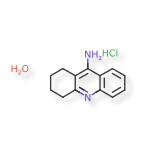
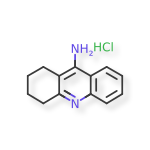
| Related Record | Type | Details | ||
|---|---|---|---|---|
|
METABOLITE -> PARENT |
URINE
|
||
|
METABOLITE ACTIVE -> PARENT |
URINE
|
||
|
METABOLITE -> PARENT |
URINE
|
||
|
METABOLITE -> PARENT |
URINE
|
||
|
METABOLITE -> PARENT |
URINE
|
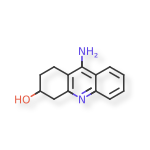
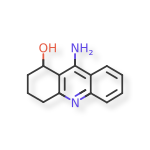

| Related Record | Type | Details | ||
|---|---|---|---|---|
|
|
ACTIVE MOIETY |
|
| Name | Property Type | Amount | Referenced Substance | Defining | Parameters | References |
|---|---|---|---|---|---|---|
| Biological Half-life | PHARMACOKINETIC |
|
|
|||
| Tmax | PHARMACOKINETIC |
|
|
|||
| Volume of Distribution | PHARMACOKINETIC |
|
|
|||