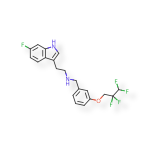
Details
| Stereochemistry | ACHIRAL |
| Molecular Formula | C20H19F5N2O |
| Molecular Weight | 398.3697 |
| Optical Activity | NONE |
| Defined Stereocenters | 0 / 0 |
| E/Z Centers | 0 |
| Charge | 0 |
SHOW SMILES / InChI
SMILES
FC(F)C(F)(F)COC1=CC(CNCCC2=CNC3=C2C=CC(F)=C3)=CC=C1
InChI
InChIKey=YBAWYTYNMZWMMJ-UHFFFAOYSA-N
InChI=1S/C20H19F5N2O/c21-15-4-5-17-14(11-27-18(17)9-15)6-7-26-10-13-2-1-3-16(8-13)28-12-20(24,25)19(22)23/h1-5,8-9,11,19,26-27H,6-7,10,12H2
| Molecular Formula | C20H19F5N2O |
| Molecular Weight | 398.3697 |
| Charge | 0 |
| Count |
|
| Stereochemistry | ACHIRAL |
| Additional Stereochemistry | No |
| Defined Stereocenters | 0 / 0 |
| E/Z Centers | 0 |
| Optical Activity | NONE |
DescriptionCurator's Comment: Description was created based on several sources, including
https://www.ncbi.nlm.nih.gov/pubmed/20569520 | https://www.ncbi.nlm.nih.gov/pubmed/27039041
Curator's Comment: Description was created based on several sources, including
https://www.ncbi.nlm.nih.gov/pubmed/20569520 | https://www.ncbi.nlm.nih.gov/pubmed/27039041
Idalopirdine (Lu AE58054) is a Serotonin 6 receptor (5-HT6) antagonist. Idalopirdine exrets good oral bioavailability and robust efficacy in a rat model of cognitive impairment in schizophrenia. In rats idalopirdine potentiates the effects of acetylcholinesterase inhibitor donepezil on two pharmacodynamic biomarkers associated with cognition, i.e. neuronal oscillations and extracellular ACh levels in the hippocampus. Such potentiation could contribute to the procognitive effects of idalopirdine observed in donepezil-treated Alzheimer's disease patients. The compound is being developed by Lundbeck as an adjunctive therapy with acetylcholinesterase inhibitor donepezil, and is in phase III development for the treatment of Alzheimer's disease in multiple countries worldwide. A phase II trial for the treatment of cognitive impairment associated with schizophrenia was conducted; however no recent reports of development for idalopirdine have been identified.
Originator
Approval Year
Doses
| Dose | Population | Adverse events |
|---|---|---|
30 mg 3 times / day multiple, oral Studied dose Dose: 30 mg, 3 times / day Route: oral Route: multiple Dose: 30 mg, 3 times / day Sources: |
unhealthy, ADULT Health Status: unhealthy Age Group: ADULT Sex: M+F Food Status: UNKNOWN Sources: |
Other AEs: Gamma-glutamyltransferase increased, Alanine aminotransferase increased... Other AEs: Gamma-glutamyltransferase increased (10%) Sources: Alanine aminotransferase increased (6%) Aspartate aminotransferase increased (4%) |
AEs
| AE | Significance | Dose | Population |
|---|---|---|---|
| Gamma-glutamyltransferase increased | 10% | 30 mg 3 times / day multiple, oral Studied dose Dose: 30 mg, 3 times / day Route: oral Route: multiple Dose: 30 mg, 3 times / day Sources: |
unhealthy, ADULT Health Status: unhealthy Age Group: ADULT Sex: M+F Food Status: UNKNOWN Sources: |
| Aspartate aminotransferase increased | 4% | 30 mg 3 times / day multiple, oral Studied dose Dose: 30 mg, 3 times / day Route: oral Route: multiple Dose: 30 mg, 3 times / day Sources: |
unhealthy, ADULT Health Status: unhealthy Age Group: ADULT Sex: M+F Food Status: UNKNOWN Sources: |
| Alanine aminotransferase increased | 6% | 30 mg 3 times / day multiple, oral Studied dose Dose: 30 mg, 3 times / day Route: oral Route: multiple Dose: 30 mg, 3 times / day Sources: |
unhealthy, ADULT Health Status: unhealthy Age Group: ADULT Sex: M+F Food Status: UNKNOWN Sources: |
Overview
| CYP3A4 | CYP2C9 | CYP2D6 | hERG |
|---|---|---|---|
OverviewOther
| Other Inhibitor | Other Substrate | Other Inducer |
|---|---|---|
Drug as perpetrator
| Target | Modality | Activity | Metabolite | Clinical evidence |
|---|---|---|---|---|
| inconclusive [IC50 25.929 uM] | ||||
| yes [IC50 0.0477 uM] | yes (co-administration study) Comment: Increased donepezil bioavailability by 10% |
|||
| yes [IC50 13.4504 uM] | ||||
| yes [IC50 9.5221 uM] |
Drug as victim
| Target | Modality | Activity | Metabolite | Clinical evidence |
|---|---|---|---|---|
| major | ||||
| yes |
PubMed
| Title | Date | PubMed |
|---|---|---|
| Idalopirdine as a treatment for Alzheimer's disease. | 2015 |
|
| Safety and efficacy of idalopirdine, a 5-HT6 receptor antagonist, in patients with moderate Alzheimer's disease (LADDER): a randomised, double-blind, placebo-controlled phase 2 trial. | 2014-11 |
|
| Serotonin 5-HT6 receptor antagonists for the treatment of cognitive deficiency in Alzheimer's disease. | 2014-09-11 |
|
| Novel aza-analogous ergoline derived scaffolds as potent serotonin 5-HT₆ and dopamine D₂ receptor ligands. | 2014-07-10 |
|
| Synthesis and structure-activity relationship (SAR) of (5,7-disubstituted 3-phenylsulfonyl-pyrazolo[1,5-a]pyrimidin-2-yl)-methylamines as potent serotonin 5-HT(6) receptor (5-HT(6)R) antagonists. | 2011-12-08 |
|
| Lu AE58054, a 5-HT6 antagonist, reverses cognitive impairment induced by subchronic phencyclidine in a novel object recognition test in rats. | 2010-09 |
|
| 5-HT6 receptor antagonists as potential therapeutics for cognitive impairment. | 2010 |
|
| Serotonin 5-HT6 receptor antagonists for the treatment of Alzheimer's disease. | 2008 |
Patents
| Substance Class |
Chemical
Created
by
admin
on
Edited
Mon Mar 31 17:55:44 GMT 2025
by
admin
on
Mon Mar 31 17:55:44 GMT 2025
|
| Record UNII |
59WCJ0YNWM
|
| Record Status |
Validated (UNII)
|
| Record Version |
|
-
Download
| Name | Type | Language | ||
|---|---|---|---|---|
|
Official Name | English | ||
|
Preferred Name | English | ||
|
Code | English | ||
|
Code | English | ||
|
Code | English | ||
|
Code | English | ||
|
Systematic Name | English | ||
|
Code | English | ||
|
Common Name | English | ||
|
Code | English | ||
|
Systematic Name | English | ||
|
Code | English | ||
|
Common Name | English | ||
|
Code | English |
| Code System | Code | Type | Description | ||
|---|---|---|---|---|---|
|
DTXSID201026015
Created by
admin on Mon Mar 31 17:55:44 GMT 2025 , Edited by admin on Mon Mar 31 17:55:44 GMT 2025
|
PRIMARY | |||
|
21071390
Created by
admin on Mon Mar 31 17:55:44 GMT 2025 , Edited by admin on Mon Mar 31 17:55:44 GMT 2025
|
PRIMARY | |||
|
9866
Created by
admin on Mon Mar 31 17:55:44 GMT 2025 , Edited by admin on Mon Mar 31 17:55:44 GMT 2025
|
PRIMARY | |||
|
100000174941
Created by
admin on Mon Mar 31 17:55:44 GMT 2025 , Edited by admin on Mon Mar 31 17:55:44 GMT 2025
|
PRIMARY | |||
|
CHEMBL3286580
Created by
admin on Mon Mar 31 17:55:44 GMT 2025 , Edited by admin on Mon Mar 31 17:55:44 GMT 2025
|
PRIMARY | |||
|
467459-31-0
Created by
admin on Mon Mar 31 17:55:44 GMT 2025 , Edited by admin on Mon Mar 31 17:55:44 GMT 2025
|
PRIMARY | |||
|
C166835
Created by
admin on Mon Mar 31 17:55:44 GMT 2025 , Edited by admin on Mon Mar 31 17:55:44 GMT 2025
|
PRIMARY | |||
|
DB11957
Created by
admin on Mon Mar 31 17:55:44 GMT 2025 , Edited by admin on Mon Mar 31 17:55:44 GMT 2025
|
PRIMARY | |||
|
BC-92
Created by
admin on Mon Mar 31 17:55:44 GMT 2025 , Edited by admin on Mon Mar 31 17:55:44 GMT 2025
|
PRIMARY | |||
|
Idalopirdine
Created by
admin on Mon Mar 31 17:55:44 GMT 2025 , Edited by admin on Mon Mar 31 17:55:44 GMT 2025
|
PRIMARY | |||
|
59WCJ0YNWM
Created by
admin on Mon Mar 31 17:55:44 GMT 2025 , Edited by admin on Mon Mar 31 17:55:44 GMT 2025
|
PRIMARY |
| Related Record | Type | Details | ||
|---|---|---|---|---|
|
|
SALT/SOLVATE -> PARENT | |||
|
TARGET -> INHIBITOR |
Phase III trials showed weak efficacy as compared to phase II trials, which may be explained by underdosing. Phase II trials evaluated the use of 90 mg daily (30 mg TID) as an adjunct to an acetylcholinesterase inhibitor. Study investigators decided to lower the dose of idalopirdine in phase III trials based on receptor occupancy analysis conducted by PET scan
|
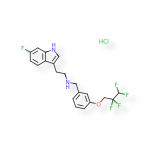

| Related Record | Type | Details | ||
|---|---|---|---|---|
|
|
ACTIVE MOIETY |