


Details
| Stereochemistry | ABSOLUTE |
| Molecular Formula | C20H28N2O5 |
| Molecular Weight | 376.4467 |
| Optical Activity | ( - ) |
| Defined Stereocenters | 3 / 3 |
| E/Z Centers | 0 |
| Charge | 0 |
SHOW SMILES / InChI
SMILES
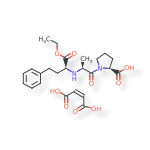
CCOC(=O)[C@H](CCC1=CC=CC=C1)N[C@@H](C)C(=O)N2CCC[C@H]2C(O)=O
InChI
InChIKey=GBXSMTUPTTWBMN-XIRDDKMYSA-N
InChI=1S/C20H28N2O5/c1-3-27-20(26)16(12-11-15-8-5-4-6-9-15)21-14(2)18(23)22-13-7-10-17(22)19(24)25/h4-6,8-9,14,16-17,21H,3,7,10-13H2,1-2H3,(H,24,25)/t14-,16-,17-/m0/s1
| Molecular Formula | C20H28N2O5 |
| Molecular Weight | 376.4467 |
| Charge | 0 |
| Count |
|
| Stereochemistry | ABSOLUTE |
| Additional Stereochemistry | No |
| Defined Stereocenters | 3 / 3 |
| E/Z Centers | 0 |
| Optical Activity | UNSPECIFIED |
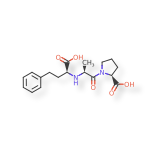
Enalapril (marketed as Vasotec in the US, Enaladex and Renitec in some other countries) is an angiotensin-converting-enzyme (ACE) inhibitor used in the treatment of hypertension, diabetic nephropathy, and some types of chronic heart failure. Enalapril, after hydrolysis to enalaprilat, inhibits angiotensin-converting enzyme (ACE) in human subjects and animals. ACE is a peptidyl dipeptidase that catalyzes the conversion of angiotensin I to the vasoconstrictor substance, angiotensin II. Angiotensin II also stimulates aldosterone secretion by the adrenal cortex. The beneficial effects of enalapril in hypertension and heart failure appear to result primarily from suppression of the renin-angiotensin-aldosterone system. Inhibition of ACE results in decreased plasma angiotensin II, which leads to decreased vasopressor activity and to decrease aldosterone secretion.
CNS Activity
Originator
Approval Year
Targets
| Primary Target | Pharmacology | Condition | Potency |
|---|---|---|---|
Target ID: CHEMBL1808 |
1.94 nM [IC50] | ||
Target ID: CHEMBL1808 |
Conditions
| Condition | Modality | Targets | Highest Phase | Product |
|---|---|---|---|---|
| Primary | VASOTEC Approved UseHypertension Enalapril maleate is indicated for the treatment of hypertension. Enalapril maleate is effective alone or in combination with other antihypertensive agents, especially thiazide-type diuretics. The blood pressure lowering effects of enalapril maleate and thiazides are approximately additive. Heart Failure Enalapril maleate is indicated for the treatment of symptomatic congestive heart failure, usually in combination with diuretics and digitalis. In these patients enalapril maleate improves symptoms, increases survival, and decreases the frequency of hospitalization (see CLINICAL PHARMACOLOGY, Heart Failure, Mortality Trials for details and limitations of survival trials). Asymptomatic Left Ventricular Dysfunction In clinically stable asymptomatic patients with left ventricular dysfunction (ejection fraction ≤35 percent), enalapril maleate decreases the rate of development of overt heart failure and decreases the incidence of hospitalization for heart failure. (See CLINICAL PHARMACOLOGY, Heart Failure, Mortality Trials for details and limitations of survival trials.) In using enalapril maleate, consideration should be given to the fact that another angiotensin converting enzyme inhibitor, captopril, has caused agranulocytosis, particularly in patients with renal impairment or collagen vascular disease, and that available data are insufficient to show that enalapril maleate does not have a similar risk. (See WARNINGS.) In considering use of enalapril maleate, it should be noted that in controlled clinical trials ACE inhibitors have an effect on blood pressure that is less in black patients than in non-blacks. In addition, it should be noted that black patients receiving ACE inhibitors have been reported to have a higher incidence of angioedema compared to non-blacks. (See WARNINGS, Head and Neck Angioedema.), Hypertension Enalapril maleate is indicated for the treatment of hypertension. Enalapril maleate is effective alone or in combination with other antihypertensive agents, especially thiazide-type diuretics. The blood pressure lowering effects of enalapril maleate and thiazides are approximately additive., Heart Failure Enalapril maleate is indicated for the treatment of symptomatic congestive heart failure, usually in combination with diuretics and digitalis. In these patients enalapril maleate improves symptoms, increases survival, and decreases the frequency of hospitalization (see CLINICAL PHARMACOLOGY, Heart Failure, Mortality Trials for details and limitations of survival trials)., Asymptomatic Left Ventricular Dysfunction In clinically stable asymptomatic patients with left ventricular dysfunction (ejection fraction ≤35 percent), enalapril maleate decreases the rate of development of overt heart failure and decreases the incidence of hospitalization for heart failure. (See CLINICAL PHARMACOLOGY, Heart Failure, Mortality Trials for details and limitations of survival trials.) In using enalapril maleate, consideration should be given to the fact that another angiotensin converting enzyme inhibitor, captopril, has caused agranulocytosis, particularly in patients with renal impairment or collagen vascular disease, and that available data are insufficient to show that enalapril maleate does not have a similar risk. (See WARNINGS.) In considering use of enalapril maleate, it should be noted that in controlled clinical trials ACE inhibitors have an effect on blood pressure that is less in black patients than in non-blacks. In addition, it should be noted that black patients receiving ACE inhibitors have been reported to have a higher incidence of angioedema compared to non-blacks. (See WARNINGS, Head and Neck Angioedema.) Launch Date1985 |
|||
| Palliative | VASOTEC Approved UseHypertension Enalapril maleate is indicated for the treatment of hypertension. Enalapril maleate is effective alone or in combination with other antihypertensive agents, especially thiazide-type diuretics. The blood pressure lowering effects of enalapril maleate and thiazides are approximately additive. Heart Failure Enalapril maleate is indicated for the treatment of symptomatic congestive heart failure, usually in combination with diuretics and digitalis. In these patients enalapril maleate improves symptoms, increases survival, and decreases the frequency of hospitalization (see CLINICAL PHARMACOLOGY, Heart Failure, Mortality Trials for details and limitations of survival trials). Asymptomatic Left Ventricular Dysfunction In clinically stable asymptomatic patients with left ventricular dysfunction (ejection fraction ≤35 percent), enalapril maleate decreases the rate of development of overt heart failure and decreases the incidence of hospitalization for heart failure. (See CLINICAL PHARMACOLOGY, Heart Failure, Mortality Trials for details and limitations of survival trials.) In using enalapril maleate, consideration should be given to the fact that another angiotensin converting enzyme inhibitor, captopril, has caused agranulocytosis, particularly in patients with renal impairment or collagen vascular disease, and that available data are insufficient to show that enalapril maleate does not have a similar risk. (See WARNINGS.) In considering use of enalapril maleate, it should be noted that in controlled clinical trials ACE inhibitors have an effect on blood pressure that is less in black patients than in non-blacks. In addition, it should be noted that black patients receiving ACE inhibitors have been reported to have a higher incidence of angioedema compared to non-blacks. (See WARNINGS, Head and Neck Angioedema.), Hypertension Enalapril maleate is indicated for the treatment of hypertension. Enalapril maleate is effective alone or in combination with other antihypertensive agents, especially thiazide-type diuretics. The blood pressure lowering effects of enalapril maleate and thiazides are approximately additive., Heart Failure Enalapril maleate is indicated for the treatment of symptomatic congestive heart failure, usually in combination with diuretics and digitalis. In these patients enalapril maleate improves symptoms, increases survival, and decreases the frequency of hospitalization (see CLINICAL PHARMACOLOGY, Heart Failure, Mortality Trials for details and limitations of survival trials)., Asymptomatic Left Ventricular Dysfunction In clinically stable asymptomatic patients with left ventricular dysfunction (ejection fraction ≤35 percent), enalapril maleate decreases the rate of development of overt heart failure and decreases the incidence of hospitalization for heart failure. (See CLINICAL PHARMACOLOGY, Heart Failure, Mortality Trials for details and limitations of survival trials.) In using enalapril maleate, consideration should be given to the fact that another angiotensin converting enzyme inhibitor, captopril, has caused agranulocytosis, particularly in patients with renal impairment or collagen vascular disease, and that available data are insufficient to show that enalapril maleate does not have a similar risk. (See WARNINGS.) In considering use of enalapril maleate, it should be noted that in controlled clinical trials ACE inhibitors have an effect on blood pressure that is less in black patients than in non-blacks. In addition, it should be noted that black patients receiving ACE inhibitors have been reported to have a higher incidence of angioedema compared to non-blacks. (See WARNINGS, Head and Neck Angioedema.) Launch Date1985 |
|||
| Palliative | VASOTEC Approved UseHypertension Enalapril maleate is indicated for the treatment of hypertension. Enalapril maleate is effective alone or in combination with other antihypertensive agents, especially thiazide-type diuretics. The blood pressure lowering effects of enalapril maleate and thiazides are approximately additive. Heart Failure Enalapril maleate is indicated for the treatment of symptomatic congestive heart failure, usually in combination with diuretics and digitalis. In these patients enalapril maleate improves symptoms, increases survival, and decreases the frequency of hospitalization (see CLINICAL PHARMACOLOGY, Heart Failure, Mortality Trials for details and limitations of survival trials). Asymptomatic Left Ventricular Dysfunction In clinically stable asymptomatic patients with left ventricular dysfunction (ejection fraction ≤35 percent), enalapril maleate decreases the rate of development of overt heart failure and decreases the incidence of hospitalization for heart failure. (See CLINICAL PHARMACOLOGY, Heart Failure, Mortality Trials for details and limitations of survival trials.) In using enalapril maleate, consideration should be given to the fact that another angiotensin converting enzyme inhibitor, captopril, has caused agranulocytosis, particularly in patients with renal impairment or collagen vascular disease, and that available data are insufficient to show that enalapril maleate does not have a similar risk. (See WARNINGS.) In considering use of enalapril maleate, it should be noted that in controlled clinical trials ACE inhibitors have an effect on blood pressure that is less in black patients than in non-blacks. In addition, it should be noted that black patients receiving ACE inhibitors have been reported to have a higher incidence of angioedema compared to non-blacks. (See WARNINGS, Head and Neck Angioedema.), Hypertension Enalapril maleate is indicated for the treatment of hypertension. Enalapril maleate is effective alone or in combination with other antihypertensive agents, especially thiazide-type diuretics. The blood pressure lowering effects of enalapril maleate and thiazides are approximately additive., Heart Failure Enalapril maleate is indicated for the treatment of symptomatic congestive heart failure, usually in combination with diuretics and digitalis. In these patients enalapril maleate improves symptoms, increases survival, and decreases the frequency of hospitalization (see CLINICAL PHARMACOLOGY, Heart Failure, Mortality Trials for details and limitations of survival trials)., Asymptomatic Left Ventricular Dysfunction In clinically stable asymptomatic patients with left ventricular dysfunction (ejection fraction ≤35 percent), enalapril maleate decreases the rate of development of overt heart failure and decreases the incidence of hospitalization for heart failure. (See CLINICAL PHARMACOLOGY, Heart Failure, Mortality Trials for details and limitations of survival trials.) In using enalapril maleate, consideration should be given to the fact that another angiotensin converting enzyme inhibitor, captopril, has caused agranulocytosis, particularly in patients with renal impairment or collagen vascular disease, and that available data are insufficient to show that enalapril maleate does not have a similar risk. (See WARNINGS.) In considering use of enalapril maleate, it should be noted that in controlled clinical trials ACE inhibitors have an effect on blood pressure that is less in black patients than in non-blacks. In addition, it should be noted that black patients receiving ACE inhibitors have been reported to have a higher incidence of angioedema compared to non-blacks. (See WARNINGS, Head and Neck Angioedema.) Launch Date1985 |
Cmax
| Value | Dose | Co-administered | Analyte | Population |
|---|---|---|---|---|
44.27 ng/mL EXPERIMENT https://pubmed.ncbi.nlm.nih.gov/29050316 |
5 mg 2 times / day multiple, oral dose: 5 mg route of administration: Oral experiment type: MULTIPLE co-administered: |
ENALAPRIL plasma | Homo sapiens population: HEALTHY age: ADULT sex: FEMALE / MALE food status: UNKNOWN |
|
37.61 ng/mL EXPERIMENT https://pubmed.ncbi.nlm.nih.gov/29050316 |
5 mg 2 times / day multiple, oral dose: 5 mg route of administration: Oral experiment type: MULTIPLE co-administered: |
ENALAPRILAT plasma | Homo sapiens population: HEALTHY age: ADULT sex: FEMALE / MALE food status: UNKNOWN |
AUC
| Value | Dose | Co-administered | Analyte | Population |
|---|---|---|---|---|
84.9 ng × h/mL EXPERIMENT https://pubmed.ncbi.nlm.nih.gov/29050316 |
5 mg 2 times / day multiple, oral dose: 5 mg route of administration: Oral experiment type: MULTIPLE co-administered: |
ENALAPRIL plasma | Homo sapiens population: HEALTHY age: ADULT sex: FEMALE / MALE food status: UNKNOWN |
|
372.6 ng × h/mL EXPERIMENT https://pubmed.ncbi.nlm.nih.gov/29050316 |
5 mg 2 times / day multiple, oral dose: 5 mg route of administration: Oral experiment type: MULTIPLE co-administered: |
ENALAPRILAT plasma | Homo sapiens population: HEALTHY age: ADULT sex: FEMALE / MALE food status: UNKNOWN |
T1/2
| Value | Dose | Co-administered | Analyte | Population |
|---|---|---|---|---|
10.75 h EXPERIMENT https://pubmed.ncbi.nlm.nih.gov/29050316 |
5 mg 2 times / day multiple, oral dose: 5 mg route of administration: Oral experiment type: MULTIPLE co-administered: |
ENALAPRIL plasma | Homo sapiens population: HEALTHY age: ADULT sex: FEMALE / MALE food status: UNKNOWN |
|
24.73 h EXPERIMENT https://pubmed.ncbi.nlm.nih.gov/29050316 |
5 mg 2 times / day multiple, oral dose: 5 mg route of administration: Oral experiment type: MULTIPLE co-administered: |
ENALAPRILAT plasma | Homo sapiens population: HEALTHY age: ADULT sex: FEMALE / MALE food status: UNKNOWN |
PubMed
| Title | Date | PubMed |
|---|---|---|
| Abnormality of the myocardial sympathetic nervous system in a patient with Becker muscular dystrophy detected with iodine-123 metaiodobenzylguanidine scintigraphy. | 2001-08 |
|
| The effect of enalapril on advanced diabetic nephropathy in African-American females. | 2001-07-18 |
|
| Angiotensin-converting enzyme inhibition with enalapril slows progressive intima-media thickening of the common carotid artery in patients with non-insulin-dependent diabetes mellitus. | 2001-07 |
|
| Protective role of enalapril for chronic tubulointerstitial lesions of hyperoxaluria. | 2001-07 |
|
| IgA nephropathy and inhibitors of the renin angiotensin system: is reduction in proteinuria adequate proof of efficacy? | 2001-07 |
|
| Coadministration of losartan and enalapril exerts additive antiproteinuric effect in IgA nephropathy. | 2001-07 |
|
| Remission achieved in chronic nephropathy by a multidrug approach targeted at urinary protein excretion. | 2001-07 |
|
| Effect of the drug-matrix on the stability of enalapril maleate in tablet formulations. | 2001-07 |
|
| The quantitative determination of several inhibitors of the angiotensin-converting enzyme by CE. | 2001-07 |
|
| Differential effects of nifedipine and co-amilozide on the progression of early carotid wall changes. | 2001-06-19 |
|
| Comparison of effects of losartan versus enalapril on fibrinolysis and coagulation in patients with acute myocardial infarction. | 2001-06-15 |
|
| Weight reduction and pharmacologic treatment in obese hypertensives. | 2001-06 |
|
| Effects of various antihypertensive drugs on the function of osteoblast. | 2001-06 |
|
| Effects of the vasopeptidase inhibitor omapatrilat on cardiac endogenous kinins in rats with acute myocardial infarction. | 2001-06 |
|
| Dyslipidemia and hypertension: twin killers in renal vascular disease. | 2001-06 |
|
| The effects of enalapril-digoxin-diuretic combination therapy on nutritional and anthropometric indices in chronic congestive heart failure: preliminary findings in cardiac cachexia. | 2001-06 |
|
| Reversible renal impairment induced by treatment with the angiotensin II receptor antagonist candesartan in a patient with bilateral renal artery stenosis. | 2001-05-17 |
|
| Resetting baroreceptors to a lower arterial pressure level by enalapril avoids baroreflex mediated activation of sympathetic nervous system by nifedipine. | 2001-05-11 |
|
| Improved survival with simendan after experimental myocardial infarction in rats. | 2001-05-11 |
|
| Effect of column temperature on the behaviour of some angiotensin converting enzyme inhibitors during high-performance liquid chromatographic analysis. | 2001-05-05 |
|
| Racial differences in the response to drugs--pointers to genetic differences. | 2001-05-03 |
|
| Lesser response to angiotensin-converting-enzyme inhibitor therapy in black as compared with white patients with left ventricular dysfunction. | 2001-05-03 |
|
| Does enalapril prevent peritoneal fibrosis induced by hypertonic (3.86%) peritoneal dialysis solution? | 2001-05-02 |
|
| Comparison of the angiotensin II type 1-receptor antagonist YM358 and the angiotensin-converting enzyme inhibitor enalapril in rats with cardiac volume overload. | 2001-05 |
|
| Influence of ACE-inhibition on salt-mediated worsening of pulmonary gas exchange in heart failure. | 2001-05 |
|
| Low birth weight-associated adult hypertension in the rat. | 2001-05 |
|
| A randomized and double-blind comparison of isradipine and spirapril as monotherapy and in combination on the decline in renal function in patients with chronic renal failure and hypertension. | 2001-05 |
|
| Effect of antihypertensive therapy using enalapril or losartan on haemostatic markers in essential hypertension: a pilot prospective randomised double-blind parallel group trial. | 2001-05 |
|
| Angiotensin type 1 receptor antagonism and ACE inhibition produce similar renoprotection in N(omega)-nitro-L>-arginine methyl ester/spontaneously hypertensive rats. | 2001-05 |
|
| Bradykinin stimulates the release of tissue plasminogen activator in human coronary circulation: effects of angiotensin-converting enzyme inhibitors. | 2001-05 |
|
| The bladder angiotensin system in female rats: response to infusions of angiotensin I and the angiotensin converting enzyme inhibitor enalaprilat. | 2001-05 |
|
| Suppression of experimental abdominal aortic aneurysms in the rat by treatment with angiotensin-converting enzyme inhibitors. | 2001-05 |
|
| Hypertensive rebound after angiotensin converting enzyme inhibitor withdrawal in diabetic patients with chronic renal failure. | 2001-05 |
|
| The effect of ACE inhibitor and angiotensin II receptor antagonist therapy on serum uric acid levels and potassium homeostasis in hypertensive renal transplant recipients treated with CsA. | 2001-05 |
|
| Cyclosporine induces myocardial connective tissue growth factor in spontaneously hypertensive rats on high-sodium diet. | 2001-04-15 |
|
| Different potentiating effects of imidapril and enalapril on kaolin-induced writhing reaction in mice. | 2001-04-13 |
|
| The effect of enalapril and verapamil on the left ventricular hypertrophy and the left ventricular cardiomyocyte numerical density in rats submitted to nitric oxide inhibition. | 2001-04 |
|
| Aspirin and ACE-inhibitors: for wedding or funeral? | 2001-04 |
|
| Involvement of angiotensin II in progression of renal injury in rats with genetic non-insulin-dependent diabetes mellitus (Wistar fatty rats). | 2001-04 |
|
| Angiotensin-converting enzyme inhibitors and AT1-receptor antagonist restore nitric oxide synthase (NOS) activity and neuronal NOS expression in the adrenal glands of spontaneously hypertensive rats. | 2001-04 |
|
| Angiotensin converting enzyme inhibitor suppresses glomerular transforming growth factor beta receptor expression in experimental diabetes in rats. | 2001-04 |
|
| The effects of allicin and enalapril in fructose-induced hyperinsulinemic hyperlipidemic hypertensive rats. | 2001-04 |
|
| The influence of chronic antihypertensive treatment on the central pressor response in SHR. | 2001-03 |
|
| Heart biometry and allometry in rats submitted to nitric oxide synthesis blockade and treatment with antihypertensive drugs. | 2001-03 |
|
| Low-dose ACE with alpha- or beta-adrenergic receptor inhibitors have beneficial SHR cardiovascular effects. | 2001-01 |
|
| Severe childhood pemphigus vulgaris aggravated by enalapril. | 2001 |
|
| Barnidipine. | 2001 |
|
| Perindopril: an updated review of its use in hypertension. | 2001 |
|
| The role of angiotensin II receptor antagonists in the management of diabetes. | 2001 |
|
| The effect duration of candesartan cilexetil once daily, in comparison with enalapril once daily, in patients with mild to moderate hypertension. | 2001 |
Patents
Sample Use Guides
Hypertension: The recommended initial dose in patients not on diuretics is 5 mg once a day.
Dosage Adjustment in Hypertensive Patients with Renal Impairment: The usual dose of enalapril is recommended for patients with a creatinine clearance >30 mL/min (serum
creatinine of up to approximately 3 mg/dL). For patients with creatinine clearance ≤30 mL/min (serum creatinine ≥3 mg/dL), the first dose is 2.5 mg once daily. The dosage may be titrated upward until blood pressure is controlled or to a maximum of 40 mg daily.
Heart Failure: The recommended initial dose is 2.5 mg. The recommended dosing range is 2.5 to 20 mg given twice a day
Route of Administration:
Oral
Primary cultures of human proximal tubular cells (PTC) and renal cortical fibroblasts (CF) were exposed for 24 h to CyA in the presence or absence of enalaprilat (enalapril is a prodrug that is rapidly metabolized by liver esterases to enalaprilat). Enalaprilat completely reversed the stimulatory effects of CyA on CF collagen synthesis (CyA + enalaprilat 6.40 +/- 0.50% vs. CyA alone 8.33 +/- 0.56% vs. control 6.57 +/- 0.62% vs. enalaprilat alone 5.55 +/- 0.93%, p < 0.05) and PTC secretion of TGFbeta1 (0.71 +/- 0.11, 1.13 +/- 0.09, 0.89 +/- 0.07, and 0.67 +/- 0.09 ng/mg protein/day, respectively, p < 0.05).
| Substance Class |
Chemical
Created
by
admin
on
Edited
Mon Mar 31 17:56:36 GMT 2025
by
admin
on
Mon Mar 31 17:56:36 GMT 2025
|
| Record UNII |
69PN84IO1A
|
| Record Status |
Validated (UNII)
|
| Record Version |
|
-
Download
| Name | Type | Language | ||
|---|---|---|---|---|
|
Official Name | English | ||
|
Preferred Name | English | ||
|
Common Name | English | ||
|
Common Name | English | ||
|
Common Name | English | ||
|
Common Name | English | ||
|
Systematic Name | English | ||
|
Common Name | English | ||
|
Systematic Name | English | ||
|
Common Name | English |
| Classification Tree | Code System | Code | ||
|---|---|---|---|---|
|
WHO-ATC |
C09AA02
Created by
admin on Mon Mar 31 17:56:36 GMT 2025 , Edited by admin on Mon Mar 31 17:56:36 GMT 2025
|
||
|
WHO-ATC |
C09BB02
Created by
admin on Mon Mar 31 17:56:36 GMT 2025 , Edited by admin on Mon Mar 31 17:56:36 GMT 2025
|
||
|
WHO-VATC |
QC09BB02
Created by
admin on Mon Mar 31 17:56:36 GMT 2025 , Edited by admin on Mon Mar 31 17:56:36 GMT 2025
|
||
|
WHO-VATC |
QC09AA02
Created by
admin on Mon Mar 31 17:56:36 GMT 2025 , Edited by admin on Mon Mar 31 17:56:36 GMT 2025
|
||
|
NDF-RT |
N0000000181
Created by
admin on Mon Mar 31 17:56:36 GMT 2025 , Edited by admin on Mon Mar 31 17:56:36 GMT 2025
|
||
|
NDF-RT |
N0000175562
Created by
admin on Mon Mar 31 17:56:36 GMT 2025 , Edited by admin on Mon Mar 31 17:56:36 GMT 2025
|
||
|
WHO-VATC |
QC09BA02
Created by
admin on Mon Mar 31 17:56:36 GMT 2025 , Edited by admin on Mon Mar 31 17:56:36 GMT 2025
|
||
|
CFR |
21 CFR 520.804
Created by
admin on Mon Mar 31 17:56:36 GMT 2025 , Edited by admin on Mon Mar 31 17:56:36 GMT 2025
|
||
|
WHO-ATC |
C09BA02
Created by
admin on Mon Mar 31 17:56:36 GMT 2025 , Edited by admin on Mon Mar 31 17:56:36 GMT 2025
|
||
|
WHO-ATC |
C09BB06
Created by
admin on Mon Mar 31 17:56:36 GMT 2025 , Edited by admin on Mon Mar 31 17:56:36 GMT 2025
|
||
|
NCI_THESAURUS |
C247
Created by
admin on Mon Mar 31 17:56:36 GMT 2025 , Edited by admin on Mon Mar 31 17:56:36 GMT 2025
|
||
|
WHO-ESSENTIAL MEDICINES LIST |
12.3
Created by
admin on Mon Mar 31 17:56:36 GMT 2025 , Edited by admin on Mon Mar 31 17:56:36 GMT 2025
|
||
|
WHO-ESSENTIAL MEDICINES LIST |
12.4
Created by
admin on Mon Mar 31 17:56:36 GMT 2025 , Edited by admin on Mon Mar 31 17:56:36 GMT 2025
|
||
|
WHO-VATC |
QC09BB06
Created by
admin on Mon Mar 31 17:56:36 GMT 2025 , Edited by admin on Mon Mar 31 17:56:36 GMT 2025
|
||
|
LIVERTOX |
NBK547936
Created by
admin on Mon Mar 31 17:56:36 GMT 2025 , Edited by admin on Mon Mar 31 17:56:36 GMT 2025
|
| Code System | Code | Type | Description | ||
|---|---|---|---|---|---|
|
75847-73-3
Created by
admin on Mon Mar 31 17:56:36 GMT 2025 , Edited by admin on Mon Mar 31 17:56:36 GMT 2025
|
PRIMARY | |||
|
4784
Created by
admin on Mon Mar 31 17:56:36 GMT 2025 , Edited by admin on Mon Mar 31 17:56:36 GMT 2025
|
PRIMARY | |||
|
D004656
Created by
admin on Mon Mar 31 17:56:36 GMT 2025 , Edited by admin on Mon Mar 31 17:56:36 GMT 2025
|
PRIMARY | |||
|
Enalapril
Created by
admin on Mon Mar 31 17:56:36 GMT 2025 , Edited by admin on Mon Mar 31 17:56:36 GMT 2025
|
PRIMARY | |||
|
5117
Created by
admin on Mon Mar 31 17:56:36 GMT 2025 , Edited by admin on Mon Mar 31 17:56:36 GMT 2025
|
PRIMARY | |||
|
69PN84IO1A
Created by
admin on Mon Mar 31 17:56:36 GMT 2025 , Edited by admin on Mon Mar 31 17:56:36 GMT 2025
|
PRIMARY | |||
|
5388962
Created by
admin on Mon Mar 31 17:56:36 GMT 2025 , Edited by admin on Mon Mar 31 17:56:36 GMT 2025
|
PRIMARY | |||
|
69PN84IO1A
Created by
admin on Mon Mar 31 17:56:36 GMT 2025 , Edited by admin on Mon Mar 31 17:56:36 GMT 2025
|
PRIMARY | |||
|
SUB06514MIG
Created by
admin on Mon Mar 31 17:56:36 GMT 2025 , Edited by admin on Mon Mar 31 17:56:36 GMT 2025
|
PRIMARY | |||
|
DTXSID5022982
Created by
admin on Mon Mar 31 17:56:36 GMT 2025 , Edited by admin on Mon Mar 31 17:56:36 GMT 2025
|
PRIMARY | |||
|
ENALAPRIL
Created by
admin on Mon Mar 31 17:56:36 GMT 2025 , Edited by admin on Mon Mar 31 17:56:36 GMT 2025
|
PRIMARY | |||
|
1005
Created by
admin on Mon Mar 31 17:56:36 GMT 2025 , Edited by admin on Mon Mar 31 17:56:36 GMT 2025
|
PRIMARY | |||
|
3827
Created by
admin on Mon Mar 31 17:56:36 GMT 2025 , Edited by admin on Mon Mar 31 17:56:36 GMT 2025
|
PRIMARY | RxNorm | ||
|
m4893
Created by
admin on Mon Mar 31 17:56:36 GMT 2025 , Edited by admin on Mon Mar 31 17:56:36 GMT 2025
|
PRIMARY | Merck Index | ||
|
CHEMBL578
Created by
admin on Mon Mar 31 17:56:36 GMT 2025 , Edited by admin on Mon Mar 31 17:56:36 GMT 2025
|
PRIMARY | |||
|
DB00584
Created by
admin on Mon Mar 31 17:56:36 GMT 2025 , Edited by admin on Mon Mar 31 17:56:36 GMT 2025
|
PRIMARY | |||
|
C62027
Created by
admin on Mon Mar 31 17:56:36 GMT 2025 , Edited by admin on Mon Mar 31 17:56:36 GMT 2025
|
PRIMARY | |||
|
100000092359
Created by
admin on Mon Mar 31 17:56:36 GMT 2025 , Edited by admin on Mon Mar 31 17:56:36 GMT 2025
|
PRIMARY | |||
|
6322
Created by
admin on Mon Mar 31 17:56:36 GMT 2025 , Edited by admin on Mon Mar 31 17:56:36 GMT 2025
|
PRIMARY |
| Related Record | Type | Details | ||
|---|---|---|---|---|
|
|
SALT/SOLVATE -> PARENT |
|
||
|
|
METABOLIC ENZYME -> SUBSTRATE |
|

| Related Record | Type | Details | ||
|---|---|---|---|---|
|
METABOLITE ACTIVE -> PRODRUG |
|
| Related Record | Type | Details | ||
|---|---|---|---|---|
|
|
ACTIVE MOIETY |
|