


Details
| Stereochemistry | ABSOLUTE |
| Molecular Formula | C37H42F2N8O4 |
| Molecular Weight | 700.7774 |
| Optical Activity | ( - ) |
| Defined Stereocenters | 4 / 4 |
| E/Z Centers | 0 |
| Charge | 0 |
SHOW SMILES / InChI
SMILES
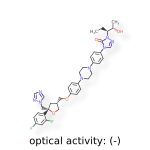
CC[C@@H]([C@H](C)O)N1N=CN(C1=O)C2=CC=C(C=C2)N3CCN(CC3)C4=CC=C(OC[C@@H]5CO[C@](CN6C=NC=N6)(C5)C7=CC=C(F)C=C7F)C=C4
InChI
InChIKey=RAGOYPUPXAKGKH-XAKZXMRKSA-N
InChI=1S/C37H42F2N8O4/c1-3-35(26(2)48)47-36(49)46(25-42-47)31-7-5-29(6-8-31)43-14-16-44(17-15-43)30-9-11-32(12-10-30)50-20-27-19-37(51-21-27,22-45-24-40-23-41-45)33-13-4-28(38)18-34(33)39/h4-13,18,23-27,35,48H,3,14-17,19-22H2,1-2H3/t26-,27+,35-,37-/m0/s1
| Molecular Formula | C37H42F2N8O4 |
| Molecular Weight | 700.7774 |
| Charge | 0 |
| Count |
|
| Stereochemistry | ABSOLUTE |
| Additional Stereochemistry | No |
| Defined Stereocenters | 4 / 4 |
| E/Z Centers | 0 |
| Optical Activity | UNSPECIFIED |
DescriptionSources: http://www.accessdata.fda.gov/drugsatfda_docs/label/2016/022003s021,205053s005,205596s004lbl.pdfCurator's Comment: description was created based on several sources, including
https://www.ncbi.nlm.nih.gov/pubmed/18035188
Sources: http://www.accessdata.fda.gov/drugsatfda_docs/label/2016/022003s021,205053s005,205596s004lbl.pdf
Curator's Comment: description was created based on several sources, including
https://www.ncbi.nlm.nih.gov/pubmed/18035188
Posaconazole is a triazole antifungal drug that is used to treat invasive infections by Candida species and Aspergillus species in severely immunocompromised patients. It marketed in the United States, the European Union, and in other countries by Schering-Plough under the trade name Noxafil. Noxafil is used for prophylaxis of invasive Aspergillus and Candida infections in patients, 13 years of age and older, who are at high risk of developing these infections due to being severely immunocompromised as a result of procedures such as hematopoietic stem cell transplant (HSCT) recipients with graft-versus-host disease (GVHD), or due to hematologic malignancies with prolonged neutropenia from chemotherapy. Also for the treatment of oropharyngeal candidiasis, including oropharyngeal candidiasis refractory to itraconazole and/or fluconazole. Posaconazole blocks the synthesis of ergosterol, a key component of the fungal cell membrane, through the inhibition of cytochrome P-450 dependent enzyme lanosterol 14α-demethylase responsible for the conversion of lanosterol to ergosterol in the fungal cell membrane. This results in an accumulation of methylated sterol precursors and a depletion of ergosterol within the cell membrane thus weakening the structure and function of the fungal cell membrane. This may be responsible for the antifungal activity of posaconazole. It is absorbed within three to five hours and predominately eliminated through the liver, and has a half-life of about 35 hours. Oral administration of posaconazole taken with a high-fat meal exceeds 90% bioavailability and increases the concentration by four times compared to fasting state.
CNS Activity
Approval Year
Targets
| Primary Target | Pharmacology | Condition | Potency |
|---|---|---|---|
Target ID: CHEMBL1780 |
25.0 nM [Kd] |
Conditions
| Condition | Modality | Targets | Highest Phase | Product |
|---|---|---|---|---|
| Preventing | NOXAFIL Approved UseNoxafil is an azole antifungal agent indicated for: injection, delayed-release tablets, and oral suspension prophylaxis of invasive Aspergillus and Candida infections in patients who are at high risk of developing these infections due to being severely immunocompromised, such as HSCT recipients with GVHD or those with hematologic malignancies with prolonged neutropenia from chemotherapy. (1.1) Oral suspension treatment of oropharyngeal candidiasis (OPC), including OPC refractory (rOPC) to itraconazole and/or fluconazole. (1.2) 1.1 Prophylaxis of Invasive Aspergillus and Candida Infections Noxafil® injection, delayed-release tablets, and oral suspension are indicated for prophylaxis of invasive Aspergillus and Candida infections in patients who are at high risk of developing these infections due to being severely immunocompromised, such as hematopoietic stem cell transplant (HSCT) recipients with graft-versus-host disease (GVHD) or those with hematologic malignancies with prolonged neutropenia from chemotherapy. Noxafil injection is indicated in patients 18 years of age and older. Noxafil delayed-release tablets and oral suspension are indicated in patients 13 years of age and older. 1.2 Treatment of Oropharyngeal Candidiasis Including Oropharyngeal Candidiasis Refractory to Itraconazole and/or Fluconazole Noxafil oral suspension is indicated for the treatment of oropharyngeal candidiasis, including oropharyngeal candidiasis refractory to itraconazole and/or fluconazole. Launch Date2006 |
|||
| Preventing | NOXAFIL Approved UseNoxafil is an azole antifungal agent indicated for: injection, delayed-release tablets, and oral suspension prophylaxis of invasive Aspergillus and Candida infections in patients who are at high risk of developing these infections due to being severely immunocompromised, such as HSCT recipients with GVHD or those with hematologic malignancies with prolonged neutropenia from chemotherapy. (1.1) Oral suspension treatment of oropharyngeal candidiasis (OPC), including OPC refractory (rOPC) to itraconazole and/or fluconazole. (1.2) 1.1 Prophylaxis of Invasive Aspergillus and Candida Infections Noxafil® injection, delayed-release tablets, and oral suspension are indicated for prophylaxis of invasive Aspergillus and Candida infections in patients who are at high risk of developing these infections due to being severely immunocompromised, such as hematopoietic stem cell transplant (HSCT) recipients with graft-versus-host disease (GVHD) or those with hematologic malignancies with prolonged neutropenia from chemotherapy. Noxafil injection is indicated in patients 18 years of age and older. Noxafil delayed-release tablets and oral suspension are indicated in patients 13 years of age and older. 1.2 Treatment of Oropharyngeal Candidiasis Including Oropharyngeal Candidiasis Refractory to Itraconazole and/or Fluconazole Noxafil oral suspension is indicated for the treatment of oropharyngeal candidiasis, including oropharyngeal candidiasis refractory to itraconazole and/or fluconazole. Launch Date2006 |
|||
| Curative | NOXAFIL Approved UseNoxafil is an azole antifungal agent indicated for: injection, delayed-release tablets, and oral suspension prophylaxis of invasive Aspergillus and Candida infections in patients who are at high risk of developing these infections due to being severely immunocompromised, such as HSCT recipients with GVHD or those with hematologic malignancies with prolonged neutropenia from chemotherapy. (1.1) Oral suspension treatment of oropharyngeal candidiasis (OPC), including OPC refractory (rOPC) to itraconazole and/or fluconazole. (1.2) 1.1 Prophylaxis of Invasive Aspergillus and Candida Infections Noxafil® injection, delayed-release tablets, and oral suspension are indicated for prophylaxis of invasive Aspergillus and Candida infections in patients who are at high risk of developing these infections due to being severely immunocompromised, such as hematopoietic stem cell transplant (HSCT) recipients with graft-versus-host disease (GVHD) or those with hematologic malignancies with prolonged neutropenia from chemotherapy. Noxafil injection is indicated in patients 18 years of age and older. Noxafil delayed-release tablets and oral suspension are indicated in patients 13 years of age and older. 1.2 Treatment of Oropharyngeal Candidiasis Including Oropharyngeal Candidiasis Refractory to Itraconazole and/or Fluconazole Noxafil oral suspension is indicated for the treatment of oropharyngeal candidiasis, including oropharyngeal candidiasis refractory to itraconazole and/or fluconazole. Launch Date2006 |
Cmax
| Value | Dose | Co-administered | Analyte | Population |
|---|---|---|---|---|
3280 ng/mL |
300 mg 1 times / day multiple, intravenous dose: 300 mg route of administration: Intravenous experiment type: MULTIPLE co-administered: |
POSACONAZOLE plasma | Homo sapiens population: UNHEALTHY age: ADULT sex: FEMALE / MALE food status: UNKNOWN |
|
2840 ng/mL |
300 mg single, intravenous dose: 300 mg route of administration: Intravenous experiment type: SINGLE co-administered: |
[NO STEREO] POSACONAZOLE plasma | Homo sapiens population: HEALTHY age: ADULT sex: FEMALE / MALE food status: UNKNOWN |
|
2764 ng/mL |
300 mg single, oral dose: 300 mg route of administration: Oral experiment type: SINGLE co-administered: |
[NO STEREO] POSACONAZOLE plasma | Homo sapiens population: HEALTHY age: ADULT sex: UNKNOWN food status: UNKNOWN |
|
935 ng/mL |
300 mg single, oral dose: 300 mg route of administration: Oral experiment type: SINGLE co-administered: |
[NO STEREO] POSACONAZOLE plasma | Homo sapiens population: HEALTHY age: ADULT sex: UNKNOWN food status: FASTED |
|
1060 ng/mL |
300 mg single, oral dose: 300 mg route of administration: Oral experiment type: SINGLE co-administered: |
[NO STEREO] POSACONAZOLE plasma | Homo sapiens population: HEALTHY age: ADULT sex: UNKNOWN food status: FED |
AUC
| Value | Dose | Co-administered | Analyte | Population |
|---|---|---|---|---|
36100 ng × h/mL |
300 mg 1 times / day multiple, intravenous dose: 300 mg route of administration: Intravenous experiment type: MULTIPLE co-administered: |
POSACONAZOLE plasma | Homo sapiens population: UNHEALTHY age: ADULT sex: FEMALE / MALE food status: UNKNOWN |
|
46400 ng × h/mL |
300 mg single, intravenous dose: 300 mg route of administration: Intravenous experiment type: SINGLE co-administered: |
[NO STEREO] POSACONAZOLE plasma | Homo sapiens population: HEALTHY age: ADULT sex: FEMALE / MALE food status: UNKNOWN |
|
51618 ng × h/mL |
300 mg single, oral dose: 300 mg route of administration: Oral experiment type: SINGLE co-administered: |
[NO STEREO] POSACONAZOLE plasma | Homo sapiens population: HEALTHY age: ADULT sex: UNKNOWN food status: UNKNOWN |
|
9093 ng × h/mL |
400 mg 2 times / day steady-state, oral dose: 400 mg route of administration: Oral experiment type: STEADY-STATE co-administered: |
[NO STEREO] POSACONAZOLE plasma | Homo sapiens population: UNHEALTHY age: ADULT sex: UNKNOWN food status: UNKNOWN |
|
26200 ng × h/mL |
300 mg single, oral dose: 300 mg route of administration: Oral experiment type: SINGLE co-administered: |
[NO STEREO] POSACONAZOLE plasma | Homo sapiens population: HEALTHY age: ADULT sex: UNKNOWN food status: FASTED |
|
38400 ng × h/mL |
300 mg single, oral dose: 300 mg route of administration: Oral experiment type: SINGLE co-administered: |
[NO STEREO] POSACONAZOLE plasma | Homo sapiens population: HEALTHY age: ADULT sex: UNKNOWN food status: FED |
T1/2
| Value | Dose | Co-administered | Analyte | Population |
|---|---|---|---|---|
24.6 h |
300 mg single, intravenous dose: 300 mg route of administration: Intravenous experiment type: SINGLE co-administered: |
[NO STEREO] POSACONAZOLE plasma | Homo sapiens population: HEALTHY age: ADULT sex: FEMALE / MALE food status: UNKNOWN |
|
31 h |
300 mg single, oral dose: 300 mg route of administration: Oral experiment type: SINGLE co-administered: |
[NO STEREO] POSACONAZOLE plasma | Homo sapiens population: HEALTHY age: ADULT sex: UNKNOWN food status: UNKNOWN |
|
31.7 h |
400 mg 2 times / day steady-state, oral dose: 400 mg route of administration: Oral experiment type: STEADY-STATE co-administered: |
[NO STEREO] POSACONAZOLE plasma | Homo sapiens population: UNHEALTHY age: ADULT sex: UNKNOWN food status: UNKNOWN |
Funbound
| Value | Dose | Co-administered | Analyte | Population |
|---|---|---|---|---|
2% |
300 mg 1 times / day multiple, intravenous dose: 300 mg route of administration: Intravenous experiment type: MULTIPLE co-administered: |
POSACONAZOLE plasma | Homo sapiens population: UNHEALTHY age: ADULT sex: FEMALE / MALE food status: UNKNOWN |
|
2% |
300 mg single, intravenous dose: 300 mg route of administration: Intravenous experiment type: SINGLE co-administered: |
[NO STEREO] POSACONAZOLE plasma | Homo sapiens population: HEALTHY age: ADULT sex: FEMALE / MALE food status: UNKNOWN |
Doses
| Dose | Population | Adverse events |
|---|---|---|
300 mg 2 times / day multiple, intravenous Recommended Dose: 300 mg, 2 times / day Route: intravenous Route: multiple Dose: 300 mg, 2 times / day Sources: |
unhealthy, 51.55 |
Disc. AE: Rash... AEs leading to discontinuation/dose reduction: Rash (0.84%) Sources: |
1600 mg 1 times / day multiple, oral Highest studied dose Dose: 1600 mg, 1 times / day Route: oral Route: multiple Dose: 1600 mg, 1 times / day Sources: |
unhealthy |
Disc. AE: Hepatic enzyme increased... Other AEs: Nausea, Vomiting... AEs leading to discontinuation/dose reduction: Hepatic enzyme increased (67%) Other AEs:Nausea (67%) Sources: Vomiting (67%) Diarrhea (67%) Somnolence (67%) |
200 mg 3 times / day multiple, oral Recommended Dose: 200 mg, 3 times / day Route: oral Route: multiple Dose: 200 mg, 3 times / day Sources: |
unhealthy Health Status: unhealthy Sources: |
Disc. AE: Nausea, Vomiting... AEs leading to discontinuation/dose reduction: Nausea (2%) Sources: Vomiting (2%) Hepatic enzymes increased (2%) |
300 mg 2 times / day multiple, intravenous Recommended Dose: 300 mg, 2 times / day Route: intravenous Route: multiple Dose: 300 mg, 2 times / day Sources: |
unhealthy Health Status: unhealthy Sources: |
Disc. AE: Arrhythmia, Electrocardiogram QTc interval prolonged... AEs leading to discontinuation/dose reduction: Arrhythmia Sources: Electrocardiogram QTc interval prolonged Hepatotoxicity |
400 mg 1 times / day multiple, oral Recommended Dose: 400 mg, 1 times / day Route: oral Route: multiple Dose: 400 mg, 1 times / day Sources: |
unhealthy Health Status: unhealthy Sources: |
Disc. AE: Pneumonia... AEs leading to discontinuation/dose reduction: Pneumonia (1%) Sources: |
400 mg 2 times / day multiple, oral Recommended Dose: 400 mg, 2 times / day Route: oral Route: multiple Dose: 400 mg, 2 times / day Sources: |
unhealthy Health Status: unhealthy Sources: |
Disc. AE: Pulmonary function impairment, AIDS... AEs leading to discontinuation/dose reduction: Pulmonary function impairment (3%) Sources: AIDS (7%) |
AEs
| AE | Significance | Dose | Population |
|---|---|---|---|
| Rash | 0.84% Disc. AE |
300 mg 2 times / day multiple, intravenous Recommended Dose: 300 mg, 2 times / day Route: intravenous Route: multiple Dose: 300 mg, 2 times / day Sources: |
unhealthy, 51.55 |
| Diarrhea | 67% | 1600 mg 1 times / day multiple, oral Highest studied dose Dose: 1600 mg, 1 times / day Route: oral Route: multiple Dose: 1600 mg, 1 times / day Sources: |
unhealthy |
| Nausea | 67% | 1600 mg 1 times / day multiple, oral Highest studied dose Dose: 1600 mg, 1 times / day Route: oral Route: multiple Dose: 1600 mg, 1 times / day Sources: |
unhealthy |
| Somnolence | 67% | 1600 mg 1 times / day multiple, oral Highest studied dose Dose: 1600 mg, 1 times / day Route: oral Route: multiple Dose: 1600 mg, 1 times / day Sources: |
unhealthy |
| Vomiting | 67% | 1600 mg 1 times / day multiple, oral Highest studied dose Dose: 1600 mg, 1 times / day Route: oral Route: multiple Dose: 1600 mg, 1 times / day Sources: |
unhealthy |
| Hepatic enzyme increased | 67% Disc. AE |
1600 mg 1 times / day multiple, oral Highest studied dose Dose: 1600 mg, 1 times / day Route: oral Route: multiple Dose: 1600 mg, 1 times / day Sources: |
unhealthy |
| Hepatic enzymes increased | 2% Disc. AE |
200 mg 3 times / day multiple, oral Recommended Dose: 200 mg, 3 times / day Route: oral Route: multiple Dose: 200 mg, 3 times / day Sources: |
unhealthy Health Status: unhealthy Sources: |
| Nausea | 2% Disc. AE |
200 mg 3 times / day multiple, oral Recommended Dose: 200 mg, 3 times / day Route: oral Route: multiple Dose: 200 mg, 3 times / day Sources: |
unhealthy Health Status: unhealthy Sources: |
| Vomiting | 2% Disc. AE |
200 mg 3 times / day multiple, oral Recommended Dose: 200 mg, 3 times / day Route: oral Route: multiple Dose: 200 mg, 3 times / day Sources: |
unhealthy Health Status: unhealthy Sources: |
| Arrhythmia | Disc. AE | 300 mg 2 times / day multiple, intravenous Recommended Dose: 300 mg, 2 times / day Route: intravenous Route: multiple Dose: 300 mg, 2 times / day Sources: |
unhealthy Health Status: unhealthy Sources: |
| Electrocardiogram QTc interval prolonged | Disc. AE | 300 mg 2 times / day multiple, intravenous Recommended Dose: 300 mg, 2 times / day Route: intravenous Route: multiple Dose: 300 mg, 2 times / day Sources: |
unhealthy Health Status: unhealthy Sources: |
| Hepatotoxicity | Disc. AE | 300 mg 2 times / day multiple, intravenous Recommended Dose: 300 mg, 2 times / day Route: intravenous Route: multiple Dose: 300 mg, 2 times / day Sources: |
unhealthy Health Status: unhealthy Sources: |
| Pneumonia | 1% Disc. AE |
400 mg 1 times / day multiple, oral Recommended Dose: 400 mg, 1 times / day Route: oral Route: multiple Dose: 400 mg, 1 times / day Sources: |
unhealthy Health Status: unhealthy Sources: |
| Pulmonary function impairment | 3% Disc. AE |
400 mg 2 times / day multiple, oral Recommended Dose: 400 mg, 2 times / day Route: oral Route: multiple Dose: 400 mg, 2 times / day Sources: |
unhealthy Health Status: unhealthy Sources: |
| AIDS | 7% Disc. AE |
400 mg 2 times / day multiple, oral Recommended Dose: 400 mg, 2 times / day Route: oral Route: multiple Dose: 400 mg, 2 times / day Sources: |
unhealthy Health Status: unhealthy Sources: |
Overview
| CYP3A4 | CYP2C9 | CYP2D6 | hERG |
|---|---|---|---|
OverviewOther
| Other Inhibitor | Other Substrate | Other Inducer |
|---|---|---|
Drug as perpetrator
| Target | Modality | Activity | Metabolite | Clinical evidence |
|---|---|---|---|---|
| no | ||||
| no | ||||
| no | ||||
| no | ||||
| yes [IC50 3 uM] | ||||
| yes [IC50 6 uM] | ||||
| yes | ||||
| yes | ||||
| yes | yes (co-administration study) Comment: concommitant administration of psconazole with midazolam increases midazolam plasma concentritons by 5-fold Page: 17.0 |
Drug as victim
| Target | Modality | Activity | Metabolite | Clinical evidence |
|---|---|---|---|---|
| yes | ||||
| yes | yes (co-administration study) Comment: rifabutin decreases posaconazole plasma concentrations Page: 16, 17, 27 |
PubMed
| Title | Date | PubMed |
|---|---|---|
| A multifactorial approach to hepatobiliary transporter assessment enables improved therapeutic compound development. | 2013-11 |
|
| Epidemiological cutoff values for fluconazole, itraconazole, posaconazole, and voriconazole for six Candida species as determined by the colorimetric Sensititre YeastOne method. | 2013-08 |
|
| In vitro antifungal susceptibility of clinically relevant species belonging to Aspergillus section Flavi. | 2013-04 |
|
| Posaconazole exhibits in vitro and in vivo synergistic antifungal activity with caspofungin or FK506 against Candida albicans. | 2013 |
|
| Effect of pH on in vitro susceptibility of Candida glabrata and Candida albicans to 11 antifungal agents and implications for clinical use. | 2012-03 |
|
| Antifungal susceptibilities of Aspergillus fumigatus clinical isolates obtained in Nagasaki, Japan. | 2012-01 |
|
| In vitro activities of new triazole antifungal agents, posaconazole and voriconazole, against oral Candida isolates from patients suffering from denture stomatitis. | 2012-01 |
|
| In vitro activity of isavuconazole against 208 Aspergillus flavus isolates in comparison with 7 other antifungal agents: assessment according to the methodology of the European Committee on Antimicrobial Susceptibility Testing. | 2011-12 |
|
| Triazole and echinocandin MIC distributions with epidemiological cutoff values for differentiation of wild-type strains from non-wild-type strains of six uncommon species of Candida. | 2011-11 |
|
| In vitro activity of a novel broad-spectrum antifungal, E1210, tested against Candida spp. as determined by CLSI broth microdilution method. | 2011-10 |
|
| Multilaboratory testing of two-drug combinations of antifungals against Candida albicans, Candida glabrata, and Candida parapsilosis. | 2011-04 |
|
| Therapeutic efficacy of posaconazole against Candida glabrata in a murine model of vaginitis. | 2011-03 |
|
| Isavuconazole: a comprehensive review of spectrum of activity of a new triazole. | 2010-11 |
|
| Potential synergistic activity of antimycotic substances in combination with human platelets against Aspergillus fumigatus. | 2010-06 |
|
| Activity of MGCD290, a Hos2 histone deacetylase inhibitor, in combination with azole antifungals against opportunistic fungal pathogens. | 2009-12 |
|
| Posaconazole-increased vincristine neurotoxicity in a child: a case report. | 2009-04 |
|
| Adverse drug events complicate antifungal therapy for pulmonary aspergilloma. | 2008-10 |
|
| Possible increase of the neurotoxicity of vincristine by the concurrent use of posaconazole in a young adult with leukemia. | 2007-02 |
|
| In vitro activities of posaconazole, fluconazole, itraconazole, voriconazole, and amphotericin B against a large collection of clinically important molds and yeasts. | 2006-06 |
|
| Posaconazole: a broad-spectrum triazole antifungal. | 2005-12 |
|
| Reversible dilated cardiomyopathy related to amphotericin B therapy. | 2004-01 |
|
| Activities of caspofungin, itraconazole, posaconazole, ravuconazole, voriconazole, and amphotericin B against 448 recent clinical isolates of filamentous fungi. | 2003-08 |
|
| Treatment of Scedosporium apiospermum brain abscesses with posaconazole. | 2002-06-15 |
|
| Activity of the new antifungal triazole, posaconazole, against Cryptococcus neoformans. | 2001-12 |
|
| Antifungals: what's in the pipeline. | 2001-10 |
|
| In vitro activities of posaconazole (Sch 56592) compared with those of itraconazole and fluconazole against 3,685 clinical isolates of Candida spp. and Cryptococcus neoformans. | 2001-10 |
|
| In vitro antifungal activity of posaconazole against various pathogenic fungi. | 2001-08 |
|
| In vitro and in vivo activities of SCH 56592 (posaconazole), a new triazole antifungal agent, against Aspergillus and Candida. | 2000-08 |
|
| In vitro activities of the new antifungal triazole SCH 56592 against common and emerging yeast pathogens. | 2000-01 |
|
| In-vitro and in-vivo activities of SCH56592 against Cryptococcus neoformans. | 1999-12 |
|
| [New antifungal drugs. Present and future]. | 1999-09 |
|
| Current and emerging azole antifungal agents. | 1999-01 |
|
| In vitro susceptibilities of Candida bloodstream isolates to the new triazole antifungal agents BMS-207147, Sch 56592, and voriconazole. | 1998-12 |
|
| SCH56592 treatment of murine invasive aspergillosis. | 1998-10 |
|
| Comparison of In vitro activities of the new triazole SCH56592 and the echinocandins MK-0991 (L-743,872) and LY303366 against opportunistic filamentous and dimorphic fungi and yeasts. | 1998-10 |
|
| In vitro activity of a new triazole antifungal agent, Sch 56592, against clinical isolates of filamentous fungi. | 1998 |
|
| Activity of SCH 56592 compared with those of fluconazole and itraconazole against Candida spp. | 1997-10 |
|
| Activity of a new triazole, Sch 56592, compared with those of four other antifungal agents tested against clinical isolates of Candida spp. and Saccharomyces cerevisiae. | 1997-02 |
|
| In vitro studies of activities of the antifungal triazoles SCH56592 and itraconazole against Candida albicans, Cryptococcus neoformans, and other pathogenic yeasts. | 1997-01 |
|
| In vitro and in vivo efficacies of the azole SCH56592 against Cryptococcus neoformans. | 1996-08 |
Patents
Sample Use Guides
Injection:
Loading dose: 300 mg Noxafil injection intravenously twice a day on the first day. Maintenance dose: 300 mg Noxafil injection intravenously once a day, starting on the second day.
Oral suspension:
Prophylaxis of invasive Aspergillus and Candida infections: 200 mg (5 mL) three times a day.
Oropharyngeal Candidiasis: Loading dose: 100 mg (2.5 mL) twice a day on the first day. Maintenance dose: 100 mg (2.5 mL) once a day for 13 days.
Route of Administration:
Other
In Vitro Use Guide
Curator's Comment: The HL-60 leukemia cell line was differentiated to a neutrophil-like phenotype (dHL-60 cells) then exposed to a range of posaconazole concentrations. The functional capacity and antifungal activity of these cells were assessed in vitro. Posaconazole accumulates to high concentrations in dHL-60 cells, and increases their antifungal activity in vitro and in vivo.
Unknown
| Substance Class |
Chemical
Created
by
admin
on
Edited
Mon Mar 31 18:03:19 GMT 2025
by
admin
on
Mon Mar 31 18:03:19 GMT 2025
|
| Record UNII |
6TK1G07BHZ
|
| Record Status |
Validated (UNII)
|
| Record Version |
|
-
Download
| Name | Type | Language | ||
|---|---|---|---|---|
|
Official Name | English | ||
|
Preferred Name | English | ||
|
Systematic Name | English | ||
|
Common Name | English | ||
|
Systematic Name | English | ||
|
Systematic Name | English | ||
|
Common Name | English | ||
|
Common Name | English | ||
|
Common Name | English | ||
|
Common Name | English | ||
|
Common Name | English | ||
|
Common Name | English | ||
|
Common Name | English | ||
|
Systematic Name | English | ||
|
Code | English | ||
|
Common Name | English | ||
|
Common Name | English | ||
|
Common Name | English | ||
|
Common Name | English |
| Classification Tree | Code System | Code | ||
|---|---|---|---|---|
|
NDF-RT |
N0000008217
Created by
admin on Mon Mar 31 18:03:19 GMT 2025 , Edited by admin on Mon Mar 31 18:03:19 GMT 2025
|
||
|
WHO-ATC |
J02AC04
Created by
admin on Mon Mar 31 18:03:19 GMT 2025 , Edited by admin on Mon Mar 31 18:03:19 GMT 2025
|
||
|
WHO-VATC |
QJ02AC04
Created by
admin on Mon Mar 31 18:03:19 GMT 2025 , Edited by admin on Mon Mar 31 18:03:19 GMT 2025
|
||
|
NCI_THESAURUS |
C514
Created by
admin on Mon Mar 31 18:03:19 GMT 2025 , Edited by admin on Mon Mar 31 18:03:19 GMT 2025
|
||
|
NDF-RT |
N0000175487
Created by
admin on Mon Mar 31 18:03:19 GMT 2025 , Edited by admin on Mon Mar 31 18:03:19 GMT 2025
|
||
|
CFR |
21 CFR 524.1610
Created by
admin on Mon Mar 31 18:03:19 GMT 2025 , Edited by admin on Mon Mar 31 18:03:19 GMT 2025
|
||
|
FDA ORPHAN DRUG |
850521
Created by
admin on Mon Mar 31 18:03:19 GMT 2025 , Edited by admin on Mon Mar 31 18:03:19 GMT 2025
|
||
|
FDA ORPHAN DRUG |
187604
Created by
admin on Mon Mar 31 18:03:19 GMT 2025 , Edited by admin on Mon Mar 31 18:03:19 GMT 2025
|
||
|
FDA ORPHAN DRUG |
539016
Created by
admin on Mon Mar 31 18:03:19 GMT 2025 , Edited by admin on Mon Mar 31 18:03:19 GMT 2025
|
||
|
LIVERTOX |
NBK548934
Created by
admin on Mon Mar 31 18:03:19 GMT 2025 , Edited by admin on Mon Mar 31 18:03:19 GMT 2025
|
| Code System | Code | Type | Description | ||
|---|---|---|---|---|---|
|
6TK1G07BHZ
Created by
admin on Mon Mar 31 18:03:19 GMT 2025 , Edited by admin on Mon Mar 31 18:03:19 GMT 2025
|
PRIMARY | |||
|
C61500
Created by
admin on Mon Mar 31 18:03:19 GMT 2025 , Edited by admin on Mon Mar 31 18:03:19 GMT 2025
|
PRIMARY | |||
|
JJ-48
Created by
admin on Mon Mar 31 18:03:19 GMT 2025 , Edited by admin on Mon Mar 31 18:03:19 GMT 2025
|
PRIMARY | |||
|
282446
Created by
admin on Mon Mar 31 18:03:19 GMT 2025 , Edited by admin on Mon Mar 31 18:03:19 GMT 2025
|
PRIMARY | RxNorm | ||
|
SUB20322
Created by
admin on Mon Mar 31 18:03:19 GMT 2025 , Edited by admin on Mon Mar 31 18:03:19 GMT 2025
|
PRIMARY | |||
|
100000089529
Created by
admin on Mon Mar 31 18:03:19 GMT 2025 , Edited by admin on Mon Mar 31 18:03:19 GMT 2025
|
PRIMARY | |||
|
171228-49-2
Created by
admin on Mon Mar 31 18:03:19 GMT 2025 , Edited by admin on Mon Mar 31 18:03:19 GMT 2025
|
PRIMARY | |||
|
m8993
Created by
admin on Mon Mar 31 18:03:19 GMT 2025 , Edited by admin on Mon Mar 31 18:03:19 GMT 2025
|
PRIMARY | Merck Index | ||
|
64355
Created by
admin on Mon Mar 31 18:03:19 GMT 2025 , Edited by admin on Mon Mar 31 18:03:19 GMT 2025
|
PRIMARY | |||
|
7421
Created by
admin on Mon Mar 31 18:03:19 GMT 2025 , Edited by admin on Mon Mar 31 18:03:19 GMT 2025
|
PRIMARY | |||
|
CHEMBL1397
Created by
admin on Mon Mar 31 18:03:19 GMT 2025 , Edited by admin on Mon Mar 31 18:03:19 GMT 2025
|
PRIMARY | |||
|
POSACONAZOLE
Created by
admin on Mon Mar 31 18:03:19 GMT 2025 , Edited by admin on Mon Mar 31 18:03:19 GMT 2025
|
PRIMARY | |||
|
3483
Created by
admin on Mon Mar 31 18:03:19 GMT 2025 , Edited by admin on Mon Mar 31 18:03:19 GMT 2025
|
PRIMARY | |||
|
7713
Created by
admin on Mon Mar 31 18:03:19 GMT 2025 , Edited by admin on Mon Mar 31 18:03:19 GMT 2025
|
PRIMARY | |||
|
6TK1G07BHZ
Created by
admin on Mon Mar 31 18:03:19 GMT 2025 , Edited by admin on Mon Mar 31 18:03:19 GMT 2025
|
PRIMARY | |||
|
468595
Created by
admin on Mon Mar 31 18:03:19 GMT 2025 , Edited by admin on Mon Mar 31 18:03:19 GMT 2025
|
PRIMARY | |||
|
DTXSID6049066
Created by
admin on Mon Mar 31 18:03:19 GMT 2025 , Edited by admin on Mon Mar 31 18:03:19 GMT 2025
|
PRIMARY | |||
|
DB01263
Created by
admin on Mon Mar 31 18:03:19 GMT 2025 , Edited by admin on Mon Mar 31 18:03:19 GMT 2025
|
PRIMARY | |||
|
C101425
Created by
admin on Mon Mar 31 18:03:19 GMT 2025 , Edited by admin on Mon Mar 31 18:03:19 GMT 2025
|
PRIMARY |
| Related Record | Type | Details | ||
|---|---|---|---|---|
|
TARGET ORGANISM->INHIBITOR |
|
||
|
EXCRETED UNCHANGED |
AMOUNT EXCRETED
FECAL
|
||
|
EXCRETED UNCHANGED |
AMOUNT EXCRETED
URINE
|
||
|
TARGET ORGANISM->INHIBITOR |
|
||
|
TRANSPORTER -> SUBSTRATE | |||
|
TARGET ORGANISM->INHIBITOR |
|
||
|
TARGET ORGANISM->INHIBITOR |
|
||
|
BINDER->LIGAND |
BINDING
|
||
|
TARGET ORGANISM->INHIBITOR |
|
||
|
TARGET ORGANISM->INHIBITOR |
|
||
|
TARGET ORGANISM->INHIBITOR |
|
||
|
TARGET ORGANISM->INHIBITOR |
|
||
|
TARGET ORGANISM->INHIBITOR |
|



| Related Record | Type | Details | ||
|---|---|---|---|---|
|
|
METABOLITE -> PARENT |
MINOR
FECAL; URINE
|
||
|
|
METABOLITE -> PARENT |
MINOR
PLASMA; URINE
|
||
|
|
METABOLITE -> PARENT |
URINE
|
||
|
METABOLITE -> PARENT |
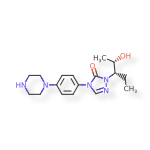
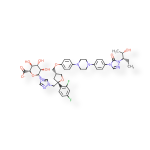
up to 28% in plasma, 1.4% urine; major posaconazole-​glucuronide produced from human liver microsomes was mediated via UGT1A4 (In vitro, Drug Metabolism and Disposition, Volume 32, Issue 2, Pages 267-271, Journal 2004)
MAJOR
PLASMA; URINE
|
||
|
METABOLITE -> PARENT |
MINOR
FECAL; PLASMA; URINE
|
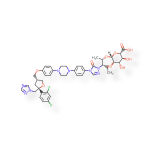
![Structure of 2-[(1S,2S)-1-Ethyl-2-hydroxypropyl]-2,4-dihydro-4-[4-[4-(4-hydroxyphenyl)-1-piperazinyl]phenyl]-3H-1,2,4-triazol-3-one](/img/e6b1ab3b-cdfb-4753-a561-b23ed44dd4f7.svg "Structure of 2-[(1S,2S)-1-Ethyl-2-hydroxypropyl]-2,4-dihydro-4-[4-[4-(4-hydroxyphenyl)-1-piperazinyl]phenyl]-3H-1,2,4-triazol-3-one")
| Related Record | Type | Details | ||
|---|---|---|---|---|
|
IMPURITY -> PARENT |
|
||
|
|
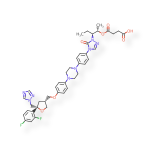
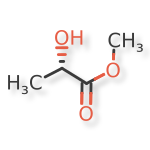
IMPURITY -> PARENT |
process impurity
Raw material used for prodcution of starting material SPOE
|
| Related Record | Type | Details | ||
|---|---|---|---|---|
|
|
ACTIVE MOIETY |
|
| Name | Property Type | Amount | Referenced Substance | Defining | Parameters | References |
|---|---|---|---|---|---|---|
| Volume of Distribution | PHARMACOKINETIC |
|
|
|||
| Biological Half-life | PHARMACOKINETIC |
|
|
|||
| Volume of Distribution | PHARMACOKINETIC |
|
Injection PHARMACOKINETIC PHARMACOKINETIC |
|
||
| Biological Half-life | PHARMACOKINETIC |
|
Elimination PHARMACOKINETIC PHARMACOKINETIC PHARMACOKINETIC |
|
||
| Tmax | PHARMACOKINETIC |
|
|
|||