


Details
| Stereochemistry | ACHIRAL |
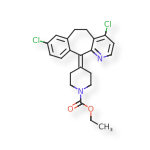
| Molecular Formula | C22H23ClN2O2 |
| Molecular Weight | 382.883 |
| Optical Activity | NONE |
| Defined Stereocenters | 0 / 0 |
| E/Z Centers | 0 |
| Charge | 0 |
SHOW SMILES / InChI
SMILES
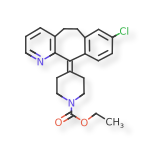
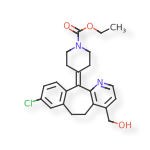
CCOC(=O)N1CCC(CC1)=C2C3=CC=C(Cl)C=C3CCC4=C2N=CC=C4
InChI
InChIKey=JCCNYMKQOSZNPW-UHFFFAOYSA-N
InChI=1S/C22H23ClN2O2/c1-2-27-22(26)25-12-9-15(10-13-25)20-19-8-7-18(23)14-17(19)6-5-16-4-3-11-24-21(16)20/h3-4,7-8,11,14H,2,5-6,9-10,12-13H2,1H3
| Molecular Formula | C22H23ClN2O2 |
| Molecular Weight | 382.883 |
| Charge | 0 |
| Count |
|
| Stereochemistry | ACHIRAL |
| Additional Stereochemistry | No |
| Defined Stereocenters | 0 / 0 |
| E/Z Centers | 0 |
| Optical Activity | NONE |
Loratadine is a derivative of azatadine and a second-generation histamine H1 receptor antagonist used in the treatment of allergic rhinitis and urticaria. Unlike most classical antihistamines (histamine H1 antagonists) it lacks central nervous system depressing effects such as drowsiness. Loratadine competes with free histamine and exhibits specific, selective peripheral H1 antagonistic activity. This blocks the action of endogenous histamine, which subsequently leads to temporary relief of the negative symptoms (eg. nasal congestion, watery eyes) brought on by histamine. Loratadine has low affinity for cholinergic receptors and does not exhibit any appreciable alpha-adrenergic blocking activity in-vitro. Loratadine also appears to suppress the release of histamine and leukotrienes from animal mast cells, and the release of leukotrienes from human lung fragments, although the clinical importance of this is unknown.
Approval Year
Targets
| Primary Target | Pharmacology | Condition | Potency |
|---|---|---|---|
Target ID: CHEMBL231 |
Conditions
| Condition | Modality | Targets | Highest Phase | Product |
|---|---|---|---|---|
| Primary | CLARITIN Approved UseUses temporarily relieves these symptoms due to hay fever or other upper respiratory allergies: •runny nose •itchy, watery eyes •sneezing •itching of the nose or throat Launch Date1993 |
Cmax
| Value | Dose | Co-administered | Analyte | Population |
|---|---|---|---|---|
10.8 ng/mL EXPERIMENT https://pubmed.ncbi.nlm.nih.gov/22806583/ |
20 mg single, oral dose: 20 mg route of administration: Oral experiment type: SINGLE co-administered: |
LORATADINE plasma | Homo sapiens population: HEALTHY age: ADULT sex: MALE food status: FASTED |
|
27.1 ng/mL EXPERIMENT https://pubmed.ncbi.nlm.nih.gov/2958516/ |
40 mg 1 times / day steady-state, oral dose: 40 mg route of administration: Oral experiment type: STEADY-STATE co-administered: |
LORATADINE plasma | Homo sapiens population: HEALTHY age: ADULT sex: MALE food status: FASTED |
|
4 ng/mL |
5 mg 1 times / day steady-state, oral dose: 5 mg route of administration: Oral experiment type: STEADY-STATE co-administered: |
DESLORATADINE plasma | Homo sapiens population: HEALTHY age: ADULT sex: UNKNOWN food status: UNKNOWN |
AUC
| Value | Dose | Co-administered | Analyte | Population |
|---|---|---|---|---|
34.4 ng × h/mL EXPERIMENT https://pubmed.ncbi.nlm.nih.gov/22806583/ |
20 mg single, oral dose: 20 mg route of administration: Oral experiment type: SINGLE co-administered: |
LORATADINE plasma | Homo sapiens population: HEALTHY age: ADULT sex: MALE food status: FASTED |
|
96 ng × h/mL EXPERIMENT https://pubmed.ncbi.nlm.nih.gov/2958516/ |
40 mg 1 times / day steady-state, oral dose: 40 mg route of administration: Oral experiment type: STEADY-STATE co-administered: |
LORATADINE plasma | Homo sapiens population: HEALTHY age: ADULT sex: MALE food status: FASTED |
|
56.9 ng × h/mL |
5 mg 1 times / day steady-state, oral dose: 5 mg route of administration: Oral experiment type: STEADY-STATE co-administered: |
DESLORATADINE plasma | Homo sapiens population: HEALTHY age: ADULT sex: UNKNOWN food status: UNKNOWN |
T1/2
| Value | Dose | Co-administered | Analyte | Population |
|---|---|---|---|---|
11 h EXPERIMENT https://pubmed.ncbi.nlm.nih.gov/22806583/ |
20 mg single, oral dose: 20 mg route of administration: Oral experiment type: SINGLE co-administered: |
LORATADINE plasma | Homo sapiens population: HEALTHY age: ADULT sex: MALE food status: FASTED |
|
14.4 h EXPERIMENT https://pubmed.ncbi.nlm.nih.gov/2958516/ |
40 mg 1 times / day steady-state, oral dose: 40 mg route of administration: Oral experiment type: STEADY-STATE co-administered: |
LORATADINE plasma | Homo sapiens population: HEALTHY age: ADULT sex: MALE food status: FASTED |
|
27 h |
5 mg 1 times / day steady-state, oral dose: 5 mg route of administration: Oral experiment type: STEADY-STATE co-administered: |
DESLORATADINE plasma | Homo sapiens population: HEALTHY age: ADULT sex: UNKNOWN food status: UNKNOWN |
Funbound
| Value | Dose | Co-administered | Analyte | Population |
|---|---|---|---|---|
84.5% |
5 mg 1 times / day steady-state, oral dose: 5 mg route of administration: Oral experiment type: STEADY-STATE co-administered: |
DESLORATADINE plasma | Homo sapiens population: HEALTHY age: ADULT sex: UNKNOWN food status: UNKNOWN |
Doses
| Dose | Population | Adverse events |
|---|---|---|
10 mg 1 times / day multiple, oral Recommended Dose: 10 mg, 1 times / day Route: oral Route: multiple Dose: 10 mg, 1 times / day Sources: |
unhealthy, 29 |
Other AEs: Somnolence, Headache... Other AEs: Somnolence (10%) Sources: Headache (9%) Fatigue (5%) Dry mouth (4%) |
5 mg 1 times / day multiple, oral Recommended Dose: 5 mg, 1 times / day Route: oral Route: multiple Dose: 5 mg, 1 times / day Sources: |
unhealthy, 3.6 Health Status: unhealthy Age Group: 3.6 Sex: M+F Sources: |
Other AEs: Fatigue, Fever... Other AEs: Fatigue (2%) Sources: Fever (7%) Headache (5%) Influenza-like symptoms (2%) Constipation (2%) Diarrhea (3%) Dyspepsia (2%) Loose stools (2%) Stomatitis (2%) Tooth disorder (2%) Vomiting (5%) Earache (2%) Drowsiness (7%) Infection viral (2%) Allergic rhinitis (2%) Coughing (3%) Epistaxis (3%) Pharyngitis (3%) Rash (2%) |
10 mg 1 times / day multiple, oral Recommended Dose: 10 mg, 1 times / day Route: oral Route: multiple Dose: 10 mg, 1 times / day Sources: |
unhealthy, 35.3 |
Other AEs: Headache... |
AEs
| AE | Significance | Dose | Population |
|---|---|---|---|
| Somnolence | 10% | 10 mg 1 times / day multiple, oral Recommended Dose: 10 mg, 1 times / day Route: oral Route: multiple Dose: 10 mg, 1 times / day Sources: |
unhealthy, 29 |
| Dry mouth | 4% | 10 mg 1 times / day multiple, oral Recommended Dose: 10 mg, 1 times / day Route: oral Route: multiple Dose: 10 mg, 1 times / day Sources: |
unhealthy, 29 |
| Fatigue | 5% | 10 mg 1 times / day multiple, oral Recommended Dose: 10 mg, 1 times / day Route: oral Route: multiple Dose: 10 mg, 1 times / day Sources: |
unhealthy, 29 |
| Headache | 9% | 10 mg 1 times / day multiple, oral Recommended Dose: 10 mg, 1 times / day Route: oral Route: multiple Dose: 10 mg, 1 times / day Sources: |
unhealthy, 29 |
| Allergic rhinitis | 2% | 5 mg 1 times / day multiple, oral Recommended Dose: 5 mg, 1 times / day Route: oral Route: multiple Dose: 5 mg, 1 times / day Sources: |
unhealthy, 3.6 Health Status: unhealthy Age Group: 3.6 Sex: M+F Sources: |
| Constipation | 2% | 5 mg 1 times / day multiple, oral Recommended Dose: 5 mg, 1 times / day Route: oral Route: multiple Dose: 5 mg, 1 times / day Sources: |
unhealthy, 3.6 Health Status: unhealthy Age Group: 3.6 Sex: M+F Sources: |
| Dyspepsia | 2% | 5 mg 1 times / day multiple, oral Recommended Dose: 5 mg, 1 times / day Route: oral Route: multiple Dose: 5 mg, 1 times / day Sources: |
unhealthy, 3.6 Health Status: unhealthy Age Group: 3.6 Sex: M+F Sources: |
| Earache | 2% | 5 mg 1 times / day multiple, oral Recommended Dose: 5 mg, 1 times / day Route: oral Route: multiple Dose: 5 mg, 1 times / day Sources: |
unhealthy, 3.6 Health Status: unhealthy Age Group: 3.6 Sex: M+F Sources: |
| Fatigue | 2% | 5 mg 1 times / day multiple, oral Recommended Dose: 5 mg, 1 times / day Route: oral Route: multiple Dose: 5 mg, 1 times / day Sources: |
unhealthy, 3.6 Health Status: unhealthy Age Group: 3.6 Sex: M+F Sources: |
| Infection viral | 2% | 5 mg 1 times / day multiple, oral Recommended Dose: 5 mg, 1 times / day Route: oral Route: multiple Dose: 5 mg, 1 times / day Sources: |
unhealthy, 3.6 Health Status: unhealthy Age Group: 3.6 Sex: M+F Sources: |
| Influenza-like symptoms | 2% | 5 mg 1 times / day multiple, oral Recommended Dose: 5 mg, 1 times / day Route: oral Route: multiple Dose: 5 mg, 1 times / day Sources: |
unhealthy, 3.6 Health Status: unhealthy Age Group: 3.6 Sex: M+F Sources: |
| Loose stools | 2% | 5 mg 1 times / day multiple, oral Recommended Dose: 5 mg, 1 times / day Route: oral Route: multiple Dose: 5 mg, 1 times / day Sources: |
unhealthy, 3.6 Health Status: unhealthy Age Group: 3.6 Sex: M+F Sources: |
| Rash | 2% | 5 mg 1 times / day multiple, oral Recommended Dose: 5 mg, 1 times / day Route: oral Route: multiple Dose: 5 mg, 1 times / day Sources: |
unhealthy, 3.6 Health Status: unhealthy Age Group: 3.6 Sex: M+F Sources: |
| Stomatitis | 2% | 5 mg 1 times / day multiple, oral Recommended Dose: 5 mg, 1 times / day Route: oral Route: multiple Dose: 5 mg, 1 times / day Sources: |
unhealthy, 3.6 Health Status: unhealthy Age Group: 3.6 Sex: M+F Sources: |
| Tooth disorder | 2% | 5 mg 1 times / day multiple, oral Recommended Dose: 5 mg, 1 times / day Route: oral Route: multiple Dose: 5 mg, 1 times / day Sources: |
unhealthy, 3.6 Health Status: unhealthy Age Group: 3.6 Sex: M+F Sources: |
| Coughing | 3% | 5 mg 1 times / day multiple, oral Recommended Dose: 5 mg, 1 times / day Route: oral Route: multiple Dose: 5 mg, 1 times / day Sources: |
unhealthy, 3.6 Health Status: unhealthy Age Group: 3.6 Sex: M+F Sources: |
| Diarrhea | 3% | 5 mg 1 times / day multiple, oral Recommended Dose: 5 mg, 1 times / day Route: oral Route: multiple Dose: 5 mg, 1 times / day Sources: |
unhealthy, 3.6 Health Status: unhealthy Age Group: 3.6 Sex: M+F Sources: |
| Epistaxis | 3% | 5 mg 1 times / day multiple, oral Recommended Dose: 5 mg, 1 times / day Route: oral Route: multiple Dose: 5 mg, 1 times / day Sources: |
unhealthy, 3.6 Health Status: unhealthy Age Group: 3.6 Sex: M+F Sources: |
| Pharyngitis | 3% | 5 mg 1 times / day multiple, oral Recommended Dose: 5 mg, 1 times / day Route: oral Route: multiple Dose: 5 mg, 1 times / day Sources: |
unhealthy, 3.6 Health Status: unhealthy Age Group: 3.6 Sex: M+F Sources: |
| Headache | 5% | 5 mg 1 times / day multiple, oral Recommended Dose: 5 mg, 1 times / day Route: oral Route: multiple Dose: 5 mg, 1 times / day Sources: |
unhealthy, 3.6 Health Status: unhealthy Age Group: 3.6 Sex: M+F Sources: |
| Vomiting | 5% | 5 mg 1 times / day multiple, oral Recommended Dose: 5 mg, 1 times / day Route: oral Route: multiple Dose: 5 mg, 1 times / day Sources: |
unhealthy, 3.6 Health Status: unhealthy Age Group: 3.6 Sex: M+F Sources: |
| Drowsiness | 7% | 5 mg 1 times / day multiple, oral Recommended Dose: 5 mg, 1 times / day Route: oral Route: multiple Dose: 5 mg, 1 times / day Sources: |
unhealthy, 3.6 Health Status: unhealthy Age Group: 3.6 Sex: M+F Sources: |
| Fever | 7% | 5 mg 1 times / day multiple, oral Recommended Dose: 5 mg, 1 times / day Route: oral Route: multiple Dose: 5 mg, 1 times / day Sources: |
unhealthy, 3.6 Health Status: unhealthy Age Group: 3.6 Sex: M+F Sources: |
| Headache | 4.2% | 10 mg 1 times / day multiple, oral Recommended Dose: 10 mg, 1 times / day Route: oral Route: multiple Dose: 10 mg, 1 times / day Sources: |
unhealthy, 35.3 |
Overview
| CYP3A4 | CYP2C9 | CYP2D6 | hERG |
|---|---|---|---|
OverviewOther
| Other Inhibitor | Other Substrate | Other Inducer |
|---|---|---|
Drug as perpetrator
| Target | Modality | Activity | Metabolite | Clinical evidence |
|---|---|---|---|---|
Page: 1.0 |
no | |||
| no | ||||
Page: 11.0 |
no | |||
| no | ||||
| yes [IC50 0.61 uM] | ||||
| yes [IC50 0.76 uM] | ||||
| yes [IC50 11 uM] | ||||
Page: 6.0 |
yes [IC50 3.36 uM] | |||
Page: 1.0 |
yes | |||
Page: 1.0 |
yes | |||
Page: 1,8 |
yes | |||
Page: 1.0 |
yes |
Drug as victim
| Target | Modality | Activity | Metabolite | Clinical evidence |
|---|---|---|---|---|
| major | yes (co-administration study) Comment: Coadministration with either ketoconazole, erythromycin (both CYP3A4 inhibitors) increased AUC of drug by 307%, 40%, respectively; coadministration with cimetidine (CYP2D6 and CYP3A4 inhibitor) increased AUC of drug by 103% Page: 1.0 |
|||
| minor | ||||
| minor | ||||
| minor | ||||
| minor | ||||
| minor | ||||
| minor | ||||
| minor | ||||
| minor | yes (co-administration study) Comment: coadministration with cimetidine (CYP2D6 and CYP3A4 inhibitor) increased AUC of drug by 103% Page: 1.0 |
|||
| yes |
Tox targets
| Target | Modality | Activity | Metabolite | Clinical evidence |
|---|---|---|---|---|
PubMed
| Title | Date | PubMed |
|---|---|---|
| LC determination of loratadine and related impurities. | 2002-06-20 |
|
| Simultaneous development of six LC-MS-MS methods for the determination of multiple analytes in human plasma. | 2002-06-15 |
|
| Stability indicating methods for the determination of loratadine in the presence of its degradation product. | 2002-06-15 |
|
| Efficacy and tolerability of montelukast alone or in combination with loratadine in seasonal allergic rhinitis: a multicenter, randomized, double-blind, placebo-controlled trial performed in the fall. | 2002-06 |
|
| Effect of desloratadine versus placebo on nasal airflow and subjective measures of nasal obstruction in subjects with grass pollen-induced allergic rhinitis in an allergen-exposure unit. | 2002-06 |
|
| Comparison of a nasal glucocorticoid, antileukotriene, and a combination of antileukotriene and antihistamine in the treatment of seasonal allergic rhinitis. | 2002-06 |
|
| Comparison of cetirizine, ebastine and loratadine in the treatment of immediate mosquito-bite allergy. | 2002-06 |
|
| Med-psych drug-drug interactions update. | 2002-05-10 |
|
| Ventricular tachycardia following ingestion of a commonly used antihistamine. | 2002-05-06 |
|
| Loratadine/nefazodone interaction. | 2002-05 |
|
| Influence of zafirlukast and loratadine on exercise-induced bronchoconstriction. | 2002-05 |
|
| Exercise-induced asthma: is there still a case for histamine? | 2002-05 |
|
| The cost of treating allergic rhinitis. | 2002-05 |
|
| Clinical evidence for antileukotriene therapy in the management of allergic rhinitis. | 2002-04 |
|
| Comparison of five new antihistamines (H1-receptor antagonists) in patients with allergic rhinitis using nasal provocation studies and skin tests. | 2002-04 |
|
| Desloratadine (Clarinex). | 2002-03-18 |
|
| [Approaches to prevention and treatment of latex allergy]. | 2002-03-08 |
|
| Which is more effective for as-needed treatment of seasonal allergy symptoms: intranasal corticosteroids or oral antihistamines? | 2002-03 |
|
| Fixed drug eruption due to loratadine. | 2002-03 |
|
| A randomized, double-blind, placebo-controlled comparison of emedastine 0.05% ophthalmic solution with loratadine 10 mg and their combination in the human conjunctival allergen challenge model. | 2002-03 |
|
| Complete remission of a primary cutaneous B-cell lymphoma of the lower leg by first-line monotherapy with the CD20-antibody rituximab. | 2002-03 |
|
| Cardiotoxicity of new antihistamines and cisapride. | 2002-02-28 |
|
| [The third-generation antihistaminics. Can they prevent the tier change?]. | 2002-02-14 |
|
| Are antihistamines useful in managing asthma? | 2002-02 |
|
| [Clinical evaluation of the ocular safety of Amukine 0.06% solution for local application versus povidone iodine (Bétadine) 5% solution for ocular irrigation) in preoperative antisepsis]. | 2002-02 |
|
| A double-blind, randomized, single-dose, crossover comparison of levocetirizine with ebastine, fexofenadine, loratadine, mizolastine, and placebo: suppression of histamine-induced wheal-and-flare response during 24 hours in healthy male subjects. | 2002-02 |
|
| Medical management of Cronkhite-Canada syndrome. | 2002-02 |
|
| Pollen immunotherapy reduces the development of asthma in children with seasonal rhinoconjunctivitis (the PAT-study). | 2002-02 |
|
| Effects of the selective H1 and H2 histamine receptor antagonists loratadine and ranitidine on autonomic control of the heart. | 2002-02 |
|
| Relationship between direct-to-consumer advertising and physician diagnosing and prescribing. | 2002-01-01 |
|
| A comparison of once daily fexofenadine versus the combination of montelukast plus loratadine on domiciliary nasal peak flow and symptoms in seasonal allergic rhinitis. | 2002-01 |
|
| The effect of loratadine in exercise-induced asthma. | 2002-01 |
|
| [Comparative antihistamine and anti-allergic effects of various antihistamine preparations]. | 2002 |
|
| Grapefruit juice reduces the oral bioavailability of fexofenadine but not desloratadine. | 2002 |
|
| Comparative onset of action and symptom relief with cetirizine, loratadine, or placebo in an environmental exposure unit in subjects with seasonal allergic rhinitis: confirmation of a test system. | 2001-12 |
|
| QTc prolongation and drugs. | 2001-12 |
|
| Superiority of an intranasal corticosteroid compared with an oral antihistamine in the as-needed treatment of seasonal allergic rhinitis. | 2001-11-26 |
|
| Inhibition of depolarization-induced [3H]noradrenaline release from SH-SY5Y human neuroblastoma cells by some second-generation H(1) receptor antagonists through blockade of store-operated Ca(2+) channels (SOCs). | 2001-11-01 |
|
| Variant effect of first- and second-generation antihistamines as clues to their mechanism of action on the sneeze reflex in the common cold. | 2001-11-01 |
|
| Desloratadine reduces nasal congestion in patients with intermittent allergic rhinitis. | 2001-11 |
|
| Evaluation of quality of life in children and teenagers with allergic rhinitis: adaptation and validation of the Rhinoconjunctivitis Quality of Life Questionnaire (RQLQ). | 2001-10-25 |
|
| Effect of specific immunotherapy versus loratadine on serum adhesion molecules. | 2001-10 |
|
| The costs of nonsedating antihistamine therapy for allergic rhinitis in managed care: an updated analysis. | 2001-10 |
|
| A double-blind, placebo-controlled, and randomized study of loratadine (Clarityne) syrup for the treatment of allergic rhinitis in children aged 3 to 12 years. | 2001-09 |
|
| Controlled clinical study of the efficacy of loratadine in Nigerian patients with allergic rhinitis. | 2001-09 |
|
| Do antihistamines impair school performance in children? | 2001-09 |
|
| Inhibition of cytokine generation and mediator release by human basophils treated with desloratadine. | 2001-09 |
|
| [Effect of loratadine in children with allergic rhinitis]. | 2001-08-26 |
|
| The acute and sub-chronic effects of levocetirizine, cetirizine, loratadine, promethazine and placebo on cognitive function, psychomotor performance, and weal and flare. | 2001 |
|
| Treatment of urticaria. An evidence-based evaluation of antihistamines. | 2001 |
Sample Use Guides
Adults and children 6 years and over: 1 tablet daily; not more than 1 tablet in 24 hours
Route of Administration:
Oral
dose-dependent inhibition of histamine release was observed at loratadine dose above 7 UM. In the rat basophilic leukemia cells (RBL-2H3) experimental system, inhibition by loratadine increased when the concentration of extracellular Ca2+ was reduced from 1.8 to 0.45 mM. Loratadine also inhibited the Mn2+ influx into these cells, thus reflecting the Ca2+ influx.
| Substance Class |
Chemical
Created
by
admin
on
Edited
Mon Mar 31 18:00:54 GMT 2025
by
admin
on
Mon Mar 31 18:00:54 GMT 2025
|
| Record UNII |
7AJO3BO7QN
|
| Record Status |
Validated (UNII)
|
| Record Version |
|
-
Download
| Name | Type | Language | ||
|---|---|---|---|---|
|
Preferred Name | English | ||
|
Official Name | English | ||
|
Code | English | ||
|
Common Name | English | ||
|
Common Name | English | ||
|
Common Name | English | ||
|
Common Name | English | ||
|
Common Name | English | ||
|
Common Name | English | ||
|
Common Name | English | ||
|
Code | English | ||
|
Common Name | English | ||
|
Code | English | ||
|
Common Name | English | ||
|
Brand Name | English | ||
|
Common Name | English | ||
|
Code | English | ||
|
Common Name | English | ||
|
Common Name | English | ||
|
Common Name | English | ||
|
Brand Name | English | ||
|
Common Name | English | ||
|
Systematic Name | English |
| Classification Tree | Code System | Code | ||
|---|---|---|---|---|
|
WHO-ATC |
R06AX13
Created by
admin on Mon Mar 31 18:00:54 GMT 2025 , Edited by admin on Mon Mar 31 18:00:54 GMT 2025
|
||
|
NCI_THESAURUS |
C29578
Created by
admin on Mon Mar 31 18:00:54 GMT 2025 , Edited by admin on Mon Mar 31 18:00:54 GMT 2025
|
||
|
WHO-VATC |
QR06AX13
Created by
admin on Mon Mar 31 18:00:54 GMT 2025 , Edited by admin on Mon Mar 31 18:00:54 GMT 2025
|
||
|
LIVERTOX |
NBK548831
Created by
admin on Mon Mar 31 18:00:54 GMT 2025 , Edited by admin on Mon Mar 31 18:00:54 GMT 2025
|
| Code System | Code | Type | Description | ||
|---|---|---|---|---|---|
|
DTXSID2023224
Created by
admin on Mon Mar 31 18:00:54 GMT 2025 , Edited by admin on Mon Mar 31 18:00:54 GMT 2025
|
PRIMARY | |||
|
7216
Created by
admin on Mon Mar 31 18:00:54 GMT 2025 , Edited by admin on Mon Mar 31 18:00:54 GMT 2025
|
PRIMARY | |||
|
758628
Created by
admin on Mon Mar 31 18:00:54 GMT 2025 , Edited by admin on Mon Mar 31 18:00:54 GMT 2025
|
PRIMARY | |||
|
100000092179
Created by
admin on Mon Mar 31 18:00:54 GMT 2025 , Edited by admin on Mon Mar 31 18:00:54 GMT 2025
|
PRIMARY | |||
|
5864
Created by
admin on Mon Mar 31 18:00:54 GMT 2025 , Edited by admin on Mon Mar 31 18:00:54 GMT 2025
|
PRIMARY | |||
|
79794-75-5
Created by
admin on Mon Mar 31 18:00:54 GMT 2025 , Edited by admin on Mon Mar 31 18:00:54 GMT 2025
|
PRIMARY | |||
|
1370270
Created by
admin on Mon Mar 31 18:00:54 GMT 2025 , Edited by admin on Mon Mar 31 18:00:54 GMT 2025
|
PRIMARY | |||
|
3957
Created by
admin on Mon Mar 31 18:00:54 GMT 2025 , Edited by admin on Mon Mar 31 18:00:54 GMT 2025
|
PRIMARY | |||
|
m6905
Created by
admin on Mon Mar 31 18:00:54 GMT 2025 , Edited by admin on Mon Mar 31 18:00:54 GMT 2025
|
PRIMARY | Merck Index | ||
|
1605
Created by
admin on Mon Mar 31 18:00:54 GMT 2025 , Edited by admin on Mon Mar 31 18:00:54 GMT 2025
|
PRIMARY | |||
|
D017336
Created by
admin on Mon Mar 31 18:00:54 GMT 2025 , Edited by admin on Mon Mar 31 18:00:54 GMT 2025
|
PRIMARY | |||
|
Loratadine
Created by
admin on Mon Mar 31 18:00:54 GMT 2025 , Edited by admin on Mon Mar 31 18:00:54 GMT 2025
|
PRIMARY | |||
|
7AJO3BO7QN
Created by
admin on Mon Mar 31 18:00:54 GMT 2025 , Edited by admin on Mon Mar 31 18:00:54 GMT 2025
|
PRIMARY | |||
|
SUB08581MIG
Created by
admin on Mon Mar 31 18:00:54 GMT 2025 , Edited by admin on Mon Mar 31 18:00:54 GMT 2025
|
PRIMARY | |||
|
3578
Created by
admin on Mon Mar 31 18:00:54 GMT 2025 , Edited by admin on Mon Mar 31 18:00:54 GMT 2025
|
PRIMARY | |||
|
W-119
Created by
admin on Mon Mar 31 18:00:54 GMT 2025 , Edited by admin on Mon Mar 31 18:00:54 GMT 2025
|
PRIMARY | |||
|
28889
Created by
admin on Mon Mar 31 18:00:54 GMT 2025 , Edited by admin on Mon Mar 31 18:00:54 GMT 2025
|
PRIMARY | RxNorm | ||
|
CHEMBL998
Created by
admin on Mon Mar 31 18:00:54 GMT 2025 , Edited by admin on Mon Mar 31 18:00:54 GMT 2025
|
PRIMARY | |||
|
7AJO3BO7QN
Created by
admin on Mon Mar 31 18:00:54 GMT 2025 , Edited by admin on Mon Mar 31 18:00:54 GMT 2025
|
PRIMARY | |||
|
DB00455
Created by
admin on Mon Mar 31 18:00:54 GMT 2025 , Edited by admin on Mon Mar 31 18:00:54 GMT 2025
|
PRIMARY | |||
|
LORATADINE
Created by
admin on Mon Mar 31 18:00:54 GMT 2025 , Edited by admin on Mon Mar 31 18:00:54 GMT 2025
|
PRIMARY | |||
|
C29162
Created by
admin on Mon Mar 31 18:00:54 GMT 2025 , Edited by admin on Mon Mar 31 18:00:54 GMT 2025
|
PRIMARY |
| Related Record | Type | Details | ||
|---|---|---|---|---|
|
BINDER->LIGAND |
|
||
|
METABOLIC ENZYME -> INHIBITOR |
IC50
|
||
|
TARGET -> INHIBITOR | |||
|
BASIS OF STRENGTH->SUBSTANCE |
ASSAY (TITRATION)
EP
|
||
|
|
PARENT->INNOVATOR | |||
|
BASIS OF STRENGTH->SUBSTANCE |
ASSAY (HPLC)
USP
|


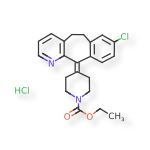
| Related Record | Type | Details | ||
|---|---|---|---|---|
|
METABOLITE ACTIVE -> PARENT | |||
|
METABOLITE ACTIVE -> PARENT |
MAJOR
|
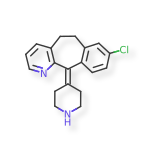
| Related Record | Type | Details | ||
|---|---|---|---|---|
|
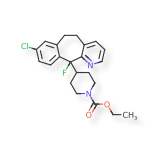
IMPURITY -> PARENT |
CHROMATOGRAPHIC PURITY (HPLC/UV)
USP
|
||
|
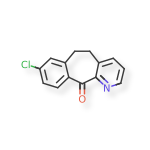
IMPURITY -> PARENT |
|
||
|
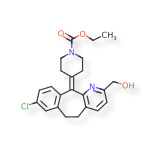
IMPURITY -> PARENT |
UNSPECIFIED
CHROMATOGRAPHIC PURITY (HPLC/UV)
EP
|
||
|
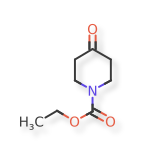
IMPURITY -> PARENT |
CHROMATOGRAPHIC PURITY (HPLC/UV)
USP
|
||
|
IMPURITY -> PARENT |
For the calculation of contents, multiply the peak areas by 1.9
CHROMATOGRAPHIC PURITY (HPLC/UV)
EP
|
||
|
IMPURITY -> PARENT |
CHROMATOGRAPHIC PURITY (HPLC/UV)
EP
|
||
|
IMPURITY -> PARENT |
CHROMATOGRAPHIC PURITY (HPLC/UV)
USP
|
||
|
IMPURITY -> PARENT |
For the calculation of contents, multiply the peak areas by 1.6
CHROMATOGRAPHIC PURITY (HPLC/UV)
EP
|
||
|
IMPURITY -> PARENT |
CHROMATOGRAPHIC PURITY (HPLC/UV)
USP
|
||
|
IMPURITY -> PARENT |
CHROMATOGRAPHIC PURITY (HPLC/UV)
USP
|
||
|
IMPURITY -> PARENT |
|
||
|
PARENT -> IMPURITY |
CHROMATOGRAPHIC PURITY (HPLC/UV)
USP
|
||
|
IMPURITY -> PARENT |
CHROMATOGRAPHIC PURITY (HPLC/UV)
USP
|
||
|
IMPURITY -> PARENT |
CHROMATOGRAPHIC PURITY (GC)
EP
|
||
|
IMPURITY -> PARENT |
CHROMATOGRAPHIC PURITY (HPLC/UV)
USP
|
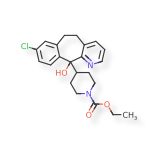
| Related Record | Type | Details | ||
|---|---|---|---|---|
|
|
ACTIVE MOIETY |
| Name | Property Type | Amount | Referenced Substance | Defining | Parameters | References |
|---|---|---|---|---|---|---|
| Biological Half-life | PHARMACOKINETIC |
|
|
|||