


Details
| Stereochemistry | ABSOLUTE |
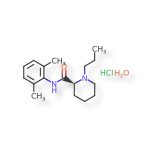
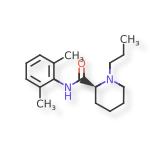
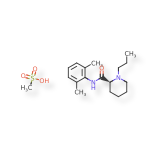
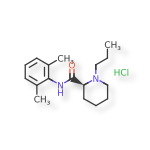
| Molecular Formula | C17H26N2O |
| Molecular Weight | 274.4011 |
| Optical Activity | UNSPECIFIED |
| Defined Stereocenters | 1 / 1 |
| E/Z Centers | 0 |
| Charge | 0 |
SHOW SMILES / InChI
SMILES
CCCN1CCCC[C@H]1C(=O)NC2=C(C)C=CC=C2C
InChI
InChIKey=ZKMNUMMKYBVTFN-HNNXBMFYSA-N
InChI=1S/C17H26N2O/c1-4-11-19-12-6-5-10-15(19)17(20)18-16-13(2)8-7-9-14(16)3/h7-9,15H,4-6,10-12H2,1-3H3,(H,18,20)/t15-/m0/s1
| Molecular Formula | C17H26N2O |
| Molecular Weight | 274.4011 |
| Charge | 0 |
| Count |
|
| Stereochemistry | ABSOLUTE |
| Additional Stereochemistry | No |
| Defined Stereocenters | 1 / 1 |
| E/Z Centers | 0 |
| Optical Activity | UNSPECIFIED |
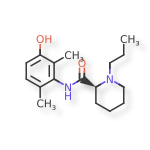
Ropivacaine is a member of the amino amide class of local anesthetics and is supplied as the pure S-(-)-enantiomer. It produces effects similar to other local anesthetics via reversible inhibition of sodium ion influx in nerve fibers. Ropivacaine is less lipophilic than bupivacaine and is less likely to penetrate large myelinated motor fibers, resulting in a relatively reduced motor blockade. Thus, ropivacaine has a greater degree of motor-sensory differentiation, which could be useful when the motor blockade is undesirable. The reduced lipophilicity is also associated with decreased potential for central nervous system toxicity and cardiotoxicity. Ropivacaine is indicated for the production of local or regional anesthesia for surgery and for acute pain management.
Approval Year
Targets
| Primary Target | Pharmacology | Condition | Potency |
|---|---|---|---|
| 2.73 µM [IC50] | |||
Target ID: CHEMBL4306 |
80.0 µM [Kd] | ||
Target ID: CHEMBL240 |
20.0 µM [IC50] |
Conditions
| Condition | Modality | Targets | Highest Phase | Product |
|---|---|---|---|---|
| Primary | NAROPIN Approved UseRopivacaine Hydrochloride Injection is indicated for the production of local or regional anesthesia for surgery and for acute pain management. Surgical Anesthesia: epidural block for surgery including cesarean section; major nerve block; local infiltration Acute Pain Management: epidural continuous infusion or intermittent bolus, eg, postoperative or labor; local infiltration Launch Date1996 |
Cmax
| Value | Dose | Co-administered | Analyte | Population |
|---|---|---|---|---|
2.4 mg/L |
1493 mg other, epidural dose: 1493 mg route of administration: Epidural experiment type: OTHER co-administered: |
ROPIVACAINE plasma | Homo sapiens population: UNHEALTHY age: ADULT sex: UNKNOWN food status: UNKNOWN |
|
2.8 mg/L |
2075 mg other, epidural dose: 2075 mg route of administration: Epidural experiment type: OTHER co-administered: |
ROPIVACAINE plasma | Homo sapiens population: UNHEALTHY age: ADULT sex: UNKNOWN food status: UNKNOWN |
|
1.1 mg/L |
150 mg single, epidural dose: 150 mg route of administration: Epidural experiment type: SINGLE co-administered: |
ROPIVACAINE plasma | Homo sapiens population: UNHEALTHY age: ADULT sex: FEMALE food status: UNKNOWN |
|
1.6 mg/L |
187.5 mg single, epidural dose: 187.5 mg route of administration: Epidural experiment type: SINGLE co-administered: |
ROPIVACAINE plasma | Homo sapiens population: UNHEALTHY age: ADULT sex: FEMALE food status: UNKNOWN |
|
2.3 mg/L |
300 mg single, epidural dose: 300 mg route of administration: Epidural experiment type: SINGLE co-administered: |
ROPIVACAINE plasma | Homo sapiens population: UNHEALTHY age: ADULT sex: UNKNOWN food status: UNKNOWN |
|
1.2 mg/L |
40 mg 1 times / day other, intravenous dose: 40 mg route of administration: Intravenous experiment type: OTHER co-administered: |
ROPIVACAINE plasma | Homo sapiens population: HEALTHY age: ADULT sex: UNKNOWN food status: UNKNOWN |
AUC
| Value | Dose | Co-administered | Analyte | Population |
|---|---|---|---|---|
135.5 mg × h/L |
1493 mg other, epidural dose: 1493 mg route of administration: Epidural experiment type: OTHER co-administered: |
ROPIVACAINE plasma | Homo sapiens population: UNHEALTHY age: ADULT sex: UNKNOWN food status: UNKNOWN |
|
145 mg × h/L |
2075 mg other, epidural dose: 2075 mg route of administration: Epidural experiment type: OTHER co-administered: |
ROPIVACAINE plasma | Homo sapiens population: UNHEALTHY age: ADULT sex: UNKNOWN food status: UNKNOWN |
|
7.2 mg × h/L |
150 mg single, epidural dose: 150 mg route of administration: Epidural experiment type: SINGLE co-administered: |
ROPIVACAINE plasma | Homo sapiens population: UNHEALTHY age: ADULT sex: FEMALE food status: UNKNOWN |
|
11.3 mg × h/L |
187.5 mg single, epidural dose: 187.5 mg route of administration: Epidural experiment type: SINGLE co-administered: |
ROPIVACAINE plasma | Homo sapiens population: UNHEALTHY age: ADULT sex: FEMALE food status: UNKNOWN |
|
13 mg × h/L |
300 mg single, epidural dose: 300 mg route of administration: Epidural experiment type: SINGLE co-administered: |
ROPIVACAINE plasma | Homo sapiens population: UNHEALTHY age: ADULT sex: UNKNOWN food status: UNKNOWN |
|
1.8 mg × h/L |
40 mg 1 times / day other, intravenous dose: 40 mg route of administration: Intravenous experiment type: OTHER co-administered: |
ROPIVACAINE plasma | Homo sapiens population: HEALTHY age: ADULT sex: UNKNOWN food status: UNKNOWN |
T1/2
| Value | Dose | Co-administered | Analyte | Population |
|---|---|---|---|---|
5 h |
1493 mg other, epidural dose: 1493 mg route of administration: Epidural experiment type: OTHER co-administered: |
ROPIVACAINE plasma | Homo sapiens population: UNHEALTHY age: ADULT sex: UNKNOWN food status: UNKNOWN |
|
5.7 h |
2075 mg other, epidural dose: 2075 mg route of administration: Epidural experiment type: OTHER co-administered: |
ROPIVACAINE plasma | Homo sapiens population: UNHEALTHY age: ADULT sex: UNKNOWN food status: UNKNOWN |
|
5.7 h |
150 mg single, epidural dose: 150 mg route of administration: Epidural experiment type: SINGLE co-administered: |
ROPIVACAINE plasma | Homo sapiens population: UNHEALTHY age: ADULT sex: FEMALE food status: UNKNOWN |
|
7.1 h |
187.5 mg single, epidural dose: 187.5 mg route of administration: Epidural experiment type: SINGLE co-administered: |
ROPIVACAINE plasma | Homo sapiens population: UNHEALTHY age: ADULT sex: FEMALE food status: UNKNOWN |
|
6.8 h |
300 mg single, epidural dose: 300 mg route of administration: Epidural experiment type: SINGLE co-administered: |
ROPIVACAINE plasma | Homo sapiens population: UNHEALTHY age: ADULT sex: UNKNOWN food status: UNKNOWN |
|
1.9 h |
40 mg 1 times / day other, intravenous dose: 40 mg route of administration: Intravenous experiment type: OTHER co-administered: |
ROPIVACAINE plasma | Homo sapiens population: HEALTHY age: ADULT sex: UNKNOWN food status: UNKNOWN |
Doses
| Dose | Population | Adverse events |
|---|---|---|
300 mg single, intravascular Overdose Dose: 300 mg Route: intravascular Route: single Dose: 300 mg Sources: |
healthy, 25 years |
Other AEs: Convulsion... |
AEs
| AE | Significance | Dose | Population |
|---|---|---|---|
| Convulsion | 1 patient | 300 mg single, intravascular Overdose Dose: 300 mg Route: intravascular Route: single Dose: 300 mg Sources: |
healthy, 25 years |
PubMed
| Title | Date | PubMed |
|---|---|---|
| Apoptosis and mitochondrial dysfunction in human chondrocytes following exposure to lidocaine, bupivacaine, and ropivacaine. | 2010-03 |
|
| Effects of mixture of lidocaine and ropivacaine at different concentrations on the central nervous system and cardiovascular toxicity in rats. | 2010-01-05 |
|
| Repeated intrathecal administration of ropivacaine causes neurotoxicity in rats. | 2009-11 |
|
| Convulsions associated with a low plasma level of local anaesthetics. | 2009-11 |
|
| Lipid emulsion improves recovery from bupivacaine-induced cardiac arrest, but not from ropivacaine- or mepivacaine-induced cardiac arrest. | 2009-10 |
|
| The addition of fentanyl to 1.5 mg/ml ropivacaine has no advantage for paediatric epidural analgesia. | 2009-09 |
|
| Transient unilateral Horner's syndrome after epidural ropivacaine in a dog. | 2009-07 |
|
| Local anesthesia with ropivacaine for patients undergoing laparoscopic cholecystectomy. | 2009-05-21 |
|
| Immediate intravenous lipid infusion in the successful resuscitation of ropivacaine-induced cardiac arrest after infraclavicular brachial plexus block. | 2009-05-14 |
|
| Regional anesthesia for carotid endarterectomy: a comparison between ropivacaine and levobupivacaine. | 2009-05 |
|
| [Grand mal convulsion after an interscalene block with ropivacaine]. | 2009-04 |
|
| Convulsions after ropivacaine 300 mg for brachial plexus block. | 2008-12 |
|
| I.V. ropivacaine compared with lidocaine for the treatment of tinnitus. | 2008-08 |
|
| Successful resuscitation after ropivacaine and lidocaine-induced ventricular arrhythmia following posterior lumbar plexus block in a child. | 2008-05 |
|
| [Transient neurological symptoms in puerperas after epidural analgesia during labor]. | 2008-03-11 |
|
| Ropivacaine-induced cardiac arrest. | 2007-06 |
|
| Successful resuscitation of an ASA 3 patient following ropivacaine-induced cardiac arrest. | 2006-12 |
|
| Preexisting subclinical neuropathy as a risk factor for nerve injury after continuous ropivacaine administration through a femoral nerve catheter. | 2006-11 |
|
| Postoperative analgesia after radical retropubic prostatectomy: a double-blind comparison between low thoracic epidural and patient-controlled intravenous analgesia. | 2006-10 |
|
| Long QT 1 mutation KCNQ1A344V increases local anesthetic sensitivity of the slowly activating delayed rectifier potassium current. | 2006-09 |
|
| The effect of epidural sufentanil in ropivacaine on urinary retention in patients undergoing gastrectomy. | 2006-09 |
|
| Successful resuscitation of a patient with ropivacaine-induced asystole after axillary plexus block using lipid infusion. | 2006-08 |
|
| Successful use of a 20% lipid emulsion to resuscitate a patient after a presumed bupivacaine-related cardiac arrest. | 2006-07 |
|
| Minimum local anaesthetic dose (MLAD) of intrathecal levobupivacaine and ropivacaine for Caesarean section. | 2006-02 |
|
| Lipid emulsion to treat overdose of local anaesthetic: the gift of the glob. | 2006-02 |
|
| Transdermal buprenorphine combined with spinal morphine and naropine for pain relief in chronic peripheral vasculopathy. | 2005-07-14 |
|
| Prediction of genotoxicity of chemical compounds by statistical learning methods. | 2005-06 |
|
| [Convulsions induced by ropivacaine after brachial plexus block]. | 2004-11 |
|
| Ectopic expression of clusterin/apolipoprotein J or Bcl-2 decreases the sensitivity of HaCaT cells to toxic effects of ropivacaine. | 2004-10 |
|
| Pain control with low-dose alfentanil in children undergoing minor abdominal and genito-urinary surgery. | 2004-09 |
|
| Ropivacaine-induced asystole: "never again" rather than "here we go again". | 2004-08 |
|
| [Pain control with epidural anesthesia for uterine artery embolization]. | 2004-04 |
|
| Can ropivacaine and levobupivacaine be used as test doses during regional anesthesia? | 2004-04 |
|
| Effects of clonidine pre-treatment on bupivacaine and ropivacaine cardiotoxicity in rats. | 2004-03 |
|
| Cardiac arrest after injection of ropivacaine for posterior lumbar plexus blockade. | 2003-12 |
|
| Ropivacaine-induced cardiac arrest after peripheral nerve block: successful resuscitation. | 2003-12 |
|
| Successful resuscitation after ropivacaine-induced ventricular fibrillation. | 2003-09 |
|
| Cardiac arrest after interscalene brachial plexus block with ropivacaine and lidocaine. | 2003-08 |
|
| Lipid emulsion infusion rescues dogs from bupivacaine-induced cardiac toxicity. | 2003-05-29 |
|
| Loss of consciousness from epidural sufentanil for labour analgesia. | 2003-05 |
|
| [Epidural anesthesia with ropivacaine vs. bupivacaine in continuous perfusion for the treatment of labor pains]. | 2003-02 |
|
| [Convulsions induced by ropivacaine after midhumeral block]. | 2002-10 |
|
| Tachycardia and convulsions induced by accidental intravascular ropivacaine injection during sciatic block. | 2002-05 |
|
| [Hyperbaric subarachnoid ropivacaine in ambulatory surgery: comparative study with hyperbaric bupivacaine]. | 2002-02 |
|
| Acute toxicity of local anesthetic ropivacaine and mepivacaine during a combined lumbar plexus and sciatic block for hip surgery. | 2002 |
|
| Convulsions induced by ropivacaine during interscalene brachial plexus block. | 1997-11 |
|
| Ropivacaine inhibits leukocyte rolling, adhesion and CD11b/CD18 expression. | 1997-10 |
|
| Central nervous and cardiovascular effects of i.v. infusions of ropivacaine, bupivacaine and placebo in volunteers. | 1997-05 |
|
| Treatment of acute systemic toxicity after the rapid intravenous injection of ropivacaine and bupivacaine in the conscious dog. | 1991-10 |
|
| Comparative systemic toxicity of convulsant and supraconvulsant doses of intravenous ropivacaine, bupivacaine, and lidocaine in the conscious dog. | 1989-12 |
Sample Use Guides
The dose of any local anesthetic administered varies with the anesthetic procedure, the area to be anesthetized, the vascularity of the tissues, the number of neuronal segments to be blocked, the depth of anesthesia and degree of muscle relaxation required, the duration of anesthesia desired, individual tolerance, and the physical condition of the patient.
For treatment of postoperative pain, the following technique can be recommended: If regional anesthesia was not used intraoperatively, then an initial epidural block with 5-7 mL Naropin is induced via an epidural catheter. Analgesia is maintained with an infusion of Naropin, 2 mg/mL (0.2%). Clinical studies have demonstrated that infusion rates of 6-14 mL (12-28 mg) per hour provide adequate analgesia with nonprogressive motor block. With this technique a significant reduction in the need for opioids was demonstrated. Clinical experience supports the use of Naropin epidural infusions for up to 72 hours.
Route of Administration:
Parenteral
Dorsal root ganglion neurons were isolated from the SD rats and cultured in vitro. The mRNA of the CaMK II subtype in dorsal root ganglion neurons were detected by real-time PCR. As well as, the dorsal root ganglion neurons were treated with ropivacaine hydrochloride in different concentration (1mM,2mM, 3mM and 4mM) for the same exposure time of 4h, or different exposure time (0h,2h,3h,4h and 6h) at the same concentration(3mM). The changes of the mRNA expression of the CaMK II subtype were observed with real-time PCR. All subtype mRNA of the CaMK II, CaMK IIα, CaMK IIβ, CaMK II δ, CaMK IIγ, can be detected in dorsal root ganglion neurons. With the increased of the concentration and exposure time of the ropivacaine hydrochloride, all the subtype mRNA expression increased. Ropivacaine hydrochloride up-regulate the CaMK IIβ, CaMK IIδ, CaMK IIg mRNA expression with the concentration and exposure time increasing.
| Substance Class |
Chemical
Created
by
admin
on
Edited
Wed Apr 02 06:56:20 GMT 2025
by
admin
on
Wed Apr 02 06:56:20 GMT 2025
|
| Record UNII |
7IO5LYA57N
|
| Record Status |
Validated (UNII)
|
| Record Version |
|
-
Download
| Name | Type | Language | ||
|---|---|---|---|---|
|
Preferred Name | English | ||
|
Official Name | English | ||
|
Common Name | English | ||
|
Code | English | ||
|
Common Name | English | ||
|
Systematic Name | English | ||
|
Common Name | English | ||
|
Common Name | English | ||
|
Common Name | English | ||
|
Common Name | English | ||
|
Common Name | English |
| Classification Tree | Code System | Code | ||
|---|---|---|---|---|
|
WHO-VATC |
QN01BB09
Created by
admin on Wed Apr 02 06:56:20 GMT 2025 , Edited by admin on Wed Apr 02 06:56:20 GMT 2025
|
||
|
NDF-RT |
N0000007681
Created by
admin on Wed Apr 02 06:56:20 GMT 2025 , Edited by admin on Wed Apr 02 06:56:20 GMT 2025
|
||
|
NDF-RT |
N0000175976
Created by
admin on Wed Apr 02 06:56:20 GMT 2025 , Edited by admin on Wed Apr 02 06:56:20 GMT 2025
|
||
|
NDF-RT |
N0000175682
Created by
admin on Wed Apr 02 06:56:20 GMT 2025 , Edited by admin on Wed Apr 02 06:56:20 GMT 2025
|
||
|
WHO-ATC |
N01BB09
Created by
admin on Wed Apr 02 06:56:20 GMT 2025 , Edited by admin on Wed Apr 02 06:56:20 GMT 2025
|
||
|
NCI_THESAURUS |
C245
Created by
admin on Wed Apr 02 06:56:20 GMT 2025 , Edited by admin on Wed Apr 02 06:56:20 GMT 2025
|
| Code System | Code | Type | Description | ||
|---|---|---|---|---|---|
|
m9659
Created by
admin on Wed Apr 02 06:56:20 GMT 2025 , Edited by admin on Wed Apr 02 06:56:20 GMT 2025
|
PRIMARY | Merck Index | ||
|
1605497
Created by
admin on Wed Apr 02 06:56:20 GMT 2025 , Edited by admin on Wed Apr 02 06:56:20 GMT 2025
|
PRIMARY | |||
|
SUB10382MIG
Created by
admin on Wed Apr 02 06:56:20 GMT 2025 , Edited by admin on Wed Apr 02 06:56:20 GMT 2025
|
PRIMARY | |||
|
7IO5LYA57N
Created by
admin on Wed Apr 02 06:56:20 GMT 2025 , Edited by admin on Wed Apr 02 06:56:20 GMT 2025
|
PRIMARY | |||
|
DTXSID4040187
Created by
admin on Wed Apr 02 06:56:20 GMT 2025 , Edited by admin on Wed Apr 02 06:56:20 GMT 2025
|
PRIMARY | |||
|
35780
Created by
admin on Wed Apr 02 06:56:20 GMT 2025 , Edited by admin on Wed Apr 02 06:56:20 GMT 2025
|
PRIMARY | RxNorm | ||
|
DB00296
Created by
admin on Wed Apr 02 06:56:20 GMT 2025 , Edited by admin on Wed Apr 02 06:56:20 GMT 2025
|
PRIMARY | |||
|
Ropivacaine
Created by
admin on Wed Apr 02 06:56:20 GMT 2025 , Edited by admin on Wed Apr 02 06:56:20 GMT 2025
|
PRIMARY | |||
|
5376
Created by
admin on Wed Apr 02 06:56:20 GMT 2025 , Edited by admin on Wed Apr 02 06:56:20 GMT 2025
|
PRIMARY | |||
|
8890
Created by
admin on Wed Apr 02 06:56:20 GMT 2025 , Edited by admin on Wed Apr 02 06:56:20 GMT 2025
|
PRIMARY | |||
|
7602
Created by
admin on Wed Apr 02 06:56:20 GMT 2025 , Edited by admin on Wed Apr 02 06:56:20 GMT 2025
|
PRIMARY | |||
|
CHEMBL1077896
Created by
admin on Wed Apr 02 06:56:20 GMT 2025 , Edited by admin on Wed Apr 02 06:56:20 GMT 2025
|
PRIMARY | |||
|
84057-95-4
Created by
admin on Wed Apr 02 06:56:20 GMT 2025 , Edited by admin on Wed Apr 02 06:56:20 GMT 2025
|
PRIMARY | |||
|
7IO5LYA57N
Created by
admin on Wed Apr 02 06:56:20 GMT 2025 , Edited by admin on Wed Apr 02 06:56:20 GMT 2025
|
PRIMARY | |||
|
C037663
Created by
admin on Wed Apr 02 06:56:20 GMT 2025 , Edited by admin on Wed Apr 02 06:56:20 GMT 2025
|
PRIMARY | |||
|
C61932
Created by
admin on Wed Apr 02 06:56:20 GMT 2025 , Edited by admin on Wed Apr 02 06:56:20 GMT 2025
|
PRIMARY | |||
|
2403
Created by
admin on Wed Apr 02 06:56:20 GMT 2025 , Edited by admin on Wed Apr 02 06:56:20 GMT 2025
|
PRIMARY | |||
|
175805
Created by
admin on Wed Apr 02 06:56:20 GMT 2025 , Edited by admin on Wed Apr 02 06:56:20 GMT 2025
|
PRIMARY | |||
|
100000084379
Created by
admin on Wed Apr 02 06:56:20 GMT 2025 , Edited by admin on Wed Apr 02 06:56:20 GMT 2025
|
PRIMARY | |||
|
ROPIVACAINE
Created by
admin on Wed Apr 02 06:56:20 GMT 2025 , Edited by admin on Wed Apr 02 06:56:20 GMT 2025
|
PRIMARY |
| Related Record | Type | Details | ||
|---|---|---|---|---|
|
|
SALT/SOLVATE -> PARENT | |||
|
EXCRETED UNCHANGED |
URINE
|
||
|
|
SALT/SOLVATE -> PARENT | |||
|
BINDER->LIGAND |
BINDING
|
||
|
METABOLIC ENZYME -> SUBSTRATE | |||
|
|
SALT/SOLVATE -> PARENT |
|
||
|
METABOLIC ENZYME -> SUBSTRATE |


| Related Record | Type | Details | ||
|---|---|---|---|---|
|
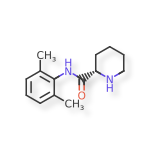
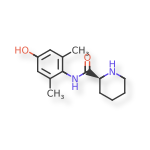
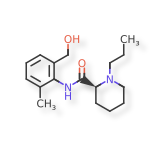
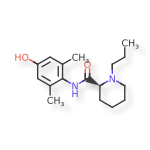
METABOLITE -> PARENT |
2% of dose;
MINOR
URINE
|
||
|
METABOLITE -> PARENT | |||
|
METABOLITE -> PARENT |
Tentatively identified in the urine of some volunteers, accounting fof about 4-15% of the dose
MINOR
URINE
|
||
|
METABOLITE -> PARENT |
Have a pharmacological activity in animal models less than that of ropivacaine
|
||
|
METABOLITE -> PARENT |
MAJOR
URINE
|
||
|
METABOLITE -> PARENT |
MINOR
URINE
|
||
|
METABOLITE -> PARENT |
Have a pharmacological activity in animal models less than that of ropivacaine
|
||
|
METABOLITE -> PARENT |
Have a pharmacological activity in animal models less than that of ropivacaine
|
||
|
METABOLITE -> PARENT |
3% of dose
MINOR
URINE
|
| Related Record | Type | Details | ||
|---|---|---|---|---|
|
|
ACTIVE MOIETY |
|
| Name | Property Type | Amount | Referenced Substance | Defining | Parameters | References |
|---|---|---|---|---|---|---|
| Volume of Distribution | PHARMACOKINETIC |
|
INTRAVASCULAR ADMINISTRATION |
|
||
| Biological Half-life | PHARMACOKINETIC |
|
INTRAVASCULAR ADMINISTRATION |
|
||