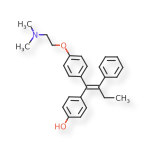
Details
| Stereochemistry | ACHIRAL |
| Molecular Formula | C26H29NO2 |
| Molecular Weight | 387.514 |
| Optical Activity | NONE |
| Defined Stereocenters | 0 / 0 |
| E/Z Centers | 1 |
| Charge | 0 |
SHOW SMILES / InChI
SMILES
CC\C(=C(/C1=CC=C(O)C=C1)C2=CC=C(OCCN(C)C)C=C2)C3=CC=CC=C3
InChI
InChIKey=TXUZVZSFRXZGTL-QPLCGJKRSA-N
InChI=1S/C26H29NO2/c1-4-25(20-8-6-5-7-9-20)26(21-10-14-23(28)15-11-21)22-12-16-24(17-13-22)29-19-18-27(2)3/h5-17,28H,4,18-19H2,1-3H3/b26-25-
| Molecular Formula | C26H29NO2 |
| Molecular Weight | 387.514 |
| Charge | 0 |
| Count |
|
| Stereochemistry | ACHIRAL |
| Additional Stereochemistry | No |
| Defined Stereocenters | 0 / 0 |
| E/Z Centers | 1 |
| Optical Activity | NONE |
Hydroxytamoxifen (Afimoxifene) is an active metabolite of tamoxifen exerting estrogen receptor modulatory function. In addition, hydroxytamoxifen binds to regulates transcriptional activity of the estrogen-related receptor gamma. ASCEND Therapeutics, Inc. was developing TamoGel (4-hydroxytamoxifen gel) for a variety of estrogen-dependent conditions, including breast cancer, cyclic breast pain and gynecomastia.
CNS Activity
Sources: https://www.ncbi.nlm.nih.gov/pubmed/21378205 | https://www.ncbi.nlm.nih.gov/pubmed/27812322
Curator's Comment: Hydroxytamoxifen is brain penetrant in animals. No human data available.
Originator
Approval Year
Cmax
| Value | Dose | Co-administered | Analyte | Population |
|---|---|---|---|---|
3.6 ng/mL EXPERIMENT https://pubmed.ncbi.nlm.nih.gov/26354796/ |
1 mg/kg single, oral dose: 1 mg/kg route of administration: Oral experiment type: SINGLE co-administered: |
HYDROXYTAMOXIFEN plasma | Mus musculus population: HEALTHY age: ADULT sex: FEMALE food status: UNKNOWN |
AUC
| Value | Dose | Co-administered | Analyte | Population |
|---|---|---|---|---|
61.5 ng × h/mL EXPERIMENT https://pubmed.ncbi.nlm.nih.gov/26354796/ |
1 mg/kg single, oral dose: 1 mg/kg route of administration: Oral experiment type: SINGLE co-administered: |
HYDROXYTAMOXIFEN plasma | Mus musculus population: HEALTHY age: ADULT sex: FEMALE food status: UNKNOWN |
T1/2
| Value | Dose | Co-administered | Analyte | Population |
|---|---|---|---|---|
31.7 h EXPERIMENT https://pubmed.ncbi.nlm.nih.gov/26354796/ |
1 mg/kg single, oral dose: 1 mg/kg route of administration: Oral experiment type: SINGLE co-administered: |
HYDROXYTAMOXIFEN plasma | Mus musculus population: HEALTHY age: ADULT sex: FEMALE food status: UNKNOWN |
Overview
| CYP3A4 | CYP2C9 | CYP2D6 | hERG |
|---|---|---|---|
OverviewOther
| Other Inhibitor | Other Substrate | Other Inducer |
|---|---|---|
Drug as perpetrator
| Target | Modality | Activity | Metabolite | Clinical evidence |
|---|---|---|---|---|
| no | ||||
| no | ||||
| no | ||||
| yes [IC50 0.0217 uM] | ||||
| yes [IC50 12.6585 uM] | ||||
| yes [IC50 40.0297 uM] | ||||
| yes [IC50 44.9141 uM] | ||||
| yes [IC50 7.4 uM] | ||||
| yes [IC50 71.184 uM] | ||||
| yes | ||||
| yes | ||||
| yes |
Drug as victim
| Target | Modality | Activity | Metabolite | Clinical evidence |
|---|---|---|---|---|
| yes | ||||
| yes | ||||
| yes | ||||
| yes | ||||
| yes | ||||
| yes | ||||
| yes | ||||
| yes | ||||
| yes | ||||
| yes |
PubMed
| Title | Date | PubMed |
|---|---|---|
| Human sex hormone-binding globulin binding affinities of 125 structurally diverse chemicals and comparison with their binding to androgen receptor, estrogen receptor, and α-fetoprotein. | 2015-02 |
|
| Selectivity of natural, synthetic and environmental estrogens for zebrafish estrogen receptors. | 2014-10-01 |
|
| Cloning of circadian rhythmic pathway genes and perturbation of oscillation patterns in endocrine disrupting chemicals (EDCs)-exposed mangrove killifish Kryptolebias marmoratus. | 2014-08 |
|
| 4-Hydroxytamoxifen-stimulated processing of cyclin E is mediated via G protein-coupled receptor 30 (GPR30) and accompanied by enhanced migration in MCF-7 breast cancer cells. | 2013-07-05 |
|
| Inverse antagonist activities of parabens on human oestrogen-related receptor γ (ERRγ): in vitro and in silico studies. | 2013-07-01 |
|
| Molecular mechanism of action of bisphenol and bisphenol A mediated by oestrogen receptor alpha in growth and apoptosis of breast cancer cells. | 2013-05 |
|
| Bisphenol A significantly modulates long-term depression in the hippocampus as observed by multi-electrode system. | 2013 |
|
| Combined effects of oestrogen receptor antagonists on in vitro vitellogenesis. | 2012-05-15 |
|
| Diesel exhaust particulate extracts inhibit transcription of nuclear respiratory factor-1 and cell viability in human umbilical vein endothelial cells. | 2012-04 |
|
| Arsenic induces functional re-expression of estrogen receptor α by demethylation of DNA in estrogen receptor-negative human breast cancer. | 2012 |
|
| Chemical genomics profiling of environmental chemical modulation of human nuclear receptors. | 2011-08 |
|
| High content imaging-based assay to classify estrogen receptor-α ligands based on defined mechanistic outcomes. | 2011-05-15 |
|
| High-throughput ectopic expression screen for tamoxifen resistance identifies an atypical kinase that blocks autophagy. | 2011-02-01 |
|
| Prolylcarboxypeptidase regulates proliferation, autophagy, and resistance to 4-hydroxytamoxifen-induced cytotoxicity in estrogen receptor-positive breast cancer cells. | 2011-01-28 |
|
| Estrogen expands breast cancer stem-like cells through paracrine FGF/Tbx3 signaling. | 2010-12-14 |
|
| Bisphenol A impairs the double-strand break repair machinery in the germline and causes chromosome abnormalities. | 2010-11-23 |
|
| Olfactomedin-4 regulation by estrogen in the human endometrium requires epidermal growth factor signaling. | 2010-11 |
|
| Development and validation of a test for environmental estrogens: Checking xeno-estrogen activity by CXCL12 secretion in BREAST CANCER CELL LINES (CXCL-test). | 2010-10 |
|
| Distinction of the binding modes for human nuclear receptor ERRgamma between bisphenol A and 4-hydroxytamoxifen. | 2010-08 |
|
| Advantages of human hepatocyte-derived transformants expressing a series of human cytochrome p450 isoforms for genotoxicity examination. | 2010-08 |
|
| Optimization and prevalidation of the in vitro ERalpha CALUX method to test estrogenic and antiestrogenic activity of compounds. | 2010-08 |
|
| The assessment of estrogenic or anti-estrogenic activity of chemicals by the human stably transfected estrogen sensitive MELN cell line: results of test performance and transferability. | 2010-08 |
|
| Increased expression of enolase alpha in human breast cancer confers tamoxifen resistance in human breast cancer cells. | 2010-06 |
|
| Estrogen and selective estrogen receptor modulators regulate vascular endothelial growth factor and soluble vascular endothelial growth factor receptor 1 in human endometrial stromal cells. | 2010-05-15 |
|
| E-cadherin mediates the aggregation of breast cancer cells induced by tamoxifen and epidermal growth factor. | 2010-05 |
|
| Delayed activation of extracellular-signal-regulated kinase 1/2 is involved in genistein- and equol-induced cell proliferation and estrogen-receptor-alpha-mediated transcription in MCF-7 breast cancer cells. | 2010-05 |
|
| c-Jun activation is required for 4-hydroxytamoxifen-induced cell death in breast cancer cells. | 2010-02-18 |
|
| Comparison of relative binding affinities to fish and mammalian estrogen receptors: the regulatory implications. | 2010-02-15 |
|
| Identification of novel ER-alpha target genes in breast cancer cells: gene- and cell-selective co-regulator recruitment at target promoters determines the response to 17beta-estradiol and tamoxifen. | 2010-01-15 |
|
| Regulation of aryl hydrocarbon receptor function by selective estrogen receptor modulators. | 2010-01 |
|
| G protein pathway suppressor 2 (GPS2) is a transcriptional corepressor important for estrogen receptor alpha-mediated transcriptional regulation. | 2009-12-25 |
|
| Activation function 2 mediates dioxin-induced recruitment of estrogen receptor alpha to CYP1A1 and CYP1B1. | 2009-07-24 |
|
| Stimulating the GPR30 estrogen receptor with a novel tamoxifen analogue activates SF-1 and promotes endometrial cell proliferation. | 2009-07-01 |
|
| Towards high-throughput identification of endocrine disrupting compounds with mass spectrometry. | 2009-06 |
|
| Estradiol downregulates miR-21 expression and increases miR-21 target gene expression in MCF-7 breast cancer cells. | 2009-05 |
|
| Estrogenic GPR30 signalling induces proliferation and migration of breast cancer cells through CTGF. | 2009-03-04 |
|
| The tamoxifen metabolite, endoxifen, is a potent antiestrogen that targets estrogen receptor alpha for degradation in breast cancer cells. | 2009-03-01 |
|
| Functional identification of genes causing estrogen independence of human breast cancer cells. | 2009-03 |
|
| Regulation of the vascular endothelial growth factor and growth by estrogen and antiestrogens through Efp in Ishikawa endometrial carcinoma cells. | 2009-02 |
|
| Identification of TACC1, NOV, and PTTG1 as new candidate genes associated with endocrine therapy resistance in breast cancer. | 2009-02 |
|
| Potential use of an estrogen-glucocorticoid receptor chimera as a drug screen for tissue selective estrogenic activity. | 2009-01 |
|
| Pharmacologic profiling of human and rat cytochrome P450 1A1 and 1A2 induction and competition. | 2008-12 |
|
| mTOR inhibition reverses acquired endocrine therapy resistance of breast cancer cells at the cell proliferation and gene-expression levels. | 2008-10 |
|
| Preliminary molecular dynamic simulations of the estrogen receptor alpha ligand binding domain from antagonist to apo. | 2008-06 |
|
| Direct evidence revealing structural elements essential for the high binding ability of bisphenol A to human estrogen-related receptor-gamma. | 2008-01 |
|
| Structural determination of estrogen-related receptor gamma in the presence of phenol derivative compounds. | 2008-01 |
|
| Human CYP2A6 is induced by estrogen via estrogen receptor. | 2007-10 |
|
| Promotion of breast cancer by beta-hexachlorocyclohexane in MCF10AT1 cells and MMTV-neu mice. | 2007-07-17 |
|
| Estrogen receptor-ligand complexes measured by chip-based nanoelectrospray mass spectrometry: an approach for the screening of endocrine disruptors. | 2007-05 |
|
| Regulation of growth hormone signaling by selective estrogen receptor modulators occurs through suppression of protein tyrosine phosphatases. | 2007-05 |
Sample Use Guides
A phase II trial of Afimoxifene (4-hydroxytamoxifen gel) for cyclical mastalgia in premenopausal women. Premenopausal women aged at least 18 years experiencing moderate to severe symptoms were randomized to receive placebo, 2 mg, or 4 mg of Afimoxifene daily delivered as a transdermal hydroalcoholic gel for 4 menstrual cycles.
Route of Administration:
Transdermal
| Substance Class |
Chemical
Created
by
admin
on
Edited
Mon Mar 31 18:25:15 GMT 2025
by
admin
on
Mon Mar 31 18:25:15 GMT 2025
|
| Record UNII |
95K54647BZ
|
| Record Status |
Validated (UNII)
|
| Record Version |
|
-
Download
| Name | Type | Language | ||
|---|---|---|---|---|
|
Preferred Name | English | ||
|
Common Name | English | ||
|
Systematic Name | English | ||
|
Common Name | English | ||
|
Common Name | English |
| Code System | Code | Type | Description | ||
|---|---|---|---|---|---|
|
C016601
Created by
admin on Mon Mar 31 18:25:15 GMT 2025 , Edited by admin on Mon Mar 31 18:25:15 GMT 2025
|
PRIMARY | |||
|
100000182681
Created by
admin on Mon Mar 31 18:25:15 GMT 2025 , Edited by admin on Mon Mar 31 18:25:15 GMT 2025
|
PRIMARY | |||
|
449459
Created by
admin on Mon Mar 31 18:25:15 GMT 2025 , Edited by admin on Mon Mar 31 18:25:15 GMT 2025
|
PRIMARY | |||
|
DTXSID7022384
Created by
admin on Mon Mar 31 18:25:15 GMT 2025 , Edited by admin on Mon Mar 31 18:25:15 GMT 2025
|
PRIMARY | |||
|
95K54647BZ
Created by
admin on Mon Mar 31 18:25:15 GMT 2025 , Edited by admin on Mon Mar 31 18:25:15 GMT 2025
|
PRIMARY | |||
|
68047-06-3
Created by
admin on Mon Mar 31 18:25:15 GMT 2025 , Edited by admin on Mon Mar 31 18:25:15 GMT 2025
|
PRIMARY | |||
|
C475919
Created by
admin on Mon Mar 31 18:25:15 GMT 2025 , Edited by admin on Mon Mar 31 18:25:15 GMT 2025
|
PRIMARY | |||
|
44616
Created by
admin on Mon Mar 31 18:25:15 GMT 2025 , Edited by admin on Mon Mar 31 18:25:15 GMT 2025
|
PRIMARY |
| Related Record | Type | Details | ||
|---|---|---|---|---|
|
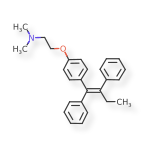
PARENT -> METABOLITE ACTIVE |
| Related Record | Type | Details | ||
|---|---|---|---|---|
|
|
ACTIVE MOIETY |