


Details
| Stereochemistry | ABSOLUTE |
| Molecular Formula | C58H73N7O17 |
| Molecular Weight | 1140.2369 |
| Optical Activity | UNSPECIFIED |
| Defined Stereocenters | 15 / 15 |
| E/Z Centers | 0 |
| Charge | 0 |
SHOW SMILES / InChI
SMILES
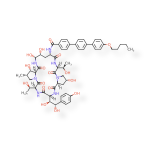
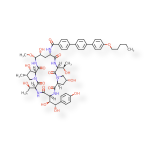
CCCCCOC1=CC=C(C=C1)C2=CC=C(C=C2)C3=CC=C(C=C3)C(=O)N[C@H]4C[C@@H](O)[C@@H](O)NC(=O)[C@@H]5[C@@H](O)[C@@H](C)CN5C(=O)[C@@H](NC(=O)[C@@H](NC(=O)[C@@H]6C[C@@H](O)CN6C(=O)[C@@H](NC4=O)[C@@H](C)O)[C@H](O)[C@@H](O)C7=CC=C(O)C=C7)[C@@H](C)O
InChI
InChIKey=JHVAMHSQVVQIOT-MFAJLEFUSA-N
InChI=1S/C58H73N7O17/c1-5-6-7-24-82-40-22-18-35(19-23-40)33-10-8-32(9-11-33)34-12-14-37(15-13-34)51(74)59-41-26-43(70)54(77)63-56(79)47-48(71)29(2)27-65(47)58(81)45(31(4)67)61-55(78)46(50(73)49(72)36-16-20-38(68)21-17-36)62-53(76)42-25-39(69)28-64(42)57(80)44(30(3)66)60-52(41)75/h8-23,29-31,39,41-50,54,66-73,77H,5-7,24-28H2,1-4H3,(H,59,74)(H,60,75)(H,61,78)(H,62,76)(H,63,79)/t29-,30+,31+,39+,41-,42-,43+,44-,45-,46-,47-,48-,49-,50-,54+/m0/s1
| Molecular Formula | C58H73N7O17 |
| Molecular Weight | 1140.2369 |
| Charge | 0 |
| Count |
|
| Stereochemistry | ABSOLUTE |
| Additional Stereochemistry | No |
| Defined Stereocenters | 15 / 15 |
| E/Z Centers | 0 |
| Optical Activity | UNSPECIFIED |
Anidulafungin (brand names Eraxis (in U.S. and Russia) and Ecalta (in Europe)) is a semi-synthetic echinocandin with antifungal activity and it is active in vitro against many Candida, as well as some Aspergillus. Like other echinocandins, anidulafungin is not active against Cryptococcus neoformans, Trichosporon, Fusarium, or zygomycetes. This drug is indicated for the treatment of candidemia and the following Candida infections: intra-abdominal abscess and peritonitis; and for the treatment of esophageal candidiasis. Anidulafungin inhibits glucan synthase, an enzyme present in fungal, but not mammalian cells. This results in inhibition of the formation of 1,3--D-glucan, an essential component of the fungal cell wall.
Approval Year
Targets
| Primary Target | Pharmacology | Condition | Potency |
|---|---|---|---|
Target ID: CHEMBL2364673 |
Conditions
| Condition | Modality | Targets | Highest Phase | Product |
|---|---|---|---|---|
| Curative | ERAXIS Approved UseERAXIS is indicated for use in adults for the treatment of the following fungal infections listed below. Specimens for fungal culture and other relevant laboratory studies (including histopathology) should be obtained prior to therapy to isolate and identify causative organism(s). Therapy may be instituted before the results of the cultures and other laboratory studies known. However, once these results become available, antifungal therapy should be adjusted accordingly. Anidulafungin is an echinocandin antifungal drug indicated in adults for the treatment of: Candidemia and other forms of Candida infections (intra-abdominal abscess and peritonitis) (1.1) Esophageal candidiasis (1.2) Limitations of use: has not been studied in endocarditis, osteomyelitis and meningitis due to Candida or in sufficient numbers of neutropenic patients (1.3) 1.1 Candidemia and Other Forms of Candida Infections (Intra-abdominal Abscess and Peritonitis) ERAXIS is indicated for the treatment of candidemia and the following Candida infections: intra-abdominal abscess and peritonitis [see Clinical Studies(14.1) and Clinical Pharmacology, Microbiology (12.4) Launch Date2006 |
|||
| Curative | ERAXIS Approved UseERAXIS is indicated for use in adults for the treatment of the following fungal infections listed below. Specimens for fungal culture and other relevant laboratory studies (including histopathology) should be obtained prior to therapy to isolate and identify causative organism(s). Therapy may be instituted before the results of the cultures and other laboratory studies known. However, once these results become available, antifungal therapy should be adjusted accordingly. Anidulafungin is an echinocandin antifungal drug indicated in adults for the treatment of: Candidemia and other forms of Candida infections (intra-abdominal abscess and peritonitis) (1.1) Esophageal candidiasis (1.2) Limitations of use: has not been studied in endocarditis, osteomyelitis and meningitis due to Candida or in sufficient numbers of neutropenic patients (1.3) 1.1 Candidemia and Other Forms of Candida Infections (Intra-abdominal Abscess and Peritonitis) ERAXIS is indicated for the treatment of candidemia and the following Candida infections: intra-abdominal abscess and peritonitis [see Clinical Studies(14.1) and Clinical Pharmacology, Microbiology (12.4) Launch Date2006 |
Cmax
| Value | Dose | Co-administered | Analyte | Population |
|---|---|---|---|---|
4.2 mg/L |
100 mg 1 times / day steady-state, intravenous dose: 100 mg route of administration: Intravenous experiment type: STEADY-STATE co-administered: |
ANIDULAFUNGIN plasma | Homo sapiens population: UNHEALTHY age: ADULT sex: FEMALE / MALE food status: UNKNOWN |
|
7.2 mg/L |
200 mg 1 times / day steady-state, intravenous dose: 200 mg route of administration: Intravenous experiment type: STEADY-STATE co-administered: |
ANIDULAFUNGIN plasma | Homo sapiens population: UNHEALTHY age: ADULT sex: FEMALE / MALE food status: UNKNOWN |
AUC
| Value | Dose | Co-administered | Analyte | Population |
|---|---|---|---|---|
55.2 mg × h/L |
100 mg 1 times / day steady-state, intravenous dose: 100 mg route of administration: Intravenous experiment type: STEADY-STATE co-administered: |
ANIDULAFUNGIN plasma | Homo sapiens population: UNHEALTHY age: ADULT sex: FEMALE / MALE food status: UNKNOWN |
|
110.3 mg × h/L |
200 mg 1 times / day steady-state, intravenous dose: 200 mg route of administration: Intravenous experiment type: STEADY-STATE co-administered: |
ANIDULAFUNGIN plasma | Homo sapiens population: UNHEALTHY age: ADULT sex: FEMALE / MALE food status: UNKNOWN |
T1/2
| Value | Dose | Co-administered | Analyte | Population |
|---|---|---|---|---|
26.5 h |
100 mg 1 times / day steady-state, intravenous dose: 100 mg route of administration: Intravenous experiment type: STEADY-STATE co-administered: |
ANIDULAFUNGIN plasma | Homo sapiens population: UNHEALTHY age: ADULT sex: FEMALE / MALE food status: UNKNOWN |
|
26.5 h |
200 mg 1 times / day steady-state, intravenous dose: 200 mg route of administration: Intravenous experiment type: STEADY-STATE co-administered: |
ANIDULAFUNGIN plasma | Homo sapiens population: UNHEALTHY age: ADULT sex: FEMALE / MALE food status: UNKNOWN |
Funbound
| Value | Dose | Co-administered | Analyte | Population |
|---|---|---|---|---|
1% |
100 mg 1 times / day steady-state, intravenous dose: 100 mg route of administration: Intravenous experiment type: STEADY-STATE co-administered: |
ANIDULAFUNGIN plasma | Homo sapiens population: UNHEALTHY age: ADULT sex: FEMALE / MALE food status: UNKNOWN |
|
1% |
200 mg 1 times / day steady-state, intravenous dose: 200 mg route of administration: Intravenous experiment type: STEADY-STATE co-administered: |
ANIDULAFUNGIN plasma | Homo sapiens population: UNHEALTHY age: ADULT sex: FEMALE / MALE food status: UNKNOWN |
Doses
| Dose | Population | Adverse events |
|---|---|---|
200 mg 1 times / day multiple, intravenous Recommended Dose: 200 mg, 1 times / day Route: intravenous Route: multiple Dose: 200 mg, 1 times / day Sources: |
unhealthy, 16-89 Health Status: unhealthy Age Group: 16-89 Sex: M+F Sources: |
Disc. AE: Multi-organ failure... AEs leading to discontinuation/dose reduction: Multi-organ failure Sources: |
200 mg 1 times / day multiple, intravenous Recommended Dose: 200 mg, 1 times / day Route: intravenous Route: multiple Dose: 200 mg, 1 times / day Sources: |
unhealthy, 56.5 (± 18.5) Health Status: unhealthy Age Group: 56.5 (± 18.5) Sex: M+F Sources: |
Disc. AE: Drug hypersensitivity, Skin rash... AEs leading to discontinuation/dose reduction: Drug hypersensitivity (2.3%) Sources: Skin rash (2.3%) |
400 mg single, intravenous Overdose Dose: 400 mg Route: intravenous Route: single Dose: 400 mg Sources: |
unhealthy Health Status: unhealthy Sources: |
|
200 mg 1 times / day multiple, intravenous Recommended Dose: 200 mg, 1 times / day Route: intravenous Route: multiple Dose: 200 mg, 1 times / day Sources: |
unhealthy Health Status: unhealthy Sources: |
Disc. AE: Abnormal liver function tests, Hepatitis... AEs leading to discontinuation/dose reduction: Abnormal liver function tests Sources: Hepatitis Hepatic failure Hypersensitivity Anaphylaxis Rash Urticaria Flushing Pruritus Bronchospasm Dyspnea Hypotension |
AEs
| AE | Significance | Dose | Population |
|---|---|---|---|
| Multi-organ failure | Disc. AE | 200 mg 1 times / day multiple, intravenous Recommended Dose: 200 mg, 1 times / day Route: intravenous Route: multiple Dose: 200 mg, 1 times / day Sources: |
unhealthy, 16-89 Health Status: unhealthy Age Group: 16-89 Sex: M+F Sources: |
| Drug hypersensitivity | 2.3% Disc. AE |
200 mg 1 times / day multiple, intravenous Recommended Dose: 200 mg, 1 times / day Route: intravenous Route: multiple Dose: 200 mg, 1 times / day Sources: |
unhealthy, 56.5 (± 18.5) Health Status: unhealthy Age Group: 56.5 (± 18.5) Sex: M+F Sources: |
| Skin rash | 2.3% Disc. AE |
200 mg 1 times / day multiple, intravenous Recommended Dose: 200 mg, 1 times / day Route: intravenous Route: multiple Dose: 200 mg, 1 times / day Sources: |
unhealthy, 56.5 (± 18.5) Health Status: unhealthy Age Group: 56.5 (± 18.5) Sex: M+F Sources: |
| Abnormal liver function tests | Disc. AE | 200 mg 1 times / day multiple, intravenous Recommended Dose: 200 mg, 1 times / day Route: intravenous Route: multiple Dose: 200 mg, 1 times / day Sources: |
unhealthy Health Status: unhealthy Sources: |
| Anaphylaxis | Disc. AE | 200 mg 1 times / day multiple, intravenous Recommended Dose: 200 mg, 1 times / day Route: intravenous Route: multiple Dose: 200 mg, 1 times / day Sources: |
unhealthy Health Status: unhealthy Sources: |
| Bronchospasm | Disc. AE | 200 mg 1 times / day multiple, intravenous Recommended Dose: 200 mg, 1 times / day Route: intravenous Route: multiple Dose: 200 mg, 1 times / day Sources: |
unhealthy Health Status: unhealthy Sources: |
| Dyspnea | Disc. AE | 200 mg 1 times / day multiple, intravenous Recommended Dose: 200 mg, 1 times / day Route: intravenous Route: multiple Dose: 200 mg, 1 times / day Sources: |
unhealthy Health Status: unhealthy Sources: |
| Flushing | Disc. AE | 200 mg 1 times / day multiple, intravenous Recommended Dose: 200 mg, 1 times / day Route: intravenous Route: multiple Dose: 200 mg, 1 times / day Sources: |
unhealthy Health Status: unhealthy Sources: |
| Hepatic failure | Disc. AE | 200 mg 1 times / day multiple, intravenous Recommended Dose: 200 mg, 1 times / day Route: intravenous Route: multiple Dose: 200 mg, 1 times / day Sources: |
unhealthy Health Status: unhealthy Sources: |
| Hepatitis | Disc. AE | 200 mg 1 times / day multiple, intravenous Recommended Dose: 200 mg, 1 times / day Route: intravenous Route: multiple Dose: 200 mg, 1 times / day Sources: |
unhealthy Health Status: unhealthy Sources: |
| Hypersensitivity | Disc. AE | 200 mg 1 times / day multiple, intravenous Recommended Dose: 200 mg, 1 times / day Route: intravenous Route: multiple Dose: 200 mg, 1 times / day Sources: |
unhealthy Health Status: unhealthy Sources: |
| Hypotension | Disc. AE | 200 mg 1 times / day multiple, intravenous Recommended Dose: 200 mg, 1 times / day Route: intravenous Route: multiple Dose: 200 mg, 1 times / day Sources: |
unhealthy Health Status: unhealthy Sources: |
| Pruritus | Disc. AE | 200 mg 1 times / day multiple, intravenous Recommended Dose: 200 mg, 1 times / day Route: intravenous Route: multiple Dose: 200 mg, 1 times / day Sources: |
unhealthy Health Status: unhealthy Sources: |
| Rash | Disc. AE | 200 mg 1 times / day multiple, intravenous Recommended Dose: 200 mg, 1 times / day Route: intravenous Route: multiple Dose: 200 mg, 1 times / day Sources: |
unhealthy Health Status: unhealthy Sources: |
| Urticaria | Disc. AE | 200 mg 1 times / day multiple, intravenous Recommended Dose: 200 mg, 1 times / day Route: intravenous Route: multiple Dose: 200 mg, 1 times / day Sources: |
unhealthy Health Status: unhealthy Sources: |
Overview
| CYP3A4 | CYP2C9 | CYP2D6 | hERG |
|---|---|---|---|
OverviewOther
| Other Inhibitor | Other Substrate | Other Inducer |
|---|---|---|
Drug as perpetrator
| Target | Modality | Activity | Metabolite | Clinical evidence |
|---|---|---|---|---|
| inconclusive | ||||
| no | ||||
| no | ||||
| no | ||||
| no | no (co-administration study) Comment: rifampin did not significantly alter anidulafungin pharmacokinetics Page: 44.0 |
|||
| no | no (co-administration study) Comment: rifampin did not significantly alter anidulafungin pharmacokinetics Page: 44.0 |
|||
| no | no (co-administration study) Comment: voriconazole did not significantly alter anidulafungin pharmacokinetics Page: 44.0 |
|||
| no | no (co-administration study) Comment: voriconazole did not significantly alter anidulafungin pharmacokinetics; rifampin did not significantly alter anidulafungin pharmacokinetics Page: 44.0 |
|||
| no | no (co-administration study) Comment: rifampin did not significantly alter anidulafungin pharmacokinetics Page: 44.0 |
|||
| no | no (co-administration study) Comment: cyclosporine did not significantly alter anidulafungin pharmacokinetics; voriconazole did not significantly alter anidulafungin pharmacokinetics; rifampin did not significantly alter anidulafungin pharmacokinetics Page: 44.0 |
|||
| strong [IC50 7 uM] |
Drug as victim
| Target | Modality | Activity | Metabolite | Clinical evidence |
|---|---|---|---|---|
| inconclusive | ||||
| no | no (co-administration study) Comment: rifampin did not significantly alter anidulafungin pharmacokinetics Page: 44, 54 |
PubMed
| Title | Date | PubMed |
|---|---|---|
| In vitro susceptibilities of invasive isolates of Candida species: rapid increase in rates of fluconazole susceptible-dose dependent Candida glabrata isolates. | 2008-08 |
|
| [Anidulafungin in the invasive fungal infection: current topics]. | 2008-06 |
|
| Liposomal amphotericin B: what is its role in 2008? | 2008-05 |
|
| Stimulation of chitin synthesis rescues Candida albicans from echinocandins. | 2008-04-04 |
|
| Management of Candida infections in the adult intensive care unit. | 2008-02 |
|
| In vivo pharmacodynamic characterization of anidulafungin in a neutropenic murine candidiasis model. | 2008-02 |
|
| Paradoxical growth effects of the echinocandins caspofungin and micafungin, but not of anidulafungin, on clinical isolates of Candida albicans and C. dubliniensis. | 2008-02 |
|
| Propofol lipidic infusion promotes resistance to antifungals by reducing drug input into the fungal cell. | 2008-01-17 |
|
| Anidulafungin was noninferior to fluconazole for invasive candidiasis. | 2008-01-04 |
|
| Early clinical experience with anidulafungin at a large tertiary care medical center. | 2008-01 |
|
| Bench-to-bedside review: Candida infections in the intensive care unit. | 2008 |
|
| Advances in antifungal therapy. | 2008 |
|
| [In vitro activity of amphotericin B and anidulafungin against Candida spp. biofilms]. | 2007-12-31 |
|
| A review of the new antifungals: posaconazole, micafungin, and anidulafungin. | 2007-12 |
|
| Update on new antifungal therapy. | 2007-11-21 |
|
| Antifungal drug discovery, six new molecules patented after 10 years of feast: why do we need new patented drugs apart from new strategies? | 2007-11 |
|
| Mould breakthrough in immunosuppressed adults receiving anidulafungin: a report of 2 cases. | 2007-11 |
|
| Management of invasive pulmonary aspergillosis in non-neutropenic critically ill patients. | 2007-10 |
|
| Anidulafungin and fluconazole for candidiasis. | 2007-09-27 |
|
| Anidulafungin and fluconazole for candidiasis. | 2007-09-27 |
|
| Recent advances in antifungal agents. | 2007-09 |
|
| Susceptibility patterns of Candida species recovered from Canadian intensive care units. | 2007-09 |
|
| Role of posaconazole in the management of oropharyngeal and esophageal candidiasis. | 2007-08 |
|
| One year prospective survey of Candida bloodstream infections in Scotland. | 2007-08 |
|
| A comparative evaluation of properties and clinical efficacy of the echinocandins. | 2007-07 |
|
| Nongastroesophageal reflux disease-related infectious, inflammatory and injurious disorders of the esophagus. | 2007-07 |
|
| Development of anidulafungin for disk diffusion susceptibility testing against Candida spp. | 2007-07 |
|
| Echinocandins--first-choice or first-line therapy for invasive candidiasis? | 2007-06-14 |
|
| Anidulafungin versus fluconazole for invasive candidiasis. | 2007-06-14 |
|
| Anidulafungin does not require dosage adjustment in subjects with varying degrees of hepatic or renal impairment. | 2007-04 |
|
| Comparison of echinocandin antifungals. | 2007-03 |
|
| Essential gene identification and drug target prioritization in Aspergillus fumigatus. | 2007-03 |
|
| Lack of pharmacokinetic interaction between anidulafungin and tacrolimus. | 2007-03 |
|
| The echinocandins. | 2007-03 |
|
| New drugs 07, part I. | 2007-02 |
|
| Anidulafungin: a new echinocandin for candidal infections. | 2007-02 |
|
| Antifungal agents in neonates: issues and recommendations. | 2007 |
|
| Role of micafungin in the antifungal armamentarium. | 2007 |
|
| Anidulafungin--state of affairs from a clinical perspective. | 2007 |
|
| Fungal infections of the CNS: treatment strategies for the immunocompromised patient. | 2007 |
|
| The safety of anidulafungin. | 2006-11 |
|
| Echinocandins in the management of invasive fungal infections, Part 2. | 2006-10-01 |
|
| Echinocandins in the management of invasive fungal infections, part 1. | 2006-09-15 |
|
| Echinocandins for candidemia in adults without neutropenia. | 2006-09-14 |
|
| Gateways to clinical trials. | 2006-09 |
|
| Another option for fungal infections. | 2006-08-16 |
|
| Anidulafungin: a new echinocandin for the treatment of fungal infections. | 2006-08 |
|
| Voriconazole in the management of nosocomial invasive fungal infections. | 2006-06 |
|
| Gateways to clinical trials. | 2006-05 |
|
| The echinocandins: comparison of their pharmacokinetics, pharmacodynamics and clinical applications. | 2006 |
Patents
Sample Use Guides
Candidemia and other Candida infections (intra-abdominal abscess, and peritonitis) The recommended dose is a single 200 mg loading dose on Day 1, followed by 100 mg daily dose thereafter. Duration of treatment should be based on the patient’s clinical response. In general, antifungal therapy should continue for at least 14 days after the last positive culture.
Esophageal Candidiasis: The recommended dose is a single 100 mg loading dose on Day 1, followed by 50 mg daily dose thereafter. Patients should be treated for a minimum of 14 days and for at least 7 days following resolution of symptoms. Duration of treatment should be based on the patient’s clinical response. Because of the risk of relapse of esophageal candidiasis in patients with HIV infections, suppressive antifungal therapy may be considered after a course of treatment.
Route of Administration:
Intravenous
A 48 hours exposure of human erythrocytes to Anidulafungin (1.5 - 6 µg/ml) significantly increased hemolysis and the percentage of annexin-V-binding cells, and significantly decreased forward scatter. Anidulafungin (6 µg/ml) slightly, but significantly inceased Fluo3-fluorescence and the effect of Anidulafungin on annexin-V-binding was slightly, but significantly blunted by removal of extracellular Ca2+. The effect of Anidulafungin on annexin-V-binding was further significantly blunted by the p38 kinase inhibitor SB203580 (2 µM) and NO donor nitroprusside (1 µM). An increase of extracellular K+ concentration significantly blunted the effect of Anidulafungin on cell volume but not on annexin-V-binding.
| Substance Class |
Chemical
Created
by
admin
on
Edited
Mon Mar 31 18:24:12 GMT 2025
by
admin
on
Mon Mar 31 18:24:12 GMT 2025
|
| Record UNII |
9HLM53094I
|
| Record Status |
Validated (UNII)
|
| Record Version |
|
-
Download
| Name | Type | Language | ||
|---|---|---|---|---|
|
Preferred Name | English | ||
|
Official Name | English | ||
|
Code | English | ||
|
Code | English | ||
|
Common Name | English | ||
|
Common Name | English | ||
|
Code | English | ||
|
Common Name | English | ||
|
Code | English | ||
|
Common Name | English | ||
|
Common Name | English | ||
|
Common Name | English | ||
|
Common Name | English | ||
|
Code | English | ||
|
Common Name | English | ||
|
Common Name | English | ||
|
Code | English | ||
|
Common Name | English | ||
|
Common Name | English |
| Classification Tree | Code System | Code | ||
|---|---|---|---|---|
|
LIVERTOX |
58
Created by
admin on Mon Mar 31 18:24:12 GMT 2025 , Edited by admin on Mon Mar 31 18:24:12 GMT 2025
|
||
|
NDF-RT |
N0000175508
Created by
admin on Mon Mar 31 18:24:12 GMT 2025 , Edited by admin on Mon Mar 31 18:24:12 GMT 2025
|
||
|
NDF-RT |
N0000175507
Created by
admin on Mon Mar 31 18:24:12 GMT 2025 , Edited by admin on Mon Mar 31 18:24:12 GMT 2025
|
||
|
NCI_THESAURUS |
C514
Created by
admin on Mon Mar 31 18:24:12 GMT 2025 , Edited by admin on Mon Mar 31 18:24:12 GMT 2025
|
||
|
WHO-ATC |
J02AX06
Created by
admin on Mon Mar 31 18:24:12 GMT 2025 , Edited by admin on Mon Mar 31 18:24:12 GMT 2025
|
||
|
NDF-RT |
N0000175508
Created by
admin on Mon Mar 31 18:24:12 GMT 2025 , Edited by admin on Mon Mar 31 18:24:12 GMT 2025
|
||
|
WHO-VATC |
QJ02AX06
Created by
admin on Mon Mar 31 18:24:12 GMT 2025 , Edited by admin on Mon Mar 31 18:24:12 GMT 2025
|
| Code System | Code | Type | Description | ||
|---|---|---|---|---|---|
|
m1919
Created by
admin on Mon Mar 31 18:24:12 GMT 2025 , Edited by admin on Mon Mar 31 18:24:12 GMT 2025
|
PRIMARY | Merck Index | ||
|
C38716
Created by
admin on Mon Mar 31 18:24:12 GMT 2025 , Edited by admin on Mon Mar 31 18:24:12 GMT 2025
|
PRIMARY | |||
|
DB00362
Created by
admin on Mon Mar 31 18:24:12 GMT 2025 , Edited by admin on Mon Mar 31 18:24:12 GMT 2025
|
PRIMARY | |||
|
9HLM53094I
Created by
admin on Mon Mar 31 18:24:12 GMT 2025 , Edited by admin on Mon Mar 31 18:24:12 GMT 2025
|
PRIMARY | |||
|
4357
Created by
admin on Mon Mar 31 18:24:12 GMT 2025 , Edited by admin on Mon Mar 31 18:24:12 GMT 2025
|
PRIMARY | |||
|
ANIDULAFUNGIN
Created by
admin on Mon Mar 31 18:24:12 GMT 2025 , Edited by admin on Mon Mar 31 18:24:12 GMT 2025
|
PRIMARY | |||
|
SUB22240
Created by
admin on Mon Mar 31 18:24:12 GMT 2025 , Edited by admin on Mon Mar 31 18:24:12 GMT 2025
|
PRIMARY | |||
|
166663-25-8
Created by
admin on Mon Mar 31 18:24:12 GMT 2025 , Edited by admin on Mon Mar 31 18:24:12 GMT 2025
|
PRIMARY | |||
|
100000089572
Created by
admin on Mon Mar 31 18:24:12 GMT 2025 , Edited by admin on Mon Mar 31 18:24:12 GMT 2025
|
PRIMARY | |||
|
341018
Created by
admin on Mon Mar 31 18:24:12 GMT 2025 , Edited by admin on Mon Mar 31 18:24:12 GMT 2025
|
PRIMARY | RxNorm | ||
|
KK-25
Created by
admin on Mon Mar 31 18:24:12 GMT 2025 , Edited by admin on Mon Mar 31 18:24:12 GMT 2025
|
PRIMARY | |||
|
55346
Created by
admin on Mon Mar 31 18:24:12 GMT 2025 , Edited by admin on Mon Mar 31 18:24:12 GMT 2025
|
PRIMARY | |||
|
CHEMBL264241
Created by
admin on Mon Mar 31 18:24:12 GMT 2025 , Edited by admin on Mon Mar 31 18:24:12 GMT 2025
|
PRIMARY | |||
|
7795
Created by
admin on Mon Mar 31 18:24:12 GMT 2025 , Edited by admin on Mon Mar 31 18:24:12 GMT 2025
|
PRIMARY | |||
|
C102786
Created by
admin on Mon Mar 31 18:24:12 GMT 2025 , Edited by admin on Mon Mar 31 18:24:12 GMT 2025
|
PRIMARY | |||
|
DTXSID50873201
Created by
admin on Mon Mar 31 18:24:12 GMT 2025 , Edited by admin on Mon Mar 31 18:24:12 GMT 2025
|
PRIMARY | |||
|
166548
Created by
admin on Mon Mar 31 18:24:12 GMT 2025 , Edited by admin on Mon Mar 31 18:24:12 GMT 2025
|
PRIMARY | |||
|
9HLM53094I
Created by
admin on Mon Mar 31 18:24:12 GMT 2025 , Edited by admin on Mon Mar 31 18:24:12 GMT 2025
|
PRIMARY |
| Related Record | Type | Details | ||
|---|---|---|---|---|
|
TARGET ORGANISM->INHIBITOR |
|
||
|
TARGET ORGANISM->INHIBITOR |
|
||
|
METABOLIC ENZYME -> NON-SUBSTRATE |
WAS NOT A SUBSTRATE FOR ANY OTHER CYP ENZYME
|
||
|
TARGET ORGANISM->INHIBITOR |
|
||
|
TARGET ORGANISM->INHIBITOR |
|
||
|
METABOLIC ENZYME -> NON-INHIBITOR |
DID NOT INHIBIT ANY OTHER CYP ENZYMES
|
||
|
METABOLIC ENZYME -> NON-INDUCER |
DID NOT INDUCE ANY OTHER CYP ENZYMES
|
||
|
EXCRETED UNCHANGED |
Based on the results of the mass balance study, approximately 10% of the administered dose were excreted in feces and none of the administered dose was excreted in urine.
|
||
|
BINDER->LIGAND |
BINDING
|



| Related Record | Type | Details | ||
|---|---|---|---|---|
|
IMPURITY -> PARENT |
|
| Related Record | Type | Details | ||
|---|---|---|---|---|
|
|
ACTIVE MOIETY |
|
| Name | Property Type | Amount | Referenced Substance | Defining | Parameters | References |
|---|---|---|---|---|---|---|
| Biological Half-life | PHARMACOKINETIC |
|
|
|||
| Volume of Distribution | PHARMACOKINETIC |
|
|
|||