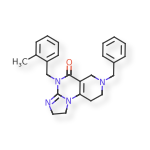
Details
| Stereochemistry | ACHIRAL |
| Molecular Formula | C24H26N4O |
| Molecular Weight | 386.4894 |
| Optical Activity | NONE |
| Defined Stereocenters | 0 / 0 |
| E/Z Centers | 0 |
| Charge | 0 |
SHOW SMILES / InChI
SMILES
CC1=CC=CC=C1CN2C3=NCCN3C4=C(CN(CC5=CC=CC=C5)CC4)C2=O
InChI
InChIKey=VLULRUCCHYVXOH-UHFFFAOYSA-N
InChI=1S/C24H26N4O/c1-18-7-5-6-10-20(18)16-28-23(29)21-17-26(15-19-8-3-2-4-9-19)13-11-22(21)27-14-12-25-24(27)28/h2-10H,11-17H2,1H3
| Molecular Formula | C24H26N4O |
| Molecular Weight | 386.4894 |
| Charge | 0 |
| Count |
|
| Stereochemistry | ACHIRAL |
| Additional Stereochemistry | No |
| Defined Stereocenters | 0 / 0 |
| E/Z Centers | 0 |
| Optical Activity | NONE |
DescriptionSources: http://adisinsight.springer.com/drugs/800039735https://www.ncbi.nlm.nih.gov/pubmed/23390247 | https://www.ncbi.nlm.nih.gov/pubmed/25587031 | https://www.scripps.edu/news/press/2014/20140519janda.htmlCurator's Comment: Description was created based on several sources, including
https://www.ncbi.nlm.nih.gov/pubmed/27602582 | https://www.ncbi.nlm.nih.gov/pubmed/25859547 | https://www.ncbi.nlm.nih.gov/pubmed/23390247 | https://www.ncbi.nlm.nih.gov/pubmed/25587031 | https://www.ncbi.nlm.nih.gov/pubmed/24838721
Sources: http://adisinsight.springer.com/drugs/800039735https://www.ncbi.nlm.nih.gov/pubmed/23390247 | https://www.ncbi.nlm.nih.gov/pubmed/25587031 | https://www.scripps.edu/news/press/2014/20140519janda.html
Curator's Comment: Description was created based on several sources, including
https://www.ncbi.nlm.nih.gov/pubmed/27602582 | https://www.ncbi.nlm.nih.gov/pubmed/25859547 | https://www.ncbi.nlm.nih.gov/pubmed/23390247 | https://www.ncbi.nlm.nih.gov/pubmed/25587031 | https://www.ncbi.nlm.nih.gov/pubmed/24838721
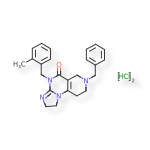
TIC10 (TIC10 isomer or ONC201 isomer) is a potent, orally active, and stable small molecule and is an efficacious antitumor therapeutic agent that acts on tumor cells and their microenvironment to enhance the concentrations of the endogenous tumor necrosis factor-related apoptosis-inducing ligand (TRAIL). The isomeric structure of TIC10/ONC201 is critical to its activity: anti-cancer activity is associated with the angular structure and not the linear TIC10 isomer. TIC10 transcriptionally induces a sustained up-regulation TRAIL in tumors and normal cells in a p53-independent manner. TIC10 inactivates kinases Akt and extracellular signal-regulated kinase (ERK), leading to the translocation of Foxo3a into the nucleus, where it binds to the TRAIL promoter to up-regulate gene transcription. TIC10 crosses the blood-brain barrier. TIC10 treatment caused tumor regression in the HCT116 p53−/− xenograft, RKO human colon cancer xenograft–bearing mice and human triple-negative breast cancer xenografts and significantly prolonged the survival of Eμ-myc transgenic mice, which spontaneously develop metastatic lymphoma from weeks 9 to 12 of age by 4 weeks.
CNS Activity
Sources: https://www.ncbi.nlm.nih.gov/pubmed/23390247 | https://www.ncbi.nlm.nih.gov/pubmed/26474387 | https://clinicaltrials.gov/ct2/show/NCT02525692 | http://oncoceutics.com/oncoceutics-awarded-nci-grant-for-clinical-trial-of-onc201-in-gbm/https://www.ncbi.nlm.nih.gov/pubmed/23390247
Curator's Comment: Known to be CNS penetrant in mouse. Human data not available
Originator
Sources: https://www.ncbi.nlm.nih.gov/pubmed/23390247 | http://adisinsight.springer.com/drugs/800039735Stähle H, Dr., Köppe H, Dr., Kummer W, Dr. Ingelheim. (1973). Imidazo-[1,2-a]-pyrido-[4,3-d]-pyrimidines, their acid addition salts and method for their manufacture. In: GERMANY FRO and OFFICE GP, eds. (Germany: C.H BOEHRINGER SOHN, INGELHEIM AM RHEIN). Retrieved from https://www.ncbi.nlm.nih.gov/pubmed/25587031
Curator's Comment: 1973
Approval Year
Targets
| Primary Target | Pharmacology | Condition | Potency |
|---|---|---|---|
Target ID: GO:0006950 |
|||
Target ID: GO:0036462 |
|||
Target ID: CHEMBL2331075 |
|||
Target ID: CHEMBL4282 |
|||
Target ID: CHEMBL1907606 |
Conditions
| Condition | Modality | Targets | Highest Phase | Product |
|---|---|---|---|---|
| Primary | Unknown Approved UseUnknown |
|||
| Primary | Unknown Approved UseUnknown |
|||
| Primary | Unknown Approved UseUnknown |
|||
| Primary | Unknown Approved UseUnknown |
|||
| Primary | Unknown Approved UseUnknown |
|||
| Primary | Unknown Approved UseUnknown |
|||
| Primary | Unknown Approved UseUnknown |
|||
| Primary | Unknown Approved UseUnknown |
Cmax
| Value | Dose | Co-administered | Analyte | Population |
|---|---|---|---|---|
3.6 μg/mL EXPERIMENT https://pubmed.ncbi.nlm.nih.gov/28331050/ |
625 mg 1 times / 3 weeks multiple, oral dose: 625 mg route of administration: Oral experiment type: MULTIPLE co-administered: |
ONC201 plasma | Homo sapiens population: UNHEALTHY age: ADULT sex: FEMALE / MALE food status: UNKNOWN |
AUC
| Value | Dose | Co-administered | Analyte | Population |
|---|---|---|---|---|
37.7 μg × h/mL EXPERIMENT https://pubmed.ncbi.nlm.nih.gov/28331050/ |
625 mg 1 times / 3 weeks multiple, oral dose: 625 mg route of administration: Oral experiment type: MULTIPLE co-administered: |
ONC201 plasma | Homo sapiens population: UNHEALTHY age: ADULT sex: FEMALE / MALE food status: UNKNOWN |
T1/2
| Value | Dose | Co-administered | Analyte | Population |
|---|---|---|---|---|
11.3 h EXPERIMENT https://pubmed.ncbi.nlm.nih.gov/28331050/ |
625 mg 1 times / 3 weeks multiple, oral dose: 625 mg route of administration: Oral experiment type: MULTIPLE co-administered: |
ONC201 plasma | Homo sapiens population: UNHEALTHY age: ADULT sex: FEMALE / MALE food status: UNKNOWN |
Overview
| CYP3A4 | CYP2C9 | CYP2D6 | hERG |
|---|---|---|---|
OverviewOther
| Other Inhibitor | Other Substrate | Other Inducer |
|---|---|---|
Drug as perpetrator
| Target | Modality | Activity | Metabolite | Clinical evidence |
|---|---|---|---|---|
| no | ||||
| yes [IC50 11.9877 uM] | ||||
| yes [IC50 11.9877 uM] | ||||
| yes [IC50 2.9093 uM] | ||||
| yes [IC50 30.1116 uM] | ||||
| yes | ||||
| yes | ||||
| yes | ||||
| yes |
Drug as victim
| Target | Modality | Activity | Metabolite | Clinical evidence |
|---|---|---|---|---|
| yes | ||||
| yes | ||||
| yes | ||||
| yes | ||||
| yes | ||||
| yes |
PubMed
| Title | Date | PubMed |
|---|---|---|
| Discovery and clinical introduction of first-in-class imipridone ONC201. | 2016-11-08 |
|
| mTOR inhibition sensitizes ONC201-induced anti-colorectal cancer cell activity. | 2016-09-30 |
|
| The preclinical evaluation of TIC10/ONC201 as an anti-pancreatic cancer agent. | 2016-08-05 |
|
| ONC201 kills solid tumor cells by triggering an integrated stress response dependent on ATF4 activation by specific eIF2α kinases. | 2016-02-16 |
|
| ATF4 induction through an atypical integrated stress response to ONC201 triggers p53-independent apoptosis in hematological malignancies. | 2016-02-16 |
|
| ONC201: Stressing tumors to death. | 2016-02-16 |
|
| TIC10/ONC201 synergizes with Bcl-2/Bcl-xL inhibition in glioblastoma by suppression of Mcl-1 and its binding partners in vitro and in vivo. | 2015-11-03 |
|
| ONC201 induces cell death in pediatric non-Hodgkin's lymphoma cells. | 2015-08-03 |
|
| Identification of TRAIL-inducing compounds highlights small molecule ONC201/TIC10 as a unique anti-cancer agent that activates the TRAIL pathway. | 2015-05-01 |
|
| Genetic and Pharmacological Screens Converge in Identifying FLIP, BCL2, and IAP Proteins as Key Regulators of Sensitivity to the TRAIL-Inducing Anticancer Agent ONC201/TIC10. | 2015-04-15 |
|
| Small-Molecule ONC201/TIC10 Targets Chemotherapy-Resistant Colorectal Cancer Stem-like Cells in an Akt/Foxo3a/TRAIL-Dependent Manner. | 2015-04-01 |
|
| TIC10/ONC201: a bend in the road to clinical development. | 2015 |
|
| The angular structure of ONC201, a TRAIL pathway-inducing compound, determines its potent anti-cancer activity. | 2014-12-30 |
|
| Pharmacophore reassignment for induction of the immunosurveillance cytokine TRAIL. | 2014-06-23 |
|
| Dual inactivation of Akt and ERK by TIC10 signals Foxo3a nuclear translocation, TRAIL gene induction, and potent antitumor effects. | 2013-02-06 |
Sample Use Guides
The first-in-human clinical trial of ONC201 in advanced aggressive refractory solid tumors confirmed that ONC201 is exceptionally well-tolerated and established the recommended phase II dose of 625 mg administered orally every three weeks defined by drug exposure comparable to efficacious levels in preclinical models.
Route of Administration:
Oral
| Substance Class |
Chemical
Created
by
admin
on
Edited
Wed Apr 02 19:46:13 GMT 2025
by
admin
on
Wed Apr 02 19:46:13 GMT 2025
|
| Record UNII |
9U35A31JAI
|
| Record Status |
Validated (UNII)
|
| Record Version |
|
-
Download
| Name | Type | Language | ||
|---|---|---|---|---|
|
Preferred Name | English | ||
|
Official Name | English | ||
|
Code | English | ||
|
Common Name | English | ||
|
Systematic Name | English | ||
|
Systematic Name | English | ||
|
Code | English | ||
|
Systematic Name | English | ||
|
Common Name | English | ||
|
Common Name | English | ||
|
Code | English | ||
|
Code | English |
| Classification Tree | Code System | Code | ||
|---|---|---|---|---|
|
FDA ORPHAN DRUG |
553316
Created by
admin on Wed Apr 02 19:46:13 GMT 2025 , Edited by admin on Wed Apr 02 19:46:13 GMT 2025
|
||
|
FDA ORPHAN DRUG |
640218
Created by
admin on Wed Apr 02 19:46:13 GMT 2025 , Edited by admin on Wed Apr 02 19:46:13 GMT 2025
|
| Code System | Code | Type | Description | ||
|---|---|---|---|---|---|
|
LM-148
Created by
admin on Wed Apr 02 19:46:13 GMT 2025 , Edited by admin on Wed Apr 02 19:46:13 GMT 2025
|
PRIMARY | |||
|
1342897-86-2
Created by
admin on Wed Apr 02 19:46:13 GMT 2025 , Edited by admin on Wed Apr 02 19:46:13 GMT 2025
|
SUPERSEDED | |||
|
C113792
Created by
admin on Wed Apr 02 19:46:13 GMT 2025 , Edited by admin on Wed Apr 02 19:46:13 GMT 2025
|
PRIMARY | |||
|
73777259
Created by
admin on Wed Apr 02 19:46:13 GMT 2025 , Edited by admin on Wed Apr 02 19:46:13 GMT 2025
|
PRIMARY | |||
|
9U35A31JAI
Created by
admin on Wed Apr 02 19:46:13 GMT 2025 , Edited by admin on Wed Apr 02 19:46:13 GMT 2025
|
PRIMARY | |||
|
12147
Created by
admin on Wed Apr 02 19:46:13 GMT 2025 , Edited by admin on Wed Apr 02 19:46:13 GMT 2025
|
PRIMARY | |||
|
300000017123
Created by
admin on Wed Apr 02 19:46:13 GMT 2025 , Edited by admin on Wed Apr 02 19:46:13 GMT 2025
|
PRIMARY | |||
|
1616632-77-9
Created by
admin on Wed Apr 02 19:46:13 GMT 2025 , Edited by admin on Wed Apr 02 19:46:13 GMT 2025
|
PRIMARY | |||
|
DB14844
Created by
admin on Wed Apr 02 19:46:13 GMT 2025 , Edited by admin on Wed Apr 02 19:46:13 GMT 2025
|
PRIMARY | |||
|
350625
Created by
admin on Wed Apr 02 19:46:13 GMT 2025 , Edited by admin on Wed Apr 02 19:46:13 GMT 2025
|
PRIMARY |
| Related Record | Type | Details | ||
|---|---|---|---|---|
|
|
SALT/SOLVATE -> PARENT |
|
||
|
TARGET -> INHIBITOR |
ANTAGONIST
|

| Related Record | Type | Details | ||
|---|---|---|---|---|
|
ACTIVE MOIETY |
Experiments showed that TIC10 had potent effects against a variety of tumours, including breast, lymphatic, colon and lung cancer. It was especially effective at triggering cell suicide in glioblastoma, a kind of brain tumour that is notoriously difficult to treat2. Mice with glioblastomas that were treated with TIC10 in combination with bevacizumab a drug used against diseases including brain tumours, and sold under the name Avastin survived three times as long as untreated mice. Even mice treated with TIC-10 alone still had better survival rates (6% longer) than those treated with bevacizumab alone.
|