


Details
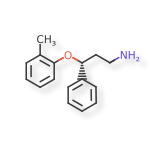
| Stereochemistry | ABSOLUTE |
| Molecular Formula | C17H21NO |
| Molecular Weight | 255.3547 |
| Optical Activity | ( - ) |
| Defined Stereocenters | 1 / 1 |
| E/Z Centers | 0 |
| Charge | 0 |
SHOW SMILES / InChI
SMILES
CNCC[C@@H](OC1=CC=CC=C1C)C2=CC=CC=C2
InChI
InChIKey=VHGCDTVCOLNTBX-QGZVFWFLSA-N
InChI=1S/C17H21NO/c1-14-8-6-7-11-16(14)19-17(12-13-18-2)15-9-4-3-5-10-15/h3-11,17-18H,12-13H2,1-2H3/t17-/m1/s1
| Molecular Formula | C17H21NO |
| Molecular Weight | 255.3547 |
| Charge | 0 |
| Count |
|
| Stereochemistry | ABSOLUTE |
| Additional Stereochemistry | No |
| Defined Stereocenters | 1 / 1 |
| E/Z Centers | 0 |
| Optical Activity | UNSPECIFIED |
DescriptionCurator's Comment: description was created based on several sources, including:
https://www.drugs.com/pro/atomoxetine.html
Curator's Comment: description was created based on several sources, including:
https://www.drugs.com/pro/atomoxetine.html
Atomoxetine is indicated for the treatment of Attention-Deficit/Hyperactivity Disorder. The precise mechanism by which atomoxetine produces its therapeutic effects in Attention-Deficit/Hyperactivity Disorder (ADHD) is unknown, but is thought to be related to selective inhibition of the pre-synaptic norepinephrine transporter. Most common adverse reactions are: nausea, vomiting, fatigue, decreased appetite, abdominal pain, and somnolence, constipation, dry mouth, dizziness, erectile dysfunction, and urinary hesitation. Atomoxetine is a substrate for CYP2D6 and hence concurrent treatment with CYP2D6 inhibitors such as bupropion (Wellbutrin) or fluoxetine (Prozac) is not recommended, as this can lead to significant elevations of plasma atomoxetine levels.
CNS Activity
Originator
Approval Year
Targets
| Primary Target | Pharmacology | Condition | Potency |
|---|---|---|---|
| 5.0 nM [Ki] | |||
Target ID: CHEMBL228 |
77.0 nM [Ki] | ||
Target ID: CHEMBL238 |
1451.0 nM [Ki] | ||
Target ID: Q00959 Gene ID: 24409.0 Gene Symbol: Grin2a Target Organism: Rattus norvegicus (Rat) |
1.58 µM [IC50] |
Conditions
| Condition | Modality | Targets | Highest Phase | Product |
|---|---|---|---|---|
| Primary | STRATTERA Approved UseAttention-Deficit/Hyperactivity Disorder (ADHD) STRATTERA is indicated for the treatment of Attention-Deficit/Hyperactivity Disorder (ADHD). The efficacy of STRATTERA Capsules was established in seven clinical trials in outpatients with ADHD: four 6 to 9-week trials in pediatric patients (ages 6 to 18), two 10-week trial in adults, and one maintenance trial in pediatrics (ages 6 to 15) [see Clinical Studies (14) Launch Date2002 |
Cmax
| Value | Dose | Co-administered | Analyte | Population |
|---|---|---|---|---|
414.82 ng/mL EXPERIMENT https://pubmed.ncbi.nlm.nih.gov/23812961 |
40 mg single, oral dose: 40 mg route of administration: Oral experiment type: SINGLE co-administered: |
ATOMOXETINE plasma | Homo sapiens population: HEALTHY age: ADULT sex: MALE food status: FASTED |
AUC
| Value | Dose | Co-administered | Analyte | Population |
|---|---|---|---|---|
2693.29 ng × h/mL EXPERIMENT https://pubmed.ncbi.nlm.nih.gov/23812961 |
40 mg single, oral dose: 40 mg route of administration: Oral experiment type: SINGLE co-administered: |
ATOMOXETINE plasma | Homo sapiens population: HEALTHY age: ADULT sex: MALE food status: FASTED |
T1/2
| Value | Dose | Co-administered | Analyte | Population |
|---|---|---|---|---|
3.64 h EXPERIMENT https://pubmed.ncbi.nlm.nih.gov/23812961 |
40 mg single, oral dose: 40 mg route of administration: Oral experiment type: SINGLE co-administered: |
ATOMOXETINE plasma | Homo sapiens population: HEALTHY age: ADULT sex: MALE food status: FASTED |
Funbound
| Value | Dose | Co-administered | Analyte | Population |
|---|---|---|---|---|
2% |
ATOMOXETINE plasma | Homo sapiens population: UNKNOWN age: UNKNOWN sex: UNKNOWN food status: UNKNOWN |
Overview
OverviewOther
| Other Inhibitor | Other Substrate | Other Inducer |
|---|---|---|
Drug as perpetrator
| Target | Modality | Activity | Metabolite | Clinical evidence |
|---|---|---|---|---|
| no | ||||
| no | ||||
| no | ||||
| no | ||||
| no | ||||
| no | ||||
| no | no (co-administration study) Comment: coadministration with desipramine did not alter the PK of desipramine Page: 11, 28, 30 |
|||
| no | no (co-administration study) Comment: coadministration with midazolam increased AUC by 15% Page: 11, 28, 30 |
Drug as victim
| Target | Modality | Activity | Metabolite | Clinical evidence |
|---|---|---|---|---|
| major | yes (co-administration study) Comment: coadministration with paroxetine or fluoxetine increased atomoxetine steady-state plasma concentrations Page: 8, 11, 22 |
|||
| unlikely | ||||
| weak | ||||
| weak | ||||
| weak | ||||
| weak | ||||
| weak | ||||
| weak | ||||
| yes |
Tox targets
| Target | Modality | Activity | Metabolite | Clinical evidence |
|---|---|---|---|---|
PubMed
| Title | Date | PubMed |
|---|---|---|
| Evaluation of the reinforcing effects of monoamine reuptake inhibitors under a concurrent schedule of food and i.v. drug delivery in rhesus monkeys. | 2005-04 |
|
| Atomoxetine: the first nonstimulant for the management of attention-deficit/hyperactivity disorder. | 2004-11-15 |
|
| New drugs for the treatment of attention-deficit/hyperactivity disorder. | 2004-11 |
|
| Combining stimulants with monoamine oxidase inhibitors: a review of uses and one possible additional indication. | 2004-11 |
|
| A lifetime of distractions. ADHD is no longer just a children's disease. Many adults are being diagnosed and treated for the condition. | 2004-10 |
|
| [Atomoxetine for the treatment of attention-deficit/hyperactivity disorder]. | 2004-10 |
|
| Mania induction associated with atomoxetine. | 2004-10 |
|
| Evaluation of the reinforcing effects of atomoxetine in monkeys: comparison to methylphenidate and desipramine. | 2004-09-06 |
|
| Management of hyperactivity and other acting-out problems in patients with autism spectrum disorder. | 2004-09 |
|
| Gateways to clinical trials. | 2004-09 |
|
| Aggression, mania, and hypomania induction associated with atomoxetine. | 2004-09 |
|
| Atomoxetine and nonresponders to stimulants. | 2004-09 |
|
| Atomoxetine and tics in ADHD. | 2004-09 |
|
| Atomoxetine (Strattera) revisited. | 2004-08-16 |
|
| Synthesis and biological evaluation of the major metabolite of atomoxetine: elucidation of a partial kappa-opioid agonist effect. | 2004-08-02 |
|
| A prospective, multicenter, open-label assessment of atomoxetine in non-North American children and adolescents with ADHD. | 2004-08 |
|
| Role of presynaptic alpha2-adrenoceptors in antidepressant action: recent findings from microdialysis studies. | 2004-08 |
|
| Atomoxetine, a novel treatment for attention-deficit-hyperactivity disorder. | 2004-08 |
|
| Improvement in health-related quality of life in children with ADHD: an analysis of placebo controlled studies of atomoxetine. | 2004-08 |
|
| The use of atomoxetine adjunctively in fibromyalgia syndrome. | 2004-07 |
|
| New options in the pharmacological management of attention-deficit/hyperactivity disorder. | 2004-07 |
|
| Attention-deficit/hyperactivity disorder: medication treatment-dosing and duration of action. | 2004-07 |
|
| Once-daily atomoxetine treatment for children with attention-deficit/hyperactivity disorder, including an assessment of evening and morning behavior: a double-blind, placebo-controlled trial. | 2004-07 |
|
| Relapse prevention in pediatric patients with ADHD treated with atomoxetine: a randomized, double-blind, placebo-controlled study. | 2004-07 |
|
| The link between health-related quality of life and clinical symptoms among children with attention-deficit hyperactivity disorder. | 2004-06 |
|
| Acute oxcarbazepine and atomoxetine overdose with quetiapine. | 2004-06 |
|
| Pharmacological management of attention-deficit hyperactivity disorder. | 2004-06 |
|
| Nonstimulant treatment of adult attention-deficit/hyperactivity disorder. | 2004-06 |
|
| Driving impairments in teens and adults with attention-deficit/hyperactivity disorder. | 2004-06 |
|
| Adrenergic alpha 2C receptor genomic organization: association study in adult ADHD. | 2004-05-15 |
|
| Atomoxetine--treatment of attention deficit hyperactivity disorder: beyond stimulants. | 2004-05 |
|
| Atomoxetine hydrochloride. | 2004-05 |
|
| Potential noradrenergic targets for cognitive enhancement in schizophrenia. | 2004-05 |
|
| New drugs of 2003. | 2004-04-22 |
|
| Seizures and prolonged QTc with atomoxetine overdose. | 2004-04 |
|
| [Attention-deficit/hyperactivity disorder (ADHS) in adulthood]. | 2004-03-24 |
|
| Evidence-based pharmacotherapy for attention-deficit hyperactivity disorder. | 2004-03 |
|
| Gateways to clinical trials. | 2004-02-28 |
|
| [Tourette syndrome: an analysis of its comorbidity and specific treatment]. | 2004-02 |
|
| [New therapeutic options in the treatment of attention deficit/hyperactivity disorder]. | 2004-02 |
|
| New drugs 04, part 1. | 2004-02 |
|
| Atomoxetine treatment of attention-deficit/hyperactivity disorder. | 2004-01 |
|
| Non-stimulant medications in the treatment of ADHD. | 2004 |
|
| Involvement of norepinephrine in the control of activity and attentive processes in animal models of attention deficit hyperactivity disorder. | 2004 |
|
| Atomoxetine and stimulants in combination for treatment of attention deficit hyperactivity disorder: four case reports. | 2004 |
|
| Spotlight on atomoxetine in adults with attention-deficit hyperactivity disorder. | 2004 |
|
| Impact of ADHD and its treatment on substance abuse in adults. | 2004 |
|
| ADHD treatment across the life cycle. | 2004 |
|
| Atomoxetine: a review of its use in adults with attention deficit hyperactivity disorder. | 2004 |
|
| Atomoxetine hydrochloride for the treatment of attention-deficit/hyperactivity disorder. | 2003-12 |
Patents
Sample Use Guides
Atomoxetine should be initiated at a total daily dose of approximately 0.5 mg/kg and increased after a minimum of 3 days to a target total daily dose of approximately 1.2 mg/kg administered either as a single daily dose in the morning or as evenly divided doses in the morning and late afternoon/early evening. No additional benefit has been demonstrated for doses higher than 1.2 mg/kg/day.
Route of Administration:
Oral
Electrophysiological recordings was performed with the extracellular standard solution at different membrane potentials ranging from -80 mV to +40 mV while the concentration of the agonists (100 uM NMDA/10 uM glycine) and the antagonist (25 uM atomoxetine) were kept constant. The inhibitory effect was clearly voltage-dependent, so that the inhibition was attenuated by depolarization.
| Substance Class |
Chemical
Created
by
admin
on
Edited
Wed Apr 02 09:16:46 GMT 2025
by
admin
on
Wed Apr 02 09:16:46 GMT 2025
|
| Record UNII |
ASW034S0B8
|
| Record Status |
Validated (UNII)
|
| Record Version |
|
-
Download
| Name | Type | Language | ||
|---|---|---|---|---|
|
Official Name | English | ||
|
Preferred Name | English | ||
|
Common Name | English | ||
|
Code | English | ||
|
Common Name | English | ||
|
Common Name | English | ||
|
Common Name | English | ||
|
Common Name | English | ||
|
Code | English | ||
|
Common Name | English |
| Classification Tree | Code System | Code | ||
|---|---|---|---|---|
|
WHO-ATC |
N06BA09
Created by
admin on Wed Apr 02 09:16:46 GMT 2025 , Edited by admin on Wed Apr 02 09:16:46 GMT 2025
|
||
|
LIVERTOX |
NBK548671
Created by
admin on Wed Apr 02 09:16:46 GMT 2025 , Edited by admin on Wed Apr 02 09:16:46 GMT 2025
|
||
|
WHO-VATC |
QN06BA09
Created by
admin on Wed Apr 02 09:16:46 GMT 2025 , Edited by admin on Wed Apr 02 09:16:46 GMT 2025
|
||
|
NCI_THESAURUS |
C265
Created by
admin on Wed Apr 02 09:16:46 GMT 2025 , Edited by admin on Wed Apr 02 09:16:46 GMT 2025
|
||
|
NDF-RT |
N0000175695
Created by
admin on Wed Apr 02 09:16:46 GMT 2025 , Edited by admin on Wed Apr 02 09:16:46 GMT 2025
|
||
|
NDF-RT |
N0000000102
Created by
admin on Wed Apr 02 09:16:46 GMT 2025 , Edited by admin on Wed Apr 02 09:16:46 GMT 2025
|
| Code System | Code | Type | Description | ||
|---|---|---|---|---|---|
|
54841
Created by
admin on Wed Apr 02 09:16:46 GMT 2025 , Edited by admin on Wed Apr 02 09:16:46 GMT 2025
|
PRIMARY | |||
|
C74141
Created by
admin on Wed Apr 02 09:16:46 GMT 2025 , Edited by admin on Wed Apr 02 09:16:46 GMT 2025
|
PRIMARY | |||
|
83015-26-3
Created by
admin on Wed Apr 02 09:16:46 GMT 2025 , Edited by admin on Wed Apr 02 09:16:46 GMT 2025
|
PRIMARY | |||
|
100000090524
Created by
admin on Wed Apr 02 09:16:46 GMT 2025 , Edited by admin on Wed Apr 02 09:16:46 GMT 2025
|
PRIMARY | |||
|
7352
Created by
admin on Wed Apr 02 09:16:46 GMT 2025 , Edited by admin on Wed Apr 02 09:16:46 GMT 2025
|
PRIMARY | |||
|
ASW034S0B8
Created by
admin on Wed Apr 02 09:16:46 GMT 2025 , Edited by admin on Wed Apr 02 09:16:46 GMT 2025
|
PRIMARY | |||
|
SUB20597
Created by
admin on Wed Apr 02 09:16:46 GMT 2025 , Edited by admin on Wed Apr 02 09:16:46 GMT 2025
|
PRIMARY | |||
|
38400
Created by
admin on Wed Apr 02 09:16:46 GMT 2025 , Edited by admin on Wed Apr 02 09:16:46 GMT 2025
|
PRIMARY | RxNorm | ||
|
ASW034S0B8
Created by
admin on Wed Apr 02 09:16:46 GMT 2025 , Edited by admin on Wed Apr 02 09:16:46 GMT 2025
|
PRIMARY | |||
|
7118
Created by
admin on Wed Apr 02 09:16:46 GMT 2025 , Edited by admin on Wed Apr 02 09:16:46 GMT 2025
|
PRIMARY | |||
|
Atomoxetine
Created by
admin on Wed Apr 02 09:16:46 GMT 2025 , Edited by admin on Wed Apr 02 09:16:46 GMT 2025
|
PRIMARY | |||
|
CHEMBL641
Created by
admin on Wed Apr 02 09:16:46 GMT 2025 , Edited by admin on Wed Apr 02 09:16:46 GMT 2025
|
PRIMARY | |||
|
ATOMOXETINE
Created by
admin on Wed Apr 02 09:16:46 GMT 2025 , Edited by admin on Wed Apr 02 09:16:46 GMT 2025
|
PRIMARY | |||
|
DB00289
Created by
admin on Wed Apr 02 09:16:46 GMT 2025 , Edited by admin on Wed Apr 02 09:16:46 GMT 2025
|
PRIMARY | |||
|
m2124
Created by
admin on Wed Apr 02 09:16:46 GMT 2025 , Edited by admin on Wed Apr 02 09:16:46 GMT 2025
|
PRIMARY | Merck Index | ||
|
331697
Created by
admin on Wed Apr 02 09:16:46 GMT 2025 , Edited by admin on Wed Apr 02 09:16:46 GMT 2025
|
PRIMARY | |||
|
C041930
Created by
admin on Wed Apr 02 09:16:46 GMT 2025 , Edited by admin on Wed Apr 02 09:16:46 GMT 2025
|
PRIMARY | |||
|
127342
Created by
admin on Wed Apr 02 09:16:46 GMT 2025 , Edited by admin on Wed Apr 02 09:16:46 GMT 2025
|
PRIMARY | |||
|
256
Created by
admin on Wed Apr 02 09:16:46 GMT 2025 , Edited by admin on Wed Apr 02 09:16:46 GMT 2025
|
PRIMARY | |||
|
5354
Created by
admin on Wed Apr 02 09:16:46 GMT 2025 , Edited by admin on Wed Apr 02 09:16:46 GMT 2025
|
PRIMARY | |||
|
DTXSID9044297
Created by
admin on Wed Apr 02 09:16:46 GMT 2025 , Edited by admin on Wed Apr 02 09:16:46 GMT 2025
|
PRIMARY |
| Related Record | Type | Details | ||
|---|---|---|---|---|
|
|
SALT/SOLVATE -> PARENT |
|
||
|
METABOLIC ENZYME -> SUBSTRATE |
|
||
|
TARGET -> INHIBITOR |
NON-COMPETITIVE
IC50
|
||
|
RACEMATE -> ENANTIOMER |
|
||
|
TARGET -> INHIBITOR |
|
||
|
METABOLIC ENZYME -> INHIBITOR | |||
|
EXCRETED UNCHANGED |
FECAL; URINE
|
||
|
METABOLIC ENZYME -> SUBSTRATE |
|
||
|
BINDER->LIGAND |
BINDING
|
||
|
SALT/SOLVATE -> PARENT |
|
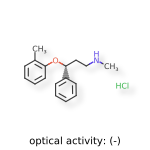


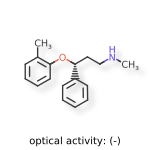

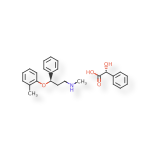
| Related Record | Type | Details | ||
|---|---|---|---|---|
|
METABOLITE -> PARENT |
|
||
|
METABOLITE ACTIVE -> PARENT |
MAJOR
|
||
|
METABOLITE -> PARENT |
|
||
|
|
METABOLITE -> PARENT |
URINE
|
||
|
METABOLITE -> PARENT |
|
||
|
|
METABOLITE -> PARENT |
URINE
|
||
|
METABOLITE -> PARENT |
|
||
|
METABOLITE LESS ACTIVE -> PARENT |
|
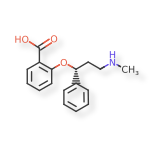
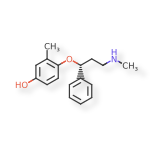
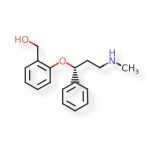
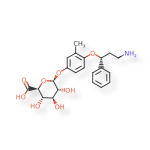


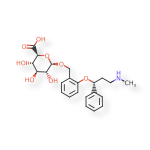
| Related Record | Type | Details | ||
|---|---|---|---|---|
|
|
ACTIVE MOIETY |
|
| Name | Property Type | Amount | Referenced Substance | Defining | Parameters | References |
|---|---|---|---|---|---|---|
| Volume of Distribution | PHARMACOKINETIC |
|
|
|||
| Tmax | PHARMACOKINETIC |
|
|
|||
| Biological Half-life | PHARMACOKINETIC |
|
|
|||