


Details
| Stereochemistry | ACHIRAL |
| Molecular Formula | C12H16N2O |
| Molecular Weight | 204.2682 |
| Optical Activity | NONE |
| Defined Stereocenters | 0 / 0 |
| E/Z Centers | 0 |
| Charge | 0 |
SHOW SMILES / InChI
SMILES
CN(C)CCC1=CNC2=C1C(O)=CC=C2
InChI
InChIKey=SPCIYGNTAMCTRO-UHFFFAOYSA-N
InChI=1S/C12H16N2O/c1-14(2)7-6-9-8-13-10-4-3-5-11(15)12(9)10/h3-5,8,13,15H,6-7H2,1-2H3
| Molecular Formula | C12H16N2O |
| Molecular Weight | 204.2682 |
| Charge | 0 |
| Count |
|
| Stereochemistry | ACHIRAL |
| Additional Stereochemistry | No |
| Defined Stereocenters | 0 / 0 |
| E/Z Centers | 0 |
| Optical Activity | NONE |
DescriptionSources: https://www.ncbi.nlm.nih.gov/pubmed/25342005 | https://www.ncbi.nlm.nih.gov/pubmed/23851905 | https://www.ncbi.nlm.nih.gov/pubmed/21148021 | https://www.ncbi.nlm.nih.gov/pubmed/11101361https://www.ncbi.nlm.nih.gov/pubmed/26841800 | https://clinicaltrials.gov/ct2/show/NCT03341689 | http://onlinelibrary.wiley.com/doi/10.1002/hlca.19590420518/abstract | https://clinicaltrials.gov/ct2/show/NCT02061293 | https://clinicaltrials.gov/ct2/show/NCT03181529
Sources: https://www.ncbi.nlm.nih.gov/pubmed/25342005 | https://www.ncbi.nlm.nih.gov/pubmed/23851905 | https://www.ncbi.nlm.nih.gov/pubmed/21148021 | https://www.ncbi.nlm.nih.gov/pubmed/11101361https://www.ncbi.nlm.nih.gov/pubmed/26841800 | https://clinicaltrials.gov/ct2/show/NCT03341689 | http://onlinelibrary.wiley.com/doi/10.1002/hlca.19590420518/abstract | https://clinicaltrials.gov/ct2/show/NCT02061293 | https://clinicaltrials.gov/ct2/show/NCT03181529
Psilocybin is a naturally occurring psychedelic prodrug compound produced by more than 200 species of mushrooms, collectively known as psilocybin mushrooms. Once ingested, psilocybin is rapidly metabolized to the psilocin, which then acts on serotonin receptors in the brain. Psilocybin was identified as the active hallucinogenic compound in magic mushrooms in 1959, but humans have used assorted psilocybin mushrooms in religious ceremonies since prehistoric times. In the 1960's psilocybin was marketed for use as a treatment for various psychoses, however, it was withdrawn from the market when the regulatory environment changed. Recently there has been as renewed interest in studying the medicinal uses of psilocybin for treatment of anxiety, depression, migraine headaches, addictions, and other neuropsychiatric conditions.
Originator
Approval Year
Targets
| Primary Target | Pharmacology | Condition | Potency |
|---|---|---|---|
Target ID: P28223 Gene ID: 3356.0 Gene Symbol: HTR2A Target Organism: Homo sapiens (Human) |
|||
Target ID: Q64264 Gene ID: 15550.0 Gene Symbol: Htr1a Target Organism: Mus musculus (Mouse) |
49.0 nM [Ki] | ||
Target ID: P35363 Gene ID: 15558.0 Gene Symbol: Htr2a Target Organism: Mus musculus (Mouse) |
25.0 nM [Ki] | ||
Target ID: P34968 Gene ID: 15560.0 Gene Symbol: Htr2c Target Organism: Mus musculus (Mouse) |
10.0 nM [Ki] |
Conditions
| Condition | Modality | Targets | Highest Phase | Product |
|---|---|---|---|---|
| Primary | Unknown Approved UseUnknown |
|||
| Primary | Unknown Approved UseUnknown |
|||
| Primary | Unknown Approved UseUnknown |
|||
| Primary | Unknown Approved UseUnknown |
|||
Cmax
| Value | Dose | Co-administered | Analyte | Population |
|---|---|---|---|---|
16 μg/L EXPERIMENT https://pubmed.ncbi.nlm.nih.gov/28353056 |
0.3 mg/kg single, oral dose: 0.3 mg/kg route of administration: Oral experiment type: SINGLE co-administered: |
PSILOCIN plasma | Homo sapiens population: UNHEALTHY age: ADULT sex: FEMALE / MALE food status: FED |
|
26 μg/L EXPERIMENT https://pubmed.ncbi.nlm.nih.gov/28353056 |
0.45 mg/kg single, oral dose: 0.45 mg/kg route of administration: Oral experiment type: SINGLE co-administered: |
PSILOCIN plasma | Homo sapiens population: UNHEALTHY age: ADULT sex: FEMALE / MALE food status: FED |
|
37.6 μg/L EXPERIMENT https://pubmed.ncbi.nlm.nih.gov/28353056 |
0.6 mg/kg single, oral dose: 0.6 mg/kg route of administration: Oral experiment type: SINGLE co-administered: |
PSILOCIN plasma | Homo sapiens population: UNHEALTHY age: ADULT sex: FEMALE / MALE food status: FED |
AUC
| Value | Dose | Co-administered | Analyte | Population |
|---|---|---|---|---|
140 μg × h/L EXPERIMENT https://pubmed.ncbi.nlm.nih.gov/28353056 |
0.3 mg/kg single, oral dose: 0.3 mg/kg route of administration: Oral experiment type: SINGLE co-administered: |
PSILOCIN plasma | Homo sapiens population: UNHEALTHY age: ADULT sex: FEMALE / MALE food status: FED |
|
213 μg × h/L EXPERIMENT https://pubmed.ncbi.nlm.nih.gov/28353056 |
0.45 mg/kg single, oral dose: 0.45 mg/kg route of administration: Oral experiment type: SINGLE co-administered: |
PSILOCIN plasma | Homo sapiens population: UNHEALTHY age: ADULT sex: FEMALE / MALE food status: FED |
|
267 μg × h/L EXPERIMENT https://pubmed.ncbi.nlm.nih.gov/28353056 |
0.6 mg/kg single, oral dose: 0.6 mg/kg route of administration: Oral experiment type: SINGLE co-administered: |
PSILOCIN plasma | Homo sapiens population: UNHEALTHY age: ADULT sex: FEMALE / MALE food status: FED |
T1/2
| Value | Dose | Co-administered | Analyte | Population |
|---|---|---|---|---|
3 h EXPERIMENT https://pubmed.ncbi.nlm.nih.gov/28353056 |
0.3 mg/kg single, oral dose: 0.3 mg/kg route of administration: Oral experiment type: SINGLE co-administered: |
PSILOCIN plasma | Homo sapiens population: UNHEALTHY age: ADULT sex: FEMALE / MALE food status: FED |
|
3 h EXPERIMENT https://pubmed.ncbi.nlm.nih.gov/28353056 |
0.45 mg/kg single, oral dose: 0.45 mg/kg route of administration: Oral experiment type: SINGLE co-administered: |
PSILOCIN plasma | Homo sapiens population: UNHEALTHY age: ADULT sex: FEMALE / MALE food status: FED |
|
3 h EXPERIMENT https://pubmed.ncbi.nlm.nih.gov/28353056 |
0.6 mg/kg single, oral dose: 0.6 mg/kg route of administration: Oral experiment type: SINGLE co-administered: |
PSILOCIN plasma | Homo sapiens population: UNHEALTHY age: ADULT sex: FEMALE / MALE food status: FED |
PubMed
| Title | Date | PubMed |
|---|---|---|
| The hallucinogenic world of tryptamines: an updated review. | 2015-08 |
|
| Effect of psilocin on extracellular dopamine and serotonin levels in the mesoaccumbens and mesocortical pathway in awake rats. | 2015 |
|
| Fungal hallucinogens psilocin, ibotenic acid, and muscimol: analytical methods and biologic activities. | 2013-08 |
|
| Differential contributions of serotonin receptors to the behavioral effects of indoleamine hallucinogens in mice. | 2011-11 |
|
| Hallucinogens as medicine. | 2010-12 |
|
| Turn on, tune in, but don't drop out: The impact of neo-liberalism on magic mushroom users' (in)ability to imagine collectivist social worlds. | 2010-11 |
|
| Psychometric evaluation of the altered states of consciousness rating scale (OAV). | 2010-08-31 |
|
| Micro-solid phase extraction coupled with high-performance liquid chromatography-tandem mass spectrometry for the determination of stimulants, hallucinogens, ketamine and phencyclidine in oral fluids. | 2010-08-24 |
|
| Timothy Leary, Richard Alpert (Ram Dass) and the changing definition of psilocybin. | 2010-05 |
|
| Glucuronidation of psilocin and 4-hydroxyindole by the human UDP-glucuronosyltransferases. | 2010-03 |
|
| Forensic analysis of hallucinogenic mushrooms and khat (Catha edulis Forsk) using cation-exchange liquid chromatography. | 2010-02-25 |
|
| Comparative study of ATR and transflection IR spectroscopic techniques for the analysis of hallucinogenic mushrooms. | 2010-02-25 |
|
| Return of a problem child. | 2009-10 |
|
| Unifying electron transfer mechanism for psilocybin and psilocin. | 2009-10 |
|
| Sensorimotor gating depends on polymorphisms of the serotonin-2A receptor and catechol-O-methyltransferase, but not on neuregulin-1 Arg38Gln genotype: a replication study. | 2009-09-15 |
|
| Availability of websites offering to sell psilocybin spores and psilocybin. | 2009-09 |
|
| Analysis of mushroom exposures in Texas requiring hospitalization, 2005-2006. | 2009-06 |
|
| Apical regional wall motion abnormalities reminiscent to Tako-Tsubo cardiomyopathy following consumption of psychoactive fungi. | 2009-05-01 |
|
| Unrecognized magic mushroom abuse in a 28-year-old man. | 2008-10 |
|
| Mystical-type experiences occasioned by psilocybin mediate the attribution of personal meaning and spiritual significance 14 months later. | 2008-08 |
|
| The structure of human serotonin 2c G-protein-coupled receptor bound to agonists and antagonists. | 2008-08 |
|
| [Hallucinogen-induced psychological disorders]. | 2008-06 |
|
| Effects of varied doses of psilocybin on time interval reproduction in human subjects. | 2008-04-11 |
|
| Hallucinogen-like effects of N,N-dipropyltryptamine (DPT): possible mediation by serotonin 5-HT1A and 5-HT2A receptors in rodents. | 2008-01 |
|
| Albert Hofmann, the father of LSD (1906-2008). | 2008 |
|
| Between prohibitions: patterns and meanings of magic mushroom use in the UK. | 2008 |
|
| [Automutilation after consumption of hallucinogenic mushrooms]. | 2007-12-29 |
|
| Psilocybin links binocular rivalry switch rate to attention and subjective arousal levels in humans. | 2007-12 |
|
| [Hallucinogenic fungi (psilocybe). Part II. Identification of Psilocybe semilanceata by PCR]. | 2007-10-03 |
|
| Psilocybin-induced stimulus control in the rat. | 2007-10 |
|
| The effects of the preferential 5-HT2A agonist psilocybin on prepulse inhibition of startle in healthy human volunteers depend on interstimulus interval. | 2007-09 |
|
| [Prof. Günther Hole on his self-experiments. "What did I actually endure?"]. | 2007-03-15 |
|
| Effects of psilocybin on time perception and temporal control of behaviour in humans. | 2007-01 |
|
| [Concentration of selected microelements in blood serum of rats exposed to the action of psilocin and phenylethylamine]. | 2007 |
|
| 5-Year trends in use of hallucinogens and other adjunct drugs among UK dance drug users. | 2007 |
|
| Phylogenetic relationship of psychoactive fungi based on rRNA gene for a large subunit and their identification using the TaqMan assay (II). | 2006-11-10 |
|
| Safety, tolerability, and efficacy of psilocybin in 9 patients with obsessive-compulsive disorder. | 2006-11 |
|
| Not imagining it. Research into hallucinogens cautiously resumes. | 2006-11 |
|
| [Chronic cluster headache: Response to psilocybin]. | 2006-10-31 |
|
| Reviving the study of hallucinogens. | 2006-10 |
|
| Investigation into the temporal stability of aqueous standard solutions of psilocin and psilocybin using high performance liquid chromatography. | 2006-09-28 |
|
| Application of ion mobility spectrometry in cases of forensic interest. | 2006-09-12 |
|
| Psilocybin can occasion mystical-type experiences having substantial and sustained personal meaning and spiritual significance. | 2006-08 |
|
| Response of cluster headache to psilocybin and LSD. | 2006-06-27 |
|
| Psilocin identified in a DUID investigation. | 2006-06 |
|
| The determination of psilocin and psilocybin in hallucinogenic mushrooms by HPLC utilizing a dual reagent acidic potassium permanganate and tris(2,2'-bipyridyl)ruthenium(II) chemiluminescence detection system. | 2006-01 |
|
| [Hallucinogenic fungi (Psylocibe). Part I. Characteristics, results of consumption, recognition]. | 2005-12-03 |
|
| [Hallucinogenic mushrooms]. | 2005 |
|
| Brain mechanisms of hallucinogens and entactogens. | 2001-12 |
|
| Effect of ring fluorination on the pharmacology of hallucinogenic tryptamines. | 2000-11-30 |
Sample Use Guides
Rats were administered 5 and 10 mg/kg of Psilocin as an intraperitoneal injection. Following the dosing protocol, extracellular dopamine levels were increased in the nucleus accumbens. Psilocin did not affect the extracellular 5-HT level in the nucleus accumbens. However, systemic administration of 10 mg/kg of psilocin significantly increased extracellular 5-HT levels in the ventral tegmental area, but decreased dopamine in this area. Behaviorally, psilocin significantly increased the number of head twitches.
Route of Administration:
Intraperitoneal
| Substance Class |
Chemical
Created
by
admin
on
Edited
Mon Mar 31 17:55:53 GMT 2025
by
admin
on
Mon Mar 31 17:55:53 GMT 2025
|
| Record UNII |
CMS88KUW0G
|
| Record Status |
Validated (UNII)
|
| Record Version |
|
-
Download
| Name | Type | Language | ||
|---|---|---|---|---|
|
Preferred Name | English | ||
|
Common Name | English | ||
|
Systematic Name | English | ||
|
Common Name | English | ||
|
Common Name | English | ||
|
Common Name | English | ||
|
Common Name | English | ||
|
Systematic Name | English |
| Classification Tree | Code System | Code | ||
|---|---|---|---|---|
|
DEA NO. |
7438
Created by
admin on Mon Mar 31 17:55:53 GMT 2025 , Edited by admin on Mon Mar 31 17:55:53 GMT 2025
|
||
|
WIKIPEDIA |
TiHKAL
Created by
admin on Mon Mar 31 17:55:53 GMT 2025 , Edited by admin on Mon Mar 31 17:55:53 GMT 2025
|
| Code System | Code | Type | Description | ||
|---|---|---|---|---|---|
|
208-296-5
Created by
admin on Mon Mar 31 17:55:53 GMT 2025 , Edited by admin on Mon Mar 31 17:55:53 GMT 2025
|
PRIMARY | |||
|
100000085668
Created by
admin on Mon Mar 31 17:55:53 GMT 2025 , Edited by admin on Mon Mar 31 17:55:53 GMT 2025
|
PRIMARY | |||
|
8613
Created by
admin on Mon Mar 31 17:55:53 GMT 2025 , Edited by admin on Mon Mar 31 17:55:53 GMT 2025
|
PRIMARY | |||
|
SUB22051
Created by
admin on Mon Mar 31 17:55:53 GMT 2025 , Edited by admin on Mon Mar 31 17:55:53 GMT 2025
|
PRIMARY | |||
|
PSILOCIN
Created by
admin on Mon Mar 31 17:55:53 GMT 2025 , Edited by admin on Mon Mar 31 17:55:53 GMT 2025
|
PRIMARY | |||
|
CMS88KUW0G
Created by
admin on Mon Mar 31 17:55:53 GMT 2025 , Edited by admin on Mon Mar 31 17:55:53 GMT 2025
|
PRIMARY | |||
|
520-53-6
Created by
admin on Mon Mar 31 17:55:53 GMT 2025 , Edited by admin on Mon Mar 31 17:55:53 GMT 2025
|
PRIMARY | |||
|
4980
Created by
admin on Mon Mar 31 17:55:53 GMT 2025 , Edited by admin on Mon Mar 31 17:55:53 GMT 2025
|
PRIMARY | |||
|
DTXSID5048899
Created by
admin on Mon Mar 31 17:55:53 GMT 2025 , Edited by admin on Mon Mar 31 17:55:53 GMT 2025
|
PRIMARY | |||
|
m9304
Created by
admin on Mon Mar 31 17:55:53 GMT 2025 , Edited by admin on Mon Mar 31 17:55:53 GMT 2025
|
PRIMARY | Merck Index | ||
|
C009105
Created by
admin on Mon Mar 31 17:55:53 GMT 2025 , Edited by admin on Mon Mar 31 17:55:53 GMT 2025
|
PRIMARY |
| Related Record | Type | Details | ||
|---|---|---|---|---|
|
|
TARGET -> AGONIST |
|
||
|
PARENT -> ACTIVE CONSTITUENT ALWAYS PRESENT |
There was approximately 85% less PSILOCIN in the stripes compared to the cap.
MINOR
|
||
|
|
LABELED -> NON-LABELED |
|
||
|
|
SALT/SOLVATE -> PARENT |
|


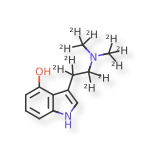
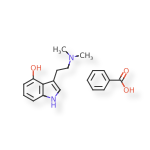
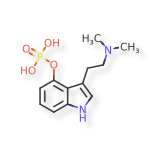
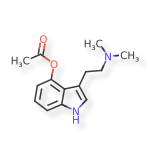
| Related Record | Type | Details | ||
|---|---|---|---|---|
|
PRODRUG -> METABOLITE ACTIVE |
|
||
|
|
PRODRUG -> METABOLITE ACTIVE |
|
| Related Record | Type | Details | ||
|---|---|---|---|---|
|
ACTIVE MOIETY |
|
