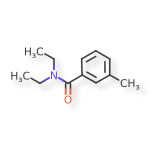
Details
| Stereochemistry | ACHIRAL |
| Molecular Formula | C12H17NO |
| Molecular Weight | 191.2695 |
| Optical Activity | NONE |
| Defined Stereocenters | 0 / 0 |
| E/Z Centers | 0 |
| Charge | 0 |
SHOW SMILES / InChI
SMILES
CCN(CC)C(=O)C1=CC=CC(C)=C1
InChI
InChIKey=MMOXZBCLCQITDF-UHFFFAOYSA-N
InChI=1S/C12H17NO/c1-4-13(5-2)12(14)11-8-6-7-10(3)9-11/h6-9H,4-5H2,1-3H3
| Molecular Formula | C12H17NO |
| Molecular Weight | 191.2695 |
| Charge | 0 |
| Count |
|
| Stereochemistry | ACHIRAL |
| Additional Stereochemistry | No |
| Defined Stereocenters | 0 / 0 |
| E/Z Centers | 0 |
| Optical Activity | NONE |
DescriptionCurator's Comment: description was created based on several sources, including:
https://ntp.niehs.nih.gov/ntp/htdocs/chem_background/exsumpdf/deet_508.pdf | https://www.epa.gov/insect-repellents/deet | http://www.swmosquito.org/pdf/PROT_DEET%20Toxicity.pdf
Curator's Comment: description was created based on several sources, including:
https://ntp.niehs.nih.gov/ntp/htdocs/chem_background/exsumpdf/deet_508.pdf | https://www.epa.gov/insect-repellents/deet | http://www.swmosquito.org/pdf/PROT_DEET%20Toxicity.pdf
Diethyltoluamide (DEET) is an insect repellent used to keep insects away. This product is effective against mosquitoes, biting flies (gnats, sandflies, deer flies, stable flies, black flies), ticks, harvest mites, and fleas. DEET is absorbed through the skin. DEET has few adverse effects when applied as directed. The most common problem is local skin irritation, including erythema and pruritis, at the site of application.
Originator
Approval Year
Targets
| Primary Target | Pharmacology | Condition | Potency |
|---|---|---|---|
| 31.3 µM [Kd] | |||
Target ID: OR136 (Culex quinquefasciatus) |
|||
Target ID: Ionotropic receptor 40a (Fruit fly) |
Conditions
| Condition | Modality | Targets | Highest Phase | Product |
|---|---|---|---|---|
| Preventing | Unknown Approved UseDEET to protect humans from mosquito-borne illnesses like West Nile Virus, the Zika virus or malaria and tick-borne illnesses like Lyme disease and Rocky Mountain spotted fever. |
|||
| Preventing | Unknown Approved UseDEET to protect humans from mosquito-borne illnesses like West Nile Virus, the Zika virus or malaria and tick-borne illnesses like Lyme disease and Rocky Mountain spotted fever. |
|||
| Preventing | Unknown Approved UseDEET to protect humans from mosquito-borne illnesses like West Nile Virus, the Zika virus or malaria and tick-borne illnesses like Lyme disease and Rocky Mountain spotted fever. |
Cmax
| Value | Dose | Co-administered | Analyte | Population |
|---|---|---|---|---|
196.5 ng/mL EXPERIMENT https://pubmed.ncbi.nlm.nih.gov/9109058/ |
15 mg/kg single, topical dose: 15 mg/kg route of administration: Topical experiment type: SINGLE co-administered: |
DIETHYLTOLUAMIDE plasma | Canis lupus population: HEALTHY age: ADULT sex: MALE food status: FASTED |
AUC
| Value | Dose | Co-administered | Analyte | Population |
|---|---|---|---|---|
2.26 mg × h/L EXPERIMENT https://pubmed.ncbi.nlm.nih.gov/9109058/ |
6 mg/kg single, intravenous dose: 6 mg/kg route of administration: Intravenous experiment type: SINGLE co-administered: |
DIETHYLTOLUAMIDE plasma | Canis lupus population: HEALTHY age: ADULT sex: MALE food status: FASTED |
|
1.03 mg × h/L EXPERIMENT https://pubmed.ncbi.nlm.nih.gov/9109058/ |
15 mg/kg single, topical dose: 15 mg/kg route of administration: Topical experiment type: SINGLE co-administered: |
DIETHYLTOLUAMIDE plasma | Canis lupus population: HEALTHY age: ADULT sex: MALE food status: FASTED |
T1/2
| Value | Dose | Co-administered | Analyte | Population |
|---|---|---|---|---|
2.56 h EXPERIMENT https://pubmed.ncbi.nlm.nih.gov/9109058/ |
6 mg/kg single, intravenous dose: 6 mg/kg route of administration: Intravenous experiment type: SINGLE co-administered: |
DIETHYLTOLUAMIDE plasma | Canis lupus population: HEALTHY age: ADULT sex: MALE food status: FASTED |
|
2.73 h EXPERIMENT https://pubmed.ncbi.nlm.nih.gov/9109058/ |
15 mg/kg single, topical dose: 15 mg/kg route of administration: Topical experiment type: SINGLE co-administered: |
DIETHYLTOLUAMIDE plasma | Canis lupus population: HEALTHY age: ADULT sex: MALE food status: FASTED |
Overview
| CYP3A4 | CYP2C9 | CYP2D6 | hERG |
|---|---|---|---|
OverviewOther
| Other Inhibitor | Other Substrate | Other Inducer |
|---|---|---|
Drug as perpetrator
| Target | Modality | Activity | Metabolite | Clinical evidence |
|---|---|---|---|---|
| inconclusive [IC50 27.5404 uM] | ||||
| inconclusive [IC50 70.9799 uM] | ||||
| no [IC50 15.8904 uM] | ||||
| no | ||||
| no | ||||
| no | ||||
| yes [Inhibition 10 uM] | ||||
| yes [Inhibition 10 uM] | ||||
| yes | ||||
| yes | ||||
| yes | ||||
| yes | ||||
| yes |
Drug as victim
| Target | Modality | Activity | Metabolite | Clinical evidence |
|---|---|---|---|---|
Page: 400 | 401 |
no | |||
| yes [Km 40.2 uM] | ||||
| yes [Km 41 uM] | ||||
| yes [Km >1000 uM] | ||||
| yes | ||||
| yes | ||||
| yes | ||||
| yes | ||||
| yes |
Tox targets
| Target | Modality | Activity | Metabolite | Clinical evidence |
|---|---|---|---|---|
PubMed
| Title | Date | PubMed |
|---|---|---|
| Mosquito repellents and superwarfarin rodenticides--are they really toxic in children? | 2006-04 |
|
| Hodgkin lymphoma, multiple myeloma, soft tissue sarcomas, insect repellents, and phenoxyherbicides. | 2006-03 |
|
| Initial evaluation of N,N-diethyl-m-toluamide and permethrin absorption in human volunteers under stress conditions. | 2006-02 |
|
| Repelling properties of some plant materials on the tick Ixodes ricinus L. | 2006-01 |
|
| Bioengineering of a cellulosic fabric for insecticide delivery via grafted cyclodextrin. | 2005-12-03 |
|
| Nitric oxide regulates prolidase activity by serine/threonine phosphorylation. | 2005-12-01 |
|
| Field evaluation of commercial repellent formulations against mosquitoes (Diptera: Culicidae) in Northern Territory, Australia. | 2005-12 |
|
| Solid lipid nanoparticles (SLN) for topical drug delivery: incorporation of the lipophilic drugs N,N-diethyl-m-toluamide and vitamin K. | 2005-12 |
|
| Evaluation of West Nile virus education campaign. | 2005-11 |
|
| Field-user acceptability of new camouflage face paint formulations in the Republic of Korea. | 2005-10 |
|
| Repellent efficacy of four commercial DEET lotions against Amblyomma hebraeum (Acari: Ixodidae), the principal vector of Rickettsia africae in southern Africa. | 2005-09 |
|
| Insect repellents, phenoxyherbicide exposure, and non-Hodgkin's lymphoma. | 2005-08 |
|
| Feeding deterrent effects of catnip oil components compared with two synthetic amides against Aedes aegypti. | 2005-07 |
|
| Survey of repellent use by service members arriving in Kuwait for Operation Iraqi Freedom 2. | 2005-06 |
|
| Food protective effect of acaricidal components isolated from anise seeds against the stored food mite, Tyrophagus putrescentiae (Schrank). | 2005-06 |
|
| In vitro evaluation of concurrent use of commercially available insect repellent and sunscreen preparations. | 2005-06 |
|
| Widespread detection of N,N-diethyl-m-toluamide in U.S. streams: comparison with concentrations of pesticides, personal care products, and other organic wastewater compounds. | 2005-05 |
|
| Comparison of contact and spatial repellency of catnip oil and N,N-diethyl-3-methylbenzamide (deet) against mosquitoes. | 2005-05 |
|
| Absorption and evaporation of N,N-diethyl-m-toluamide from human skin in vitro. | 2005-04-01 |
|
| Biodegradation of the insecticide N,N-diethyl-m-toluamide by fungi: identification and toxicity of metabolites. | 2005-04 |
|
| Acaricidal activity of active constituent isolated in Chamaecyparis obtusa leaves against Dermatophagoides spp. | 2005-03-23 |
|
| Monoterpenes from thyme (Thymus vulgaris) as potential mosquito repellents. | 2005-03 |
|
| Repellency of deet and SS220 applied to skin involves olfactory sensing by two species of ticks. | 2005-03 |
|
| The metabolism of nonane, a JP-8 jet fuel component, by human liver microsomes, P450 isoforms and alcohol dehydrogenase and inhibition of human P450 isoforms by JP-8. | 2005-02-10 |
|
| Acaricidal activity of Paeonia suffruticosa root bark-derived compounds against Dermatophagoides farinae and Dermatophagoides pteronyssinus (Acari: Pyroglyphidae). | 2004-12-29 |
|
| Effect of topical agents on cercariae of Schistosoma mansoni. | 2004-12 |
|
| Comparative study of the topical effectiveness of the Andiroba oil (Carapa guianensis) and DEET 50% as repellent for Aedes sp. | 2004-11-02 |
|
| Repellency of aerosol and cream products containing fennel oil to mosquitoes under laboratory and field conditions. | 2004-11 |
|
| Comparative efficacy of IR3535 and deet as repellents against adult Aedes aegypti and Culex quinquefasciatus. | 2004-09 |
|
| Analysis and mass spectrometric characterization of the insect repellent Bayrepel and its main metabolite Bayrepel-acid. | 2004-08-13 |
|
| Protective behavior survey, West Nile virus, British Columbia. | 2004-08 |
|
| A comparison of topical formulations for the prevention of human schistosomiasis. | 2004-08 |
|
| Insect repellent [correction of repellant] interactions: sunscreens enhance DEET (N,N-diethyl-m-toluamide) absorption. | 2004-08 |
|
| Determination of selected pharmaceuticals and caffeine in sewage and seawater from Tromsø/Norway with emphasis on ibuprofen and its metabolites. | 2004-08 |
|
| Schistosomiasis prophylaxis in vivo using N,N-diethyl-m-toluamide (DEET). | 2004-07-21 |
|
| Repellency of aromatic medicinal plant extracts and a steam distillate to Aedes aegypti. | 2004-06 |
|
| In vitro repellency of N,N-diethyl-3-methylbenzamide and N,N-diethylphenylacetamide analogs against Aedes aegypti and Anopheles stephensi (Diptera: Culicidae). | 2004-05 |
|
| Comparative resistance of Anopheles albimanus and Aedes aegypti to N,N-diethyl-3-methylbenzamide (Deet) and 2-methylpiperidinyl-3-cyclohexen-1-carboxamide (AI3-37220) in laboratory human-volunteer repellent assays. | 2004-05 |
|
| Field evaluation of repellent formulations containing deet and picaridin against mosquitoes in Northern Territory, Australia. | 2004-05 |
|
| In-vitro permeation of the insect repellent N,N-diethyl-m-toluamide (DEET) and the sunscreen oxybenzone. | 2004-05 |
|
| Active ingredients in sunscreens act as topical penetration enhancers for the herbicide 2,4-dichlorophenoxyacetic acid. | 2004-03-15 |
|
| p-Anisaldehyde: acaricidal component of Pimpinella anisum seed oil against the house dust mites Dermatophagoides farinae and Dermatophagoides pteronyssinus. | 2004-03 |
|
| Comparative activity of deet and AI3-37220 repellents against the ticks Ixodes scapularis and Amblyomma americanum (Acari: Ixodidae) in laboratory bioassays. | 2004-03 |
|
| DEET mosquito repellent sold through social marketing provides personal protection against malaria in an area of all-night mosquito biting and partial coverage of insecticide-treated nets: a case-control study of effectiveness. | 2004-03 |
|
| DEET mosquito repellent provides personal protection against malaria: a household randomized trial in an Afghan refugee camp in Pakistan. | 2004-03 |
|
| Evaluation of the sensitivity of Aedes aegypti and Anopheles gambiae complex mosquitoes to two insect repellents: DEET and KBR 3023. | 2004-03 |
|
| Inhibition of trans-permethrin hydrolysis in human liver fractions by chloropyrifos oxon and carbaryl. | 2004 |
|
| Analysis and fate of insect repellents. | 2004 |
|
| Chemical sensitivity in symptomatic Cambodia veterans. | 2003-12 |
|
| Amphiphilic star-like macromolecules as novel carriers for topical delivery of nonsteroidal anti-inflammatory drugs. | 2003-10-16 |
Patents
Sample Use Guides
Sparingly to exposed area(s) of skin. Reapply when necessary. Use a product that contains low amounts (less than 30%) of diethyltoluamide. One application using a product that contains low amounts of diethyltoluamide will last about 4 to 8 hours.
Route of Administration:
Topical
DEET-containing formulations applied at a concentration of 320-360 ug/cm^2 1.6 (7-1.88 uM/cm^2) using human and pig skin. A minimum evaporation rate of 5 ug/cm^2/h (0.03 uM/cm^2/h) for DEET over 5-15 minutes was determined for human and pig skin. In vitro, penetration of DEET in the mouse (33.3 ug/cm^2; 0.174 uM/cm^2), rat (38.7 ug/cm^2; 0.202 uM/cm^2), hairless guinea pig (12.5 ug/cm^2; 0.0653 uM/cm^2), pig (19.4 ug/cm^2; 0.101 uM/cm^2), human (44.7 ug/cm^2; 0.234 uM/cm^2), as well as cultured human skin (27.9 ug/cm^2; 0.146 uM/cm^2) was assessed using an automated, flow-through skin penetration apparatus (AIDA).
| Substance Class |
Chemical
Created
by
admin
on
Edited
Mon Mar 31 17:52:55 GMT 2025
by
admin
on
Mon Mar 31 17:52:55 GMT 2025
|
| Record UNII |
FB0C1XZV4Y
|
| Record Status |
Validated (UNII)
|
| Record Version |
|
-
Download
| Name | Type | Language | ||
|---|---|---|---|---|
|
Official Name | English | ||
|
Preferred Name | English | ||
|
Systematic Name | English | ||
|
Code | English | ||
|
Systematic Name | English | ||
|
Common Name | English | ||
|
Common Name | English | ||
|
Common Name | English | ||
|
Code | English | ||
|
Common Name | English | ||
|
Common Name | English | ||
|
Common Name | English | ||
|
Common Name | English | ||
|
Common Name | English | ||
|
Common Name | English | ||
|
Systematic Name | English | ||
|
Brand Name | English | ||
|
Code | English | ||
|
Common Name | English | ||
|
Common Name | English | ||
|
Common Name | English | ||
|
Common Name | English | ||
|
Systematic Name | English |
| Classification Tree | Code System | Code | ||
|---|---|---|---|---|
|
WHO-ATC |
P03BX01
Created by
admin on Mon Mar 31 17:52:55 GMT 2025 , Edited by admin on Mon Mar 31 17:52:55 GMT 2025
|
||
|
EPA PESTICIDE CODE |
80301
Created by
admin on Mon Mar 31 17:52:55 GMT 2025 , Edited by admin on Mon Mar 31 17:52:55 GMT 2025
|
||
|
NCI_THESAURUS |
C737
Created by
admin on Mon Mar 31 17:52:55 GMT 2025 , Edited by admin on Mon Mar 31 17:52:55 GMT 2025
|
||
|
WHO-VATC |
QP53GX01
Created by
admin on Mon Mar 31 17:52:55 GMT 2025 , Edited by admin on Mon Mar 31 17:52:55 GMT 2025
|
| Code System | Code | Type | Description | ||
|---|---|---|---|---|---|
|
134-62-3
Created by
admin on Mon Mar 31 17:52:55 GMT 2025 , Edited by admin on Mon Mar 31 17:52:55 GMT 2025
|
PRIMARY | |||
|
Diethyltoluamide
Created by
admin on Mon Mar 31 17:52:55 GMT 2025 , Edited by admin on Mon Mar 31 17:52:55 GMT 2025
|
PRIMARY | |||
|
diethyltoluamide
Created by
admin on Mon Mar 31 17:52:55 GMT 2025 , Edited by admin on Mon Mar 31 17:52:55 GMT 2025
|
PRIMARY | |||
|
3129
Created by
admin on Mon Mar 31 17:52:55 GMT 2025 , Edited by admin on Mon Mar 31 17:52:55 GMT 2025
|
PRIMARY | RxNorm | ||
|
FB0C1XZV4Y
Created by
admin on Mon Mar 31 17:52:55 GMT 2025 , Edited by admin on Mon Mar 31 17:52:55 GMT 2025
|
PRIMARY | |||
|
DIETHYLTOLUAMIDE
Created by
admin on Mon Mar 31 17:52:55 GMT 2025 , Edited by admin on Mon Mar 31 17:52:55 GMT 2025
|
PRIMARY | Description: Colourless or faintly yellow liquid.Solubility: Practically immiscible in water and glycerol R; miscible with ethanol (~750 g/l) TS and ether R.Category: Insect repellent.Storage: Diethyltoluamide should be kept in a tightly closed container.Additional information: CAUTION: Diethyltoluamide is an irritant to eyes and mucous membranes.Requirements: Diethyltoluamide contains not less than 97.0% and not more than 103.0% of C12H17NO, calculated with reference to the anhydrous substance. | ||
|
33840
Created by
admin on Mon Mar 31 17:52:55 GMT 2025 , Edited by admin on Mon Mar 31 17:52:55 GMT 2025
|
PRIMARY | |||
|
7071
Created by
admin on Mon Mar 31 17:52:55 GMT 2025 , Edited by admin on Mon Mar 31 17:52:55 GMT 2025
|
PRIMARY | |||
|
6685
Created by
admin on Mon Mar 31 17:52:55 GMT 2025 , Edited by admin on Mon Mar 31 17:52:55 GMT 2025
|
PRIMARY | |||
|
FB0C1XZV4Y
Created by
admin on Mon Mar 31 17:52:55 GMT 2025 , Edited by admin on Mon Mar 31 17:52:55 GMT 2025
|
PRIMARY | |||
|
4418
Created by
admin on Mon Mar 31 17:52:55 GMT 2025 , Edited by admin on Mon Mar 31 17:52:55 GMT 2025
|
PRIMARY | |||
|
DB11282
Created by
admin on Mon Mar 31 17:52:55 GMT 2025 , Edited by admin on Mon Mar 31 17:52:55 GMT 2025
|
PRIMARY | |||
|
4284
Created by
admin on Mon Mar 31 17:52:55 GMT 2025 , Edited by admin on Mon Mar 31 17:52:55 GMT 2025
|
PRIMARY | |||
|
SUB07114MIG
Created by
admin on Mon Mar 31 17:52:55 GMT 2025 , Edited by admin on Mon Mar 31 17:52:55 GMT 2025
|
PRIMARY | |||
|
DTXSID2021995
Created by
admin on Mon Mar 31 17:52:55 GMT 2025 , Edited by admin on Mon Mar 31 17:52:55 GMT 2025
|
PRIMARY | |||
|
100000083130
Created by
admin on Mon Mar 31 17:52:55 GMT 2025 , Edited by admin on Mon Mar 31 17:52:55 GMT 2025
|
PRIMARY | |||
|
205-149-7
Created by
admin on Mon Mar 31 17:52:55 GMT 2025 , Edited by admin on Mon Mar 31 17:52:55 GMT 2025
|
PRIMARY | |||
|
D003671
Created by
admin on Mon Mar 31 17:52:55 GMT 2025 , Edited by admin on Mon Mar 31 17:52:55 GMT 2025
|
PRIMARY | |||
|
m4129
Created by
admin on Mon Mar 31 17:52:55 GMT 2025 , Edited by admin on Mon Mar 31 17:52:55 GMT 2025
|
PRIMARY | Merck Index | ||
|
C80601
Created by
admin on Mon Mar 31 17:52:55 GMT 2025 , Edited by admin on Mon Mar 31 17:52:55 GMT 2025
|
PRIMARY | |||
|
DEET
Created by
admin on Mon Mar 31 17:52:55 GMT 2025 , Edited by admin on Mon Mar 31 17:52:55 GMT 2025
|
PRIMARY | |||
|
1197007
Created by
admin on Mon Mar 31 17:52:55 GMT 2025 , Edited by admin on Mon Mar 31 17:52:55 GMT 2025
|
PRIMARY | |||
|
CHEMBL1453317
Created by
admin on Mon Mar 31 17:52:55 GMT 2025 , Edited by admin on Mon Mar 31 17:52:55 GMT 2025
|
PRIMARY | |||
|
1582
Created by
admin on Mon Mar 31 17:52:55 GMT 2025 , Edited by admin on Mon Mar 31 17:52:55 GMT 2025
|
PRIMARY |
| Related Record | Type | Details | ||
|---|---|---|---|---|
|
METABOLIC ENZYME -> SUBSTRATE | |||
|
METABOLIC ENZYME -> SUBSTRATE | |||
|
METABOLIC ENZYME -> SUBSTRATE | |||
|
METABOLIC ENZYME -> SUBSTRATE | |||
|
METABOLIC ENZYME -> SUBSTRATE |
|
||
|
METABOLIC ENZYME -> SUBSTRATE | |||
|
METABOLIC ENZYME -> SUBSTRATE |

| Related Record | Type | Details | ||
|---|---|---|---|---|
|
METABOLITE -> PARENT | |||
|
METABOLITE -> PARENT |
IN VITRO
|

| Related Record | Type | Details | ||
|---|---|---|---|---|
|
|
ACTIVE MOIETY |