


Details
| Stereochemistry | ABSOLUTE |
| Molecular Formula | C22H25N3O7S |
| Molecular Weight | 475.515 |
| Optical Activity | UNSPECIFIED |
| Defined Stereocenters | 6 / 6 |
| E/Z Centers | 0 |
| Charge | 0 |
SHOW SMILES / InChI
SMILES
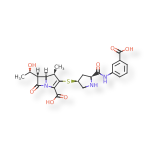
C[C@@H](O)[C@@H]1[C@H]2[C@@H](C)C(S[C@@H]3CN[C@@H](C3)C(=O)NC4=CC(=CC=C4)C(O)=O)=C(N2C1=O)C(O)=O
InChI
InChIKey=JUZNIMUFDBIJCM-ANEDZVCMSA-N
InChI=1S/C22H25N3O7S/c1-9-16-15(10(2)26)20(28)25(16)17(22(31)32)18(9)33-13-7-14(23-8-13)19(27)24-12-5-3-4-11(6-12)21(29)30/h3-6,9-10,13-16,23,26H,7-8H2,1-2H3,(H,24,27)(H,29,30)(H,31,32)/t9-,10-,13+,14+,15-,16-/m1/s1
| Molecular Formula | C22H25N3O7S |
| Molecular Weight | 475.515 |
| Charge | 0 |
| Count |
|
| Stereochemistry | ABSOLUTE |
| Additional Stereochemistry | No |
| Defined Stereocenters | 6 / 6 |
| E/Z Centers | 0 |
| Optical Activity | UNSPECIFIED |
DescriptionCurator's Comment: description was created based on several sources, including:
https://www.drugs.com/ppa/ertapenem.html | https://dailymed.nlm.nih.gov/dailymed/drugInfo.cfm?setid=33f3b99b-fa82-42e0-26bf-f49891ae3d22 | http://www.rxlist.com/invanz-drug.htm
Curator's Comment: description was created based on several sources, including:
https://www.drugs.com/ppa/ertapenem.html | https://dailymed.nlm.nih.gov/dailymed/drugInfo.cfm?setid=33f3b99b-fa82-42e0-26bf-f49891ae3d22 | http://www.rxlist.com/invanz-drug.htm
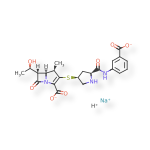
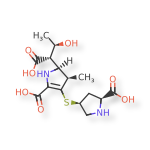
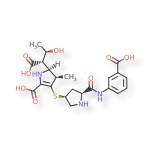
Ertapenem is a carbapenem antibiotic marketed by Merck as Invanz. The bactericidal activity of ertapenem results from the inhibition of cell wall synthesis and is mediated through ertapenem binding to penicillin binding proteins (PBPs). In Escherichia coli, it has strong affinity toward PBPs 1a, 1b, 2, 3, 4 and 5 with preference for PBPs 2 and 3. Ertapenem has been designed to be effective against Gram-negative and Gram-positive bacteria. The most common drug-related adverse experiences in patients treated with INVANZ, including those who were switched to therapy with an oral antimicrobial, were diarrhea (5.5%), infused vein complication (3.7%), nausea (3.1%), headache (2.2%), vaginitis in females (2.1%), phlebitis/thrombophlebitis (1.3%), and vomiting (1.1%). The coadministration with probenecid to extend the half-life of ertapenem is not recommended.
CNS Activity
Originator
Approval Year
Targets
| Primary Target | Pharmacology | Condition | Potency |
|---|---|---|---|
Target ID: CHEMBL2354204 |
|||
Target ID: P0AD65 Gene ID: 945240.0 Gene Symbol: mrdA Target Organism: Escherichia coli (strain K12) |
|||
Target ID: P0AD68 Gene ID: 944799.0 Gene Symbol: ftsI Target Organism: Escherichia coli (strain K12) |
Conditions
| Condition | Modality | Targets | Highest Phase | Product |
|---|---|---|---|---|
| Curative | INVANZ Approved UseTo reduce the development of drug-resistant bacteria and maintain the effectiveness of INVANZ® and other antibacterial drugs, INVANZ should be used only to treat or prevent infections that are proven or strongly suspected to be caused by susceptible bacteria. When culture and susceptibility information are available, they should be considered in selecting or modifying antibacterial therapy. In the absence of such data, local epidemiology and susceptibility patterns may contribute to the empiric selection of therapy. Treatment INVANZ is indicated for the treatment of adult patients and pediatric patients (3 months of age and older) with the following moderate to severe infections caused by susceptible isolates of the designated microorganisms [see Dosage and Administration (2) Launch Date2001 |
|||
| Curative | INVANZ Approved UseTo reduce the development of drug-resistant bacteria and maintain the effectiveness of INVANZ® and other antibacterial drugs, INVANZ should be used only to treat or prevent infections that are proven or strongly suspected to be caused by susceptible bacteria. When culture and susceptibility information are available, they should be considered in selecting or modifying antibacterial therapy. In the absence of such data, local epidemiology and susceptibility patterns may contribute to the empiric selection of therapy. Treatment INVANZ is indicated for the treatment of adult patients and pediatric patients (3 months of age and older) with the following moderate to severe infections caused by susceptible isolates of the designated microorganisms [see Dosage and Administration (2) Launch Date2001 |
|||
| Curative | INVANZ Approved UseTo reduce the development of drug-resistant bacteria and maintain the effectiveness of INVANZ® and other antibacterial drugs, INVANZ should be used only to treat or prevent infections that are proven or strongly suspected to be caused by susceptible bacteria. When culture and susceptibility information are available, they should be considered in selecting or modifying antibacterial therapy. In the absence of such data, local epidemiology and susceptibility patterns may contribute to the empiric selection of therapy. Treatment INVANZ is indicated for the treatment of adult patients and pediatric patients (3 months of age and older) with the following moderate to severe infections caused by susceptible isolates of the designated microorganisms [see Dosage and Administration (2) Launch Date2001 |
|||
| Curative | INVANZ Approved UseTo reduce the development of drug-resistant bacteria and maintain the effectiveness of INVANZ® and other antibacterial drugs, INVANZ should be used only to treat or prevent infections that are proven or strongly suspected to be caused by susceptible bacteria. When culture and susceptibility information are available, they should be considered in selecting or modifying antibacterial therapy. In the absence of such data, local epidemiology and susceptibility patterns may contribute to the empiric selection of therapy. Treatment INVANZ is indicated for the treatment of adult patients and pediatric patients (3 months of age and older) with the following moderate to severe infections caused by susceptible isolates of the designated microorganisms [see Dosage and Administration (2) Launch Date2001 |
|||
| Curative | INVANZ Approved UseTo reduce the development of drug-resistant bacteria and maintain the effectiveness of INVANZ® and other antibacterial drugs, INVANZ should be used only to treat or prevent infections that are proven or strongly suspected to be caused by susceptible bacteria. When culture and susceptibility information are available, they should be considered in selecting or modifying antibacterial therapy. In the absence of such data, local epidemiology and susceptibility patterns may contribute to the empiric selection of therapy. Treatment INVANZ is indicated for the treatment of adult patients and pediatric patients (3 months of age and older) with the following moderate to severe infections caused by susceptible isolates of the designated microorganisms [see Dosage and Administration (2) Launch Date2001 |
Cmax
| Value | Dose | Co-administered | Analyte | Population |
|---|---|---|---|---|
663.1 ug/mL Clinical Trial https://clinicaltrials.gov/ct2/show/NCT02159859 |
1 g 3 times / week multiple, intravenous dose: 1 g route of administration: intravenous experiment type: multiple co-administered: |
ERTAPENEM plasma | Homo sapiens population: unhealthy age: sex: food status: |
|
70.6 μg/mL EXPERIMENT https://pubmed.ncbi.nlm.nih.gov/12709348 |
1 g single, intramuscular dose: 1 g route of administration: Intramuscular experiment type: SINGLE co-administered: |
ERTAPENEM plasma | Homo sapiens population: HEALTHY age: ADULT sex: FEMALE / MALE food status: UNKNOWN |
|
75.7 μg/mL EXPERIMENT https://pubmed.ncbi.nlm.nih.gov/12709348 |
1 g 1 times / day multiple, intramuscular dose: 1 g route of administration: Intramuscular experiment type: MULTIPLE co-administered: |
ERTAPENEM plasma | Homo sapiens population: HEALTHY age: ADULT sex: FEMALE / MALE food status: UNKNOWN |
|
155 μg/mL |
1 g single, intravenous dose: 1 g route of administration: Intravenous experiment type: SINGLE co-administered: |
ERTAPENEM plasma | Homo sapiens population: HEALTHY age: ADULT sex: UNKNOWN food status: UNKNOWN |
AUC
| Value | Dose | Co-administered | Analyte | Population |
|---|---|---|---|---|
6225 ug*h/mL Clinical Trial https://clinicaltrials.gov/ct2/show/NCT02159859 |
1 g 3 times / week multiple, intravenous dose: 1 g route of administration: intravenous experiment type: multiple co-administered: |
ERTAPENEM plasma | Homo sapiens population: unhealthy age: sex: food status: |
|
541.8 μg × h/mL EXPERIMENT https://pubmed.ncbi.nlm.nih.gov/12709348 |
1 g single, intramuscular dose: 1 g route of administration: Intramuscular experiment type: SINGLE co-administered: |
ERTAPENEM plasma | Homo sapiens population: HEALTHY age: ADULT sex: FEMALE / MALE food status: UNKNOWN |
|
506.4 μg × h/mL EXPERIMENT https://pubmed.ncbi.nlm.nih.gov/12709348 |
1 g 1 times / day multiple, intramuscular dose: 1 g route of administration: Intramuscular experiment type: MULTIPLE co-administered: |
ERTAPENEM plasma | Homo sapiens population: HEALTHY age: ADULT sex: FEMALE / MALE food status: UNKNOWN |
T1/2
| Value | Dose | Co-administered | Analyte | Population |
|---|---|---|---|---|
19.3 h Clinical Trial https://clinicaltrials.gov/ct2/show/NCT02159859 |
1 g 3 times / week multiple, intravenous dose: 1 g route of administration: intravenous experiment type: multiple co-administered: |
ERTAPENEM plasma | Homo sapiens population: unhealthy age: sex: food status: |
|
3.8 h EXPERIMENT https://pubmed.ncbi.nlm.nih.gov/12709348 |
1 g single, intramuscular dose: 1 g route of administration: Intramuscular experiment type: SINGLE co-administered: |
ERTAPENEM plasma | Homo sapiens population: HEALTHY age: ADULT sex: FEMALE / MALE food status: UNKNOWN |
|
3.5 h EXPERIMENT https://pubmed.ncbi.nlm.nih.gov/12709348 |
1 g 1 times / day multiple, intramuscular dose: 1 g route of administration: Intramuscular experiment type: MULTIPLE co-administered: |
ERTAPENEM plasma | Homo sapiens population: HEALTHY age: ADULT sex: FEMALE / MALE food status: UNKNOWN |
|
4 h |
1 g single, intravenous dose: 1 g route of administration: Intravenous experiment type: SINGLE co-administered: |
ERTAPENEM plasma | Homo sapiens population: HEALTHY age: ADULT sex: UNKNOWN food status: UNKNOWN |
Funbound
| Value | Dose | Co-administered | Analyte | Population |
|---|---|---|---|---|
10% |
1 g single, intravenous dose: 1 g route of administration: Intravenous experiment type: SINGLE co-administered: |
ERTAPENEM plasma | Homo sapiens population: HEALTHY age: ADULT sex: UNKNOWN food status: UNKNOWN |
Doses
| Dose | Population | Adverse events |
|---|---|---|
3 g 1 times / day steady, intravenous Highest studied dose Dose: 3 g, 1 times / day Route: intravenous Route: steady Dose: 3 g, 1 times / day Sources: |
healthy, 18-49 years Health Status: healthy Age Group: 18-49 years Sex: M+F Sources: |
|
500 mg 1 times / day steady, intravenous Dose: 500 mg, 1 times / day Route: intravenous Route: steady Dose: 500 mg, 1 times / day Sources: |
unhealthy, 59 years |
Disc. AE: Encephalopathy... AEs leading to discontinuation/dose reduction: Encephalopathy (1 patient) Sources: |
1 g 1 times / day steady, intravenous Recommended Dose: 1 g, 1 times / day Route: intravenous Route: steady Dose: 1 g, 1 times / day Sources: |
unhealthy, 71 years |
Disc. AE: Hallucinations, Delirium... AEs leading to discontinuation/dose reduction: Hallucinations (1 patient) Sources: Delirium (1 patient) |
1 g 1 times / day steady, intravenous|intramuscular Recommended Dose: 1 g, 1 times / day Route: intravenous|intramuscular Route: steady Dose: 1 g, 1 times / day Sources: |
unhealthy, adult Health Status: unhealthy Age Group: adult Sources: |
Disc. AE: Rash, Confusion... AEs leading to discontinuation/dose reduction: Rash (1 patient) Sources: Confusion (1 patient) Seizure (1 patient) Thrombocytopenia (1 patient) |
1 g 3 times / day single, intravenous Overdose Dose: 1 g, 3 times / day Route: intravenous Route: single Dose: 1 g, 3 times / day Sources: |
healthy Health Status: healthy Sources: |
Other AEs: Diarrhea, Dizziness... Other AEs: Diarrhea (1 patient) Sources: Dizziness (1 patient) |
AEs
| AE | Significance | Dose | Population |
|---|---|---|---|
| Encephalopathy | 1 patient Disc. AE |
500 mg 1 times / day steady, intravenous Dose: 500 mg, 1 times / day Route: intravenous Route: steady Dose: 500 mg, 1 times / day Sources: |
unhealthy, 59 years |
| Delirium | 1 patient Disc. AE |
1 g 1 times / day steady, intravenous Recommended Dose: 1 g, 1 times / day Route: intravenous Route: steady Dose: 1 g, 1 times / day Sources: |
unhealthy, 71 years |
| Hallucinations | 1 patient Disc. AE |
1 g 1 times / day steady, intravenous Recommended Dose: 1 g, 1 times / day Route: intravenous Route: steady Dose: 1 g, 1 times / day Sources: |
unhealthy, 71 years |
| Confusion | 1 patient Disc. AE |
1 g 1 times / day steady, intravenous|intramuscular Recommended Dose: 1 g, 1 times / day Route: intravenous|intramuscular Route: steady Dose: 1 g, 1 times / day Sources: |
unhealthy, adult Health Status: unhealthy Age Group: adult Sources: |
| Rash | 1 patient Disc. AE |
1 g 1 times / day steady, intravenous|intramuscular Recommended Dose: 1 g, 1 times / day Route: intravenous|intramuscular Route: steady Dose: 1 g, 1 times / day Sources: |
unhealthy, adult Health Status: unhealthy Age Group: adult Sources: |
| Seizure | 1 patient Disc. AE |
1 g 1 times / day steady, intravenous|intramuscular Recommended Dose: 1 g, 1 times / day Route: intravenous|intramuscular Route: steady Dose: 1 g, 1 times / day Sources: |
unhealthy, adult Health Status: unhealthy Age Group: adult Sources: |
| Thrombocytopenia | 1 patient Disc. AE |
1 g 1 times / day steady, intravenous|intramuscular Recommended Dose: 1 g, 1 times / day Route: intravenous|intramuscular Route: steady Dose: 1 g, 1 times / day Sources: |
unhealthy, adult Health Status: unhealthy Age Group: adult Sources: |
| Diarrhea | 1 patient | 1 g 3 times / day single, intravenous Overdose Dose: 1 g, 3 times / day Route: intravenous Route: single Dose: 1 g, 3 times / day Sources: |
healthy Health Status: healthy Sources: |
| Dizziness | 1 patient | 1 g 3 times / day single, intravenous Overdose Dose: 1 g, 3 times / day Route: intravenous Route: single Dose: 1 g, 3 times / day Sources: |
healthy Health Status: healthy Sources: |
Overview
| CYP3A4 | CYP2C9 | CYP2D6 | hERG |
|---|---|---|---|
OverviewOther
| Other Inhibitor | Other Substrate | Other Inducer |
|---|---|---|
Drug as perpetrator
| Target | Modality | Activity | Metabolite | Clinical evidence |
|---|---|---|---|---|
| no [IC50 >133 uM] | ||||
| no [IC50 >133 uM] | ||||
| no [IC50 >133 uM] | ||||
Page: (Pharm) 9, (ClinP) 3, 23 |
no [IC50 >500 uM] | |||
Page: (Pharm) 9, (ClinP) 3, 23 |
no [IC50 >500 uM] | |||
Page: (Pharm) 9, (ClinP) 3, 23 |
no [IC50 >500 uM] | |||
| no | ||||
| no | ||||
| no | ||||
| yes [IC50 56.2 uM] |
Drug as victim
| Target | Modality | Activity | Metabolite | Clinical evidence |
|---|---|---|---|---|
| no | ||||
| no | ||||
| no | ||||
| no | ||||
| no | ||||
| no |
PubMed
| Title | Date | PubMed |
|---|---|---|
| Penetration of ertapenem into different pulmonary compartments of patients undergoing lung surgery. | 2005-06 |
|
| Activity of three {beta}-lactams (ertapenem, meropenem and ampicillin) against intraphagocytic Listeria monocytogenes and Staphylococcus aureus. | 2005-06 |
|
| Antibacterial susceptibility of extended-spectrum beta-lactamase-producing Klebsiella pneumoniae and Escherichia coli. | 2005-05 |
|
| Comparative activity of doripenem and three other carbapenems tested against Gram-negative bacilli with various beta-lactamase resistance mechanisms. | 2005-05 |
|
| Characterization of a new integron containing bla(VIM-1) and aac(6')-IIc in an Enterobacter cloacae clinical isolate from Greece. | 2005-05 |
|
| Gateways to clinical trials. | 2005-04 |
|
| In vitro activity of antimicrobial agents against extended-spectrum beta-lactamase-producing Escherichia coli and Klebsiella pneumoniae at a tertiary care center in Lebanon. | 2005-04 |
|
| Gateways to clinical trials. | 2005-03 |
|
| Selectivity of ertapenem for Pseudomonas aeruginosa mutants cross-resistant to other carbapenems. | 2005-03 |
|
| In vitro activity of ertapenem against bacteraemic pneumococci: report of a French multicentre study including 339 strains. | 2005-03 |
|
| Ertapenem: review of a new carbapenem. | 2005-02 |
|
| [Activity of ertapenem and 19 other antimicrobial agents against beta-lactam-resistant Streptococcus pneumoniae and Haemophilus influenzae respiratory tract isolates]. | 2005-02 |
|
| Ertapenem-associated seizures in a peritoneal dialysis patient. | 2005-02 |
|
| Distribution and characteristics of Escherichia coli clonal group A. | 2005-01 |
|
| Pharmacodynamic modeling of carbapenems and fluoroquinolones against bacteria that produce extended-spectrum beta-lactamases. | 2004-11 |
|
| In vitro activity of ertapenem against selected respiratory pathogens. | 2004-11 |
|
| [Investigation of the in-vitro effectiveness of ertapenem against Pseudomonas aeruginosa strains isolated from intensive care unit patients]. | 2004-10 |
|
| Gateways to clinical trials. | 2004-10 |
|
| Appropriate use of the carbapenems. | 2004-10 |
|
| Ertapanem therapy for community-acquired pneumonia in the elderly. | 2004-10 |
|
| Beta-lactam antibiotics: newer formulations and newer agents. | 2004-09 |
|
| Optimizing antimicrobial pharmacodynamics: dosage strategies for meropenem. | 2004-08 |
|
| Doripenem (S-4661), a novel carbapenem: comparative activity against contemporary pathogens including bactericidal action and preliminary in vitro methods evaluations. | 2004-07 |
|
| Activity of ertapenem against Neisseria gonorrhoeae. | 2004-07 |
|
| Gateways to clinical trials. | 2004-06 |
|
| Treatment of complicated community-acquired infections with ertapenem, the first Group 1 carbapenem. Introduction. | 2004-06 |
|
| Emerging issues in infective endocarditis. | 2004-06 |
|
| Ertapenem: a new opportunity for outpatient parenteral antimicrobial therapy. | 2004-06 |
|
| Safety and tolerability of ertapenem. | 2004-06 |
|
| Treatment of complicated urinary tract infection in adults: combined analysis of two randomized, double-blind, multicentre trials comparing ertapenem and ceftriaxone followed by appropriate oral therapy. | 2004-06 |
|
| Ertapenem versus ceftriaxone for the treatment of community-acquired pneumonia in adults: combined analysis of two multicentre randomized, double-blind studies. | 2004-06 |
|
| Treatment of polymicrobial infections: post hoc analysis of three trials comparing ertapenem and piperacillin-tazobactam. | 2004-06 |
|
| Complicated infections of skin and skin structures: when the infection is more than skin deep. | 2004-06 |
|
| Intra-abdominal infections: review of the bacteriology, antimicrobial susceptibility and the role of ertapenem in their therapy. | 2004-06 |
|
| Pharmacokinetics and pharmacodynamics of ertapenem: an overview for clinicians. | 2004-06 |
|
| In vitro activity of ertapenem: review of recent studies. | 2004-06 |
|
| Ertapenem: a Group 1 carbapenem with distinct antibacterial and pharmacological properties. | 2004-06 |
|
| Antimicrobial susceptibility of the pathogens of bacteraemia in the UK and Ireland 2001-2002: the BSAC Bacteraemia Resistance Surveillance Programme. | 2004-06 |
|
| In vitro susceptibility of recent antibiotic-resistant urinary pathogens to ertapenem and 12 other antibiotics. | 2004-06 |
|
| Exploring the effectiveness of tazobactam against ceftazidime resistant Escherichia coli: insights from the comparison between susceptibility testing and beta-lactamase inhibition. | 2004-05-01 |
|
| Comparative disposition of [14C]ertapenem, a novel carbapenem antibiotic, in rat, monkey and man. | 2004-04 |
|
| Gateways to clinical trials. | 2004-04 |
|
| New therapies for pneumococcal meningitis. | 2004-04 |
|
| Efficacy of ertapenem against methicillin-susceptible Staphylococcus aureus in complicated skin/skin structure infections: results of a double-blind clinical trial versus piperacillin-tazobactam. | 2004-03 |
|
| Gateways to clinical trials. | 2004-03 |
|
| Management of complicated appendicitis and comparison of outcome with other primary sites of intra-abdominal infection: results of a trial comparing ertapenem and piperacillin-tazobactam. | 2004-02 |
|
| Stability and compatibility of reconstituted ertapenem with commonly used i.v. infusion and coinfusion solutions. | 2004-01-01 |
|
| Newer treatment options for skin and soft tissue infections. | 2004 |
|
| Ertapenem as initial antimicrobial monotherapy for patients with chronic obstructive pulmonary disease hospitalized with typical community-acquired pneumonia. | 2004 |
|
| [Efficacy of invanz proven in the treatment of intra-abdominal infections in one of the largest studies yet conducted on surgical patients]. | 2003 |
Sample Use Guides
1 g given once a day. Intravenous infusion for up to 14 days or intramuscular injection for up to 7 days.
Route of Administration:
Other
| Substance Class |
Chemical
Created
by
admin
on
Edited
Mon Mar 31 18:15:35 GMT 2025
by
admin
on
Mon Mar 31 18:15:35 GMT 2025
|
| Record UNII |
G32F6EID2H
|
| Record Status |
Validated (UNII)
|
| Record Version |
|
-
Download
| Name | Type | Language | ||
|---|---|---|---|---|
|
Official Name | English | ||
|
Preferred Name | English | ||
|
Systematic Name | English | ||
|
Systematic Name | English | ||
|
Common Name | English | ||
|
Common Name | English | ||
|
Common Name | English |
| Classification Tree | Code System | Code | ||
|---|---|---|---|---|
|
NDF-RT |
N0000011294
Created by
admin on Mon Mar 31 18:15:35 GMT 2025 , Edited by admin on Mon Mar 31 18:15:35 GMT 2025
|
||
|
NDF-RT |
N0000011294
Created by
admin on Mon Mar 31 18:15:35 GMT 2025 , Edited by admin on Mon Mar 31 18:15:35 GMT 2025
|
||
|
NDF-RT |
N0000011294
Created by
admin on Mon Mar 31 18:15:35 GMT 2025 , Edited by admin on Mon Mar 31 18:15:35 GMT 2025
|
||
|
NDF-RT |
N0000011294
Created by
admin on Mon Mar 31 18:15:35 GMT 2025 , Edited by admin on Mon Mar 31 18:15:35 GMT 2025
|
||
|
NDF-RT |
N0000011294
Created by
admin on Mon Mar 31 18:15:35 GMT 2025 , Edited by admin on Mon Mar 31 18:15:35 GMT 2025
|
||
|
NDF-RT |
N0000011294
Created by
admin on Mon Mar 31 18:15:35 GMT 2025 , Edited by admin on Mon Mar 31 18:15:35 GMT 2025
|
||
|
NDF-RT |
N0000175496
Created by
admin on Mon Mar 31 18:15:35 GMT 2025 , Edited by admin on Mon Mar 31 18:15:35 GMT 2025
|
||
|
NDF-RT |
N0000011294
Created by
admin on Mon Mar 31 18:15:35 GMT 2025 , Edited by admin on Mon Mar 31 18:15:35 GMT 2025
|
||
|
WHO-ATC |
J01DH03
Created by
admin on Mon Mar 31 18:15:35 GMT 2025 , Edited by admin on Mon Mar 31 18:15:35 GMT 2025
|
||
|
NCI_THESAURUS |
C260
Created by
admin on Mon Mar 31 18:15:35 GMT 2025 , Edited by admin on Mon Mar 31 18:15:35 GMT 2025
|
||
|
WHO-VATC |
QJ01DH03
Created by
admin on Mon Mar 31 18:15:35 GMT 2025 , Edited by admin on Mon Mar 31 18:15:35 GMT 2025
|
||
|
NDF-RT |
N0000011294
Created by
admin on Mon Mar 31 18:15:35 GMT 2025 , Edited by admin on Mon Mar 31 18:15:35 GMT 2025
|
||
|
NDF-RT |
N0000011294
Created by
admin on Mon Mar 31 18:15:35 GMT 2025 , Edited by admin on Mon Mar 31 18:15:35 GMT 2025
|
||
|
LIVERTOX |
NBK548006
Created by
admin on Mon Mar 31 18:15:35 GMT 2025 , Edited by admin on Mon Mar 31 18:15:35 GMT 2025
|
| Code System | Code | Type | Description | ||
|---|---|---|---|---|---|
|
G32F6EID2H
Created by
admin on Mon Mar 31 18:15:35 GMT 2025 , Edited by admin on Mon Mar 31 18:15:35 GMT 2025
|
PRIMARY | |||
|
Ertapenem
Created by
admin on Mon Mar 31 18:15:35 GMT 2025 , Edited by admin on Mon Mar 31 18:15:35 GMT 2025
|
PRIMARY | |||
|
G32F6EID2H
Created by
admin on Mon Mar 31 18:15:35 GMT 2025 , Edited by admin on Mon Mar 31 18:15:35 GMT 2025
|
PRIMARY | |||
|
C446479
Created by
admin on Mon Mar 31 18:15:35 GMT 2025 , Edited by admin on Mon Mar 31 18:15:35 GMT 2025
|
PRIMARY | |||
|
325642
Created by
admin on Mon Mar 31 18:15:35 GMT 2025 , Edited by admin on Mon Mar 31 18:15:35 GMT 2025
|
PRIMARY | RxNorm | ||
|
SUB25388
Created by
admin on Mon Mar 31 18:15:35 GMT 2025 , Edited by admin on Mon Mar 31 18:15:35 GMT 2025
|
PRIMARY | |||
|
1046
Created by
admin on Mon Mar 31 18:15:35 GMT 2025 , Edited by admin on Mon Mar 31 18:15:35 GMT 2025
|
PRIMARY | |||
|
m5001
Created by
admin on Mon Mar 31 18:15:35 GMT 2025 , Edited by admin on Mon Mar 31 18:15:35 GMT 2025
|
PRIMARY | Merck Index | ||
|
DB00303
Created by
admin on Mon Mar 31 18:15:35 GMT 2025 , Edited by admin on Mon Mar 31 18:15:35 GMT 2025
|
PRIMARY | |||
|
8020
Created by
admin on Mon Mar 31 18:15:35 GMT 2025 , Edited by admin on Mon Mar 31 18:15:35 GMT 2025
|
PRIMARY | |||
|
153832-46-3
Created by
admin on Mon Mar 31 18:15:35 GMT 2025 , Edited by admin on Mon Mar 31 18:15:35 GMT 2025
|
PRIMARY | |||
|
150610
Created by
admin on Mon Mar 31 18:15:35 GMT 2025 , Edited by admin on Mon Mar 31 18:15:35 GMT 2025
|
PRIMARY | |||
|
404903
Created by
admin on Mon Mar 31 18:15:35 GMT 2025 , Edited by admin on Mon Mar 31 18:15:35 GMT 2025
|
PRIMARY | |||
|
C61752
Created by
admin on Mon Mar 31 18:15:35 GMT 2025 , Edited by admin on Mon Mar 31 18:15:35 GMT 2025
|
PRIMARY | |||
|
100000089365
Created by
admin on Mon Mar 31 18:15:35 GMT 2025 , Edited by admin on Mon Mar 31 18:15:35 GMT 2025
|
PRIMARY | |||
|
8049
Created by
admin on Mon Mar 31 18:15:35 GMT 2025 , Edited by admin on Mon Mar 31 18:15:35 GMT 2025
|
PRIMARY | |||
|
DTXSID50165456
Created by
admin on Mon Mar 31 18:15:35 GMT 2025 , Edited by admin on Mon Mar 31 18:15:35 GMT 2025
|
PRIMARY | |||
|
CHEMBL1359
Created by
admin on Mon Mar 31 18:15:35 GMT 2025 , Edited by admin on Mon Mar 31 18:15:35 GMT 2025
|
PRIMARY | |||
|
ERTAPENEM
Created by
admin on Mon Mar 31 18:15:35 GMT 2025 , Edited by admin on Mon Mar 31 18:15:35 GMT 2025
|
PRIMARY |
| Related Record | Type | Details | ||
|---|---|---|---|---|
|
TARGET ORGANISM->INHIBITOR |
|
||
|
TARGET ORGANISM->INHIBITOR |
|
||
|
ENZYME->SUBSTRATE |
Low level activity could still lead to resistance to the antibiotic.
|
||
|
TARGET ORGANISM->INHIBITOR |
|
||
|
TARGET ORGANISM->INHIBITOR |
|
||
|
SALT/SOLVATE -> PARENT |
|
||
|
TARGET ORGANISM->INHIBITOR |
|
||
|
TARGET ORGANISM->INHIBITOR |
|
||
|
LIGAND->BINDER |
BINDING
|
||
|
TARGET ORGANISM->INHIBITOR |
|



| Related Record | Type | Details | ||
|---|---|---|---|---|
|
METABOLITE -> PARENT |
MINOR
URINE
|
||
|
METABOLITE INACTIVE -> PARENT |
MAJOR
URINE
|
| Related Record | Type | Details | ||
|---|---|---|---|---|
|
ACTIVE MOIETY |
|
| Name | Property Type | Amount | Referenced Substance | Defining | Parameters | References |
|---|---|---|---|---|---|---|
| Volume of Distribution | PHARMACOKINETIC |
|
|
|||