


Details
| Stereochemistry | RACEMIC |
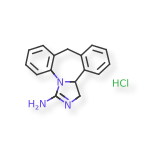
| Molecular Formula | C16H15N3.ClH |
| Molecular Weight | 285.771 |
| Optical Activity | ( + / - ) |
| Defined Stereocenters | 0 / 1 |
| E/Z Centers | 0 |
| Charge | 0 |
SHOW SMILES / InChI
SMILES
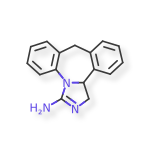
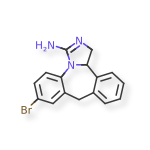
Cl.NC1=NCC2N1C3=CC=CC=C3CC4=CC=CC=C24
InChI
InChIKey=VKXSGUIOOQPGAF-UHFFFAOYSA-N
InChI=1S/C16H15N3.ClH/c17-16-18-10-15-13-7-3-1-5-11(13)9-12-6-2-4-8-14(12)19(15)16;/h1-8,15H,9-10H2,(H2,17,18);1H
| Molecular Formula | ClH |
| Molecular Weight | 36.461 |
| Charge | 0 |
| Count |
|
| Stereochemistry | ACHIRAL |
| Additional Stereochemistry | No |
| Defined Stereocenters | 0 / 0 |
| E/Z Centers | 0 |
| Optical Activity | NONE |
| Molecular Formula | C16H15N3 |
| Molecular Weight | 249.3104 |
| Charge | 0 |
| Count |
|
| Stereochemistry | RACEMIC |
| Additional Stereochemistry | No |
| Defined Stereocenters | 0 / 1 |
| E/Z Centers | 0 |
| Optical Activity | ( + / - ) |
Epinastine (brand names Alesion, Elestat, Purivist, Relestat) is a second-generation antihistamine and mast cell stabilizer. Epinastine is a topically active, direct H1-receptor antagonist and an inhibitor of the release of
histamine from the mast cell. Epinastine is selective for the histamine H1-receptor and has affinity for
the histamine H2 receptor. Epinastine also possesses affinity for the α1-, α2-, and 5-HT2 –receptors.
Epinastine does not penetrate the blood/brain barrier and, therefore, is not expected to induce side effects of the central nervous system. Elestat ophthalmic solution is indicated for the prevention of itching associated with
allergic conjunctivitis.
Originator
Approval Year
Targets
| Primary Target | Pharmacology | Condition | Potency |
|---|---|---|---|
| 7.6 null [pIC50] |
Conditions
| Condition | Modality | Targets | Highest Phase | Product |
|---|---|---|---|---|
| Primary | ELESTAT Approved UseEpinastine HCl ophthalmic solution is indicated for the prevention of itching associated with allergic conjunctivitis. Epinastine HCl ophthalmic solution is an H1 histamine receptor antagonist indicated for the prevention of itching associated with allergic conjunctivitis. (1) Launch Date2003 |
Cmax
| Value | Dose | Co-administered | Analyte | Population |
|---|---|---|---|---|
14.82 ng/mL EXPERIMENT https://pubmed.ncbi.nlm.nih.gov/31947890 |
20 mg single, oral dose: 20 mg route of administration: Oral experiment type: SINGLE co-administered: |
EPINASTINE plasma | Homo sapiens population: HEALTHY age: ADULT sex: MALE food status: FASTED |
|
15.69 ng/mL EXPERIMENT https://pubmed.ncbi.nlm.nih.gov/31947890 |
20 mg 1 times / day steady-state, oral dose: 20 mg route of administration: Oral experiment type: STEADY-STATE co-administered: |
EPINASTINE plasma | Homo sapiens population: HEALTHY age: ADULT sex: MALE food status: FASTED |
|
15.5 ng/mL |
20.6 mg single, oral dose: 20.6 mg route of administration: Oral experiment type: SINGLE co-administered: |
EPINASTINE plasma | Homo sapiens population: UNKNOWN age: ADULT sex: MALE food status: UNKNOWN |
|
0.025 ng/mL |
0.05 % single, ocular dose: 0.05 % route of administration: Ocular experiment type: SINGLE co-administered: |
EPINASTINE plasma | Homo sapiens population: UNHEALTHY age: ADULT sex: UNKNOWN food status: UNKNOWN |
|
0.042 ng/mL |
0.05 % 2 times / day multiple, ocular dose: 0.05 % route of administration: Ocular experiment type: MULTIPLE co-administered: |
EPINASTINE plasma | Homo sapiens population: UNHEALTHY age: ADULT sex: UNKNOWN food status: UNKNOWN |
AUC
| Value | Dose | Co-administered | Analyte | Population |
|---|---|---|---|---|
144.88 ng × h/mL EXPERIMENT https://pubmed.ncbi.nlm.nih.gov/31947890 |
20 mg single, oral dose: 20 mg route of administration: Oral experiment type: SINGLE co-administered: |
EPINASTINE plasma | Homo sapiens population: HEALTHY age: ADULT sex: MALE food status: FASTED |
|
157.38 ng × h/mL EXPERIMENT https://pubmed.ncbi.nlm.nih.gov/31947890 |
20 mg 1 times / day steady-state, oral dose: 20 mg route of administration: Oral experiment type: STEADY-STATE co-administered: |
EPINASTINE plasma | Homo sapiens population: HEALTHY age: ADULT sex: MALE food status: FASTED |
|
0.465 ng × h/mL |
0.05 % single, ocular dose: 0.05 % route of administration: Ocular experiment type: SINGLE co-administered: |
EPINASTINE plasma | Homo sapiens population: UNHEALTHY age: ADULT sex: UNKNOWN food status: UNKNOWN |
|
0.347 ng × h/mL |
0.05 % 2 times / day multiple, ocular dose: 0.05 % route of administration: Ocular experiment type: MULTIPLE co-administered: |
EPINASTINE plasma | Homo sapiens population: UNHEALTHY age: ADULT sex: UNKNOWN food status: UNKNOWN |
T1/2
| Value | Dose | Co-administered | Analyte | Population |
|---|---|---|---|---|
7.08 h EXPERIMENT https://pubmed.ncbi.nlm.nih.gov/31947890 |
20 mg single, oral dose: 20 mg route of administration: Oral experiment type: SINGLE co-administered: |
EPINASTINE plasma | Homo sapiens population: HEALTHY age: ADULT sex: MALE food status: FASTED |
|
7.35 h EXPERIMENT https://pubmed.ncbi.nlm.nih.gov/31947890 |
20 mg 1 times / day steady-state, oral dose: 20 mg route of administration: Oral experiment type: STEADY-STATE co-administered: |
EPINASTINE plasma | Homo sapiens population: HEALTHY age: ADULT sex: MALE food status: FASTED |
|
9.26 h |
0.05 % single, ocular dose: 0.05 % route of administration: Ocular experiment type: SINGLE co-administered: |
EPINASTINE plasma | Homo sapiens population: UNHEALTHY age: ADULT sex: UNKNOWN food status: UNKNOWN |
|
11.9 h |
0.05 % 2 times / day multiple, ocular dose: 0.05 % route of administration: Ocular experiment type: MULTIPLE co-administered: |
EPINASTINE plasma | Homo sapiens population: UNHEALTHY age: ADULT sex: UNKNOWN food status: UNKNOWN |
Funbound
| Value | Dose | Co-administered | Analyte | Population |
|---|---|---|---|---|
35.8% |
single, oral |
EPINASTINE plasma | Homo sapiens population: UNKNOWN age: UNKNOWN sex: UNKNOWN food status: UNKNOWN |
PubMed
| Title | Date | PubMed |
|---|---|---|
| Effects of sedative and nonsedative antihistamines on prefrontal activity during verbal fluency task in young children: a near-infrared spectroscopy (NIRS) study. | 2009-11 |
|
| Drugs associated with more suicidal ideations are also associated with more suicide attempts. | 2009-10-02 |
|
| Multiple action agents and the eye: do they really stabilize mast cells? | 2009-10 |
|
| Epinastine: topical ophthalmic second generation antihistamine without significant systemic side effects. | 2009-09 |
|
| Roles of octopaminergic and dopaminergic neurons in appetitive and aversive memory recall in an insect. | 2009-08-04 |
|
| Efficacy of olopatadine HCI 0.1%, ketotifen fumarate 0.025%, epinastine HCI 0.05%, emedastine 0.05% and fluorometholone acetate 0.1% ophthalmic solutions for seasonal allergic conjunctivitis: a placebo-controlled environmental trial. | 2009-08 |
|
| Contrasting role of octopamine in appetitive and aversive learning in the crab Chasmagnathus. | 2009-07-15 |
|
| The role of dopamine in Drosophila larval classical olfactory conditioning. | 2009-06-12 |
|
| Suppression of histamine- and allergen-induced skin reactions: comparison of first- and second-generation antihistamines. | 2009-06 |
|
| Octopamine and tyramine modulate pheromone-sensitive olfactory sensilla of the hawkmoth Manduca sexta in a time-dependent manner. | 2009-06 |
|
| Differential effects of octopamine and tyramine on the central pattern generator for Manduca flight. | 2009-03 |
|
| Modulation of eosinophil survival by epinastine hydrochloride, an H1 receptor antagonist, in vitro. | 2009-02-03 |
|
| Epinastine 0.05% ophthalmic solution in contact lens-wearing subjects with a history of allergic conjunctivitis. | 2009-01 |
|
| Management of allergic conjunctivitis: an evaluation of the perceived comfort and therapeutic efficacy of olopatadine 0.2% and azelastine 0.05% from two prospective studies. | 2009 |
|
| Influence of epinastine hydrochloride, an H1-receptor antagonist, on the function of mite allergen-pulsed murine bone marrow-derived dendritic cells in vitro and in vivo. | 2009 |
|
| Repeated pre-treatment with antihistamines suppresses [corrected] transcriptional up-regulations of histamine H(1) receptor and interleukin-4 genes in toluene-2,4-diisocyanate-sensitized rats. | 2008-12 |
|
| Regulatory effects of antihistamines on the responses to staphylococcal enterotoxin B of human monocyte-derived dendritic cells and CD4+ T cells. | 2008-10 |
|
| Treatment of allergic conjunctivitis with olopatadine hydrochloride eye drops. | 2008-09 |
|
| Arousal facilitates collision avoidance mediated by a looming sensitive visual neuron in a flying locust. | 2008-08 |
|
| Development and characterisation of a novel and rapid lung eosinophil influx model in the rat. | 2008-08 |
|
| Ocular comfort and drying effects of three topical antihistamine/mast cell stabilizers in adults with allergic conjunctivitis: a randomized, double-masked crossover study. | 2008-07 |
|
| Intact cell binding for in vitro prediction of sedative and non-sedative histamine H1-receptor antagonists based on receptor internalization. | 2008-05 |
|
| Suppressive activity of epinastine hydrochloride on eosinophil activation in vitro. | 2008-04-10 |
|
| Analysis of disease-dependent sedative profiles of H(1)-antihistamines by large-scale surveillance using the visual analog scale. | 2008-04 |
|
| Inhibition of angiogenic factor production from murine mast cells by an antiallergic agent (epinastine hydrochloride) in vitro. | 2008 |
|
| Octopamine partially restores walking in hypokinetic cockroaches stung by the parasitoid wasp Ampulex compressa. | 2007-12 |
|
| Ocular anti-allergic compounds selectively inhibit human mast cell cytokines in vitro and conjunctival cell infiltration in vivo. | 2007-11 |
|
| Development and validation of liquid chromatographic and ultraviolet derivative spectrophotometric methods for determination of epinastine hydrochloride in coated tablets. | 2007-10-25 |
|
| Effects of sedative and non-sedative H1 antagonists on cognitive tasks: behavioral and near-infrared spectroscopy (NIRS) examinations. | 2007-09 |
|
| Duration of action of topical antiallergy drugs in a Guinea pig model of histamine-induced conjunctival vascular permeability. | 2007-08 |
|
| Simultaneous multiresponse optimization applied to epinastine determination in human serum by using capillary electrophoresis. | 2007-07-09 |
|
| Inhibition of IgE-mediated phosphorylation of FcepsilonRIgamma protein by antiallergic drugs in rat basophilic leukemia (RBL-2H3) cells: a novel action of antiallergic drugs. | 2007-07 |
|
| Development of new atopic dermatitis models characterized by not only itching but also inflammatory skin in mice. | 2007-06-22 |
|
| Efficacy and comfort of olopatadine 0.2% versus epinastine 0.05% ophthalmic solution for treating itching and redness induced by conjunctival allergen challenge. | 2007-06 |
|
| An open-label, investigator-masked, crossover study of the ocular drying effects of two antihistamines, topical epinastine and systemic loratadine, in adult volunteers with seasonal allergic conjunctivitis. | 2007-04 |
|
| Expanding the neuron's calcium signaling repertoire: intracellular calcium release via voltage-induced PLC and IP3R activation. | 2007-04 |
|
| Aversive learning in honeybees revealed by the olfactory conditioning of the sting extension reflex. | 2007-03-14 |
|
| Influences of histamine H1 receptor antagonists on maximal electroshock seizure in infant rats. | 2007-03 |
|
| Effect of topical olopatadine and epinastine in the botulinum toxin B-induced mouse model of dry eye. | 2007-02 |
|
| Influences of octopamine and juvenile hormone on locomotor behavior and period gene expression in the honeybee, Apis mellifera. | 2007-02 |
|
| Inhibitory effects of epinastine on chemokine production and MHC class II/CD54 expression in keratinocytes. | 2007-02 |
|
| Effect of topical ophthalmic epinastine and olopatadine on tear volume in mice. | 2006-12 |
|
| Octopamine boosts snail locomotion: behavioural and cellular analysis. | 2006-12 |
|
| Octopamine mediates thermal preconditioning of the locust ventilatory central pattern generator via a cAMP/protein kinase A signaling pathway. | 2006-11-22 |
|
| Distribution to the skin of epinastine hydrochloride in atopic dermatitis patients. | 2006-10-14 |
|
| Efficacy and response with olopatadine versus epinastine in ocular allergic symptoms: a post hoc analysis of data from a conjunctival allergen challenge study. | 2006-10 |
|
| Roles of octopaminergic and dopaminergic neurons in mediating reward and punishment signals in insect visual learning. | 2006-10 |
|
| Inhibition of the antigen provoked nasal reaction by second-generation antihistamines in patients with Japanese cedar pollinosis. | 2006-09 |
|
| Antihistaminic activity and side effect profile of epinastine and terfenadine in healthy volunteers. | 1990-12 |
|
| New tetracyclic guanidine derivatives with H1-antihistaminic properties. Chemistry of epinastine. | 1990-04 |
Sample Use Guides
The recommended dosage is one drop in each eye twice a day.
Treatment should be continued throughout the period of exposure (i.e., until the pollen season is
over or until exposure to the offending allergen is terminated), even when symptoms are absent.
Route of Administration:
Topical
Nasal epithelial cells (NECs) were stimulated with 25 ng/ml TNF-alpha in the presence of Epinastine (10 to 30 ng/ml). The minimum concentration of Epinastine (EP) that caused a significant decrease in eosinophil survival was 25 ng/ml. The addition of EP into eosinophil cultures did not cause inhibition of eosinophil survival, which was prolonged by stimulation with granulocyte-macrophage colony-stimulating factor (GM-CSF), even when 40 ng/ml EP was added to cell cultures.
| Substance Class |
Chemical
Created
by
admin
on
Edited
Mon Mar 31 18:22:46 GMT 2025
by
admin
on
Mon Mar 31 18:22:46 GMT 2025
|
| Record UNII |
GFM415S5XL
|
| Record Status |
Validated (UNII)
|
| Record Version |
|
-
Download
| Name | Type | Language | ||
|---|---|---|---|---|
|
Preferred Name | English | ||
|
Common Name | English | ||
|
Code | English | ||
|
Common Name | English | ||
|
Systematic Name | English | ||
|
Code | English | ||
|
Common Name | English | ||
|
Common Name | English | ||
|
Common Name | English | ||
|
Code | English | ||
|
Common Name | English | ||
|
Brand Name | English | ||
|
Common Name | English | ||
|
Code | English | ||
|
Common Name | English | ||
|
Common Name | English | ||
|
Common Name | English |
| Classification Tree | Code System | Code | ||
|---|---|---|---|---|
|
NCI_THESAURUS |
C29578
Created by
admin on Mon Mar 31 18:22:46 GMT 2025 , Edited by admin on Mon Mar 31 18:22:46 GMT 2025
|
| Code System | Code | Type | Description | ||
|---|---|---|---|---|---|
|
1236889
Created by
admin on Mon Mar 31 18:22:46 GMT 2025 , Edited by admin on Mon Mar 31 18:22:46 GMT 2025
|
PRIMARY | |||
|
GFM415S5XL
Created by
admin on Mon Mar 31 18:22:46 GMT 2025 , Edited by admin on Mon Mar 31 18:22:46 GMT 2025
|
PRIMARY | |||
|
DBSALT000961
Created by
admin on Mon Mar 31 18:22:46 GMT 2025 , Edited by admin on Mon Mar 31 18:22:46 GMT 2025
|
PRIMARY | |||
|
236961
Created by
admin on Mon Mar 31 18:22:46 GMT 2025 , Edited by admin on Mon Mar 31 18:22:46 GMT 2025
|
PRIMARY | RxNorm | ||
|
SUB01910MIG
Created by
admin on Mon Mar 31 18:22:46 GMT 2025 , Edited by admin on Mon Mar 31 18:22:46 GMT 2025
|
PRIMARY | |||
|
956316-28-2
Created by
admin on Mon Mar 31 18:22:46 GMT 2025 , Edited by admin on Mon Mar 31 18:22:46 GMT 2025
|
NON-SPECIFIC STOICHIOMETRY | |||
|
m4943
Created by
admin on Mon Mar 31 18:22:46 GMT 2025 , Edited by admin on Mon Mar 31 18:22:46 GMT 2025
|
PRIMARY | Merck Index | ||
|
157313
Created by
admin on Mon Mar 31 18:22:46 GMT 2025 , Edited by admin on Mon Mar 31 18:22:46 GMT 2025
|
PRIMARY | |||
|
C053090
Created by
admin on Mon Mar 31 18:22:46 GMT 2025 , Edited by admin on Mon Mar 31 18:22:46 GMT 2025
|
PRIMARY | |||
|
100000087245
Created by
admin on Mon Mar 31 18:22:46 GMT 2025 , Edited by admin on Mon Mar 31 18:22:46 GMT 2025
|
PRIMARY | |||
|
CHEMBL1106
Created by
admin on Mon Mar 31 18:22:46 GMT 2025 , Edited by admin on Mon Mar 31 18:22:46 GMT 2025
|
PRIMARY | |||
|
80012-44-8
Created by
admin on Mon Mar 31 18:22:46 GMT 2025 , Edited by admin on Mon Mar 31 18:22:46 GMT 2025
|
SUPERSEDED | |||
|
108929-04-0
Created by
admin on Mon Mar 31 18:22:46 GMT 2025 , Edited by admin on Mon Mar 31 18:22:46 GMT 2025
|
PRIMARY | |||
|
DTXSID1046502
Created by
admin on Mon Mar 31 18:22:46 GMT 2025 , Edited by admin on Mon Mar 31 18:22:46 GMT 2025
|
PRIMARY | |||
|
C47512
Created by
admin on Mon Mar 31 18:22:46 GMT 2025 , Edited by admin on Mon Mar 31 18:22:46 GMT 2025
|
PRIMARY | |||
|
GFM415S5XL
Created by
admin on Mon Mar 31 18:22:46 GMT 2025 , Edited by admin on Mon Mar 31 18:22:46 GMT 2025
|
PRIMARY |
| Related Record | Type | Details | ||
|---|---|---|---|---|
|
|
PARENT -> SALT/SOLVATE | |||
|
BASIS OF STRENGTH->SUBSTANCE |
ASSAY (TITRATION)
EP
|
| Related Record | Type | Details | ||
|---|---|---|---|---|
|
IMPURITY -> PARENT |
CHROMATOGRAPHIC PURITY (HPLC/UV)
EP
|
||
|
|
IMPURITY -> PARENT | |||
|
IMPURITY -> PARENT |
CHROMATOGRAPHIC PURITY (HPLC/UV)
EP
|
| Related Record | Type | Details | ||
|---|---|---|---|---|
|
|
ACTIVE MOIETY |