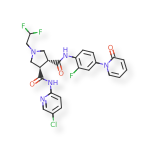
Details
| Stereochemistry | ABSOLUTE |
| Molecular Formula | C24H21ClF3N5O3 |
| Molecular Weight | 519.903 |
| Optical Activity | UNSPECIFIED |
| Defined Stereocenters | 2 / 2 |
| E/Z Centers | 0 |
| Charge | 0 |
SHOW SMILES / InChI
SMILES
FC(F)CN1C[C@@H]([C@H](C1)C(=O)NC2=CC=C(C=C2F)N3C=CC=CC3=O)C(=O)NC4=NC=C(Cl)C=C4
InChI
InChIKey=DVMCMTVFXINJGW-IRXDYDNUSA-N
InChI=1S/C24H21ClF3N5O3/c25-14-4-7-21(29-10-14)31-24(36)17-12-32(13-20(27)28)11-16(17)23(35)30-19-6-5-15(9-18(19)26)33-8-2-1-3-22(33)34/h1-10,16-17,20H,11-13H2,(H,30,35)(H,29,31,36)/t16-,17-/m0/s1
| Molecular Formula | C24H21ClF3N5O3 |
| Molecular Weight | 519.903 |
| Charge | 0 |
| Count |
|
| Stereochemistry | ABSOLUTE |
| Additional Stereochemistry | No |
| Defined Stereocenters | 2 / 2 |
| E/Z Centers | 0 |
| Optical Activity | UNSPECIFIED |
Approval Year
| Substance Class |
Chemical
Created
by
admin
on
Edited
Tue Apr 01 16:28:37 GMT 2025
by
admin
on
Tue Apr 01 16:28:37 GMT 2025
|
| Record UNII |
H5XZ7LKC6C
|
| Record Status |
Validated (UNII)
|
| Record Version |
|
-
Download
| Name | Type | Language | ||
|---|---|---|---|---|
|
Code | English | ||
|
Preferred Name | English | ||
|
Systematic Name | English | ||
|
Systematic Name | English | ||
|
Systematic Name | English |
| Code System | Code | Type | Description | ||
|---|---|---|---|---|---|
|
H5XZ7LKC6C
Created by
admin on Tue Apr 01 16:28:37 GMT 2025 , Edited by admin on Tue Apr 01 16:28:37 GMT 2025
|
PRIMARY | |||
|
24849206
Created by
admin on Tue Apr 01 16:28:37 GMT 2025 , Edited by admin on Tue Apr 01 16:28:37 GMT 2025
|
PRIMARY | |||
|
865451-66-7
Created by
admin on Tue Apr 01 16:28:37 GMT 2025 , Edited by admin on Tue Apr 01 16:28:37 GMT 2025
|
PRIMARY |
| Related Record | Type | Details | ||
|---|---|---|---|---|
|
TARGET -> INHIBITOR |
Ki
|

| Related Record | Type | Details | ||
|---|---|---|---|---|
|
ACTIVE MOIETY |
R1663 doses up to 300 mg twice daily or 400 mg once daily were administered for seven days. The exploration of gender and age effect was carried out in separate cohorts of eight male and eight female volunteers aged 45 to 65 years. Multiple oral doses of R1663 were safe and well tolerated. Pharmacokinetics was linear and showed moderate variability. Plasma concentrations peaked at 3 hour. Terminal half-life at steady state was 3-5 hours. Accumulation of R1663 was minimal. R1663 prolonged clotting times, inhibited thrombin generation (peak height and endogenous thrombin potential (ETP)) and anti-factor Xa activity in a concentration-dependent manner without increasing bleeding time. Pharmacodynamic parameters were strongly correlated to R1663 plasma concentrations. The inhibition was more pronounced on peak height (IC50 = 194 ng/ml) than on ETP (2790 ng/ml). Pharmacokinetics and pharmacodynamics of R1663 appeared not to be substantially affected by age or gender but remained to be confirmed in larger clinical trials including older patients.
|
||
|
ACTIVE MOIETY |
Class: Anticoagulant, Antithrombotic, Small molecule; Mechanism of Action: Factor Xa inhibitor;
Highest Development Phase: Phase I for Thrombosis; Most Recent Events: 28 Aug 2012 Roche completes a phase I trial in Healthy volunteers in United Kingdom, 03 May 2012 Roche completes a phase I trial in Healthy volunteers in United Kingdom, 03 May 2012 Phase-I clinical trials in Thrombosis (in volunteers) in United Kingdom (PO)
|
||
|
ACTIVE MOIETY |
AIMS: To explore the effect of food intake on the relative bioavailability of R1663 and on its pharmacodynamic effects (prothrombin time (PT) and activated partial thromboplastin time (aPTT)) after a single oral dose of 200 mg.
RESULTS: Following food intake, C(max) was reduced by 10% with CI extended outside the bioequivalence range (GMR, 0.90
CI 0.72 - 1.13). R1663 t(max) was delayed in the fed state (4 h) as compared to the fasted state (1 h). There was no significant food effect on R1663 AUC(0-) (GMR, 1.09
CI 0.97 - 1.24). Although the Emax of PT showed statistically significant reduction with food, the 90% CIs for Emax and AUE(0-48) of PT and aPTT were all contained within the bioequivalence range (0.80 - 1.25).
|