


Details
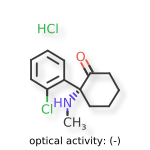
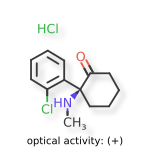
| Stereochemistry | RACEMIC |
| Molecular Formula | C13H16ClNO.ClH |
| Molecular Weight | 274.186 |
| Optical Activity | ( + / - ) |
| Defined Stereocenters | 0 / 1 |
| E/Z Centers | 0 |
| Charge | 0 |
SHOW SMILES / InChI
SMILES
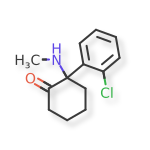
Cl.CNC1(CCCCC1=O)C2=CC=CC=C2Cl
InChI
InChIKey=VCMGMSHEPQENPE-UHFFFAOYSA-N
InChI=1S/C13H16ClNO.ClH/c1-15-13(9-5-4-8-12(13)16)10-6-2-3-7-11(10)14;/h2-3,6-7,15H,4-5,8-9H2,1H3;1H
| Molecular Formula | ClH |
| Molecular Weight | 36.461 |
| Charge | 0 |
| Count |
|
| Stereochemistry | ACHIRAL |
| Additional Stereochemistry | No |
| Defined Stereocenters | 0 / 0 |
| E/Z Centers | 0 |
| Optical Activity | NONE |
| Molecular Formula | C13H16ClNO |
| Molecular Weight | 237.725 |
| Charge | 0 |
| Count |
|
| Stereochemistry | RACEMIC |
| Additional Stereochemistry | No |
| Defined Stereocenters | 0 / 1 |
| E/Z Centers | 0 |
| Optical Activity | ( + / - ) |
DescriptionCurator's Comment: description was created based on several sources, including
https://www.ncbi.nlm.nih.gov/pubmed/23432384
Curator's Comment: description was created based on several sources, including
https://www.ncbi.nlm.nih.gov/pubmed/23432384
Ketamine (brand name Ketalar) is a cyclohexanone derivative used for induction of anesthesia. Ketalar is indicated as the sole anesthetic agent for diagnostic and surgical procedures that do not require skeletal muscle relaxation; also, it is indicated for the induction of anesthesia prior to the administration of other general anesthetic agents. Ketamine blocks NMDA receptors through an interaction with sites thought to be located within the ion channel pore region. However, the complete pharmacology of ketamine is more complex, and it is known to directly interact with a variety of other sites to varying degrees. Recently, it was shown that inclusion of the NR3B subunit does not alter the ketamine sensitivity of recombinant NR1/NR2 receptors expressed in oocytes. Likewise, 100 μM ketamine produced only weak inhibition of the glycine-induced current of NR1/NR3A/NR3B receptors. The side effects of ketamine noted in clinical studies include psychedelic symptoms (hallucinations, memory defects, panic attacks), nausea/vomiting, somnolence, cardiovascular stimulation and, in a minority of patients, hepatoxicity. The recreational use of ketamine is increasing and comes with a variety of additional risks ranging from bladder and renal complications to persistent psychotypical behaviour and memory defects. Ketamine was first synthesized in 1962 by Calvin Stevens at Parke-Davis Co (now Pfizer) as an alternative anesthetic to phencyclidine. It was first used in humans in 1965 by Corssen and Domino and was introduced into clinical practice by 1970.
Originator
Curator's Comment: Ketamine was first synthesized in 1962 by Calvin Stevens at Parke-Davis Co (now Pfizer) as an alternative anesthetic to phencyclidine. It was first used in humans in 1965 by Corssen and Domino and was introduced into clinical practice by 1970. # in 1962 Calvin Stevens at Parke-Davis Co (now Pfizer)
Approval Year
Targets
| Primary Target | Pharmacology | Condition | Potency |
|---|---|---|---|
Target ID: CHEMBL2094124 |
Conditions
| Condition | Modality | Targets | Highest Phase | Product |
|---|---|---|---|---|
| Primary | KETALAR Approved UseKetamine hydrochloride injection is indicated as the sole anesthetic agent for diagnostic and surgical procedures that do not require skeletal muscle relaxation. Ketamine hydrochloride is best suited for short procedures but it can be used, with additional doses, for longer procedures. Ketamine hydrochloride injection is indicated for the induction of anesthesia prior to the administration of other general anesthetic agents. Ketamine hydrochloride injection is indicated to supplement low-potency agents, such as nitrous oxide. Specific areas of application are described in the CLINICAL PHARMACOLOGY Section. Launch Date1970 |
Cmax
| Value | Dose | Co-administered | Analyte | Population |
|---|---|---|---|---|
496 ng/mL EXPERIMENT https://pubmed.ncbi.nlm.nih.gov/8881626/ |
3 mg/kg single, nasal dose: 3 mg/kg route of administration: Nasal experiment type: SINGLE co-administered: |
KETAMINE plasma | Homo sapiens population: HEALTHY age: CHILD sex: UNKNOWN food status: UNKNOWN |
|
2104 ng/mL EXPERIMENT https://pubmed.ncbi.nlm.nih.gov/8881626/ |
9 mg/kg single, nasal dose: 9 mg/kg route of administration: Nasal experiment type: SINGLE co-administered: |
KETAMINE plasma | Homo sapiens population: HEALTHY age: CHILD sex: UNKNOWN food status: UNKNOWN |
|
632 ng/mL EXPERIMENT https://pubmed.ncbi.nlm.nih.gov/8881626/ |
9 mg single, rectal dose: 9 mg route of administration: Rectal experiment type: SINGLE co-administered: |
KETAMINE plasma | Homo sapiens population: HEALTHY age: CHILD sex: UNKNOWN food status: UNKNOWN |
AUC
| Value | Dose | Co-administered | Analyte | Population |
|---|---|---|---|---|
76.4 mg × min/L EXPERIMENT https://pubmed.ncbi.nlm.nih.gov/8881626/ |
3 mg/kg single, nasal dose: 3 mg/kg route of administration: Nasal experiment type: SINGLE co-administered: |
KETAMINE plasma | Homo sapiens population: HEALTHY age: CHILD sex: UNKNOWN food status: UNKNOWN |
|
163.6 mg × min/L EXPERIMENT https://pubmed.ncbi.nlm.nih.gov/8881626/ |
9 mg/kg single, nasal dose: 9 mg/kg route of administration: Nasal experiment type: SINGLE co-administered: |
KETAMINE plasma | Homo sapiens population: HEALTHY age: CHILD sex: UNKNOWN food status: UNKNOWN |
|
148.3 mg × min/L EXPERIMENT https://pubmed.ncbi.nlm.nih.gov/8881626/ |
3 mg/kg single, intravenous dose: 3 mg/kg route of administration: Intravenous experiment type: SINGLE co-administered: |
KETAMINE plasma | Homo sapiens population: HEALTHY age: CHILD sex: UNKNOWN food status: UNKNOWN |
|
111.2 ng × min/mL EXPERIMENT https://pubmed.ncbi.nlm.nih.gov/8881626/ |
9 mg single, rectal dose: 9 mg route of administration: Rectal experiment type: SINGLE co-administered: |
KETAMINE plasma | Homo sapiens population: HEALTHY age: CHILD sex: UNKNOWN food status: UNKNOWN |
T1/2
| Value | Dose | Co-administered | Analyte | Population |
|---|---|---|---|---|
123 min EXPERIMENT https://pubmed.ncbi.nlm.nih.gov/8881626/ |
3 mg/kg single, nasal dose: 3 mg/kg route of administration: Nasal experiment type: SINGLE co-administered: |
KETAMINE plasma | Homo sapiens population: HEALTHY age: CHILD sex: UNKNOWN food status: UNKNOWN |
|
120 min EXPERIMENT https://pubmed.ncbi.nlm.nih.gov/8881626/ |
9 mg/kg single, nasal dose: 9 mg/kg route of administration: Nasal experiment type: SINGLE co-administered: |
KETAMINE plasma | Homo sapiens population: HEALTHY age: CHILD sex: UNKNOWN food status: UNKNOWN |
|
125 min EXPERIMENT https://pubmed.ncbi.nlm.nih.gov/8881626/ |
3 mg/kg single, intravenous dose: 3 mg/kg route of administration: Intravenous experiment type: SINGLE co-administered: |
KETAMINE plasma | Homo sapiens population: HEALTHY age: CHILD sex: UNKNOWN food status: UNKNOWN |
|
100 min EXPERIMENT https://pubmed.ncbi.nlm.nih.gov/8881626/ |
9 mg single, rectal dose: 9 mg route of administration: Rectal experiment type: SINGLE co-administered: |
KETAMINE plasma | Homo sapiens population: HEALTHY age: CHILD sex: UNKNOWN food status: UNKNOWN |
Overview
| CYP3A4 | CYP2C9 | CYP2D6 | hERG |
|---|---|---|---|
Drug as perpetrator
| Target | Modality | Activity | Metabolite | Clinical evidence |
|---|---|---|---|---|
| likely | unlikely (co-administration study) Comment: Compared ketamine group with the control group, there were no significant difference for AUC of metroprolol, omeprazole and tolbutamide, it show that the ketamine may not induce or inhibit the activity of CYP1A2, CYP3A4 and CYP2B6 enzyme |
|||
| likely | unlikely (co-administration study) Comment: Compared ketamine group with the control group, there were no significant difference for AUC of metroprolol, omeprazole and tolbutamide, it show that the ketamine may not induce or inhibit the activity of CYP1A2, CYP3A4 and CYP2B6 enzyme |
|||
| likely | unlikely (co-administration study) Comment: Compared ketamine group with the control group, there were no significant difference for AUC of metroprolol, omeprazole and tolbutamide, it show that the ketamine may not induce or inhibit the activity of CYP1A2, CYP3A4 and CYP2B6 enzyme |
|||
| yes [Ki 114.5 uM] | ||||
| yes [Ki 22.7 uM] | ||||
| yes [Ki 225.7 uM] |
Drug as victim
| Target | Modality | Activity | Metabolite | Clinical evidence |
|---|---|---|---|---|
| yes | ||||
| yes | ||||
| yes |
Tox targets
| Target | Modality | Activity | Metabolite | Clinical evidence |
|---|---|---|---|---|
PubMed
| Title | Date | PubMed |
|---|---|---|
| Peri-operative ketamine for acute post-operative pain: a quantitative and qualitative systematic review (Cochrane review). | 2005-11 |
|
| Cortical glutamate-dopamine interaction and ketamine-induced psychotic symptoms in man. | 2005-11 |
|
| [Comparison of the suppressive effects of tramadol and low-dose ketamine on the patients with postoperative hyperalgesia after remifentanil-based anaesthesia]. | 2005-10 |
|
| Topical amitriptyline and ketamine in neuropathic pain syndromes: an open-label study. | 2005-10 |
|
| Ischemic brain damage after ketamine and xylazine treatment in a young laboratory monkey (Macaca fascicularis). | 2005-09 |
|
| Induction of rat hepatic cytochrome P-450 by ketamine and its toxicological implications. | 2005-09 |
|
| Ketamine reduces lidocaine-induced seizures in mice. | 2005-08 |
|
| Remifentanil-induced postoperative hyperalgesia and its prevention with small-dose ketamine. | 2005-07 |
|
| Safety of mixture of morphine with ketamine for postoperative patient-controlled analgesia: an audit with 1026 patients. | 2005-07 |
|
| Naloxone increases ketamine-induced hyperactivity in the open field in female rats. | 2005-07 |
|
| Ketamine and amphetamine both enhance synaptic transmission in the amygdala-nucleus accumbens pathway but with different time-courses. | 2005-07 |
|
| Adverse events associated with procedural sedation and analgesia in a pediatric emergency department: a comparison of common parenteral drugs. | 2005-06 |
|
| The anesthetics nitrous oxide and ketamine are more neurotoxic to old than to young rat brain. | 2005-06 |
|
| Severe refractory status epilepticus owing to presumed encephalitis. | 2005-03 |
|
| Characterization of morphine-induced hyperalgesia in male and female rats. | 2005-03 |
|
| Effect of N-methyl-D-aspartate receptor epsilon1 subunit gene disruption of the action of general anesthetic drugs in mice. | 2005-03 |
|
| Ketamine inhibits LPS-induced tumour necrosis factor-alpha and interleukin-6 in an equine macrophage cell line. | 2005-02-22 |
|
| Ketamine pretreatment with venous occlusion attenuates pain on injection with propofol. | 2005-01 |
|
| Comparison of ephedrine and ketamine in prevention of injection pain and hypotension due to propofol induction. | 2005-01 |
|
| Ketamine and postoperative pain--a quantitative systematic review of randomised trials. | 2005-01 |
|
| Preemptive ketamine during general anesthesia for postoperative analgesia in patients undergoing laparoscopic cholecystectomy. | 2004-10 |
|
| Intravenous ketamine infusion as an adjuvant to morphine in a 2-year-old with severe cancer pain from metastatic neuroblastoma. | 2004-10 |
|
| Caudal analgesia in children: S(+)-ketamine vs S(+)-ketamine plus clonidine. | 2004-10 |
|
| Phenyl-tetrazolyl acetophenones: discovery of positive allosteric potentiatiors for the metabotropic glutamate 2 receptor. | 2004-08-26 |
|
| [Expression of HSP70 induced by ketamine in the hippocampus of rat at different ages]. | 2004-07 |
|
| Influence of different anaesthetics on pro-inflammatory cytokine expression in rat spleen. | 2004-07 |
|
| Influence of O(3)/O(2)-pneumoperitoneum as an oxidative stressor on duration of anaesthesia, loss of different reflexes and cytokine mRNA expression. | 2004-07 |
|
| Postanesthetic cerebellar dysfunction in cats. | 2004-06-11 |
|
| Participation of adenosine system in the ketamine-induced motor activity in mice. | 2004-05-10 |
|
| Normal spatial and contextual learning for ketamine-treated rats in the pilocarpine epilepsy model. | 2004-05 |
|
| The development and maintenance of human visceral pain hypersensitivity is dependent on the N-methyl-D-aspartate receptor. | 2004-03 |
|
| Ketamine impairs response inhibition and is positively reinforcing in healthy volunteers: a dose-response study. | 2004-03 |
|
| The neuromatrix and the epileptic brain: behavioral and learning preservation in limbic epileptic rats treated with ketamine but not acepromazine. | 2004-02 |
|
| Acute effects of ketamine on memory systems and psychotic symptoms in healthy volunteers. | 2004-01 |
|
| Schizophrenia, VIII: pharmacologic models. | 2003-12 |
|
| Pretreatment with intravenous ketamine reduces propofol injection pain. | 2003-11 |
|
| Preprocedural fasting state and adverse events in children undergoing procedural sedation and analgesia in a pediatric emergency department. | 2003-11 |
|
| Synergistic antinociceptive effects of ketamine and morphine in the orofacial capsaicin test in the rat. | 2003-10 |
|
| The effect of variable-dose diazepam on dreaming and emergence phenomena in 400 cases of ketamine-fentanyl anaesthesia. | 2003-09 |
|
| Double-blind randomized placebo-controlled trial of the effect of ketamine on postoperative morphine consumption in children following appendicectomy. | 2003-06 |
|
| Search of antimicrobial activity of selected non-antibiotic drugs. | 2003-04-03 |
|
| Effects of different subanaesthetic doses of (S)-ketamine on psychopathology and binocular depth inversion in man. | 2003-03 |
|
| Ketamine for refractory status epilepticus: a case of possible ketamine-induced neurotoxicity. | 2003-02 |
|
| Cold allodynia and hyperalgesia in neuropathic pain: the effect of N-methyl-D-aspartate (NMDA) receptor antagonist ketamine--a double-blind, cross-over comparison with alfentanil and placebo. | 2003-02 |
|
| [Anaesthesia for caesarean section. Comparison of two general anaesthetic regimens and spinal anaesthesia]. | 2003-01 |
|
| Interaction of ketamine with mu2 opioid receptors in SH-SY5Y human neuroblastoma cells. | 1999 |
|
| Emergence delirium following oral ketamine. | 1992-09 |
|
| Venodilator effects of adenosine triphosphate and sodium nitroprusside; comparisons during controlled hypotension. | 1987-09-01 |
|
| Effects of halothane anesthesia on the biodisposition of ketamine in rats. | 1976-03 |
|
| Electroencephalographic study of children during ketamine anesthesia. | 1976 |
Patents
Sample Use Guides
Intravenous Route:
The initial dose of Ketalar (ketamine hydrochloride injection) administered intravenously may range from 1 mg/kg to 4.5 mg/kg (0.5 to 2 mg/lb). The average amount required to produce five to ten minutes of surgical anesthesia has been 2 mg/kg (1 mg/lb).
Intramuscular Route:
The initial dose of Ketalar administered intramuscularly may range from 6.5 to 13 mg/kg (3 to 6 mg/lb). A dose of 10 mg/kg (5 mg/lb) will usually produce 12 to 25 minutes of surgical anesthesia.
Route of Administration:
Other
| Substance Class |
Chemical
Created
by
admin
on
Edited
Mon Mar 31 18:31:57 GMT 2025
by
admin
on
Mon Mar 31 18:31:57 GMT 2025
|
| Record UNII |
O18YUO0I83
|
| Record Status |
Validated (UNII)
|
| Record Version |
|
-
Download
| Name | Type | Language | ||
|---|---|---|---|---|
|
Official Name | English | ||
|
Preferred Name | English | ||
|
Common Name | English | ||
|
Code | English | ||
|
Code | English | ||
|
Common Name | English | ||
|
Systematic Name | English | ||
|
Brand Name | English | ||
|
Systematic Name | English | ||
|
Common Name | English | ||
|
Common Name | English | ||
|
Common Name | English | ||
|
Common Name | English | ||
|
Common Name | English | ||
|
Common Name | English | ||
|
Common Name | English | ||
|
Code | English | ||
|
Common Name | English | ||
|
Common Name | English | ||
|
Systematic Name | English | ||
|
Common Name | English | ||
|
Code | English | ||
|
Common Name | English | ||
|
Common Name | English | ||
|
Brand Name | English | ||
|
Code | English | ||
|
Common Name | English | ||
|
Code | English | ||
|
Brand Name | English | ||
|
Common Name | English | ||
|
Common Name | English | ||
|
Common Name | English |
| Classification Tree | Code System | Code | ||
|---|---|---|---|---|
|
FDA ORPHAN DRUG |
860021
Created by
admin on Mon Mar 31 18:31:57 GMT 2025 , Edited by admin on Mon Mar 31 18:31:57 GMT 2025
|
||
|
FDA ORPHAN DRUG |
901422
Created by
admin on Mon Mar 31 18:31:57 GMT 2025 , Edited by admin on Mon Mar 31 18:31:57 GMT 2025
|
||
|
DEA NO. |
7285
Created by
admin on Mon Mar 31 18:31:57 GMT 2025 , Edited by admin on Mon Mar 31 18:31:57 GMT 2025
|
||
|
CFR |
21 CFR 522.1222
Created by
admin on Mon Mar 31 18:31:57 GMT 2025 , Edited by admin on Mon Mar 31 18:31:57 GMT 2025
|
||
|
CFR |
21 CFR 522.1222B
Created by
admin on Mon Mar 31 18:31:57 GMT 2025 , Edited by admin on Mon Mar 31 18:31:57 GMT 2025
|
||
|
NCI_THESAURUS |
C245
Created by
admin on Mon Mar 31 18:31:57 GMT 2025 , Edited by admin on Mon Mar 31 18:31:57 GMT 2025
|
| Code System | Code | Type | Description | ||
|---|---|---|---|---|---|
|
DBSALT000396
Created by
admin on Mon Mar 31 18:31:57 GMT 2025 , Edited by admin on Mon Mar 31 18:31:57 GMT 2025
|
PRIMARY | |||
|
C29142
Created by
admin on Mon Mar 31 18:31:57 GMT 2025 , Edited by admin on Mon Mar 31 18:31:57 GMT 2025
|
PRIMARY | |||
|
100477-73-4
Created by
admin on Mon Mar 31 18:31:57 GMT 2025 , Edited by admin on Mon Mar 31 18:31:57 GMT 2025
|
SUPERSEDED | |||
|
6121
Created by
admin on Mon Mar 31 18:31:57 GMT 2025 , Edited by admin on Mon Mar 31 18:31:57 GMT 2025
|
PRIMARY | |||
|
SUB02830MIG
Created by
admin on Mon Mar 31 18:31:57 GMT 2025 , Edited by admin on Mon Mar 31 18:31:57 GMT 2025
|
PRIMARY | |||
|
79499-52-8
Created by
admin on Mon Mar 31 18:31:57 GMT 2025 , Edited by admin on Mon Mar 31 18:31:57 GMT 2025
|
SUPERSEDED | |||
|
O18YUO0I83
Created by
admin on Mon Mar 31 18:31:57 GMT 2025 , Edited by admin on Mon Mar 31 18:31:57 GMT 2025
|
PRIMARY | |||
|
650657
Created by
admin on Mon Mar 31 18:31:57 GMT 2025 , Edited by admin on Mon Mar 31 18:31:57 GMT 2025
|
PRIMARY | |||
|
217-484-6
Created by
admin on Mon Mar 31 18:31:57 GMT 2025 , Edited by admin on Mon Mar 31 18:31:57 GMT 2025
|
PRIMARY | |||
|
203184
Created by
admin on Mon Mar 31 18:31:57 GMT 2025 , Edited by admin on Mon Mar 31 18:31:57 GMT 2025
|
PRIMARY | RxNorm | ||
|
CHEMBL742
Created by
admin on Mon Mar 31 18:31:57 GMT 2025 , Edited by admin on Mon Mar 31 18:31:57 GMT 2025
|
PRIMARY | |||
|
1356009
Created by
admin on Mon Mar 31 18:31:57 GMT 2025 , Edited by admin on Mon Mar 31 18:31:57 GMT 2025
|
PRIMARY | |||
|
81771-21-3
Created by
admin on Mon Mar 31 18:31:57 GMT 2025 , Edited by admin on Mon Mar 31 18:31:57 GMT 2025
|
SUPERSEDED | |||
|
96448-41-8
Created by
admin on Mon Mar 31 18:31:57 GMT 2025 , Edited by admin on Mon Mar 31 18:31:57 GMT 2025
|
SUPERSEDED | |||
|
15851
Created by
admin on Mon Mar 31 18:31:57 GMT 2025 , Edited by admin on Mon Mar 31 18:31:57 GMT 2025
|
PRIMARY | |||
|
1867-66-9
Created by
admin on Mon Mar 31 18:31:57 GMT 2025 , Edited by admin on Mon Mar 31 18:31:57 GMT 2025
|
PRIMARY | |||
|
DTXSID4040137
Created by
admin on Mon Mar 31 18:31:57 GMT 2025 , Edited by admin on Mon Mar 31 18:31:57 GMT 2025
|
PRIMARY | |||
|
m6613
Created by
admin on Mon Mar 31 18:31:57 GMT 2025 , Edited by admin on Mon Mar 31 18:31:57 GMT 2025
|
PRIMARY | Merck Index | ||
|
O18YUO0I83
Created by
admin on Mon Mar 31 18:31:57 GMT 2025 , Edited by admin on Mon Mar 31 18:31:57 GMT 2025
|
PRIMARY | |||
|
KETAMINE HYDROCHLORIDE
Created by
admin on Mon Mar 31 18:31:57 GMT 2025 , Edited by admin on Mon Mar 31 18:31:57 GMT 2025
|
PRIMARY | Description: A white, crystalline powder; odour, characteristic. Solubility: Freely soluble in water and methanol R; soluble in ethanol (~750 g/l) TS; practically insoluble in ether R. Category: General anaesthetic. Storage: Ketamine hydrochloride should be kept in a well-closed container. Requirement: Ketamine hydrochloride contains not less than 98.5% and not more than the equivalent of 101.0% of C13H16ClNO,HCl, calculated with reference to the dried substance. | ||
|
100000091352
Created by
admin on Mon Mar 31 18:31:57 GMT 2025 , Edited by admin on Mon Mar 31 18:31:57 GMT 2025
|
PRIMARY | |||
|
42551-62-2
Created by
admin on Mon Mar 31 18:31:57 GMT 2025 , Edited by admin on Mon Mar 31 18:31:57 GMT 2025
|
SUPERSEDED |
| Related Record | Type | Details | ||
|---|---|---|---|---|
|
|
ENANTIOMER -> RACEMATE | |||
|
BASIS OF STRENGTH->SUBSTANCE |
CHROMATOGRAPHIC PURITY (HPLC/UV)
EP
|
||
|
|
ENANTIOMER -> RACEMATE | |||
|
BASIS OF STRENGTH->SUBSTANCE |
ASSAY (HPLC)
USP
|
||
|
|
PARENT -> SALT/SOLVATE |

| Related Record | Type | Details | ||
|---|---|---|---|---|
|
IMPURITY -> PARENT |
CHROMATOGRAPHIC PURITY (HPLC/UV)
EP
|
||
|
IMPURITY -> PARENT |
|
||
|
IMPURITY -> PARENT |
CHROMATOGRAPHIC PURITY (HPLC/UV)
EP
|
||
|
IMPURITY -> PARENT |
CHROMATOGRAPHIC PURITY (HPLC/UV)
EP
|
![Structure of 1-[(2-Chlorophenyl)(methylimino)methyl]cyclopentan-1-ol](/img/8c7aa903-a2e5-43f6-a717-f0e71177cff9.svg "Structure of 1-[(2-Chlorophenyl)(methylimino)methyl]cyclopentan-1-ol")
| Related Record | Type | Details | ||
|---|---|---|---|---|
|
|
ACTIVE MOIETY |
|